Dickinson College Food Studies Certificate Program

Category: Alumni Spotlights

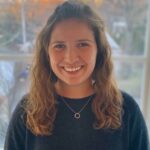
Alumni Spotlight: Elizabeth Gallo ’20

Elizabeth Gallo graduated from Dickinson College in 2020 with a degree in Studio Art and French and Francophone Studies, as well as the Food Studies Certificate. When choosing Dickinson, she was drawn to the College Farm and the emphasis on sustainability.

Growing up, Elizabeth and her family had their own small garden, where she credits her obsession with growing her own food. In High School, Elizabeth learned about an urban farm in her area from a peer and knew she wanted to get involved. Through the rest of her High School career and several summers in college, Elizabeth worked at Boone Street Farm in Baltimore, Maryland.  This farm worked with the city to use plots of unused land as agricultural space and was very ingrained in the community. The leaders of the farm were locals themselves, and kids from around the neighborhood would frequently stop by to learn more about what was happening or just see what was going on.

During her time at Dickinson, Elizabeth noted how well her three programs meshed together; Studio Art fulfilled her tactical need, and during her time abroad in France, she was able to become involved with a community gardening program with her knowledge of French. She reflected that having a language program with the Food Studies Certificate makes a lot of sense; it is so much easier to get involved and learn about foreign farming and agriculture policies.

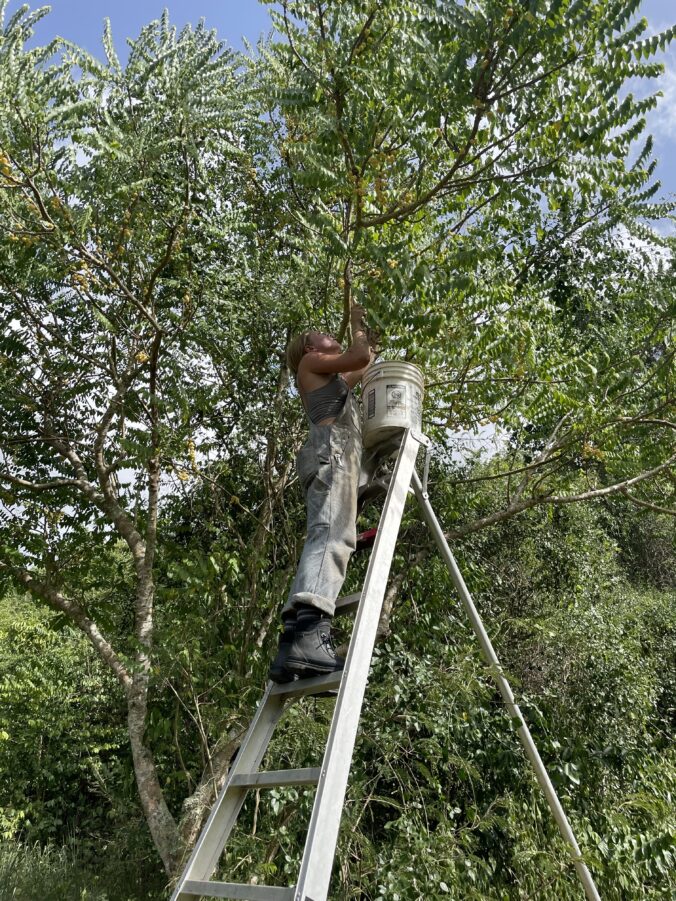
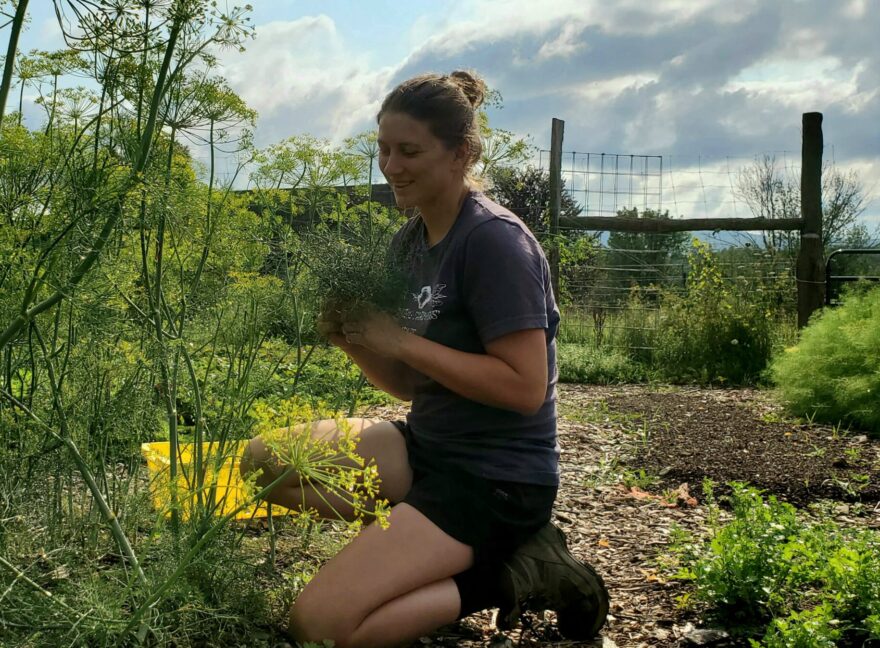
After graduation, Elizabeth moved to St. Croix, USVI, to work at Ridge to Reef Farm, the only USDA Certified Organic farm on St. Croix. After moving up in management and working at a few other farms on St. Croix, Elizabeth moved to St. John last year. Now she works on an organic (although not certified organic) commercial farm. This farm follows organic farming practices and provides greens and herbs to restaurants on the island. This farm and the woman who runs it have an incredible business model that Elizabeth looks to learn from and hopefully implement in her own business one day. The USVI have a year-long growing season and good soil with ample farming space too.  Still, businesses and grocery stores rely heavily on the importation of food, which is becoming more difficult as tariffs continue to be implemented. Elizabeth strives to one day own her own land and be able to farm. to provide for her community, saying how cool it would be for people to buy kale from her local farm instead of imported kale from the grocery store that would mold in two days.
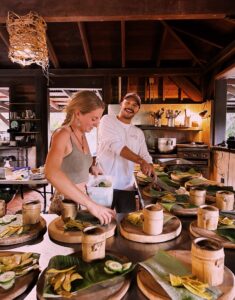
In addition to working on the commercial organic farm, Elizabeth also works with the VI Department of Agriculture, visiting other farms and helping to write land management plans. Although she did not focus much on forestry and ecology in her time at Dickinson, she says that the Food Studies Certificate and her farm experience were great foundations that made it easier to learn new aspects of Food Studies.
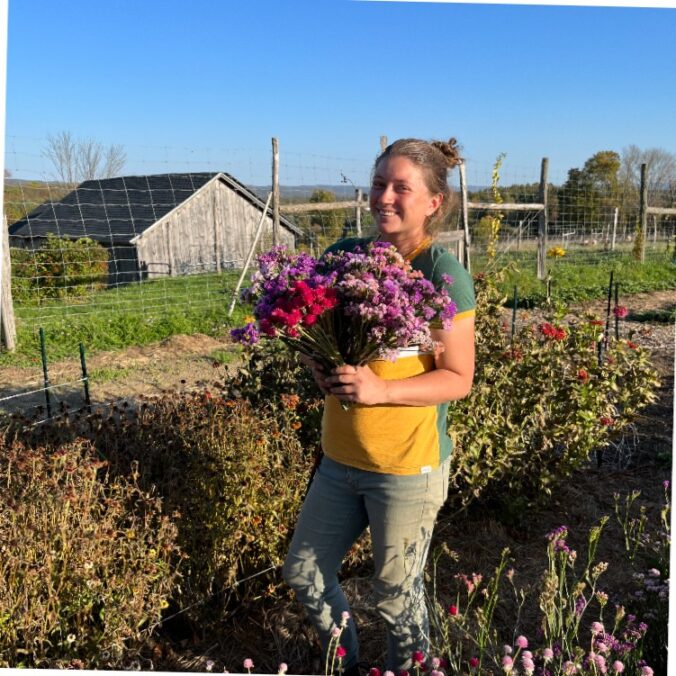
Alumni Spotlight: Cecilie Macpherson ’20

Cecilie Macpherson graduated from Dickinson College in 2020 with a degree in Environmental Science and the Food Studies Certificate.

When looking at Dickinson as a potential college, the main draw for choosing was the college farm. Based on what she learned during her pre-orientation, she knew she wanted to grow food in her future career. With her interest in the Dickinson farm, she conducted agroecology

Cecilie, while working with TerraCorps

research there, monitoring fly pests with the cattle, and helping with farm chores. 

During her time abroad in Denmark, she took an eight-month culinary course that instilled in her a desire to study food. This led her to pursue the Food Studies Certificate. Through the certificate, she took a variety of food-related courses. But the course that impacted her the most was Professor Pawly’s history of food course. She was fascinated to learn how food got to where it is currently.  

After Dickinson, her first farming job was at TerraCorps, where she worked as a Sustainability Agriculture Coordinator. Cecilie describes “​​TerraCorps was my first farming, like full season farming, so I really learned the process of seeing crops grow all the way through, in all stages of life. How important it was to take care of the soil and utilize integrated pest management systems.” This job allowed her to put into practice the skills she learned while at Dickinson. In addition to farming, she also worked with local youth, teaching high schoolers to grow food in the summer and delivering food-related lessons at elementary schools. Where she could put into practice the knowledge from working in a Dickinson program, teaching third graders about food.  

While working at TerraCorps, she became increasingly interested in saving seeds. Cecilie reflects, “I thought it’d be really cool to work for a seed company and see that process of saving seeds on a larger level.” This led her to look at seed companies to work for. The two seed companies she researched were Hudson Valley Seed Company and High Mowing Organic Seeds. Cecilie chose High Mowing because the company aligned with her values. “I really love the outreach that they have and what they are doing for the company.” She states, when asked why High Mowing. 

At High Mowing, she helps trial seeds that are not yet on the market and determine which ones are the best. Then she helped advocate for the seeds to be organic and sometimes added them to the company’s catalog. 

A typical day for Cecilie at High Mowing is that, in the spring and summer, there is a lot of seeding and greenhouse maintenance. Then, as the season progresses, she transplants the seeds, taking care of them until it is time to harvest. During the off-season, she works in customer service: answering questions from a question inbox, talking to customers on the phone, and taking seed orders. 

Alumni Spotlight: Kate Shepherd (’21)

A Career in Aquaculture after Dickinson

Kate Shepard (class of ’21) chose Dickinson in part for its Food Studies Certificate program. She describes a long-standing interest in food systems and food in general; being able to explore that while also getting a broader liberal arts education drew her to the school.

As an American Studies major, she was able to explore the structures that shape American society, and therefore the structures that shape our food systems. “Food for me has always been a big part of my identity and so I was really curious about how food shapes other identities and cultures,” she said on the topic of combining her major and certificate. “I think I definitely was more the people side of things, not necessarily the science side…” At Dickinson she combined her interests in social sciences like anthropology and sociology with environmental and food systems studies.

After graduation in 2021, Kate had a few shorter-term jobs before entering the oyster farming industry. “I was like I don’t want to go work in an office…so I went and lived out on Martha’s Vineyard for a couple of years and I fell in love with just like being near the water and working waterfronts because that was a whole side of the food system that I never really thought about.” When a cousin was working at a mussel farm in Portland, she decided she wanted to relocate there as well and got accepted to the second cohort of the Maine Aquaculture Apprenticeship. There, she gained experience working on an oyster farm and also took technical classes, building up the biology and ecology background necessary for a career in aquaculture.

After completing the apprenticeship, Kate stayed on as a farmhand and now runs the nursery program and oyster seed hatchery where they are raised to a certain size before being sent to the grow-out site. When asked what her favorite part of her job is, she said: “I love being outside and working with my hands, and you have like a tangible product at the end of the day…I think it’s just been really fun to kind of learn a whole different industry that I didn’t really know existed…” She says the work can be difficult, and it’s hard to keep people in the industry long-term. There has also been some backlash against oyster farms, and the process of leasing waterways can be a significant barrier. However, she sees promise in the industry as a sustainable and low-input way of growing food. One oyster can filter up to fifty gallons of water a day, making them useful both as a food source and for improving water quality. Kate describes aquaculture as an important up-and-coming source of income for Maine residents, particularly since historical economies like lobstering are under threat from over-fishing and changing oceans.

Kate believes that Food Studies and her Dickinson experience helped prepare her for her career by encouraging and fostering critical thinking, problem-solving, and communication skills, and also gave her a good foundation of food systems knowledge that was useful to her. She encourages current students to follow their interests. “Work isn’t your whole life, but it does make up a decent bit of your time, and for me, knowing that I’m doing something where I feel like I’m contributing to something good has been meaningful.”


Kate Shepherd, Class of 2021

© 2026 Food Studies


Academic Technology services: GIS | Media Center | Language Exchange

Theme by Anders NorenUp ↑