http://Cast Down Your Bucket.mov
“There is no escape through law of man or God from the inevitable: The laws of changeless justice bind Oppressor with oppressed; And close as sin and suffering joined We march to fate abreast.”[1]
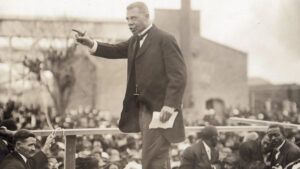
Booker T. Washington delivers the “Atlanta Compromise” speech to the 1895 Atlanta Cotton States and International Exposition (Library of Congress)
This line was read by Booker T. Washington in his famous 1895 speech, “Cast Down Your Bucket,” recognized today as the “Atlanta Compromise.”[2] The speech earned Washington renown as one of the most prominent (Black) spokesmen of the Black race in the late 19th and early 20th centuries. Recognizing his precarious position as a Black orator before a majority-white crowd, Washington used his platform to advocate for economic cooperation between the races, without which neither group could attain its fullest social or political potential. His speech, an embodiment of his situatedness as both a devout (Black) Southerner and civil rights leader, opened up the possibility for racial reconciliation in the South at a time when it had seemed otherwise impossible.
The “Cast Down Your Bucket” speech was delivered on September 18th, 1895, at the Cotton States and International Exposition in Atlanta, Georgia.
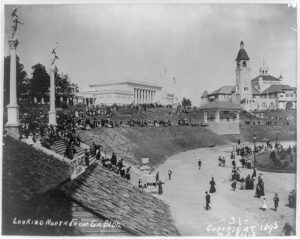
“Cotton States Exposition, Atlanta, Georgia; looking north from Georgia Building” (Library of Congress)
The typed, seven-page speech aimed to “cement the friendship of the races” by responding to Southern anxieties about the ‘Negro Problem.’[3] Washington introduced his speech by declaring that “[n]o enterprise seeking the material, civil, or moral welfare of this section can disregard [Black Americans] in our population and reach the highest success.”[4] He believed that the cooperation of the races would be mutually beneficial, and even stressed that the continued oppression and condition of the Black population would prevent American society from progressing.[5] Rather than holding whites accountable for their role as the “Oppressor,” Washington graciously thanked his white audience at the Exposition, for “in no way ha[d] the value and manhood of the American Negro been more fittingly and generously recognized than by the managers of this magnificent Exposition.”[6]
Far from accusatory, Booker T. Washington highlighted the sacrifices and responsibilities of Black Americans that were necessary to achieve racial collaboration. He explained to his audience that naïve Black Americans needed to redirect their energies from political equality to racial self-improvement and vocational competency; civic rights would be inevitably awarded to them once they demonstrated that they were qualified to exercise them. Emphasizing the loyalty of Southern Black people, “the most patient, faithful, law-abiding, and unresentful people,” to the white South, Washington urged white audience members to take a chance on Black Americans and invest in their labor.[7] However, he reassured them that he had no desire for social inequality, and that “[i]n all things that are purely social [Black and white people] can be as separate as the fingers, yet one as the hand in all things essential to mutual progress.”[8]
Context
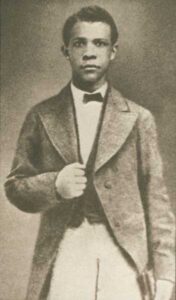
“Booker T. Washington, about the time he attended Hampton Institute” (U.S. National Park Service)
Booker Taliaferro Washington was born into slavery in 1856 in West Virginia. With the help of several white individuals, he provided himself with an education starting at a young age. In the years following the 1863 Emancipation Proclamation, Black universities and educational institutions began to emerge, including the Hampton Institute. In 1872, at the age of sixteen, Washington traveled, mostly by foot, from his home in West Virginia to Virginia to attend the university. Understanding the importance of vocational education for Black Americans, Washington founded the Tuskegee Institute in Alabama in 1881.[9] He lived in Tuskegee, Alabama, until his death in 1915.
The period following the end of the Civil War in 1865 and extending through the early decades of the 20th century is often referred to as the ‘nadir of American race relations.’ The Black Codes passed in the South, race riots, and the rise of white supremacist groups like the KKK had already established an atmosphere rife with racial violence and fear in the South. While the ratification of the Fourteenth Amendment in 1868 and the Fifteenth Amendment in 1870 signified a new era of political freedom for Black Americans, it actually exacerbated the violence Black Americans faced, especially for Black Southerners.
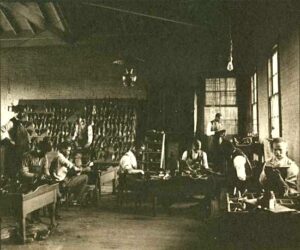
Students at the Tuskegee Institute (U.S. National Park Service)
Booker T. Washington made his debut as an orator in 1884 at the National Education Association in Wisconsin. Just like in his 1895 speech, he spoke to a majority-white audience of four thousand about the need for the white and Black races to “develop friendly relations.”[10] Washington’s platform of economic equality, rather than political equality, was a radical break from the activism of Black civil rights contemporaries, most notably, Frederick Douglass. Consequently, white audiences found him charismatic and his platform agreeable, earning him, at the Cotton States and International Exposition, the endearing title of “representative of Negro enterprise and Negro civilization.”[11]
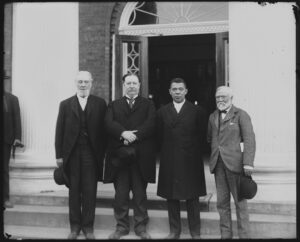
“Robert C. Ogden, U.S. Secretary of War William Howard Taft, Booker T. Washington and Andrew Carnegie, standing on the steps of a building, at the Tuskegee Institute’s 25th anniversary celebration” (Library of Congress)
A renowned businessman and orator, Booker T. Washington was also friends with affluent, multi-millionaire philanthropists like Andrew Carnegie, who helped Washington establish the National Negro Business League in 1900.[12] Although Washington had connections to big names, he, too, was a sought-after ally. Before the Cotton States International Exposition, Washington was called upon by affluent Atlantans to deliver a speech on “the progress African Americans were making since the abolition of enslavement” to members of Congress, to help fundraise for the Exposition.[13]
Subtext
The most memorable parts of Washington’s speech are when he called upon Black and white people alike to “Cast down your bucket where you are.”[14] While his message to both races was the same, the implications were radically different. Speaking to “those of my race who depend on bettering their condition in a foreign land or who underestimate the importance of cultivating friendly relations with the Southern white man,” Washington urged Black Americans to stay in the South.[15]
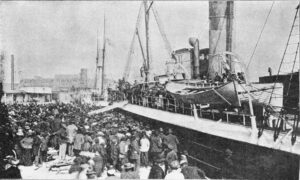
“Departure of colored emigrants for Liberia” in 1896 (The New York Public Library Digital Collections)
The fear of racial violence and the desire to escape their old lives caused many formerly enslaved African Americans to migrate to the North, and even led some to participate in colonization and settle in Liberia. Nonetheless, Booker T. Washington challenged Black Southerners to stay where they were; in order to develop racial cooperation, Black Americans needed to humble themselves—rid themselves of their prejudices and suspicions—for the better good of cultivating relationships with the “Southern white man.” On the other hand, he encouraged white people, once Black Americans had fulfilled their (humiliating) responsibility of ‘casting down their bucket,’ to graciously receive Black people and purchase their labor (by ‘casting down their buckets’). Consequently, what Washington proposed to the Exposition was a paternalistic relationship between white and Black Southerners; these unequal power dynamics are further exemplified when Washington promises that “we shall stand by you… ready to lay down our lives, if need be, in defense of yours.” [16] To many critics, it seemed that Washington was willing to compromise the dignity of the race and sacrifice the hard work of political activists for a small taste of economic prosperity—granted, of course, that Southern whites actually ‘cast down their buckets’ too.
The speech was further lambasted for its purposefully ambiguous and passive references to the racial oppression and violence faced by Black Americans. The address went so far as to criticize Black individuals for exhibiting resentment towards whites: Washington argued that another barrier to racial collaboration was the fact that Black people “permit our grievances to overshadow our opportunities.”[17] He declined to clarify what these grievances and opportunities were. In the same evasive manner, Washington concluded his speech by praying that some higher power would arrive and remove “sectional differences and racial animosities and suspicions [to] bring into our beloved South a new heaven and a new earth.”[18]
Booker T. Washington’s speech antagonized, and to this day, still antagonizes, Black Americans and civil rights advocates who recognize that political equality is a democratic and human right. After all, Washington “encouraged African Americans to work hard and not complain[,] said blacks were ‘unresentful’ without mentioning anything they should resent[,] [and] prayed for willing obedience to the mandates of the law at a time when Jim Crow was expanding, and state legislatures were rewriting laws to the disadvantage of the African American.”[19] However, it is critical to acknowledge that he was writing to a Southern white audience: his goal was not to antagonize the audience, but to persuade them to consider his proposition of racial allyship. Also, since he helped fundraise for the Exposition, Washington had a personal investment in the success of the Exposition; it was in his best interest to not upset the crowd, the event’s organizers, Congress, or any white reader who would later read his speech in the paper.[20]
In addition, his vulnerable position, as a Black man surrounded by white men, was a safety concern. Washington’s audience at the Exposition was described by his daughter, Portia, as a “white mob of red-necks [that was] waiting to set upon my Pa if he had said but one word against the South.”[21] Many historians make the unfair comparison between Booker T. Washington and Frederick Douglass, which often results in the (mis)characterization of Washington as anti-political equality and an assimilationist—a traitor of the Black race. Washington, himself, wrote that he “believe[d] in universal, free suffrage,” and that he did not “believe that the Negro should cease voting.”[22] It is often forgotten that, between Douglass and Washington, “one man stayed and fought most of his life in the North, and the other stayed and fought most of his life in the South.”[23] Like Douglass, Washington, too, advocated for Black enfranchisement. However, he recognized the “peculiar conditions” of the South that precluded him from doing so in public and uncensored ways.”[24]
Conclusion
A loyal Southerner, through and through, Washington knew how to speak to Southerners. His speech was effective at priming the South for the possibility of racial reconciliation because he knew how to strategically leverage assimilationist, racist, and deprecating language to make a case for racial cooperation. To Southern whites, he advocated for Black self-determination, crafting an argument that would appeal to their racial superiority and entrepreneurial desire for profit. Booker T. Washington’s accomplishment is best encapsulated by the statement provided by the editor of the Atlanta Constitution, who complimented the speech as “one of the most notable speeches, both as to character and as to the warmth of its reception, ever delivered to a Southern audience. The address was a revelation. The whole speech is a platform upon which blacks and whites can stand with full justice to each other.”[25]
Footnotes
[1] Booker T. Washington, “Chapter XIV: The Atlanta Exposition Address,” in Up From Slavery: An Autobiography (Project Gutenberg, 2000), [WEB] (accessed May 4, 2026).
[2] Mark Christian, Booker T. Washington: A Life in American History (ABC-CLIO, 2021), 69, [EBSCOhost] (accessed May 4, 2026).
[3] Booker T. Washington, “Atlanta Exposition Speech,” September 18, 1895, speech, from Library of Congress, 1895, [WEB] (accessed May 4, 2026); Washington, Up From Slavery, chap. 14.
[4] Washington, Up From Slavery, chap. 14.
[5] Washington, Up From Slavery, chap. 14.
[6] Washington, Up From Slavery, chap. 14.
[7] Washington, Up From Slavery, chap. 14.
[8] Washington, Up From Slavery, chap. 14.
[9] Russell Brooker, The American Civil Rights Movement 1865-1950: Black Agency and People of Good Will (Lexington Books, 2017), 92, [EBSCOhost].
[10] Christian, Booker T. Washington, 66.
[11] Washington, Up From Slavery, chap. 14.
[12] Brooker, The American Civil Rights Movement 1865-1950, 114.
[13] Christian, Booker T. Washington, 67.
[14] Washington, Up From Slavery, chap. 14.
[15] Washington, Up From Slavery, chap. 14.
[16] Washington, Up From Slavery, chap. 14.
[17] Washington, Up From Slavery, chap. 14.
[18] Washington, Up From Slavery, chap. 14.
[19] Brooker, The American Civil Rights Movement 1865-1950, 96.
[20] Christian, Booker T. Washington, 68.
[21] Christian, Booker T. Washington, 69.
[22] Washington, Up From Slavery, chap. 14.
[23] Christian, Booker T. Washington, 73-74.
[24] Washington, Up From Slavery, chap. 14.
[25] Washington, Up From Slavery, chap. 14.