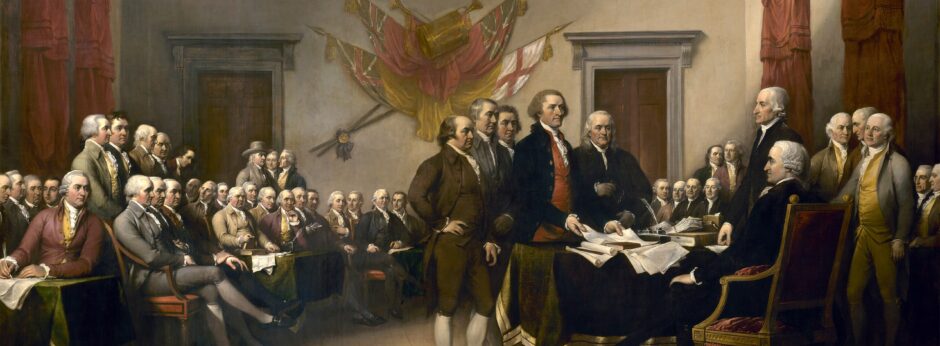
A Contested Standard: Morris’ Funeral Oration for Washington
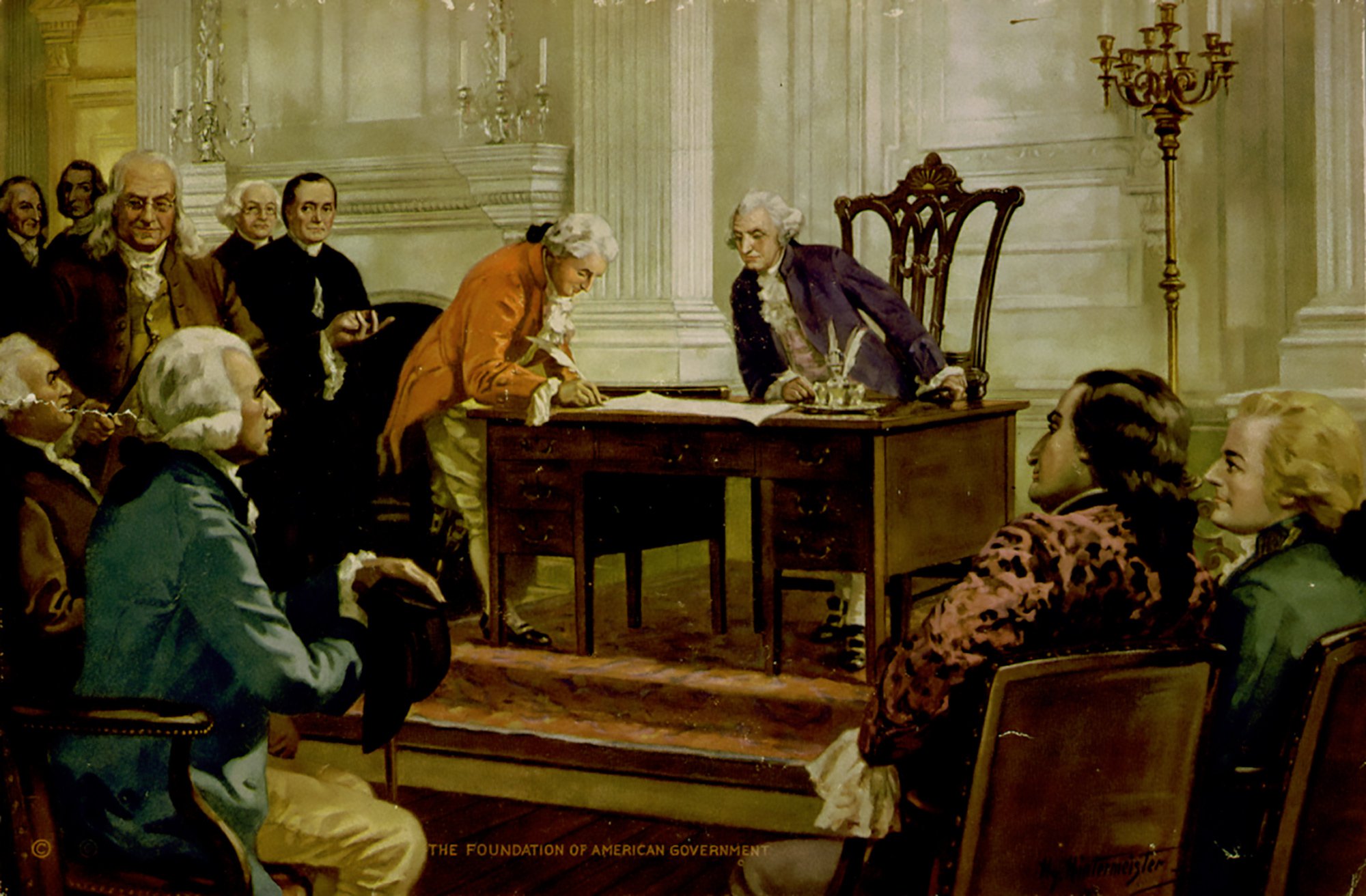
Gouverneur Morris signs the Constitution, painting by John Henry Hintermeister
On the mournful New Year’s Day of 1800, Gouverneur Morris stood to eulogize the recently deceased George Washington. Morris, the “Penman of the Constitution,” praised the former President and credited him with words that defended a Federalist concern about popular passions that were of particular importance to Morris. In doing so, he was an early example of an American tradition that endures centuries later: claiming Washington’s legacy in support of factional interests.
Text Summary
Morris and Washington had been friends and allies since the Revolutionary War–there were few better positioned to speak to the former President’s service. Morris began by praising Washington as a man of tremendous personal virtue and cultivated self control, “so great the empire he there acquired, that calmness of manner and of conduct distinguished him through his life.” [1]. Morris seemed to believe that Washington’s greatness in public life was predicated on personal moderation. At times, his description bordered on the hagiographic: “Was he the slave of avarice ? No. Wealth was an object too mean for his regard … Was he ambitious ? No. His spirit soared beyond ambition’s reach.” [2] From there, Morris turned to the tensions of the early Republic, stating that “the different states had been held together, in no small degree, by the external pressure of war. That pressure removed, they might fall asunder.” [3] What might now bind the states together? In Morris’ telling, it was Washington’s wisdom. In response to delegates at the Constitutional Convention overly concerned with popularity and ignoring prudent governance in favor of acquiescence to popular passion, Morris recalls Washington spoke extemporaneously: “It is too probable that no plan we propose will be adopted. Perhaps another dreadful conflict is to be sustained. If, to please the people, we offer what we ourselves disapprove, how can we afterwards defend our work? Let us raise a standard to which the wise and honest can repair. The event is in the hand of God.” [4] The rest of the oration followed a familiar pattern: as general or President, Washington’s good character and inflexible disposition enabled him to stand athwart the tides of popular passion. This account of Washington’s words have become among his most widely-quoted, etched into monuments and federal buildings centuries later.
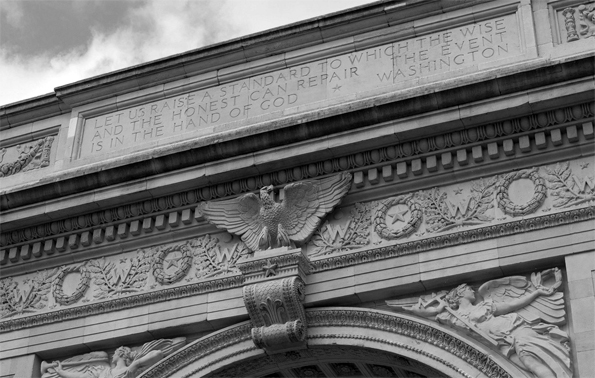
Washington Arch Inscription (Village Preservation)
Context
Naturally, the context surrounding this oration requires untangling. Gouverneur Morris was born the last son into a prominent and wealthy family in New York in 1752 [5] As a talented lawyer and politician during the Revolutionary War, he came to know Washington well. The two first became acquainted during the hard period at Valley Forge in 1778, when Morris visited as a New York delegate to the Continental Congress and remained a steadfast supporter and friend of Washington thereafter. [6]. Following the war, Morris served as an indispensable delegate to the Constitutional Convention of 1787 in Philadelphia and served on two committees that shaped the Constitution and composed the document’s preamble. [7] In the words of James Madison, “The finish given to the style and arrangement of the Constitution, fairly belongs to the pen of Mr. Morris.” [8].
Morris was among the most talented rhetoricians of the Founding Fathers and Alexander Hamilton even approached him to write the essays that would become The Federalist Papers. [9] Morris declined. But more than a skilled writer, he was a man of firm and well-considered political attitudes. Morris was for religious liberty, against slavery, supportive of a strong executive and stronger property rights, and perhaps above all else, skeptical of the popular passions that he saw firsthand had the potential to create a nation or destroy it. [10]
After traveling to France for financial dealings, Morris became a fixture of the American presence in Paris alongside Thomas Jefferson and an eyewitness to the unfolding and increasingly violent French Revolution. He noted how it differed from the American Revolution: “our Contest has given a confused Notion of Liberty to this Country [France]” [11]. Washington appointed him Ambassador to France in 1791, and Morris, an opponent of popular excitability, became increasingly concerned by the direction of the revolution. He assisted Louis XVI with his affairs and even designed unfulfilled plans for the King to escape to safety. [12] During the Reign of Terror [1793-1794], Morris’ diary recorded his firsthand accounts of the violence and barbarism that swept the country. [13]
The fiery and bloody upheaval that he witnessed back in France weighed on him as he returned to America in 1798 and saw the division that gripped the United States.
Washington had retired and left John Adams in his stead, who would soon be in a vicious election against his Vice President, the Democratic Republican Thomas Jefferson. Additionally the Federalist Party itself was split between supporters of Adams and Hamilton. [14] At the same time, tensions rose with France, a threat that had even compelled Washington to leave his retirement and align with the Federalists by returning to command as a Lieutenant General and spend long days at Mount Vernon drawing war plans.
It was this political environment that Morris inhabited on New Year’s Day 1800, with one difference: On a cold winter night in 1799, attended by doctors and family, Washington died from a sudden illness. As the news spread from Mount Vernon to the nation’s capital in Philadelphia four days later and New York two days after that, Congress declared a nation-wide period of remembrance and a state funeral. The country came together in acts of mourning across more than 400 funerals and 300 eulogies. [15] But Washington was gone, and along with him the immediate stabilizing and unifying effect that he provided the country. At the same time, his legacy immediately became contested among the Americans who sought to lay claim to it, a tradition that continues to this day.
Subtext
The subtext of Morris’ speech is as complex as the political maelstrom that surrounded it. In a textual reading, Morris recalled a time at the Constitutional Convention where delegates wavered and nearly chose expediency over principles if not for Washington. In this reading, invoking Washington’s words was a call for unity around the founding principles and the Constitution that they birthed. At the same time, Washington’s words were in response to a very particular concern: popular passions. Morris described Washington as eloquently speaking against those who would imprudently offer few protections against direct democracy. In private, Morris was less polite: in 1774 he described a passionate political meeting in New York: “The mob being to think and reason. Poor reptiles!” [16] Popular will and the protection of individual rights had long been central to Morris’ political philosophy but their importance was underscored in his mind by what he had so recently witnessed in revolutionary France: “In the sincere Desire to promote [the public good], just men may be proscribed, unjustice be declared, property be invaded and violence patronized.” [17]. In Morris’ telling, Washington was a passionate defender of those same interests.
There is also the question of whether Washington ever truly said these words. Writing more than a century later, the great Senator Henry Cabot Lodge noted that Madison never recorded such a speech at the Convention; nevertheless, while the “language is no doubt that of Morris…” Lodge wrote, “… the noble and courageous sentiment which they express is thoroughly characteristic of the man to whom they were attributed.” [18]
Morris laid claim to Washington’s legacy and attached the deceased to a factional view, but he was not the only one to do so. At another funeral for Washington in Augusta, Maine, Federalist Benjamin Whitwell began by “forgetting domestic feuds and party dissensions,” and ended by endorsing Adams as Washington’s political heir. [19] Similarly, the Reverend Richard Allen, a prominent black Methodist, eulogized Washington as an advocate for the oppressed and a “sympathizing friend and tender father [who] has watched over us and viewed our degraded and afflicted fate with compassion and pity.” [20]
While Washington is widely regarded as among the greatest American Presidents, he became far more of a unifying figure in death than in life. As a man, he weighed into the debates of his time with reticence. As a symbol, countless mourners and future generations could connect their concerns to his character and deeds.
Conclusion
On December 7 1799, Morris wrote to his old friend at Mount Vernon, asking him to return to the presidency and restore unity to the increasingly fractious country. But by the time the letter arrived, Washington had already passed. [21] Americans today may find themselves similarly wishing for the return of a uniting figure. The ceaseless appeals to his legacy that sprung up in the wake of his death have not yet abated, more than 200 years later. Morris’ quote has proved enduring not just as Washington’s description of what the Constitution meant at the time, but what Washington’s legacy, debated over and variously laid claim to, has meant to Americans for more than 200 years. Washington’s legacy is a standard raised to all his heirs. The future of this nation remains in the hand of God.
[1] Gouverneur Morris, An Oration, upon the Death of General Washington (New York: John Furman, 1800), 8.
[2] Gouverneur Morris, An Oration, upon the Death of General Washington, 13.
[3] Gouverneur Morris, An Oration, upon the Death of General Washington, 22.
[4] Gouverneur Morris, An Oration, upon the Death of General Washington, 25.
[5] William Howard Adams, Gouverneur Morris: An Independent Life (New Haven: Yale University Press, 2003), 11.
[6] Theresa DeCicco, “Gouverneur Morris: The Forgotten Founding Father,” Fraunces Tavern Museum, accessed May 2, 2026.
[7] Theresa DeCicco, “Gouverneur Morris: The Forgotten Founding Father.”
[8] Theresa DeCicco, “Gouverneur Morris: The Forgotten Founding Father.”
[9] Theresa DeCicco, “Gouverneur Morris: The Forgotten Founding Father.”
[10] Philipp Ziesche, “Exporting American Revolutions: Gouverneur Morris, Thomas Jefferson, and the National Struggle for Universal Rights in Revolutionary France,” Journal of the Early Republic 26, no. 3 (2006): 428.
[11] Philipp Ziesche, “Exporting American Revolutions: Gouverneur Morris, Thomas Jefferson, and the National Struggle for Universal Rights in Revolutionary France,” 430.
[12] Max M. Mintz, “Gouverneur Morris, George Washington’s War Hawk,” Virginia Quarterly Review 79, no. 4 (2003): 569.
[13] Philipp Ziesche, “Exporting American Revolutions: Gouverneur Morris, Thomas Jefferson, and the National Struggle for Universal Rights in Revolutionary France,” 437.
[14] William Howard Adams, Gouverneur Morris: An Independent Life, 269.
[15] Gerald E. Kahler, The Long Farewell: Americans Mourn the Death of George Washington (Charlottesville: University of Virginia Press, 2008), 11-13.
[16] Richard Brookhiser, “The Forgotten Founding Father,” City Journal, April 1, 2002.
[17] Jennifer Nedelsky, Private Property and the Limits of American Constitutionalism (Chicago: University of Chicago Press, 1990), 69.
[18] Henry Cabot Lodge, George Washington, vol. 2 (Boston: Houghton, Mifflin and Company, 1889), 32.
[19] Gerald E. Kahler, The Long Farewell: Americans Mourn the Death of George Washington, 19.
[20] Gerald E. Kahler, The Long Farewell: Americans Mourn the Death of George Washington, 17.
[21] William Howard Adams, Gouverneur Morris: An Independent Life, 269