
Peaceful End to the Cold War video
By Luke Beiles
When John Sullivan joined the United States Naval Academy in the 1980s, the Cold War was at the forefront of American minds. A peaceful end to the war was hard to imagine, with the arms race in full effect. Both the United States and the Soviet Union had enough nuclear warheads to destroy one another multiple times over. “You feared nuclear annihilation… it did kind of consume your physic,” [1] said Sullivan, who began service as a chief medical officer in 1987. Upon his entrance to the Navy, Sullivan believed that the Cold War would “persist longer or even result in a nuclear war” [2] In 1992 he was sent on a 2-year set of orders, stationed in Gaeta, Italy aboard the USS Belknap. If someone had told Sullivan when he was joining the Navy that he would be peacefully sailing the USS Belknap into Novorrossik in 1994, the first United States ship into Russia since World War II, he would’ve said that’s simply impossible, especially for a medical officer. [3] This inconceivable dream did indeed come true for Sullivan. In American Dreams by H.W. Brands, the peaceful end to the Cold War is attributed to the Reagan Arms acceleration, the role of Mikhail Gorbachev in peace talks, and the diplomatic efforts of President Bush, but, although John Sullivan’s recollections from his time aboard the USS Belknap do add depth to Brands analysis, the peaceful end should also be attributed to the Malta Summit of 1989.
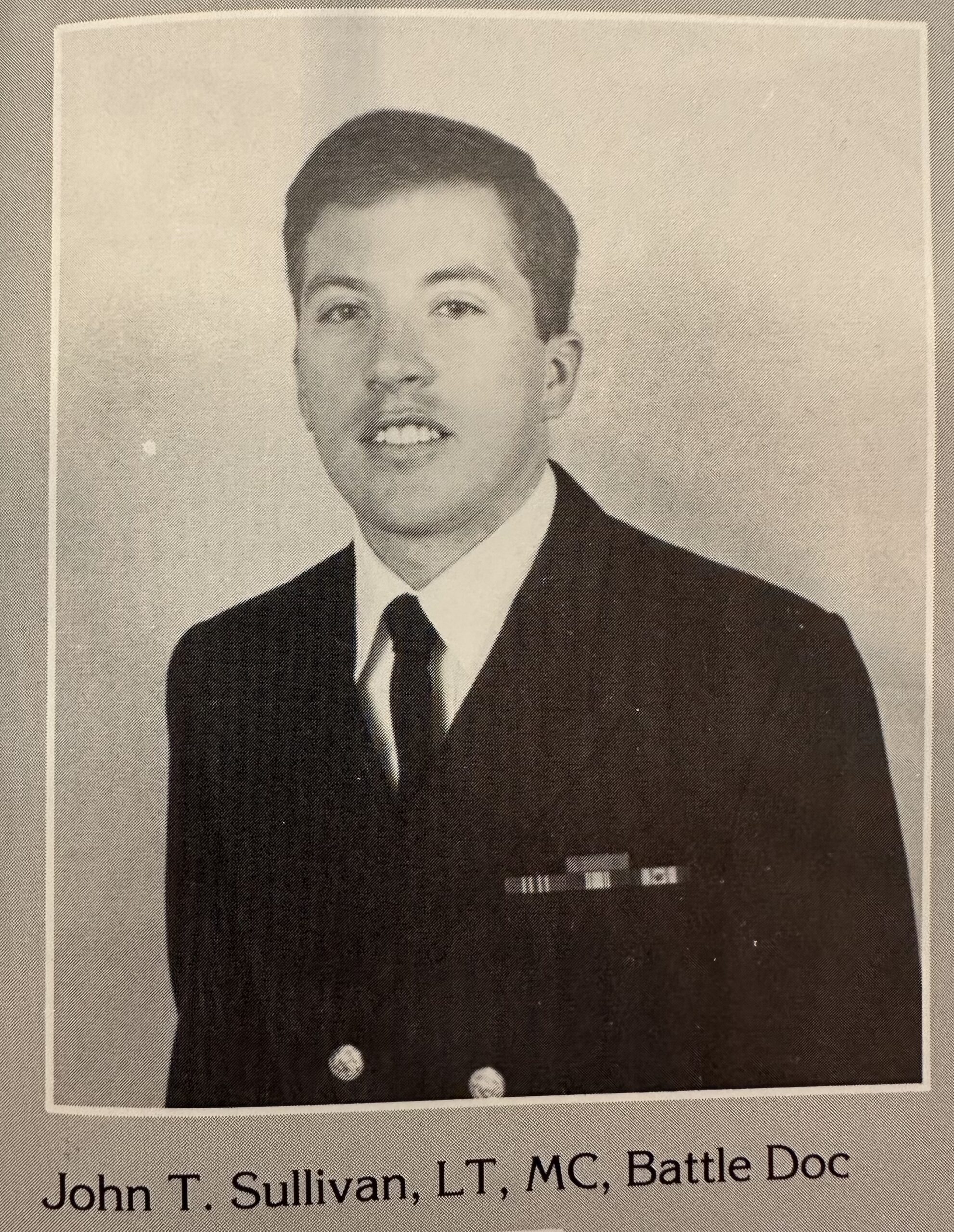
Sullivan served in the United States Naval Academy as a Medical officer for 32 years
The early 1980s saw the Reagan administration begin a buildup of arms in hopes of restoring American self-confidence in the Cold War against the “evil empire” of the Soviet Union. [4] Reagan’s actions at the beginning of his presidency annoyed then Premier Leonid Brezhnev, of the Soviet Union, “His frustration grew as Reagan approved a program calling for defense expenditures that totaled $1.5 trillion.” [5] The United States arms buildup coincided with the decline of the Soviet Union economy, which was going to struggle to keep up with the spending of the Reagan administration. Brezhnev passed away in 1982, and “most elite groups understood that the Soviet economy was in trouble.”[6] Mikhail Gorbachev, who came into power in the Soviet Union in 1985, understood the economic trouble that the Soviet Union was going through and sought to cut government spending. The Soviet Union was spending around 25 percent of its gross national product on its defense build-up. [7] This spending was not sustainable given the economic dilemma that the Soviet Union faced. The nail in the coffin was when the Reagan administration proposed the Strategic Defense Initiative, at which point Gorbachev decided that the Soviet Union could not continue to attempt to “match the Americans at each step of the technological way” [8] As a result, Gorbachev knew that their Cold War policy had to change. Gorbachev’s intention to create change became immediately apparent, he intended to make it clear to not only the United States but to the world that the Soviet Union was not an international threat. Sullivan recalls having a “favorable impression of Gorbachev. I knew that his decisions were reducing our angst over the possibility of nuclear war. For that I was grateful.” [9]
Despite the introduction of a true peacemaker at the helm of the Soviet Union, the Cold War was still not over, although Reagan and Gorbachev had discussions of arms reductions and even of the elimination of nuclear weapons entirely in October of 1986 in Reykjavík, the two leaders could not come to an agreement. Reagan and Gorbachev were both facing pressure from their respective governments, and the history of mistrust between the nations hindered the possibility of a comprehensive end to the Cold War. Sullivan joined the Navy just a year later in 1987, and at the time he still feared the possibility of nuclear war due to the “proliferation of nuclear weapons and intransigence on each side.” [10] Although Reagan certainly played his part in the easing of Cold War tensions, particularly with his own ideological shift from building up American arms when entering office, to agreeing to destroy nuclear missiles through the 1987 INF treaty, it wasn’t until George H.W Bush entered office where peace truly became in sight.
When Bush entered office, he was aware that the Soviet Union was “imploding”, but he also knew he had to be wary of the fact that the Soviets still had the firepower to destroy the United States within minutes. [11] The Soviet Union was collapsing, much to the surprise of the world. Sullivan recalled, “I didn’t think that the Soviet Union would dissolve, and certainly not so precipitously.” [12] But this was the reality, Gorbachev’s reform effort was effectively “surrendering the superpower status,” of the Soviet Union. [13] Gorbachev intended to make this very clear to President Bush on December 2nd, 1989, off the coast of Malta. The soviet cruiser, Slava, was to moor alongside the USS Belknap, where Bush and Gorbachev were to engage in serious discussions regarding arms reductions. Although Sullivan himself was not on the ship at the time, one of his friends named Jeff Kaiser, who was the medical officer on board the USS Belknap at the time, described to Sullivan the remarkable story of the Malta Summit. Meeting planners hoped that Malta would be a picturesque site for the crucial get-together of Bush and Gorbachev. [14] However picturesque would be far from the word to describe the inclement weather that the ships encountered. Kaiser described the elements as “just horrible… there was so much wind that the ship was at risk of being pulled off its mooring.” [15] As a result of the weather, those who were not used to being aboard the ship were experiencing sickness, including Secretary of State James Baker, Chief of Staff John H. Sonunu, and National Security Advisor Brent Scowcroft. Kaiser treated the gentlemen with scopolamine, and despite the weather, President Bush and Gorbachev went on to ensue discussion the following day. H.W. Brands does not mention the Malta Summit despite it being a huge turning point in the Cold War. At this meeting, Gorbachev made clear to Bush that “the Soviet Union will not under any circumstances initiate a war… Moreover, the USSR is prepared to cease considering the U.S. as an enemy and announce this openly.” [16] Although this meeting did not effectively end the Cold War, Gorbachev’s senior foreign policy aide, Anatoly Chernyaev, came out of the meeting with the understanding that “the threat of nuclear war was a thing of the past. As was the Cold War itself” [17] Given the magnitude of this change in understanding after the discussions in Malta, it was surprising that Brands did not cover the Malta Summit in any capacity.
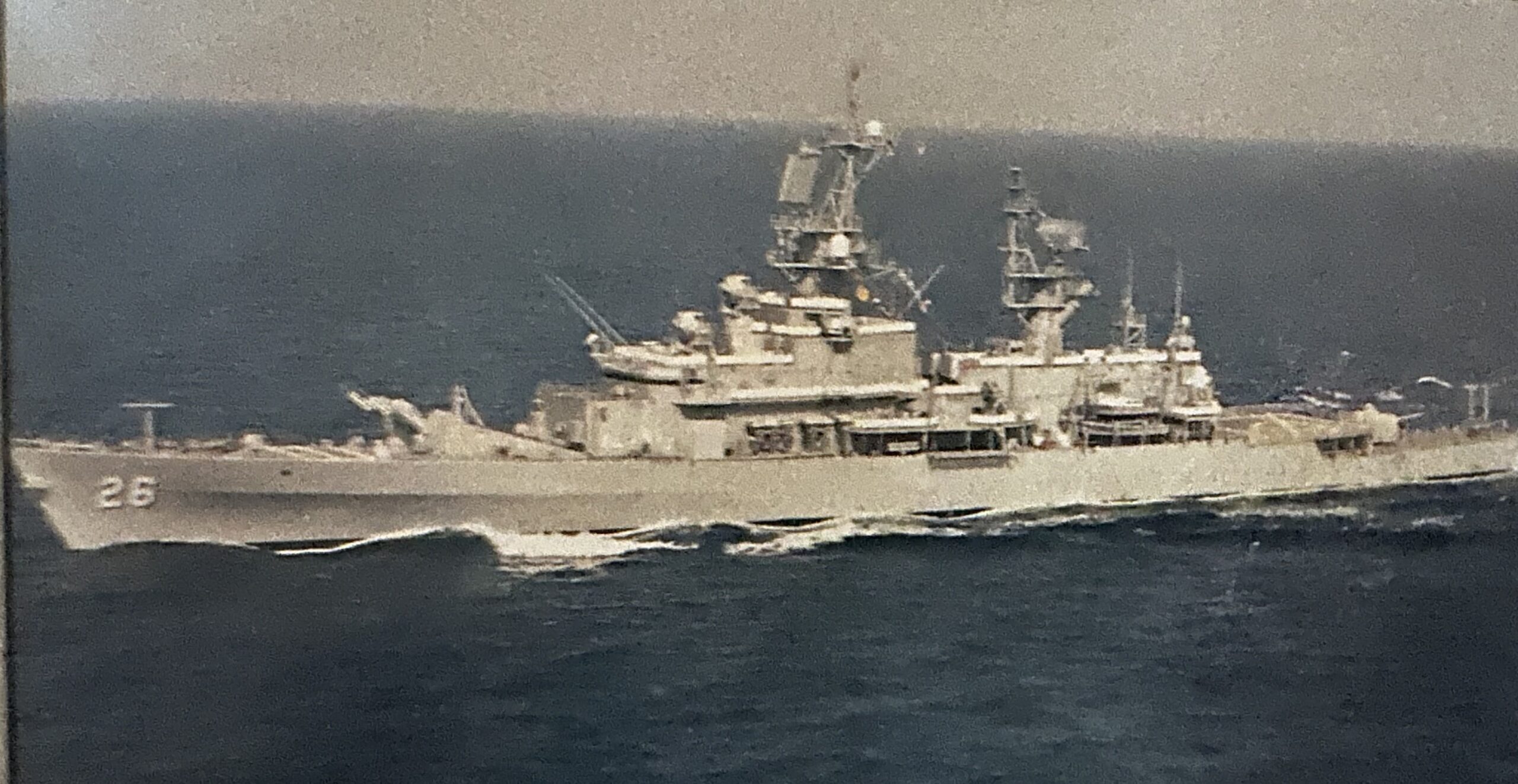
The USS Belknap, the 6th fleet flagship, is the ship that was present at the Malta Conference. Sullivan sailed this ship into Novorossiysk, Russia in October of 1994.
The end of the Cold War was solidified during the Bush presidency, notably marked by the dissolution of the Soviet Union in 1991. While the formal end of the Cold War wasn’t a result of a single agreement during the Bush term, his approach to diplomacy and cooperation with Gorbachev played a pivotal role in managing the peaceful transition of the Soviet Union. Despite the Cold War being more or less done by the time Sullivan was called into service in 1992, the job was not finished. Very few envisioned the downfall of the Soviet Union, and those who did, expected the dismantling of the Empire to occur violently. [18] Bush had a large task on his hands of handling these countries that were in a transition phase from the Soviet Union. The president visualized a “New World Order” that would share a “respect for freedom, democracy, and free markets.” [19] Sullivan and his comrades aboard the USS Belknap were responsible for executing the vision of the President. The role of the USS Belknap was to “go around the Mediterranean, port to port, and conduct diplomacy.” [20] This included diplomatic visits to former Soviet states such as Bulgaria, Romania, Ukraine, and Russia. When visiting these countries, Sullivan described something of a victory tour, “It felt like we won the Cold War – we pulled into these places, set up American bands, and danced with their women.” (20, Zoom) The receptiveness to American presence was apparent even in the former Soviet states, which surprised Sullivan, who had “assumed that they were more loyal to the Kremlin.” (21, Email) In October 1994, the Belknap was set to arrive on a diplomatic visit to Novorossiysk, Russia. Sullivan, who had received the officer of the deck award the day prior for effectively communicating the presence of a Russian backfire bomber within striking range of the Belknap, received an incredible honor from Captain Moller: the first Naval officer to pull a ship into Russia since World War II. (22, Zoom Interview)
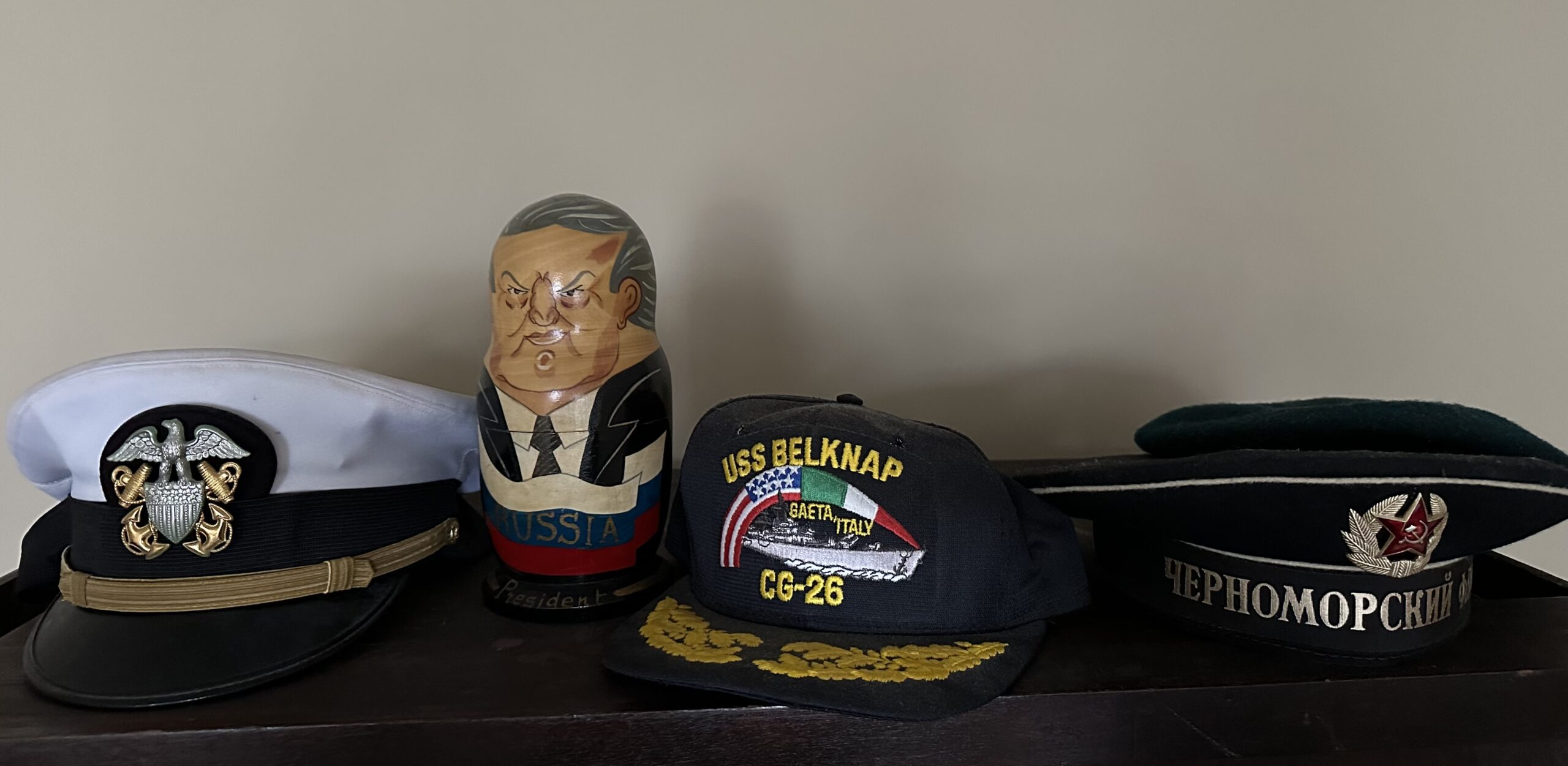
Left to right: US Navy hat, Russian doll of Gorbachev, USS Belknap hat, Russian sailor “Black Sea Fleet” hat
Sullivan pulling the USS Belknap into Novorrosik shows a remarkable change in the relationship between the United States and the Soviet Union since Sullivan’s upbringing in the 80’s and 90’s. Sullivan went from entering the Navy with true fear of nuclear war with the Soviet Union, to peacefully sailing the USS Belknap into Novorossiysk just 6 years later. This extraordinary achievement would not have been possible had it not been for Reagan and his arms buildup, Gorbachev’s intentions for peace and his role in the fall of the Soviet Union, and Bush’s effective diplomacy. While H.W. Brands does an excellent job of describing the roles Reagan, Gorbachev, and Bush had in the mellow end to the Cold War, through John Sullivan’s recollections it was made clear that Brands should have included the events in Malta in 1989. The illustration of Sullivan pulling the USS Belknap into Russia tremendously personifies the peaceful end to the Cold War, to which the world is astoundingly grateful.
[1] Zoom Interview with John Sullivan, November 17, 2023.
[2] Email Interview with John Sullivan, December 6th, 2023.
[3] Email Interview with John Sullivan, December 6th, 2023.
[4] H.W. Brands, American Dreams: The United States Since 1945 (New York: Penguin Books, 2010), 219.
[5] Wilson, James Graham. “Did Reagan Make Gorbachev Possible?” Presidential Studies Quarterly 38, no. 3 (2008): 456–75. http://www.jstor.org/stable/41219690.
[6] Britannica Academic, s.v. “Russia,” accessed December 5, 2023, https://academic.eb.com/levels/collegiate/article/Russia/109504#38564.toc.
[7] Britannica Academic, s.v. “Russia,” accessed December 5, 2023, https://academic.eb.com/levels/collegiate/article/Russia/109504#38564.toc.
[8] H.W. Brands, American Dreams: The United States Since 1945 (New York: Penguin Books, 2010), 260.
[9] Email Interview with John Sullivan, December 6th, 2023.
[10] Email Interview with John Sullivan, December 6th, 2023.
[11] H.W. Brands, American Dreams: The United States Since 1945 (New York: Penguin Books, 2010), 272.
[12] Email Interview with John Sullivan, December 6th, 2023.
[13] H.W. Brands, American Dreams: The United States Since 1945 (New York: Penguin Books, 2010), 276.
[14] Gorbachev and Bush: The Last Superpower Summits. Conversations that Ended the Cold War (Central European University Press, 2020), 7.
[15] Zoom Interview with John Sullivan, November 17, 2023.
[16] Gorbachev and Bush: The Last Superpower Summits. Conversations that Ended the Cold War (Central European University Press, 2020), 7.
[17] Gorbachev and Bush: The Last Superpower Summits. Conversations that Ended the Cold War (Central European University Press, 2020), 13.
[18] H.W. Brands, American Dreams: The United States Since 1945 (New York: Penguin Books, 2010), 291.
[19] Eales, Stewart C. “Democracy Promotion in the Post-Cold War Era.” Edited by Larry D. Miller. The Army War College Review. Strategic Studies Institute, US Army War College, 2016. http://www.jstor.org/stable/resrep11940.4.
[20] Zoom Interview with John Sullivan, November 17, 2023.
[21] Zoom Interview with John Sullivan, November 17, 2023.
[22] Email Interview with John Sullivan, December 6th, 2023.
[23] Zoom Interview with John Sullivan, November 17, 2023.
Appendix
“The reunification of Germany might have marked the definitive end of the Cold War – which, after all, had started with the division of Germany – had another event, still more definitive in concluding the contest between the United States and the Soviet Union, not followed within several months.” (H.W. Brands, American Dreams p. 276)
Interview Subject
John Sullivan, age 58, currently Senior Vice President and Chief Medical Officer at St. Clair Health in Pittsburgh, served as a Medical Officer in the Navy for 32 years. He was stationed in Gaeta, Italy from 1992 to 1994, where he was on board the USS Belknap.
Interview
Zoom recording with John Sullivan, Carlisle, PA, November 17, 2023.
Selected Transcript
Luke: Did you feel like the Cold War was over when the Wall fell?
John: It felt like we won. It felt like we won the Cold War – and then we pulled into these places and set up American bands and danced with their women. It felt like our American trophies. I literally was dancing in the squares of Odesa Ukraine with a beautiful Ukrainian women – it felt like it was over. It felt like they (Ukraine) were going to be moving towards democracy, it didn’t feel like it was moving to an autocratic state at all. The former Soviet Republics had broken off but I still perceived them as part of the Soviet Union, certainly Ukraine felt like Russia to me. Growing up in the 70s and 80s you feared nuclear annihilation. It did kind of consume your physic growing up. So this felt like the end point. Summer of ’91 it was like ok we won, we’re done. We outspent them. I joined the military in the ‘80s during the Reagan run up to just outspend the Soviets and you could argue that that worked. It was a little risky, there were skirmishes, the Russians were in Afghanistan at the time in ‘80s.
Luke: So when did you end up going overseas again?
John: I went over in August of ’92, on a 2 year set of orders that got extended another 6-8 months. THE war in Bosnia had just started, most of my time over there was spent intermittently cruising the Mediterranean and serving on the 6th fleet Flagship. I spent August ‘92 through the winter of ‘94. The ship I was on interestingly hosted a major nuclear arm agreement between Bush Sr and Gorbachev in December of ’89. The ships met off the coast of Malta. In a bay in Malta. It was the USS Belknap, the 6th fleet Flagship and a Soviet cruiseliner, it wasn’t a military vessel. They moored alongside each other. Bush and his cabinet advisors who included Scowcraft, secretary of state, Sonunu and Baker. They were on board the ship negotiating the last minute deals to this nuclear disarmament agreement. My friend, the medical officer on board told me this anecdote from it. He said that it ended up being this horrible storm. They were anchored in this protected harbor on the North side of Malta. Horrible winds and seas. So much wind that the ship was at risk of dragging anchor and being pulled off of its mooring. The ship was rocking even at anchorage, but for whatever reason a lot of the non-ship board company, essentially the secret service, were all sick. They were vomiting passageways, my friend Jeff Kaiser, who was the medical officer at the time, described handing out sea sickness medication. But late that evening, the night before Bush was to meet Gorbachev, he got called to the admirals cabinet where the president and his advisors were for sea sickness medicine. He said I went to my drawer and he said his armamentarium was the same as mine at the time, he had the antihistamine pill called meclizine, and a patch called scopolamine, the side effects of each of them he quickly considered before he went up there. The meclizine was not as effective and it tended to make you sleepy, and he said that seems disadvantageous for this group working on a nuclear disarmament agreement. The scopolamine patch is more effective and it has a lower side effect profile, but for some elderly people it creates psychosis. He says well that doesn’t sound good for a nuclear disarmament working group. He said well he figured the likelihood of that happening to all of them was nil. He said I went up to the admirals cabin, the president of the United States was behind the admirals desk, he was fine. He was an old navy man and he had fished off of Maine a lot, he had no problem. But Baker, Sonunu, and Scowcraft were sick. Baker was a 6 foot 5 Texan, and he stood up from behind a little booth in his office, where my friend was about 5 foot 6. He said this man was towering above him. He said the longest minute of his life was when Baker said, “give me the patch doc” He said he handed out the patch plenty of times over the last 2 years but never actually opened one. He was trying to peel open this package and then peel the patch off of its backing. Meanwhile the leader of the free world was watching him try to do this as he goes so slowly. He slapped the patch on James Baker, he said the next day they were planning to go over to negotiate with Gorbachov, and they were still decided whether it was safe or not to cross on small boats over to the Soviet ship. They were all on the bridge and wind was blowing, in really heavy winds you can put a man forward called the anchor watch, who is outside the very bow of the ship in heavy wind and rain, freezing in December as you could imagine, with his pea coat pulled up around his head. He just stands and watches the anchor and sees if it starts to drag and alerts the ship to get underway. Everyone is up on the bridge decided whether they should go or not. They decided that ultimately it was up to the President, and they looked around themselves and the President was missing. And they said well where is he? They were sending people in different directions looking for him and finally someone looked out and saw that the President was out on the bow of the ship with the kid on the anchor watch. And he had his arm around this guy in his pea coat. The kid later said I’m out there freezing my tail off, thinking I only got like 15 more minutes on this watch and President Bush shows up and asks me “where are you from?” Ultimately the President decided to go over to the Soviet ship, they conducted the negotiation, it was over the START II nuclear disarmament agreement. The purpose of it was to reduce total number of nuclear weapons. I remember at that time we were just building, we were each at 40 or 50 thousand nuclear warheads. It was an arms race, it was getting to the point where each of us had hundreds if that thousands more weapons than you needed to destroy the other one. So why don’t we just both cap what we’re doing, save money and improve world safety.
But yea this was on my ship, the USS Belknap, based out of Italy. Which you can imagine was a glorious duty station. I was 25 years old and I got assigned that. I was pretty convinced I got the best duty station in the Navy. A ship between Rome and Naples on the coast for several years, and all we did was go around the Medittereanean, port to port and conduct diplomacy. At first I had this moment within my first couple of months thinking whether this was good use of taxpayer dollars. And then I realized it was actually fairly cost effective diplomacy, when the French were balking participating in a no fly zone over Bosnia, we got sent up there and put on a party and conducted a negotiation settlement and they were in. And I thought to myself well it probably cost 10,000 gallons of Marine diesel fuel, 20 cases of champagne, and a frozen shrimp tree. We used to have parties on the night we would get there, we would all get in our dress uniforms, get on the fan tail, they would open up the alcohol cabinets. We were one of the few Navy ships that had alcohol on board because we were always entertaining the Europeans. Your Aunt Aleca would hop in the car and drive up to like Southern France and we usually said, whether it was Barcelona, St. Tropez, Toulouse, wherever we pulled in. I said “well what day are you gonna get up there?” And whatever we said we would agree to meet at the shrimp tree at the reception. She would like pull in, throw a dress on, come up to the party. But it was interesting, we would have the reception, the next day we’d go into the ward room, and the negotiators would hammer out the negotiations. Sometimes, for whatever reason they didn’t like empty seats on the table, like I had no role in negotiating diplomatic issues. They, if there were 2 empty seats at the end of the table, they wanted it filled with junior naval officers just to make it look good. We stayed there a couple of days in Odesa, we pulled around the Cremian peninsula, and I remember thinking to myself as we steamed along the coast there. I look out, I see Sevastipole, the lights of Sevastipole and just thinking like “that was the enemy fleet right there”, we were pulling along the coast and at this very moment I was looking on the chart, there was a gap along the coastline, the valley of Balaclava, where the British light brigade made their failed charge in the Cremian war. I remember in that very moment just thinking about the history of that when I got the following call, I had the deck on the ship. Even though I was a medical officer, I started taking officer of the deck watch, like a line officer just because I liked to, I just thought it was cool. I got a call from combat, sir we’ve got an inbound aircraft, hostile profile, 80 miles out. I was like ok, track it, follow up with report, and like 30 seconds later I got another call saying “sir confirmed inbound Russian backfire bomber, on hostile profile, now 70 miles out, what do you want to do?” I remember just thinking, we’re pulling into Russia tomorrow, but youre also thinking like your at the range where if he puts a missile down, missile hit to a ship is usually 50-100 people dead, including potentially you. You have to make some decision but it didn’t make any sense, we were an invited guest. Why would they be coming for us? But hostile profile means it was coming right down at you. So I called the captain and just described “Sir I’ve got a Russian backfire bomber 70 miles out hostile profile, I’m gonna continue to track with air search radar, I’m not gonna light him up with fire control radar” and he said “Roger that John I don’t want to see myself on the cover of Newsweek here” To light him up with fire control radar would mean my missile is on him, which is technically an act of war. But that’s kind of your next step, I’ve tracked him, should I shoot him before he shoots me.
We pulled in the next day, I got the honor of getting the officer of the deck award. So the captain gave me the honor: the first Naval officer to pull a ship into Russia since World War II was me. In the Black Sea, it was amazing, into Novorossiyk. We were pulling in, it was a beautiful October day in ’94, it was warm almost 80 degrees. It was unusually warm, we were wearing black wool uniforms because that was typically what you wear at that time of year. The uniform was set by Moscow. The Russians came out in a small boat as I was maneuvering the guided missile cruiser in. A couple of their admirals came up to the bridge, and on the bridge the only voice that’s above kind of a whisper is mine. “Right full rutter, right full rutter” I hear my three star admiral saying to them through the translators, “please tell them that that is our medical officer driving the ship.” And I hear the Russians say back through the translators “Uh Admiral, in the Russian Navy medical officers don’t drive ships”. And he said “Please tell them that in our Navy they do.” I remember thinking to myself that was one of my glorious moments. Pulled the ship, moored to a cravat class cruiser called the Marshall Usitinav. We toured the Russians through our ship and they toured us through their ship. I remember thinking when we were on their ship that everything onboard their ship was analog, I was just stunned. We had computer screens and everything was digital while these guys were like dialing 096, and I remember thinking like how were these guys a serious threat. One of my intelligence officers, said looking out “I’ve spent a 20 year career in the Navy spying on the Russians. I’ve looked at pictures of this ship through grainy photographs taken at the risk of someone’s life. And now im moored to the ship right next to it.” He couldn’t believe it. And they had their spies, CGB guys on our ship and one of them I remember being pretty clear that he was CGB by this conversation. I said to him about the uniforms, which I was like sweating in my uniform, and I said “It’s warmer here than we expected” and he said “Yes um I think you Americans would call this Indian summer” and I’m thinking wow that’s real command of the language, he’s intel for sure if he knows that much. But whatever they were spying on us we were spying on them. But it was extraordinary to be there, my sailors didn’t want to leave. They were all taking girls out to dinner, buying them things. I remember them telling me they didn’t want to leave and I was like “what do you mean you don’t want to leave Russia?” and he goes “I just took this girl out to dinner I paid her 20 bucks and I slept at her place all night. Not only that but I signed autographs all the way back to the ship the next morning.” And I’m like yea that’s pretty cool. Nontheless this is Russia. It was weird to be there. The city squares theres like Lenin, we walked into department stores where the shelves were empty and the lights were off. It was just weird. We went to a museum called the heroes of the Soviet Union. It just felt like we were just thrown out of time, like all this stuff the Russians were the enemy and we were in this museum called Hereos of the Soviet Union.
Second Interview
Email Interview on December 7, 2023.
Transcript
Luke: One quote from the textbook that I found might directly relate to you and your ships involvement was – “Those few who had foreseen the demise of the Soviet empire had generally expected the breakup to occur violently… but the dismantling of the empire had occurred peacefully for the most part. That it did so owed a great deal to the diplomacy of George Bush. American officials might have pushed too hard too fast.” My question for you after seeing this quote is – Do you feel that Bush deserves credit for the peaceful end to the Cold War?
John: Well many credit the demise of the Soviet Union to the aggressive military buildup under Reagan that preceded Bush. They ulitmately couldn’t keep up economically against a capitalist society. Not sure how true that turned out to be. Gorbachov deserves most of the credit I think for being forward-thinking and progressive probably when he was surrounded by many old-school, hardliners who knew of nothing but communism. The personalities of Gorbachov and Bush toghether likely fostered a smoother transition. I was surprised to see how enthusiatistic many of the former Soviet states were to peel away from Moscow. I had assumed that they were more loyal to the Kremlin. Ukraine being the most noteworthy of those that I observed personally.
Luke: Or does the credit really belong to the Gorbachev and his willingness to surrender the Soviet’s superpower status?
John: Yes, Gorbachov was likely very pragmatic in realizing the current confrontational course was unsustainable. And perhaps the rise of Putin reflected a underlying bitterness among Russians to have lost their preeminant status on the world stage in this transition.
Luke: What did you envision as the outcome of the Cold War when you joined the Navy? Did you think there was any way the war would end peacefully?
John: I think many of us thought it would persist longer and even result in a nuclear war. We really feared that liklihood given the proliferation of nuclear weapons on both sides and the intransigence of both sides. I didn’t think that the soviet union would dissolve, and certainly not so precipitously.
Luke: Could you ever have imagined sailing the first ship into Russia when you joined the Navy?
John: Of course not. It’s hard to even think of it now particularly for a medical officer. I assumed I was just going to perform medical duties when deployed. It was remarkable to be given the chance to qualify as an officer of the deck on a warship. I’m not sure why Captain Moller gave me the honor. It’s possible that it was intentional, or that it was just the natural rotation of the watch. He did like that I was ambitous about obtaining line officer qualifications. He sometimes used that to motivate his regular officers, “For God’s sake gentleman, the doctor is doing this better than you.” Being in Russia in uniform was simply surreal only 6 years after attending officer school and listening to a lecture about the psychology of Russians at the Newport Naval War College. What stands out is seeing statues of Lenin, going to the Hero of the Soviet Union museum in Novorosisk (it felt llike going to a Nazi history museum), buying soviet trinkets on the streets, and seeing bare shelves in department stores. I also remember thinkking that we had substantially overestimated their military capabilities when we toured their ship, the Marshall Ustinov, with its pitiful analog technology.
Luke: What was your opinion on Gorbachev? What was your overall awareness of his policies during the 1980s?
John: I had a very favorable impression of Gorby although I didn’t know much about the specific details of his policies in the 1980s. He was easing the policy of detente. I knew that his decisions were reducing our angst over the risk of nuclear war. For that I was grateful. I recall how extraordianry it was that he and Reagan met in Reykjavik, Iceland and then he visited Washington DC. And for that enlisted man on USS Belknap’s honor guard to have been standing on the portico when Gorbachov pulled up and met Reagan and overheard their conversations at that historic moment was memorable. Reagan pointed to this sailor and said, “This is my Navy.” The sailor whose name I forgot was so proud of that.
Further Research
Bialer, S., & Jervis, R. (1991). Soviet-American relations after the Cold War. Duke University Press.
Simmons, Dean, Phillip Gould, Verena Vomastic, and Philip Walsh. “Air Operations over Bosnia.” Proceedings 123, no. 5 (May 1997): 131.
Steinmetz, Greg, and ROBERT S GREENBERGER Staff Reporters of THE WALL,STREET JOURNAL. “U.S. Embassies Give American Companies More Help Overseas: End of the Cold War, Surge in Competition Change the Game for Diplomats an Envoy Eats a Hamburger.” Wall Street Journal (1923-), Jan 21, 1997, pp. 2. ProQuest, https://dickinson.idm.oclc.org/login?url=https://www.proquest.com/historical-newspapers/u-s-embassies-give-american-companies-more-help/docview/1619943839/se-2.
Gorbachev and Bush: The Last Superpower Summits. Conversations that Ended the Cold War, Central European University Press, 2020.
Ekedahl, Carolyn Mcgiffert, and Melvin A. Goodman. “Eduard Shevardnadze: Leading the Soviet Union out of the Cold War.” International Journal 52, no. 2 (1997): 219–42.
Eales, Stewart C. “Democracy Promotion in the Post-Cold War Era.” Edited by Larry D. Miller. The Army War College Review. Strategic Studies Institute, US Army War College, 2016. http://www.jstor.org/stable/resrep11940.4.
Philps, Alan. “Handshake That Ended the Cold War.” The World Today 70, no. 6 (2014): 38–40. http://www.jstor.org/stable/45048695.
Britannica Academic, s.v. “Russia,” accessed December 5, 2023, https://academic.eb.com/levels/collegiate/article/Russia/109504#38564.toc.
WILSON, JAMES GRAHAM. “Did Reagan Make Gorbachev Possible?” Presidential Studies Quarterly 38, no. 3 (2008): 456–75. http://www.jstor.org/stable/41219690.
Leave a Reply