Dickinson College, Spring 2025

Author: boyerk

Middle Class Women in the 1950s and 1960s

Middle Class Women in the 1950s and 1960s

By Matthew Tabrisky

“It was, I guess you could say common knowledge that you could be a secretary, you could be a teacher, you could be an airline stewardess, you could be a nurse. And, you know, that was about it….,”[1] recalls Barbara Leighton, a former nurse and 1957 graduate of Syracuse University who took part in a new Bachelor of Science oriented nursing program. These innovative programs constituted a part of the growing opportunities that American middle-class women were beginning to see in education and careers during the 1950s and 1960s. Yet just as Leighton describes, career options were still limited, and many of these women later moved into domestic life despite professional success. Leighton herself had such a pivotal moment in 1963 with a heart surgeon who, “…asked me to go to New York with him when he went to Mount Sinai as head of cardiac surgery. However, I got married instead,”[2] as Leighton recalls. In H.W. Brand’s book American Dreams: The United States Since 1945, Brand touches on the career restrictions middle-class women faced during the late 1950s, as well as the discontent many women had with their domestic lives as argued in Betty Friedan’s Feminine Mystique. Though not directly challenging Brand’s description, and despite a pause in her own career for marriage, Leighton had a negative view of women like Friedan, believing they just complained instead of engaging in nondomestic activities. Leighton’s outlook aligned more with the idea of celebrating women when they could balance both career and homemaking, emphasized in women’s magazines. While Brands highlights the nature of women’s career restrictions and discontent, his narrative lacks the greater complexity and detail regarding middle class women’s access to higher education, career options and developments in fields such as nursing, as well as comment on the stories of women with both careers and domestic life in magazines and the unique perspective held by those like Leighton regarding the dissatisfaction stressed by Friedan.
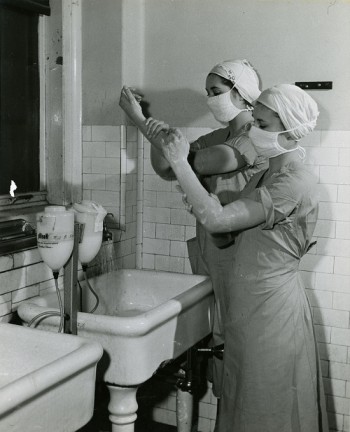
Nurses preparing for a surgical procedure, Philadelphia General hospital, c. 1960, courtesy of University of Pennsylvania

Women’s education and professional careers saw substantial growth through the 1950s and 1960s, albeit within limits from traditional gender expectations. Though Brands mentions that most middle class wives did not work during the 1950s, he omits details of women’s increasing college attendance and job participation.[3] In the 1950s and 1960s, Women’s college enrollment annually increased 5 and 9 percent respectively, both more than men.[4] This coincided with an increasing percentage of married working women, as the 1960 decennial census found that more than half of working women were married and typically college educated.[5] Universities such as Harvard even creating part time degree programs for older women to become teachers.[6] The nursing profession especially felt this change, with the postwar era marking the rise of college-educated and specialized nurses, including nurse practitioners, anesthetic and cardiac nurses.[7] “At the time open heart surgery was just starting. Not too many nurses that were on the roster wanted to take those cases, and I said I would. I became known as a cardiac nurse,”[8] Leighton recalls in her time at Miami Dade Memorial Hospital.

Yet despite this growth, societal norms limited both the accessibility and type of education middle class women received. Various private colleges and universities had admission rules favorable to men, with institutions like Stanford even placing quotas on women’s admission.[9] These limitations even affected classes for female dominated careers like nursing, as Leighton recalls, “I think there were thirty students in my class. We started out with around fifty in our freshman year, and a number of them obviously dropped out.”[10] Leighton’s tiny nursing class compared to some thousands of students in her year is better contextualized with the few career options and lack of expectation beyond domestic life many had for women.

Throughout the academic world, many educators sought to design homemaking-based curriculums for female students, expecting most women to settle down after some time spent in traditionally female jobs, such as teaching and nursing.[11] From 1953-1962, the ACE’s (American council of education) Commission on the Education of Women conducted research into women’s education and job choice for application to collegiate curriculums across the country. As their research indicated that women’s decisions regarding motherhood and career were highly individual based, some members proposed curriculums centered around homelife and community building, while others still advocated for a more job-oriented curriculum. The commission’s conclusion was thus the need for a broad liberal arts education to satisfy both aims.[12]

Though this liberal’s arts education supported some career-oriented women, job choices remained extremely limited, with many educators pushing college women into one of a few careers. In American Dreams, Brands indirectly mentions these limitations, but never explicitly describes the larger forces contributing to them. A 1964 address to the American Association for University women advocated for the nursing profession and highlighted its “…open pathway to a full and useful profession after periods of nonemployment imposed by family obligations.”[13] During the space race, a 1957 national policy report titled Womanpower even recommended that women study more science and languages for teaching high school and thus “free” more men for key positions in higher education and research.[14] Such career limitations and lack of expectation for their professional lives were obvious to women, as Leighton recalls, “…at that time, there were not that many options that we knew about.”[15]
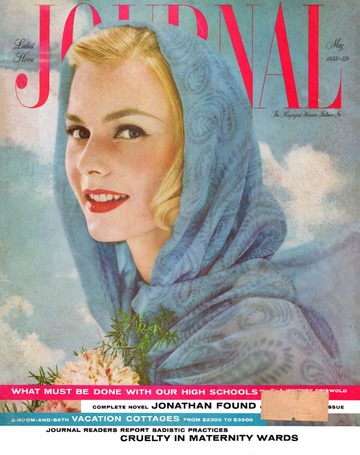
Ladies Home Journal May 1958, courtesy of Internet Archive

Just as liberal arts education for women mixed domestic and professional attitudes, media perceptions of women focused on both domesticity and professional achievement through individual success. Stories of women who had both a career and a family were popular in women’s magazines, including an article in a 1958 Ladies Home Journal article about Frances Olsen, a mother who entered medical school to become a doctor in an “act of sheer self-assertion” to both satisfy her love of medicine and take care of her family.[16] Similarly, a 1954 Coronet article described Sylvia F. Porter, a journalist who turned a small newspaper job into a thriving column, with enough “energy left over to manage her roles as a wife and mother, write popular books on investments and savings and edit a newsletter on government finance.”[17] In these articles and others, professional achieving outside domesticity was even the primary focus, with most praise given to a woman’s career and her domestic life as an added benefit.[18]
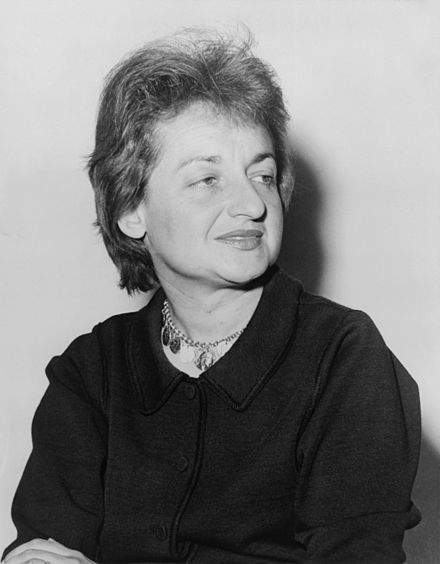
Betty Friedan in 1960, courtesy of Wikipedia

This celebration of a woman’s public and professional success lay in stark contrast to the opinions of many other middle-class women. In her 1963 The Feminine Mystique book Second wave feminists like Betty Friedan held a different view of women’s opporuntites in her 1963 book , with Friedan detailing women’s discontent with their lives as homemakers, as well as the pressures they felt from education and the media to settle down and not pursue careers.[19] Friedan was not a lone voice either, as a 1962 Gallup poll stated that around 90 percent of housewives expressed dissatisfaction with their life, wanting their daughters to be better educated and settle down later.[20] While perhaps in the minority, as Brand’s account of women’s reactions to Friedan concurs with description, Leighton disagreed with Friedan’s methods, echoing the individual achievement applauded in women’s magazines, as Leighton recalls about this dissatisfaction, “If you’re not that happy with it, go to school, take classes, and learn, you know…. Some women were rather too loud about their positions in life.  And my thought was, well, go and do something about it. Don’t broadcast it all the time.”[21]

Middle-class women experienced a mix of both increased and limited opportunities for education and careers, adding complexity to Brand’s description of women’s overall career limitations. While women’s participation in higher education and the workforce grew over the decades, expectations of women as homemakers restricted their career options and changed collegiate curriculums to emphasize domestic livelihood. Magazines also brought focus to women who managed both successful careers and domestic lives. The stories of women like Barbara Leighton elucidate these complexities, with Leighton’s view of dissatisfied women like Friedan as complaining instead of solving their problem providing a distinct perspective in relation to Brand’s account of Second Wave feminism. The gradual but substantial changes in education and career, as well as evolving attitudes towards domesticity that middle class women saw in the 1950s and 1960s, lay the foundation for understanding the greater changes in access and opportunity for women in the following decades.

[1] Audio Interview with Barbara Leighton, Pikesville, MD, November 25, 2023

[2] Audio Interview with Barbara Leighton, Pikesville, MD, November 24, 2023.

[3] H.W. Brands, American Dreams: The United States Since 1945 (New York: Penguin Books, 2010), 80.

[4] Stacey Jones, “Dynamic Social Norms and the Unexpected Transformation of Women’s Higher Education, 1965–1975.” Social Science History 33, no. 3 (2009): 261.

[5] Jones, 260.

[6] Jones, 265.

[7] Apesoa-Varano, Ester C., and Charles S. Varano. “Nurses and Labor Activism in the United States: The Role of Class, Gender, and Ideology.” Social Justice 31, no. 3 (97) (2004): 87.

[8] Audio Interview with Barbara Leighton, Pikesville, MD, November 25, 2023.

[9] Jones, 262.

[10] Audio Interview with Barbara Leighton, Pikesville, MD, November 25, 2023.

[11] Jones, 263.

[12] Linda Eisenmann, “A Time of Quiet Activism: Research, Practice, and Policy in American Women’s Higher Education, 1945-1965.” History of Education Quarterly 45, no. 1 (2005): 10-11.

[13] Jean Wells, “Women’s Job Prospects.” American Association of University Women Journal 58, (1964): 23, quoted in Stacey Jones, “Dynamic Social Norms and the Unexpected Transformation of Women’s Higher Education, 1965–1975.” Social Science History 33, no. 3 (2009): 263.

[14] National Manpower Council, Womanpower, 1957, in Stacey Jones, “Dynamic Social Norms and the Unexpected Transformation of Women’s Higher Education, 1965–1975.” Social Science History 33, no. 3 (2009): 263.

[15] Audio Interview with Barbara Leighton, Pikesville, MD, November 24, 2023.

[16] Neal Gilkyson Stuart, “Mother Is a Doctor Now!” Ladies Home Journal, 75 (May 1958), 136.

[17] Jana Guerrier, “Wall Street Woman,” Coronet, 35 (Jan. 1954), 26.

[18] Joanne Meyerowitz, “Beyond the Feminine Mystique: A Reassessment of Postwar Mass Culture, 1946- 1958.” The Journal of American History 79, no. 4 (1993): 1460–1461.

[19] Meyerowitz, 1455.

[20] Jones, 265.

[21] Audio Interview with Barbara Leighton, Pikesville, MD, November 24, 2023.

Appendix

“The [middle-class] workers were mostly men, except for the secretaries in the offices, and their wives typically did not work outside the home.” (H.W. Brands, American Dreams, p. 80)

Interview Subject

Barbara Leighton, age 88, is a former nurse who got her license in 1957 from Syracuse and worked in a variety of hospitals along the East Coast before settling in New Hampshire with her family in the mid 1960s. She took a break from nursing to raise her children but then returned to work full-time in the 1970s and retired in 2013.

Interviews

– Audio recording, Pikesville, MD, November 24 2023

– Audio recording, Pikesville, MD, November 25 2023

Selected Transcript

11/24/23

Q: At that time, I believe it was when a lot of medical procedures were just at their inception, such as open heart surgery. Because of  procedures like that, was that what drew you in to like these kind of workplaces, like that opportunity to be a part of something?

A: Yes, very definitely…. We worked at Miami Dade Memorial Hospital. And then I did private duty and got into open heart surgery with one surgeon. And  I worked very hard. And it was brand new.  And, luckily, the surgeon seemed to like what I did, so he asked for me constantly. So I had a really, really good experience there. Nicely enough, he asked me to go to New York with him when he went to Mount Sinai as head of cardiac surgery. However, I got married instead. But the experience was wonderful. 

Q: In the 60s there was this like growing support for the Equal Rights Amendment, and Betty Friedan published The Feminine Mystique in 1963, which talked about the dissatisfaction some women felt in their lives as just mothers and homemakers. Did you disagree with this perspective?

A: Probably, Matthew, I can’t pinpoint it at this point. I had a career. I was quite happy with it. I  still pursued it off and on.  And, we did have a you know, a group of friends that they had been to college but hadn’t, hadn’t pursued a career very truthfully. There were some that did not go to college. And, yes, I remember the feminine mystique.  I don’t know that I identified with it very truthfully. Maybe because I had a profession. I knew I could go back to it if I had to. I could support my children if I had to.  And I liked being a homemaker. So, but I also knew that I, you know, I was a good nurse. I could go back to it. So I can’t say that I, you know, I associated with a lot of people that were dissatisfied, a lot of females that were dissatisfied.  Or if they were, I didn’t recognize it because I wasn’t.

Q: Um, did you feel that was like, true in like the media and like what you read? Like,  did you read a lot about women just being viewed as like homemakers and like, uh, caregivers and mothers?

A: Yeah, I read about it and I guess very truthfully I would think well, you know, if you feel this way, go back to school  get a profession or do something about it. Maybe that’s because I had a profession and I was very proud of it and I knew I could go back to it if I had to. But, you know, some, some of it, you know, was a little more whiny than I thought was necessary,  truthfully.  And, sometimes, you know, as this movement continued, there were too many people that I think chimed in and didn’t know what they were talking about half the time. 

Q: Could you, explain more about that?  Like, what do you mean by, like, people who think you didn’t know much about it?

A: Well, there seemed to be a lot of, you know, all I do is take care of my children and wash the dishes and make dinner and stuff like that. And, yeah, if we were housewives, we all did it. And I guess also I was of the generation that, yes, that’s also what you did.  But if you’re not that happy with it, take, you know, go to school, take classes,  learn, you know, you don’t have to get a degree or something, but stimulate your mind. You can, read.  I’m an inveterate reader, as you well know.

Q: You recently mentioned that, like, you know, at the time there weren’t that many career options for women. Did you find a problem with that? Or, did you not, like, think about that at all?

A: It was, I guess you could say common knowledge and that, you know, you could be a secretary, you could be a teacher, meaning women. You could be an airline stewardess. You could be a nurse. And, you know, that was about it. And, I guess I didn’t think too much about it one way or the other because, I had my goal, if I was inviolate, I had to be a nurse. And if the other people wanted to do something else, that was fine. But,  that was basically what, more or less what, uh, at that time, there were not that many options that we knew about, I guess you could put it that way. As there are today, there’s so many more.  That was not the rule at that point. It was starting. I worked with some female doctors, not many, not many at all.

11/25/23

Q: You’ve mentioned that all of these nurses were women. So at Syracuse,  were there a lot of like female students at that time and like people going into the nursing?  Or was it pretty limited?

A: It was quite limited. I think there were like 30 students in my class. And we started out with like 50 odd  in our, in our freshman year. And a number of them obviously dropped out. 

Q: I’ve been doing some research on women’s magazines, like from the fifties and sixties that often highlight women who were both successful mothers and, like, in their careers. Did you, like, read any of those stories or, like, see anything on the TV that you identified with in that sense?

A: Oh, yes. Yeah, it was very popular, you know, whatever I did.  And, good for them. I did not, you know, I did not feel cheated or left out or something like that. Interestingly enough, I also had enough friends who liked my nursing expertise. Let’s put it that way. And, that kept me busy too. But other than that, no, I read the magazines. I did understand.  That, frankly I felt, you know, there were times when I read it and I thought, well, I really should go back. You know I’m a good nurse. I know what I should be doing. But between marriage and the children, I didn’t. 

Further Research

Apesoa-Varano, Ester C., and Charles S. Varano. “Nurses and Labor Activism in the United States: The Role of Class, Gender, and Ideology.” Social Justice 31, no. 3 (97) (2004): 77–104. http://www.jstor.org/stable/29768259. [JSTOR]

Linda Eisenmann, “A Time of Quiet Activism: Research, Practice, and Policy in American Women’s Higher Education, 1945-1965.” History of Education Quarterly 45, no. 1 (2005): vi–17. http://www.jstor.org/stable/20461921. [JSTOR]

Joanne Meyerowitz, “Beyond the Feminine Mystique: A Reassessment of Postwar Mass Culture, 1946- 1958.” The Journal of American History 79, no. 4 (1993): 1455–82. https://doi.org/10.2307/2080212. [JSTOR]

Stacey Jones, “Dynamic Social Norms and the Unexpected Transformation of Women’s Higher Education, 1965–1975.” Social Science History 33, no. 3 (2009): 247–91. http://www.jstor.org/stable/40268002. [JSTOR]

Neal Gilkyson Stuart, “Mother Is a Doctor Now!” Ladies Home Journal, 75 (May 1958), 136-137. https://archive.org/details/ladies-home-journal-v-075-n-05-1958-05/page/136/mode/2up. [Internet Archive]

Jana Guerrier, “Wall Street Woman,” Coronet, 35 (Jan. 1954), 26-29. https://archive.org/details/sim_coronet_1954-01_35_3_0/page/26/mode/2up. [Internet Archive]
John F. Kennedy and Physical Fitness

By Jenna Deep

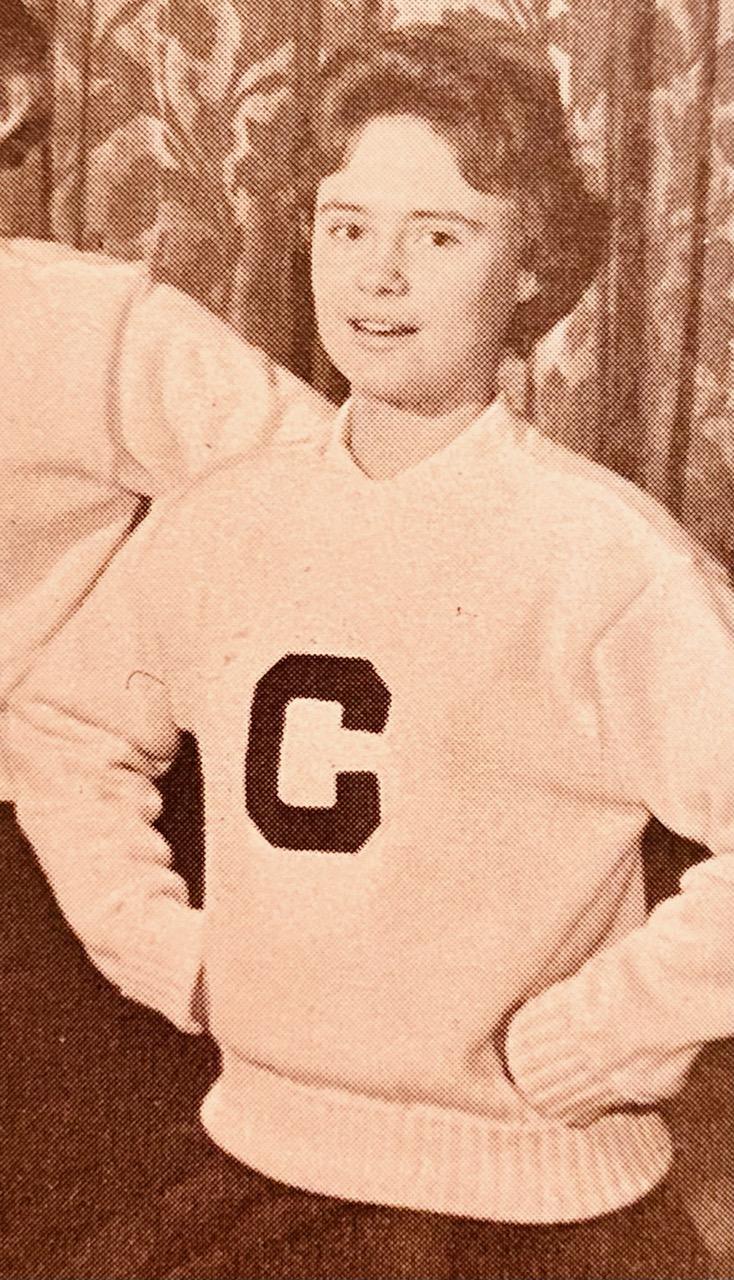
“Ask not what your country can do for you, ask what you can do for your country.”[1] These words from President John F. Kennedy’s 1961 inaugural address captured the attention of the nation. One person who was captivated by this was a twelve-year-old girl in Clinton, New York, Barbara-Jo Deep. Watching the inauguration on television, those words “made the biggest impression. It started making me feel empowered.”[2] Kennedy’s sway of the American people helped to drive national programs and policies, especially his stress on individual contribution to make America greater. “He always seemed to ask for our help,” Deep recalls. “He always said “I need your help, we need to be strong, I believe the country is strong, but we can be stronger.”[3] This made Deep feel a strong sense of patriotism and duty towards her country.

Barbara-Jo Deep circa 1961

Barbara-Jo Deep circa 1961
Courtesy of Barbara-Jo Deep

While historian H.W. Brands does a reasonably good job describing Kennedy’s election, policies, and influence in American Dreams, he does not discuss President Kennedy’s emphasis on personal fitness. Kennedy’s fitness program is an excellent case study that demonstrates the intersection of his policies and influence that impacted the lives of everyday Americans. The fitness program also offers insights into the state of the American government during the Cold War, particularly the looming fear of a physical war with the Soviet Union. As a young girl in Clinton, New York, Barbara-Jo Deep recalls the way that the president’s advocacy of personal fitness influenced her and her community in ways that Brands is unable to document in American Dreams.

When John F. Kennedy began his presidential campaign in 1960, he quickly captured the nation’s attention as “the vigorous exemplar of the new generation.”[4] The rise of television in particular helped contribute to this. In the first televised debate in American history, Kennedy was able to make his opponent Richard Nixon appear “harried and worn.”[5] Kennedy’s collected appearance on television was a major factor in terms of his public perception both before and after the election. After his election, Kennedy’s charm and use of media continued to influence the American people. Deep recalls that the press and reporters were “very complimentary to the president and his family,” which enabled Kennedy to promote his ideas to Americans.[6]

One of the most impactful ways JFK influenced teens like Deep during his term was the use of his fitness program. Though Kennedy can be credited with the popularization of fitness, presidential concern over the physical well-being of Americans began with President Eisenhower. A 1955 report found that 57.9% of American children failed at least one category in the Kraus-Weber fitness test as opposed to just 8.7% of European youths.[7] This caused a panic within the executive branch that Americans were growing weak or ‘soft’, leading to the president calling a council regarding youth fitness in 1955. Eisenhower feared that in the case of a hot war with the Soviet Union, American would be physically unfit to fight, which led to the establishment of the President’s Council on Youth Fitness (PCYF) in 1956.[8] However, PCYF was not very effective. The US government had no power to mandate or implement fitness policies into American schools or youth life, and therefore very little change was made.[9] Kennedy was able to use media outreach to encourage Americans to buy in to the suggested fitness program. In this way, he was able to succeed where Eisenhower failed.

Kennedy began promoting this program while president-elect. On December 26, 1960, an article he wrote was published in Sports Illustrated. Titled “The Soft American,” it warned of the decreasing fitness of the American youth, and the dangers it could pose to society. He cites the same fears that Eisenhower had, that in a war with the Soviet Union, unfit Americans would be unable to fight them.[10] However, Kennedy had a different approach in reaching the American people than Eisenhower had, by turning fitness into a patriotic gesture. He published this article in a popular magazine that was readily consumed by the masses and shared with the nation how disastrous unfitness could be for national security. Kennedy wrote “the physical well-being of the citizen is an important foundation for the vigor and vitality of all the activities of the nation,” and encouraged individuals to improve their fitness to improve the country.[11] In this article, he outlines administrative goals for American fitness, but specifically acknowledges that the government cannot impose itself on Americans to enforce such goals. While the government could not force people to exercise, “we can fully restore the physical soundness of our nation only if every American is willing to assume responsibility for his own fitness and the fitness of his children.”[12] This individualized fitness and transformed it into a patriotic statement rather than just another government policy.

Kennedy strengthened his suggestions by portraying them as a means of preserving the free state of the American people by implicitly juxtaposing it to the Soviet Union. “We do not live in a regimented society where men are forced to live their lives in the interest of the state.”[13] By contrasting the United States to the Soviet Union’s totalitarianism, he was able to capture the fear of a communist state but also individualized the prevention of its actualization to amplify his call to action. “He specifically said that a strong and great country needs strong healthy people,” says Deep, “he really felt that you needed to take care of your health, he really stressed that you needed to be healthy and active and strong.”[14]

Once he assumed full presidential duties in 1961, Kennedy quickly rebranded the PCYF to the President’s Council on Physical Fitness (PCPF), which used more covert strategies to encourage American fitness. “The council hired Oklahoma football coach Bud Wilkinson as their first celebrity spokesman” for both his prestige and prior rhetoric on the importance of American fitness on the global stage.[15] Kennedy also struck a deal with ABC news to have free airtime to promote fitness, and used marketing tactics directed at children to grab their attention. Not only was Wilkenson used to promote fitness, but astronauts and other celebrities, including Kennedy himself, starred in ads and even a promotional film about the importance of fitness.[16] New technologies like personal televisions and accessible movie theaters enabled the widespread advertising of Kennedy’s program that helped make it so popular.

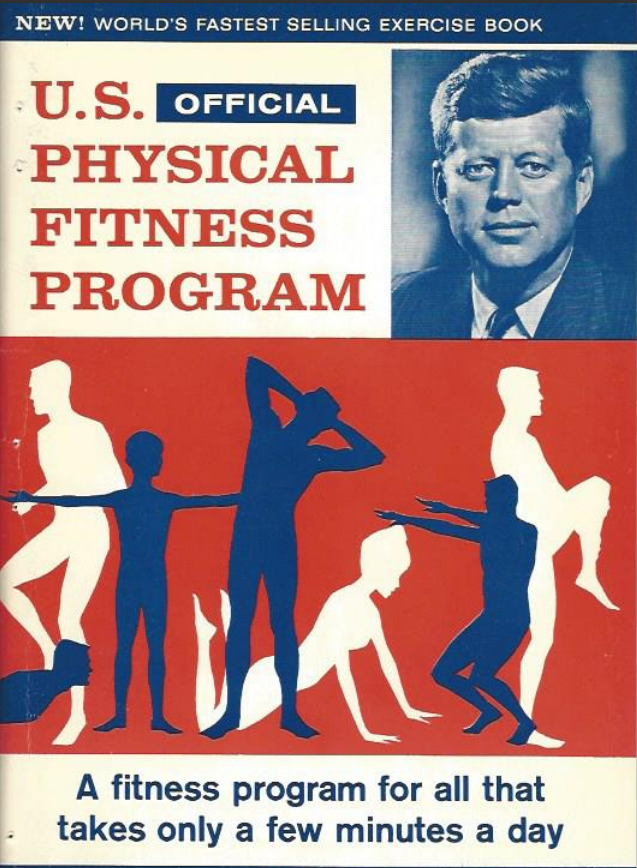
Red white and blue fitness pamphlet with a photo of JFK on the front to detail and demonstrate exercises to keep Americans fit.

PCPF fitness booklet
Courtesy of jfklibrary.org

Deep recalls that the Kennedy administration encouraged physical fitness in American youth through schools. Although the federal government could not mandate that schools use their fitness program, schools were encouraged to buy into it. “The Council… strongly encourages every school to adopt the basic philosophy of Wilkinson’s program” but made it clear that such an adoption was a choice.[17] The government sold blue books to schools that detailed exercises and recommendations for improving fitness. Deep’s school, Clinton High School, opted to use these books in Phys. Ed. class. “There was a little blurb in the front that said it was sponsored by President Kennedy,” she remembers. “I know that I spent a lot of time looking through it and figuring out the exercises in it and doing them, because he said that we need to be strong and healthy to be a strong country.”[18] According to Deep, the exercises mostly focused on bodyweight movements and calisthenics rather than things like weightlifting. These strategies were effective in encouraging school engagement with the presidential fitness program. Before the PCPF, “fewer than 18 million school children had participated in physical education… while about 27 million had by 1964,” and a majority of these students had P.E. at least three times a week.[19] Some states even codified P.E. requirements into their state education systems, demonstrating the effectiveness of using schools to promote American fitness. In addition to this, “half again as many students passed a physical fitness test” in 1962, one year after implementing the Kennedy fitness program.[20]

Another way the Kennedy administration went about encouraging fitness was the promotion of a fifty-mile hike. While Kennedy himself never engaged in such a hike, he challenged his press secretary, Pierre Salinger, to complete it. This became a bit of banter used in public, which Salinger declined each time, but brought attention to the initiative. In early 1963, Salinger “ finally released a statement… in which he publicly declined the honor.”[21] Famously, Kennedy’s brother and Attorney General Robert Kennedy completed the hike in the snow in loafers to demonstrate that the hike was nothing to shy away from. Although the administration did not largely engage in this hike, “the real impact of the fifty-mile hike was with the public at large” and many Americans felt encouraged to attempt it due to these efforts.[22]

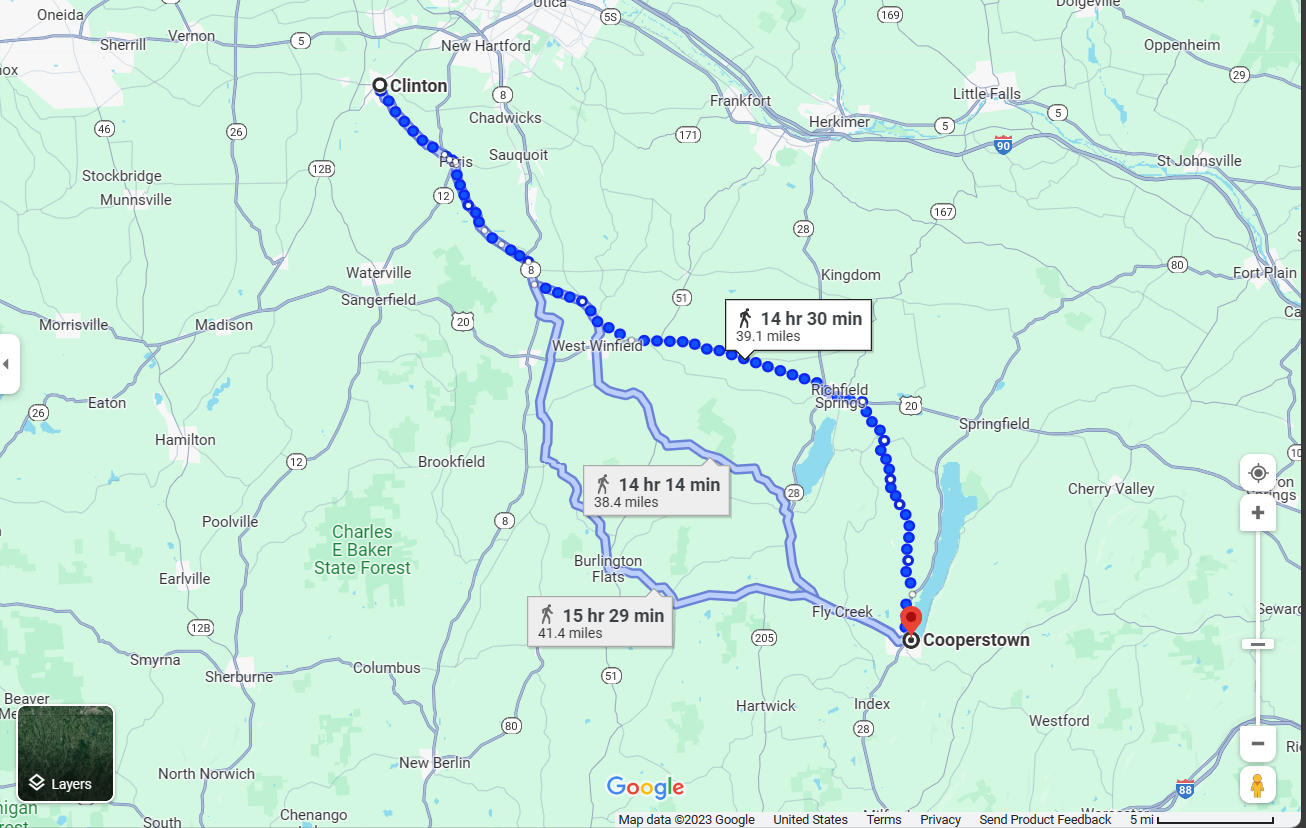
Google Maps route of a similar path to what the boys would have taken from Clinton to Cooperstown

Route from Clinton to Cooperstown
Courtesy of Google Maps

The high schoolers in Clinton viewed this hike to be an admirable expression of patriotism. In the fall of 1961, a group of boys including Deep’s brother, cousins, and boyfriend all decided they would go on their own ‘Kennedy March.’ Around twelve boys total partook in the walk, and they ranged from fifteen to eighteen years old. “They were all juniors or seniors in high school,” and many of them had just wrapped up football season, “so they were pretty well conditioned, but not conditioned to walk fifty miles.”[23] Their route was from the Clinton town center to Cooperstown.  “It was pretty much a last-minute thing.”, Deep remembers. “They didn’t really train for walking that far…within a day it just came upon them… so they all got together a day or two later in the morning” to begin their walk.[24]

Deep went with her parents to drop off her brother in front of the newspaper office. The boys began their walk early in the morning and it took them “in the range of like 9-11 hours. It depended on whether you were in the front of the pack or, you know, further behind.”[25] Deep and her parents also drove out to Cooperstown to watch the boys finish their hike and give them a ride back home. They came upon them a few miles away from Cooperstown, and Deep’s boyfriend did not want to continue walking. “He was beat, I was literally pushing him physically the last 2 miles,” Deep recalls, laughing. “I kinda got in on the walk, but only the last couple of miles from the end, but I felt like I was a part of that because of doing that.”[26] Although she did not do the whole hike, she still feels an immense amount of pride that she was able to help someone else complete the Kennedy March.  Deep wishes that a group of girls had also done the hike, but “I don’t even remember think that we should do it as girls, I guess that was just the mindset back then, where nowadays I think that would be totally different.”[27] Had the hike taken place in the modern day, “we probably would have walked together, not separated male/female, and girls definitely would do it.”[28]

On the ride back to Clinton, “They were all just so beat. riding back in the car took a little over an hour, their muscles kinda seized up.”[29] While waiting outside the paper office, one of the writers found out what the boys were planning to do and ended up running a story on them later on. “When the community found out about it, they were all definitely getting, you know, pats on the back when their names were in the paper.”[30] When they went to school on Monday, they were “heroes for at least a day or a week. You know, wow, they actually listened to our president, they went out and they did it, hooray?! It was definitely, everybody was just so happy about it and praised them.”[31] While this route ended up being closer to forty miles than fifty, the principle behind the march was still the same. “The President had inspired them!”[32]

While the intent of American Dreams is to provide the reader a firm foundation of historiography and context from 1945 onward, this means that lesser-known events are often left out of the book. Brands’s book is an important resource to use to develop a broad understanding of historical context before diving into small-scale or personal accounts of history. Brands makes it clear that the Kennedy administration was able to use new media combined with the influential nature of the president to sway the public. However, Deep’s account brings the idea of Kennedy’s influence to life with her vivid recollection of him and his promotion of fitness. By describing what the actual implementation of school fitness guidelines looked like, as well as her own reaction to them, she is able to showcase the individual impact Kennedy had on her. By describing the hike her classmates went on, Deep is able to demonstrate that other people were inspired and influenced by Kennedy’s words as well. She describes the general atmosphere around such fitness initiatives as patriotic, or inspiring. A purely academic text may not be able to address the human emotion in the same way as an oral history. While Brands may not be able to incorporate personal accounts into his book for clarity and conciseness, personal accounts are an important supplementary resource to demonstrate the real life impact of the events detailed in his book.


[1] “Inaugural Address.” JFK Library. [WEB].

[2] Email interview with Barbara-Jo Deep, Clinton NY, November 13, 2023.

[3] Interview with Barbara-Jo Deep, Clinton NY, November 24, 2023.

[4] H.W. Brands, American Dreams: The United States Since 1945 ( Penguin Books, 2010), 103.

[5] Brands, American Dreams, 103.

[6] Interview with Barbara-Jo Deep, Clinton NY, November 24, 2023.

[7] Matthew T. Bower and Thomas M. Hunt “The President’s Council on Physical Fitness and the Systematisation of Children’s Play in America”, International Journal of the History of Sport, Vol. 28, No. 11, (August 2011): 1497. DOI: 10.1080/09523367.2011.586789.1497 [EBSCO].

[8] Bower and Hunt, “The President’s Council on Physical Fitness and the Systematisation of Children’s Play in America”, [EBSCO] 1499.

[9] “The Federal Government Takes on Physical Fitness.” JFK Library. [WEB].

[10] John F. Kennedy,  “The Soft American,” Sports Illustrated Magazine, December 26, 1960. [WEB], 2.

[11] Kennedy,  “The Soft American,” [WEB] 1.

[12] Kennedy,  “The Soft American,” [WEB]4.

[13] Kennedy,  “The Soft American,” [WEB] 4.

[14] Interview with Barbara-Jo Deep, Clinton NY, November 24, 2023.

[15] Rachel Louise Moran, Governing Bodies: Americcan Politics and the Shaping of the Modern Physique, (University of Pennsylvania Press, 2018), [JSTOR] 100.

[16] Moran, Governing Bodies [JSTOR] 100.

[17] Moran, Governing Bodies [JSTOR] 103.

[18] Interview with Barbara-Jo Deep, Clinton NY, November 24, 2023.

[19] Moran, Governing Bodies, [JSTOR] 104.

[20] “The Federal Government Takes on Physical Fitness,” [WEB].

[21] “The Federal Government Takes on Physical Fitness,” [WEB].

[22] “The Federal Government Takes on Physical Fitness,” [WEB].

[23] Interview with Barbara-Jo Deep, Clinton NY, November 24, 2023.

[24] Interview with Barbara-Jo Deep, Clinton NY, November 24, 2023.

[25] Interview with Barbara-Jo Deep, Clinton NY, November 24, 2023.

[26] Interview with Barbara-Jo Deep, Clinton NY, November 24, 2023.

[27] Interview with Barbara-Jo Deep, Clinton NY, November 24, 2023.

[28] Interview with Barbara-Jo Deep, Clinton NY, November 24, 2023.

[29] Interview with Barbara-Jo Deep, Clinton NY, November 24, 2023.

[30] Interview with Barbara-Jo Deep, Clinton NY, November 24, 2023.

[31] Interview with Barbara-Jo Deep, Clinton NY, November 24, 2023.

[32] Email Interview with Barbara-Jo Deep, Clinton NY, November 13, 2023.


Further Reading:

Bowers, Matthew T. and Thomas M. Hunt. “The President’s Council on Physical Fitness and the Systematisation of Children’s Play in America”, International Journal of the History of Sport Vol. 28, No. 11, (August 2011): 1496-1511. DOI: 10.1080/09523367.2011.586789.

Brands, H.W. American Dreams: The United States Since 1945. Penguin Books, 2010. Chapter 5.

JFK Library. “Inaugural Address.” Inaugural Address | JFK Library

JFK Library. “The Federal Government Takes on Physical Fitness.” The Federal Government Takes on Physical Fitness | JFK Library.

Jenkinson, Clay S. “John F. Kennedy and Theodore Roosevelt: Parallels and Common Ground, including North Dakota”. North Dakota History 78, no.3-4 (2013): 2-18. JFK Library.

Kennedy, John F. “The Soft American” Sports Illustrated Magazine, December 26, 1960. The Soft American : Free Download, Borrow, and Streaming : Internet Archive

Moran, Rachel Louise. Governing Bodies: American Politics and the Shaping of the Modern Physique Selling Postwar Fitness: Advertising, Education, and the Presidents Council. University of Pennsylvania Press, 2018. https://www.jstor.org/stable/j.ctv16t67w9.7.


Appendix

“Kennedy’s style charmed the Democratic convention and it charmed the country after he landed the nomination”

H.W. Brands, American Dreams: The United States Since 1945. New York: Penguin Books, 2010, 102.

Interview Subject:

Barbara-Jo Deep, age 74, was a young teen during the Kennedy administration, and recalls the powerful effect Kennedy had on the American public.

EMAIL INTERVIEW SELECTED TRANSCRIPT: November 13, 2023

Q: How old were you during the Kennedy campaign? How old were you when he was assassinated?

A: 12,15. I do remember I had to do a school project in a scrap book with the topic of the Presidential campaigns: Kennedy vs. Nixon.

Q: Did you have an idea of who you/your family supported during the Kennedy-Nixon election?

A: family supported Kennedy

Q:What was the popular climate in Clinton around the election? Did it seem that more people supported Kennedy?

A: At the time Clinton was very Republican. But at School the young people I knew supported Kennedy, but I believe adults supported Nixon.

Q: Were you able to watch the televised debates? If so, do you remember who you thought did a better job? What did people around you think?

A: I watched the debates and I thought Kennedy did better. More poised, relaxed but engaged, Seemed like he was for the “ little guy”, not the elite. I remember pundits reporting that Nixon was sweating. That was a negative. Kennedy seemed more personable. My friends at school liked Kennedy. I don’t know about adults except my parents. They liked Kennedy. I did too.

Q: What was the most impactful statement that Kennedy made and how did it impact your perspective?

A: “Ask not what your country can do for you;ask what you can do for your country “. That made the biggest impression. Started me feeling empowered and not looking to the government to “take care” of me.

Q: Tell me about the walk that your brothers and Gido (Grandpa) went on after Kennedy discusses fitness standards for Americans.

A: The President stressed physical fitness. We were given ( in school) nice little books of exercises as a guide. President Kennedy encouraged walking and hiking and kind of challenged people to strive for 50 mile hikes. My brother and friends, including my cousin and my then boyfriend ( Giddo) decided to do a 50 mile hike from Clinton to Cooperstown. It was pretty much a last minute thing. They hiked and I went with my parents by car to see them walk into Cooperstown. I think the local newspaper was reporting on it. They were about 5 miles from Cooperstown when we came upon them. Your grandfather was exhausted and I thought he couldn’t finish. I got out of the car and literally pushed him from behind for the last mile! They were so sore because they didn’t train for it. But the President had inspired them! It gave them a great deal of prestige at school on Monday. I think we all felt very inspired to challenge ourselves to be better for the sake of our country.

Q: What do you remember about the Kennedy assassination/learning that the president had been shot?

A: I was sitting in the next to the last set of desks ( near the windows) with my friend Patty to my left. It was English class with Miss Jacobs, a middle aged, short dramatic type of teacher. I can see it like it was yesterday . Someone ( a school secretary) knocked on the door and quietly said something to Miss Jacobs. She ( Miss Jacobs ) put her hands up top of her  head and spun around in circles. Patty and I looked at each other and laughed because she looked so frazzled and funny. Then she told the class dramatically and overly emotionally “ president Kennedy has been shot!”. She kept spinning and we did stop laughing  in a second or two. I don’t remember what exactly happened for the next 5-10 minutes. I know we didn’t resume our lessons. So about  10 minutes later there was another knock on the door and whispering to Miss Jacobs. She exclaimed as if in pain “ The President is Dead!” She paced about the front of the room. She was crying. We were all silent. For some reason I remember at dismissal everyone was quiet, not noisy as usual, and there was a boy in the hall near the auditorium with a pack of cigarettes in his front white T  shirt pocket. I don’t know why that stuck in my mind, but he was an upper classman and was normally boisterous.

Q: What other information do you think I should have about this time period/administration that I haven’t asked about that you think I should know?

A: The newspapers and TV were very complimentary to The President and his family. We saw images of him with his wife and children. He had a great smile and looked as though he was a wonderful family man. Jackie Kennedy was seen as a role model, and a very intelligent, interesting person. She did defer to her husband when asked political questions. Something like “ I am in favor of whatever my husband is”. She did a live tour of the Whitehouse on TV and was poised and knew a great deal about the history of the Whitehouse. She said it had been worn and shabby, and needed restoration. She wanted to treat it with honor and respect.


I remember hearing President Kennedy commit to sending a man to the moon in the next decade. I remember him saying something like (paraphrasing) “we choose to do these things not because they are easy—-but because they are hard.” It made me believe as Americans we can do wondrous things. That made me feel confident. There is certainly other stuff about that time period. I’ll think about it.

IN-PERSON INTERVIEW SELECTED TRANSCRIPT: November 24, 2023

Q: How did you feel watching JFK speak?

A: Well, he always seemed to ask for our help. He didn’t, like, always say how great he was, I don’t even know if I ever heard him say things about himself, he always said “I need your help, we need to be strong, I believe the country is strong, but we can be stronger, I believe we’re great, but we could be greater,” he never was negative, he was always very positive, and that’s what I remember about him, and of course, his Boston accent too.

Q: Did you feel uplifted or optimistic about the future of the country? Did his speeches increase your patriotism?

A: Oh absolutely. It was really a time of patriotism because he was calling us together to make the country greater. He wasn’t saying “I’m gonna do this or I’m gonna do that, he said I need you to do this, or I need you to do that”, and it made us feel like we could actually do something about the country. He didn’t disparage the country but he said we can make it better and we can do things, we needed to be stronger and , yes, he gave us a lot of patriotism and a lot of very optimistic feelings. He never bragged about us like we were better than any other country, he just said, you know, together we can make the country even better than it is right now.

Q: So you said that your mother and father supported Kennedy. Did they ever talk to you about why they liked him, or anything like that?

A: Well, I don’t recall a lot of it, but I remember that, for example, when I was about that age or a little younger, my dad was working 2 jobs because we didn’t really, have any kind of financial backing, when they got married they started from scratch, and they had 5 kids, so they felt that Kennedy was for the working man, and really, for the working MAN, because women didn’t really work a lot back then. My mom was a stay at home mom, not that Kennedy discouraged women from seeking work and being active, and getting an education, I mean, he really pushed education, but my parents really, especially my mom was interested in his ideas on education, and my dad liked that he was really, you know, for the working man. He wasn’t really elite. Where we lived was a pretty elite town, and at that point in time, the town was very Republican, and at that time the Republicans were more for the elite and the Democrats more for the working class, and my family was working class.

Q: So your parents were Democrats?

A: Absolutely Democrats. But they did feel that they were discriminated against in the community, because it was so Republican, it wasn’t something that they talked about, you know, in groups, because in this town if you weren’t Republican, people get opposed to you. So it was yes they’re Democrats, but you don’t kinda talk about that with others.

Q: Even though Clinton was primarily Republican, do you know if people crossed party lines in support of Kennedy?

A: I wouldn’t really know, but my feeling from growing up here is that not many crossed the line. I mean, when Kennedy won, of course they backed him, but I don’t think they voted for him because at that time in this community, Republicans were just voting Republican. But again, when Kennedy was elected, it was pretty much treated positively.

Q:Do you remember why Kennedy was so big on physical fitness?

A: I’m not sure that he ever said why other than to make our country better, because a strong country means.. HE specifically said that a strong and great country needs strong healthy people, and he really felt that you needed to take care of your health, he really stressed that you needed to be you know, healthy and active and strong, and I remember getting little booklets from School about physical fitness, we got it in gym class, and it was called the Presidential Physical Fitness and it had diagrams and there was a little blurb in the front that it was sponsored by President Kennedy, and we were encouraged, and I know that I spent a lot of time looking through it and figuring out the exercises in it and doing them, because he said that we need to be strong and healthy to be a strong country.

Q: Those exercise books, were there standards related to sex and age corresponding to say, how many pushups you should be able to do?

A: It wasn’t standards, it was just do the exercises, and if you did it, youd be good, it didn’t really tell us to do X amount of whatever, it would suggest so many repetitions, but it didn’t set a standard. Instead of measuring yourself against others, you were competing against yourself.

Q: Do you remember any of the exercises that were depicted in the booklet?  Was it mostly muscle-building, cardio, flexibility, a combination?

A: It wasn’t cardio, it was mostly muscle building , and what we called calisthenics back then. I don’t remember any weight training, although I do remember being encouraged to do like pushups and chin-ups and things like that. And Kennedy specifically said that fit people without any infirmities should strive to walk for 50 miles, and that would prove, if you could do that , you were healthy. HE didn’t say to go out tomorrow with no training and do it, but he said that all young strong healthy people that don’t have a disability should try to be able to walk 50 miles.

Q: Did he or his admin talk about a healthy diet along with exercise?

A: I don’t remember anything about diet at that time. And remember, back then, there wasn’t a lot of processed foods, everything was pretty fresh My mother canned foods, and in fact, with the vegetable garden, everyone in the country grew vegetable gardens, and like potato chips, my mom would make her own by cutting up potatoes and frying them. You didn’t go to the store and get them with preservatives and stuff.

Q: What time of year did that group do the 50 mile march?

A: It was in I think 61, it was pretty early in the Kennedy administration. I wanna say it was in the fall, after football, because all but 1 of them or 2 that marched were all football players. So they were pretty well conditioned, but not conditioned to walk 50 miles.

Q: So it was in like late October, early November?

A: yeah, I’m pretty sure it was. The local paper wrote about it so you could find out exactly, but I’m just taking a guess about it. Because it wasn’t really hot and it wasn’t really cold, and school was in session.

Q:  How did the newspaper found out about this?

A: Well, we-I say we, I wasn’t actually walking, I just dropped my brother off, but they had assembled outside the Clinton Courier office at the time, by the post office, and they were probably in the office and saw them and wanted to know what they were doing. They were all boys by the way, because back then you didn’t really see girls and boys together except on social occasions, it wasn’t a social occasion, it was really a show of strength to say that “I’m gonna do what the president has challenged us to do!” For whatever reason, it was all boys, and they at the spur of the moment, it wasn’t planned, so they didn’t really train for walking that far, they basically within a day it just came upon them “lets do it”, so they all got together a day or two later in the morning and then after they did, the newspaper did run an article on them.

Q: Do you remember how long it took them?

A: It was over 8 hours for sure. They left early in the morning, and it was before daylight savings, so… I’m gonna say maybe 11 hours. Some did it faster than others. I think in the range of like 9-11 hours maybe? It depended on whether you were in the front of the pack or, you know, further behind.

Q: In that group, what was the age range of them?

A: They were all I think between 15 and 17. They were all like juniors or seniors in high school. I think there might have been an 18 year old in there too.

Q: How many people did you say did it?

A: Oh I would guess about 12 of them, I think.

Q: Did they see this as a more political or patriotic act?

A: Patriotic, definitely. Nothing political about it. When the community found out about it, they were all definitely getting, you know, pats on the back when their names were in the paper. It was definitely not political, it was a patriotic challenge. And the way Kennedy challenged you inspired you, made you want to do it!

Q: Within that praise, when they went to school the next day, was it mostly from peers, or teachers, or both?

A: Everybody, everybody. They were like heroes for at least a day or a week. You know, wow, they actually listened to our president, they went out and they did it, hooray, you know?! It was definitely, everybody was just so happy about it and praised them.

Q: Do you remember any specific times they were praised?

A: Seeing them Monday in school, you saw other people, like wow, going up and congratulating them. It was all word of mouth, there was no text or social media or anything, but the word spread. Some of them were just so beat too. Like my cousin, wore brand new blue jeans without washing them to hike, and back then, you know, they were stiff, cotton and thick. He had gotten so sore from the jeans rubbing, he could hardly walk from that, never mind the muscles! Their muscles, riding back in the car took a little over an hour, their muscles kinda seized up.

Q: What else do you want to tell me about fitness, or the 50 mile hike that I haven’t asked about yet?

A: I mean, I was there at the end, my brother and my boyfriend at the time were both doing it, and um, you know, my boyfriend didn’t want to continue the last couple miles, he was beat, and I was literally pushing him physically the last 2 miles, so I kinda got in on the walk, but only the last couple of miles from the end, but I felt like I was a part of that because of doing that. And I don’t know why a group of girls didn’t then decide to do it. Cause I was very athletic and did all kinds of sports, the girls were pretty fit. I don’t even remember think that we should do it as girls, I guess that was just the mindset back then, where nowadays I think that would be totally different. Now, we probably would have walked together, not separated male/female, and girls probably definitely would do it.

Q: Do you remember the exact start or end points of the hike?

A: I know they started by, there’s a parking lot, kind of in front of where the NBT bank is, on the north side of the village green, and I don’t remember where they ended, if it was the park in Cooperstown, or just the sign that said Cooperstown.

The Summer of Love?

The Summer of Love?

By Jack Hentschel

Berkeley protestors in 1965 (AP)


During a lunch break in the summer of 1967, a friend and coworker of Jack Hentschel suggested they visit his alma mater, the University of California, Berkeley. They left San Francisco’s Financial District and eventually arrived at the campus, where they made their way through a maze of card tables in front of Sproul Hall, protesting everything from the FBI to Christianity. Then they entered the friend’s former frat house. “There, in the lounge, at high noon, on a couch,” recalls Jack, “was a demonstration of what the Summer of Love was all about, as a couple of lovers were in the act of “how to do it,” without shame.” Though the lovers seemed to be having fun, Jack was not impressed.[1] Neither were many Americans in the summer of 1967—or, to the hippies of San Francisco, the “Summer of Love.” In the Haight-Ashbury neighborhood of the city, young people engaged in casual sex, listened to psychedelic rock, recited avant-garde poetry, preached peace and love, and consumed all kinds of drugs, all summer long. But soon enough, the drugs became pricey, the camaraderie caused overcrowding, and peace and love turned to violence as dealers gunned each other down in the street. H.W. Brands, in his book American Dreams: The United States Since 1945, writes that the Summer of Love “proved to be a letdown, as was probably inevitable.”[2] Thanks to his experience in the Bay Area throughout the Sixties and Seventies, Jack Hentschel would tend to agree. Though it began as a genuine movement of nonviolence and self-expression, the Summer of Love quickly deteriorated into the very thing it preached against. 

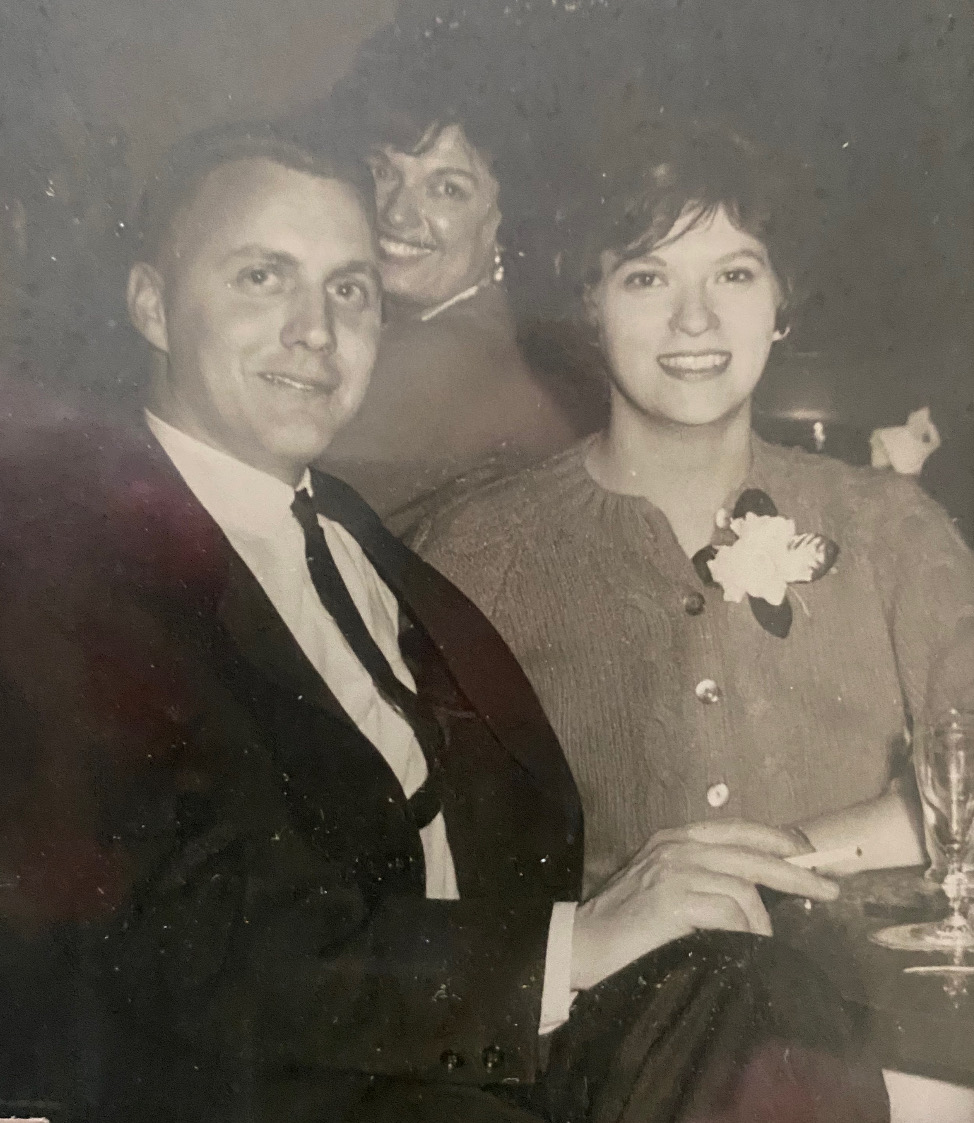
Jack and Mary Hentschel in 1962 (Mary Hentschel)

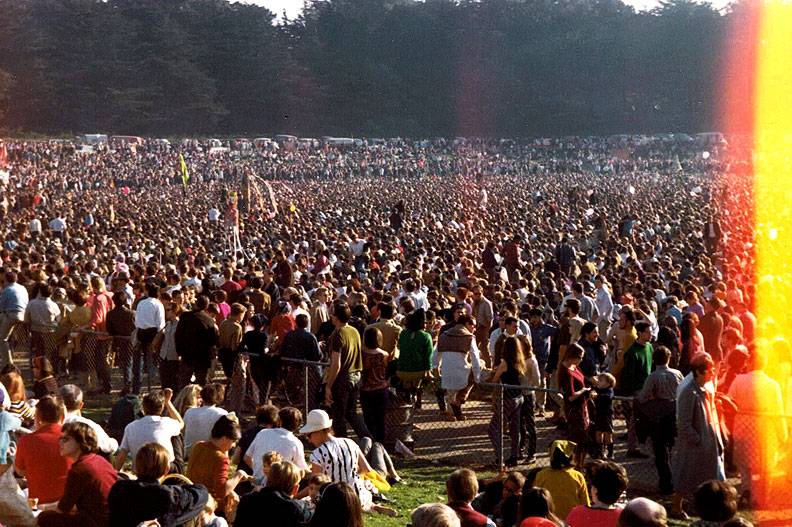
Jack Hentschel first moved to San Francisco in 1961. There, he met Mary Muldoon, and during the couple’s brief stay back east, she became Mary Hentschel. In 1964, the Hentschels returned to the city with a baby boy. They bought a house in the suburb of Walnut Creek the following year, and another boy followed the year after that. Jack lived in the Bay Area and worked in San Francisco’s Financial District until 1979, when he and his family moved again to his home state of Connecticut. He saw the rise and fall of the hippies at their nexus.[3] When exactly they began to rise, though, is hard to determine. Jeremy Guida, in his article “The Summer of Love Wasn’t All Peace and Hippies,” claims that the idea of a hippie was “defined by the media more than anything else.”[4] The hippies evolved from a related, yet distinct group in San Francisco called the beatniks, who protested the social conformity of postwar America. Hippies originally consisted of artistic, younger adults more politically minded than the beatniks—and more interested in drugs and rock and roll.[5] Even in its early years, the subculture was not relegated to San Francisco—it popped up in parts of New York, Chicago, and Seattle—but that is where it flourished, especially in the Haight-Ashbury neighborhood. Integral to its development was the January 1967 “Human Be-In” in Golden Gate Park, a combination of peace rally, music festival, and poetry recitation.[6] Thanks to the success of the event, the hippies declared the summer of 1967 to be the “Summer of Love.” When fall rolled around, the parks grew chilly, and the school-aged hippies returned to their studies. The subculture would continue to thrive in certain pockets of the country for the remainder of the decade, but it never again reached the heights of the summer of 1967. 

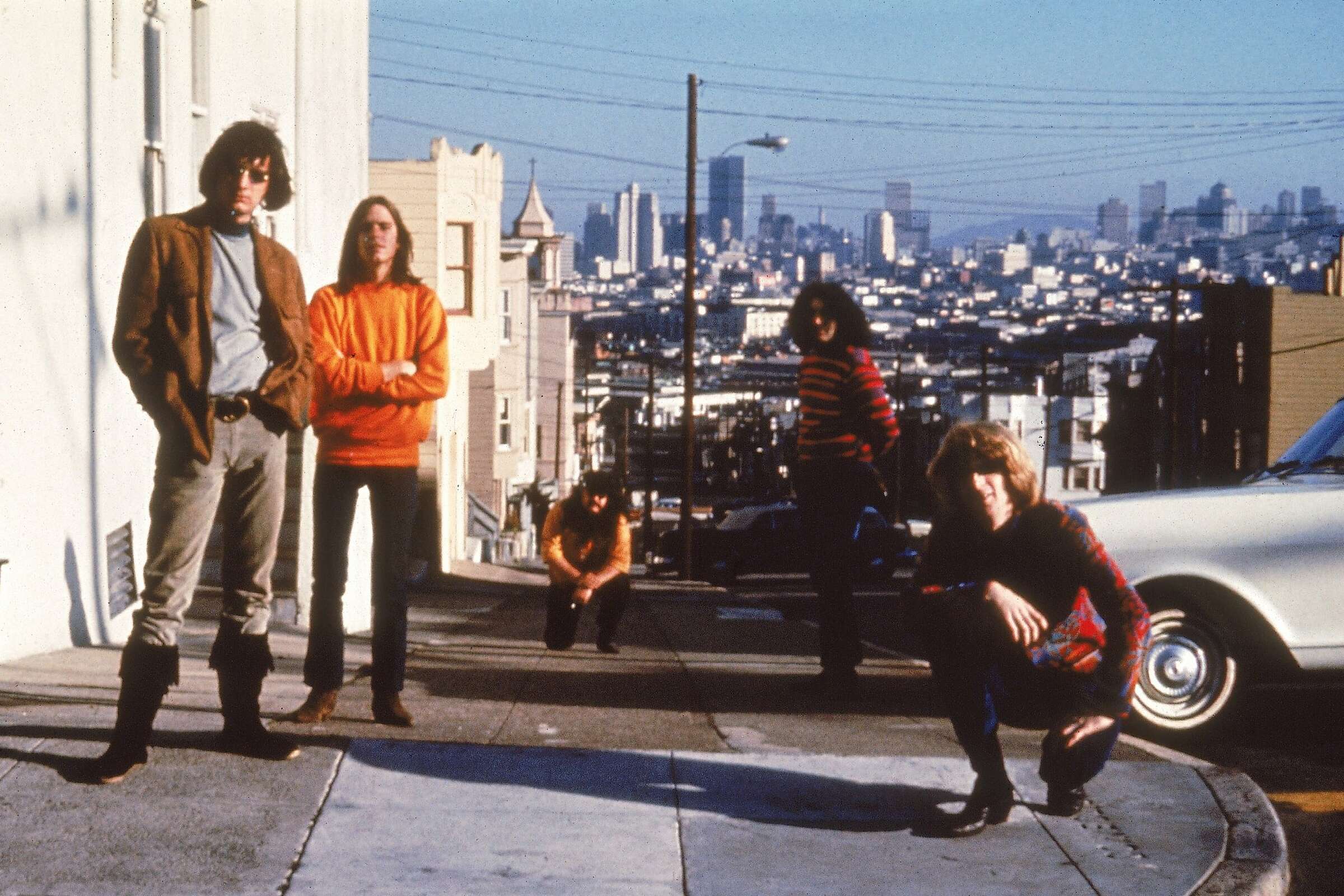
The Grateful Dead in Haight-Ashbury in 1965 (Hulton Archive/Getty Images)

For Jack Hentschel, the story of the hippies starts with his move to San Francisco. Initially, they constituted only one part of the city’s general vibrancy. He recalls that “in the first apartment we had, not far from the Golden Gate Park and the H-A district, it was like living in a United Nations compound. English was not the first language for many.”[7] A few teenagers having sex and smoking pot, therefore, garnered neither a strong reaction nor any specific attention from him. “For the most part,” he says, “before hard drugs took control of the movement, I viewed them as harmless, entertaining and in many ways refreshing from the norm.”[8] Caught in the generational gap between the hippies and their frustrated parents, he could relate, and not relate, to both. He admired the hippie desire for freedom, independence, and self-expression. And thanks to his childhood, “molded by parents of the Depression and the WW2 experience, I had tremendous respect for authority and doing what was right.”[9] When he himself became a father, he found it easier to side for parental control. He especially disliked the drug use, even in the movement’s early stages, when it was relegated to marijuana: “I nearly got lung cancer from ingesting secondhand pot smoke from parties that we attended.”[10] Pot smoke was not the only thing in the air. In addition to new drugs, the hippie movement also introduced new forms of music to the American people—a lot of which, like psychedelic rock, was inspired by drugs. Of this, too, Jack was not a fan: “The noise from the Stones and the Dead never found a place on our tape recorder.” But it found a place on their sons’.[11]

The 1967 Human Be-In (Lonnie Robbins)

As the movement progressed and politicized, Jack’s disagreements with the hippies became more a matter of ideology than taste. Like the hippies, he loathed the Vietnam War, but he also “was not in favor of large-scale and anti-USA demonstrations,” which is how he viewed the peace rally aspect of the Human Be-In.[12] And though the Be-In sparked a Summer of Love for the hippies, to Jack, it was just another summer: “1967 was much like any other ‘60s year to us, and the Summer of Love had no particular impact on us.”[13] But the concept fueled itself, and by June, the brand-new Monterey International Pop Festival was netting an attendance of 75,000.[14] It launched the careers of unknowns like Janis Joplin and the (aptly named) Who and provided rockstars, like Jimi Hendrix, their biggest venue yet. Jack pitied those in the crowd: “My observation was that the movement was co-opted by the slick and greedy shysters in the music industry and that, in reality, the flower children became victims of those who were in it only to make a very large and easy payday.”[15] Pity turned to active dislike with the introduction of hard drugs like cocaine, methamphetamines, and LSD, which brought even more hippies to The Haight and increased gang violence: “As the movement advanced in numbers and notoriety and members of one protest group became commingled with others in parallel groups, overall chaos on the street became more apparent.”[16] And while the Summer of Love eventually ended, its effects reverberate today. In her article “The Long Summer of Love,” Zoë Corbyn argues that “because so many countercultural practices have become mainstream, they are difficult to see.”[17] The hippies not only popularized yoga, meditation, and vegetarianism, but also political movements like environmentalism and sexual liberation. Jack believes that many of the domestic issues America currently faces can “trace their roots to the permissiveness that led to the hippie movement and its egocentric mind set.”[18] So much for peace and love. 

H.W. Brands is right to call the Summer of Love a “letdown.”[19] Moderate Americans like Jack Hentschel, though they could sometimes find fault with the indulgences of the hippie lifestyle, were not its primary victims. The hippies themselves faced the consequences for their overlong party. They were the ones who lived in the crowded Haight, or who blew their money on thrills, or who became addicted to meth. Along the way, the hippies championed noble causes like anti-consumerism and protesting the Vietnam War. But any coherent message was lost as the protests turned into drug-fueled orgies, and the hippies’ insatiable appetites brought gun violence onto the streets. When Jack entered his friend’s old frat house at Berkeley, the lovers were not alone. At the base of the couch lay a large, sleeping dog. “The sleeping pooch could only have been symbolic of the general public,” Jack muses, “ourselves included, that ignored the raging chaos that was all around us.”[20]

[1] Email interview with John Hentschel, April 19, 2023.

[2] H.W. Brands, American Dreams: The United States Since 1945 (New York: Penguin Books, 2010), 148.

[3] Hentschel.

[4] Jeremy Guida, “The Summer of Love Wasn’t All Peace and Hippies – JSTOR DAILY.” JSTOR, https://daily.jstor.org/the-summer-of-love-wasnt-all-peace-and-hippies/.

[5] Jill D’Alessandro et al., Summer of Love: Art, Fashion, and Rock and Roll (Berkeley, CA: University of California Press, 2017), 20. [Google Books]

[6] Brands, 146-147.

[7] Hentschel.

[8] Hentschel.

[9] Hentschel.

[10] Hentschel.

[11] Hentschel.

[12] Hentschel.

[13] Hentschel.

[14] Russell Duncan, “The Summer of Love and Protest,” De Gruyter, https://www.degruyter.com/document/doi/10.1515/transcript.9783839422168.144/html. 

[15] Hentschel.

[16] Hentschel.

[17] Zoë Corbyn, “The Long Summer of Love,” The Chronicle of Higher Education, https://www.chronicle.com/article/the-long-summer-of-love/.

[18] Hentschel.

[19] Brands, 148.

[20] Hentschel.

Appendix

“The summer of love that followed proved to be a letdown, as was probably inevitable.” (H.W. Brands, American Dreams: The United States Since 1945, p. 148)

Interview Subject

John ‘Jack’ Hentschel, age 87, who lived in the Bay Area and worked in San Francisco from 1964 to 1979

Interviews

  • Email, April 19, 2023

Selected Transcript

From email:

Q. When did you first become aware of the emerging “hippie” subculture? What were your initial thoughts on it?

A. San Francisco in the ’60s was a very vibrant and fun place to live and work. In many respects, counterculture was the culture, therefore there were many faces and identities, some welcoming, some not. I recall that in the first apartment we had, not far from Golden Gate Park and the H-A district, it was like living in a United Nations compound. English was not the first language for many. The way life was, it just seemed that the flower children were part of the fabric and that their “Thing” was just one of many different things that made up the City. Initial reaction therefore was “live and let live.” They were as much part of the landscape as the fog horns we heard daily.

Q. You became a father to two boys in the 1960s. Did you feel allegiance to any group in the “hippie debate”? Did you align more with the young people or their frustrated parents?

A. Generally speaking, I was a half-generation older than the average hippie and a half-generation younger than their parents, so I could relate to both in many ways. I found the hippie desire for freedom, self-expression and independence something I could embrace. However, being a child molded by parents of the Depression and the WW2 experience, I had tremendous respect for authority and doing what was “right.” Therefore, disappointing my parents was the last thing I could consciously do. Score one for parental control.

Q. San Francisco was seen as the “hippie Mecca.” How visible were hippies in your day-to-day life in San Francisco? Was there a marked difference between your experience in San Francisco and in other parts of the country?

A. Being centered in the Haight-Ashbury and the western part of town, the enclave was several miles from the Financial District where I spent eight hours a day. Occasionally we would see a few at a time on the streets, but as a group, we rarely encountered them. For the most part, before hard drugs took control of the movement, I viewed them as harmless, entertaining and in many ways refreshing from the norm.

Q. The hippie subculture was defined in large part by its association with illegal substances. Did you ever encounter drug use during your time in San Francisco? Did you ever partake? What were your thoughts on it?

A. Early on, smoking a little pot, 24-hour sex, protesting the war (draft), plucking a guitar, dressing in funny clothes and listening to heavy metal music defined the movement. As things developed, it was the open use of and effect of hard drugs (thank you Timothy Leary and LSD) that most people associated with the hippie lifestyle and which ultimately was the cause for its downfall. Grammy and I are probably the only two people of that era who, not once, experimented with any drug use. That is not to say that we weren’t aware of its existence. Pot was openly in use everywhere. I nearly got lung cancer from ingesting secondhand pot smoke from parties that we attended.

Q. The hippie movement brought new forms of music to the American people. What were your reactions to bands like the Grateful Dead and Jefferson Airplane? Did your children become fans?

A. Peter, Paul and Mary signing “Where Have All the Flowers Gone?” was as much as I could handle from the music world. The noise from the Stones and the Dead never found a place on our tape recorder. I know that your father and Uncle John were much bigger fans of rock than we were.

Q. In January 1967 the hippies moved from Haight-Ashbury to Golden Gate Park, where they staged “the first human be-in.” Do you recall this event, or the presence of hippies in San Francisco’s public parks? What were your thoughts on the Vietnam War, which the be-in protested?

A. I’m aware of the human be-in event and vaguely remember that it received a positive reaction in the mainstream press, as did much of the hippie movement. I thought the war was a monumental mistake and couldn’t understand why our government was supporting a nation and people who, for the most part, were not eager to defend themselves. Having said that, I was not in favor of large-scale and anti-USA demonstrations. Anything anti-USA was not and is not in my DNA.

Q. The hippies declared the summer of 1967 to be the “Summer of Love.” Did the hippie subculture in San Francisco become more visible to you that summer? How was the Haight affected? Did you notice an increase in visitors to the city?

A. I had a friend who was proud of his degree from Berkeley and suggested we visit the campus one day during our lunch break. After negotiating our way through a maze of card tables set up in front of Sproul Hall protesting everything from the FBI (J. Edgar Hoover “The PIG”) to “Christianity Is a Fraud,” we paid a visit to my friend’s frat house (I think SAE). There, in the lounge, at high noon, on a coach was a demonstration of what the Summer of Love was all about, as a couple of lovers were in the act of “how to do it,” without shame. My friend, who was straighter then straight, was not a happy camper. 1967 was much like any other ’60s year to us, and the Summer of Love had no particular impact on us. Our focus was on two infant sons, the Raiders’ new Oakland home and the move of the Kansas City A’s to Oakland. By 1967 the flower children were competing for “shelf space” in the press with a host of other protest movements that had emerged or were developing: civil rights, gay/lesbian, feminism (I liked the no-bra look), Free Speech (Mario Savio), Black Panthers (Huey Newton), Marxism at Cal Berkeley (Angela Davis), Québec libre (Charles de Gaulle), and the Alcatraz encampment (Indians).

Q. The Monterey International Pop Festival occurred in June of 1967. Do you recall this event, or was it localized to Monterey? Do you recall any other mass gatherings of hippies? Did you ever experience the emerging culture of music festivals in San Francisco?

A. I don’t have any recollection of this event. Like many in my generation, I enjoyed the early introduction of rock, but as the noise grew louder, together with the rapid use of harder drugs, I turned off the sound. My observation was that the movement was co-opted by the slick and greedy shysters in the music industry and that, in reality, the flower children became victims of those who were in it only to make a very large and easy payday. The Stones and the Dead were more capitalist pigs than they were bleeding heart idealists.

Q. Did you notice an uptick in crime in San Francisco during the Summer of Love? Did the incoming drugs spark visible conflict in the streets, or were you far enough removed from those substances and that world?

A. As the movement advanced in numbers and notoriety and members of one protest group became commingled with others in parallel groups, overall chaos on the streets became more apparent. My instinct is that serious crime became more of an issue, but that is only a guess. I’ll use your words to answer your question: yes “I was far enough removed from those substances and that world,” while paying close attention to raising a family, rooting for the Raiders and A’s and lobbying Grammy for a dog. Hardly anything has changed in sixty years.

Q. Did the hippie presence in San Francisco die down after the Summer of Love? Was your subsequent experience in the Bay Area affected by the hippies?

A. After the Summer of Love we had the assassinations of MLK and RFK. The 1968 Democratic Convention in Chicago was the Mother of all nightmares. The rise of the Symbionese Liberation Army, the Watts riot, anarchy in our major cities in subsequent years and even the divide that we as  a nation experience today can in many ways trace their roots to the permissiveness that led to the  hippie movement and its egocentric mind set. So yes, my experience in the Bay Area has been affected by the hippies.

Powered by WordPress & Theme by Anders Norén