Dickinson College, Spring 2025

Category: Uncategorized

Horgler Collins King and Intriguing Leads: A First Step Analysis of the Dickinson College Class of 1858

Data Overview:

The first source I had upon receiving my class year was the alumni record, edited by George L. Reed. From this source, I gathered that in the class of 1858, there are 110 total students, 35 of which successfully obtained a bachelors degree. 110 is a lot of students to study, so I will most likely focus on the 35 graduates, who I have more information about anyways. However, for this exercise, I collected and organized data on every student, as I wanted to get a sense of who the class of 1858 was.

At first, trying to get all the information out of the alumni record for 110 students seemed daunting- there were way too many tiny words in that packet. However, once I began to read through each student’s record, I easily began to develop a sense of the type of information provided- namely, birth and death dates, place of origin, occupation, family information (occasionally), and campus affiliations. Therefore, it was pretty easy to decide how I would categorize and organize the information on an Excel spreadsheet. As I will be focusing more on the graduates than the entire student body in later research, I created two spreadsheets- one of all students, and one of the graduates only. This way, I can choose how closely I want to focus on the information I obtain from the alumni record.

The first category I created in the spreadsheet was place of origin. Of all of the students in the class of 1858, the record was able to find and report the place of origin from 91.8% of the students. From the information gathered, I created the following chart:

place of origin


As can be seen from the pie chart, a very large majority of the students were from close by. Interestingly enough, one of the students in the “Other” category originated from the West Indies. I would assume that he comes from a family of major plantation owners, considering that most of the natives of the Bahamas were enslaved by white Americans and thus would not attend an institution of higher education. It still may be interesting to look into his life and see if I can glean any information about 19th century life in the Caribbean.

The second category I created was occupation. It is important to note that the record reported the occupations of only 60% of the members of the class, so it is not a perfectly complete description. After reading through the occupations, I chose to generalize each specific job into one of seven categories: law, education, religion, business, politics, military, and other, for a few jobs that did not fit into these major categories. This was because I did not want to overwhelm myself with unnecessarily specific information. The point of this exercise is to create a general sense of who these people were, not to write 110 biographies. From this information, I created another chart:

occupation

I chose not to include the 40% unknown occupations, as that would consume the entire chart and take away from my ability to comprehend the information that I do have. I will also note that there were many mixtures of occupations per person, as a person obviously does not always do the same thing his whole life. I recorded this in my spreadsheet by listing each category and separating them with a slash. My goal is not yet to understand the specific chronology of each student’s life, but to gain a sense of the types of careers these students went in to.

However, in listing each occupation category for each student, what captured my attention was the occupational mobility these men had. Many were involved in religion, education, politics, law, and business in some manner throughout their lives. I would be interested in looking into the educational structure of Dickinson College at this time to see what these men were studying to give them so many opportunities. Did they even have majors at this time? Were students able to pick and choose classes for their schedules? These are some question I may pursue in future research.

The last category I created was campus affiliation. The alumni record, reported the affiliations of 73% of the class, and the results are complied below:

campus affilations

Clearly, with 73% of the class year involved in at least one, but usually two, campus organizations, I would have a lot of material to look at if I choose to research student life. I would be especially interested in examining the fraternities to take a look at masculinity structures and male gender roles, as that is a topic that has always interested me.


Other Reference:
cloud

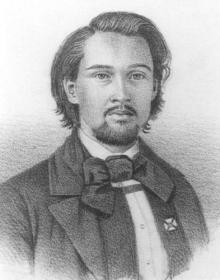
Daniel Mountjoy Cloud Courtesy of Dickinson Archives

My first candidate for the external reference aspect of the assignment was Daniel Mountjoy Cloud, as he served as a captain in the secret service of the Confederacy,  which seems interesting.

I first searched for him on the Dickinson Archives and got multiple results. The first, a short biography, gave me a good summary of his life. Interestingly enough, I found that while in the Confederate secret service, he actually worked with fellow Dickinsonian Thomas Conrad in a plot to kill Abraham Lincoln. I had head about Conrad’s involvement in that plot a few times before, but I had no idea that an individual from my own assigned class year was also an integral part of the planning.

Cloud was also in another search result in the Dickinson Archives entitled “Students Bury Book.” I must admit I was intrigued. The link led me to a journal entry from another one of the students in my class year, Horatio Collins King (discussed further below). In the entry, King describes an event in which students stole an apparently widely-hated book from a professor and buried it. I suppose mid-19th century college students lacked the many methods of entertainment-or outlets of frustration, depending on how you look at it-that we are lucky to have today. In all seriousness, I really enjoyed reading this small anecdote into student life, and will definitely be looking into the journal of Horatio Collins King in later research.

To continue my research on Daniel Cloud, I moved to Wikipedia. When I typed in his name, an article for Thomas Nelson Conrad appeared just as it did in Dickinson Archives. I learned that when Conrad went to Washington to discuss plans to kill Lincoln, Cloud accompanied him, and that the two were actually college roommates and fraternity brothers. Beyond that, there was no information about Cloud in Conrad’s entry. I moved my search after this to Google Books, and although I found a few secondary sources that mentioned Cloud, I could not find another reference source. In terms of this part of my research, I’ve reached a bit of a dead end, but I do have secondary and primary sources to look in to later on if I so choose.
 

hulsey

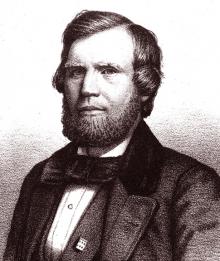
Jennings M.C. Hulsey Courtesy of Dickinson Archives

A second student that I researched, Jennings M.C. Hulsey, was killed at the Battle of Bull Run according to the alumni record, which I found intriguing. I found him on Dickinson Archives and learned that he fought in a Confederate unit that “saw some of the heaviest fighting,” and, arguably more importantly, that he was quite the prankster. The reference specifically relates an incident in which he tarred a professor’s blackboards and was temporarily suspended from the college. It seems like a major part of my class year’s day-to-day affairs involved a lot of pranks; it would definitely be fun and interesting to center my project around that idea, if there was enough information on it.

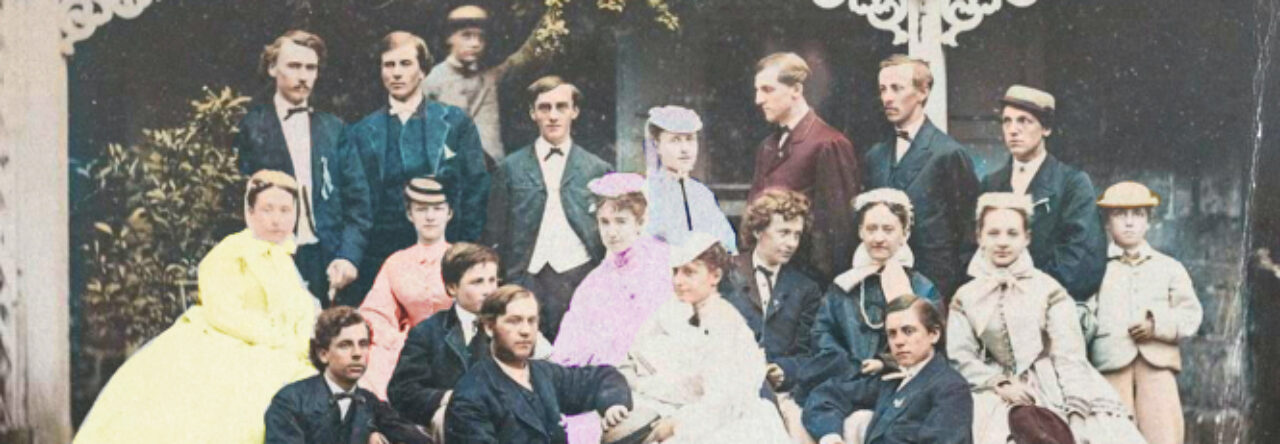
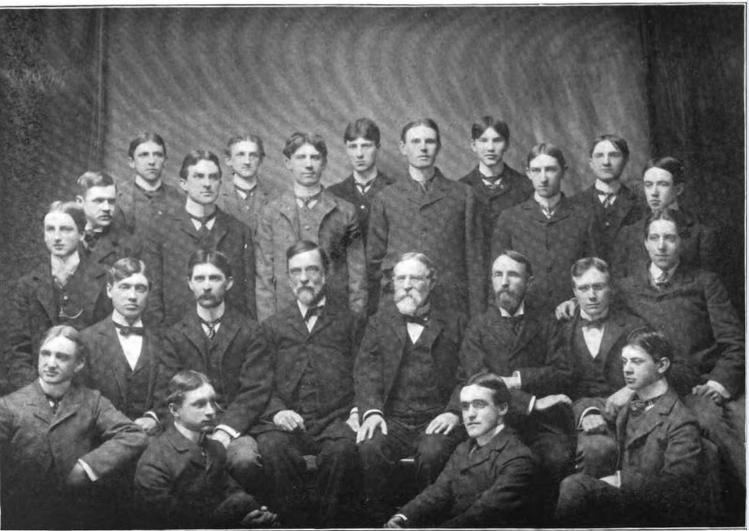
On Google Books, I found him in a 1900 register of his fraternity, Phi Kappa Sigma. Although this document was made less than half a century after his death, and it could certainly be argued that it is a primary and not a reference source, it does have the potential purpose of a gateway into further research. As this was the purpose that it served me, for this assignment I am considering it a reference source. I didn’t gain any new information from the register, but I found an awesome picture of Hulsey’s chapter, which presumably includes Hulsey, although there is no way to tell who is who.
courtesy of Google Books

Epsilon Chapter of Phi Kappa Sigma Courtesy of Google Books

I tried figuring out which one was Hulsey by comparing it to the other picture of him from the Dickinson Archives, but I couldn’t make a definite conclusion. It is also possible that this picture was taken when the register was written, which would mean Hulsey would have been dead for a few decades and certainly would not have been in the picture. Either way, it’s a cool picture, and it’s nice to know that fraternities leave behind so many documents and pictures of their members.
 

Courtesy of Dickinson Archives

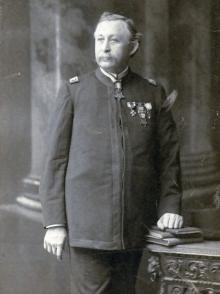
Horatio Collins King Courtesy of Dickinson Archives

After looking into the project that a previous student already made about Horatio Collins King, as well as personally reading his journal entry about burying the abominable book, I knew I had to look into him. There were a LOT of search results from him on the Dickinson Archives site (11 pages to be specific), but as I am currently just looking for reference sources, I focused on the short biography the archives provided. King was involved in many things throughout his life- he wrote and edited books and newspapers, he fought in the Union Army and received a Congressional Medal of Honor, he ran for congress and other political positions, and most importantly, he wrote a lot of songs.

Reference information of King can also be found on his Wikipedia page, which interestingly writes that he took a stance against anti-Chinese sentiment during his time as a judge-advocate-general in New York. I also found more reference sources of him on Google Books, including the 1917 edition of Who’s Who in New York as well as the Biographical Directory of the State of New York 1900but these sources did not give me any information that I had not learned from Wikipedia or the Dickinson Archives. It seems that historical research-especially when you are only researching references-is a lot of reading the same information 50 times in a row and hoping for one minute detail you haven’t come across yet.

Joshua Allan Lippincott Courtesy of Dickinson Archives

Joshua Allan Lippincott Courtesy of Dickinson Archives

The last person I searched for was Joshua Allan Lippincott. He was the president of the University of Kansas, so I thought he would be relevant enough to have a few sources written about him.

As always, I searched the Dickinson Archives first and found, as always, a short bio. Based on this source he seems like a pretty unpleasant person. (He may or may not have had an illegitimate child and is explicitly described as “dour, pious, and grim.”) However, this is about research, and not morality, so I put that aside and looked at the facts. I read that he was a chief adviser for the Carlisle Indian School. I had learned about the school last year during my American History class, so I was immediately intrigued.

Next, I searched for Lippincott on Wikipedia, finding an article, but it was actually seriously lacking in information in comparison with the Dickinson Archives reference. Perhaps if I do choose to research this man more in depth, I could make some contributions to the page. On Google Books, I found a geneology of his family, which although counts as a reference source in my mind, as it contains brief bits of information that I could then use to further my research elsewhere, it did not provide me with any new information about Lippincott. I also found a short biography on him in the National Cyclopedia of American Biography, but there was no mention of the Carlisle Indian School, which was what I was most interested in. I continued to search, but only found primary sources concerning his relationship with the Carlisle Indian School. However, I am very excited about this find, and will definitely be looking into it more deeply when we analyze primary source documents.

Census Records:

The census records search was probably the least exciting part of my research for this assignment. Although it is always fun to be able to look at a document that was actually written a century and a half ago, census documents can be pretty dull, especially when you are reading 15 of them, one after the other. I researched 3 individuals: Horatio Collins King, Joseph Emory Broadwater (who I did look into in other references, but didn’t mention here due to a lack of significant results) and Joshua Lippincott.

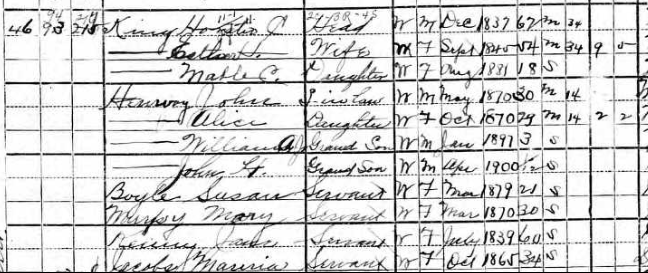
King was fairly easy to find, as I knew his place and date of birth as well as the names of his parents, children, and wives. Screenshots of three records from his life can be seen below:

Interestingly enough, in the last census taken, while King was at the age of 72, the census taker misspelled his name and wrote Horgler instead of Horatio. This was much funnier to me while in the throes of research insanity after staring at census records for the past 5 hours. However, it also shows how important it is to pay close attention, as if I had not noticed that every other piece of information was correct, I would not have noticed that record.


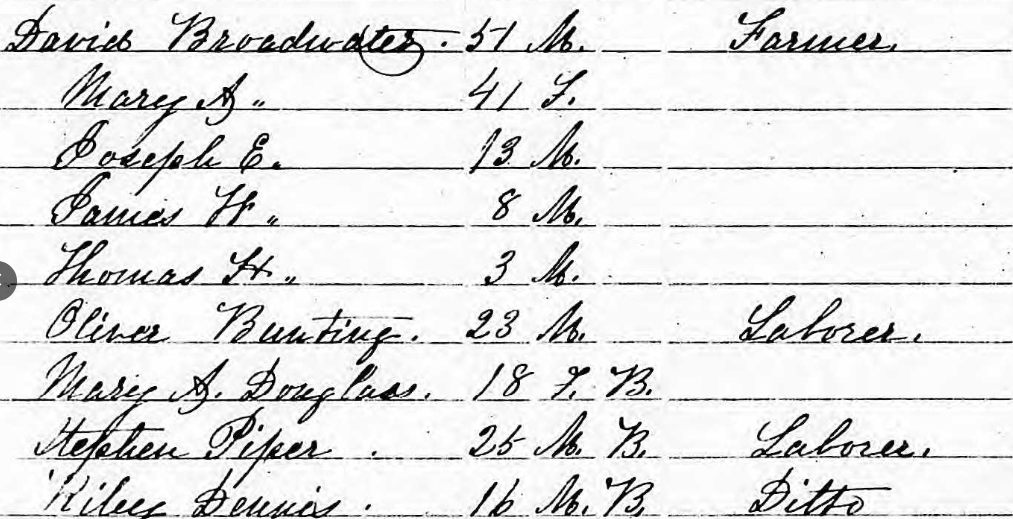
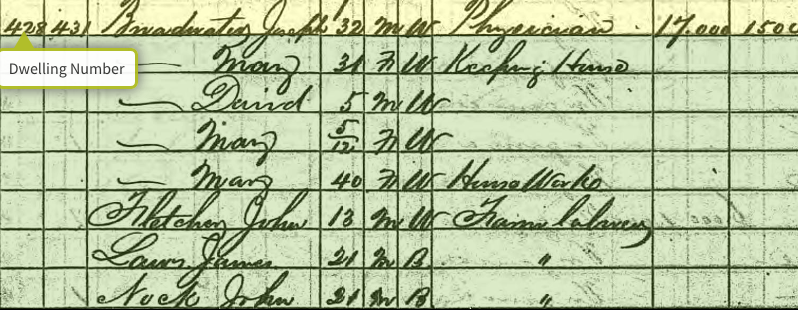
Joseph Emory Broadwater didn’t have any funny spelling errors and was fairly easy to find census record on.

There is no mention of a son named Wharton in other record or references, so I’m not sure if that is a typo or a boy living with the Broadwaters who was mistaken for a family member, but it could use some further investigation.


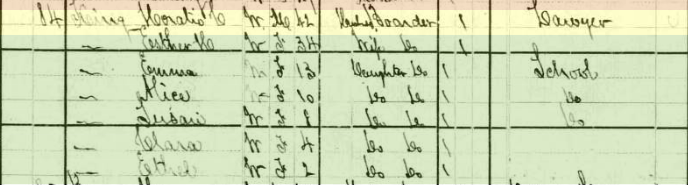
Joshua Lippincott was difficult to find records on, and I’m still not even sure that the second one is actually him.

In the second record shown, every single fact lines up perfectly with the Lippincott from the class of 1858. His occupation, his name, his age, and his location all make sense. However, the Dickinson Archives reference stated that there was no record of Lippincott marrying and having children (other than the possible illegitimate child). It is possible that Lippincott had random people living in his house and the census taker assumed they were his family, or maybe Lippincott was married all along and his family simply does not exist according to Dickinson College. Maybe Lippincott had a twin who did the exact same thing he did, but ended up marrying and having a family. Either way, I am certainly intrigued.
Dickinson’s Class of 1845

Data Overview

Dickinson’s Class of 1845 consisted of a total of 49 students: 18 graduates and 31 non-graduates. In order to get a better sense of who these men were, I compiled them into a spreadsheet using the information available in the 1905 Alumni Record. Each student’s name, birth state, occupation, campus involvement, and whether or not they graduated were included in this spreadsheet. The students were listed alphabetically by last name to facilitate easier navigation. The categories above were chosen for a few reasons. I decided to include each student’s state of birth (if listed) in order to get a better idea of what sort of demographics the class was made up of. The majority of the students came from the mid Atlantic but there were some students from states farther west and south. Knowing where the students came from is important because it gives a better understanding of each student’s values.

In terms of occupation, I listed the broader category of profession for each student rather than their specific job. Since I haven’t gotten into the meat of this project yet, I decided that it’s not that pertinent to know what exactly each student was doing in the years after they graduated. The most common professions were religion and education, but students also became employed in things such as trade, finance, law, and the military. Using the broader category also shows the most common fields of employment for the class which I can then use to decide what I want to focus on for the final project.

During the 1840s the only extracurriculars offered on campus were the Belles Lettres and Union Philosophical Societies. 25 of the members of the class of 1845 belonged to the Belles Lettres Society while 18 were involved in the Union Philosophical Society. 6 students had no affiliation listed in the Alumni Record.

In addition to the columns talked about above, I included a final column titled “Follow Up”. In this column I put down whether or not I thought the student was someone I wanted to research in more detail. This was based primarily on the amount of information available for the student in the Alumni Record because the students with the most information seemed to have led the most distinguished lives. This column allows me to quickly find who I want to research more later on rather than having to enter search every name and see what comes up. Of the 49 members of the class of 1845, there were 8 students that I thought were worth researching further.

Other Reference

Going off this shortlist, I started by entering each student’s name into Google. While I didn’t get any useful hits apart from the Dickinson Encyclopedia for most of the men, there were a couple that did get some hits. One of these was Robert Samuel Maclay, a methodist missionary who was in charge of the missionaries in China, Japan and Korea during the mid 1800s.Through this search I found multiple reference sources about Maclay’s life. In addition to an entry in the Dickinson College Encyclopedia, I also found a Wikipedia page for him and an entry in the Biographical Dictionary of Chinese Christianity. This last source is a project seeking to compile entries on all Chinese and foreign Christian missionaries who played a part in expanding Christianity in China and is contributed to by scholars from all over the world. I found the Dickinson Encyclopedia entry to be the most useful of these sources as it contained the most information about Maclay’s life.

ed_maclayRS

Robert Samuel Maclay. Courtesy of Dickinson College Encyclopedia.

I also came across a description of Maclay’s life and work on the Long Island Korean United Methodist Church website. This popular source focused primarily on Maclay’s time as a missionary in Korea and read more like a biography than a reference source.

Reading through these entries was quite interesting, particularly the one on the LIKUMC site because it gave some background information on the state of relations between the US and Korea during this time period. I learned from these sources that Maclay wrote 2 books while in China: Life Among the Chinese With Characteristic Sketches and Incidents of Missionary Operations in China, which described not only his missionary work in China but also discussed the history and culture of China at the time, and Alphabetic Dictionary of the Chinese Language in the Foochow Dialect. It would be interesting to try to find a copy of either of these books to peruse as it would give me a much better idea of what Maclay’s missionary experience was like. I also learned that Maclay was responsible for opening up Korea to Methodist missionaries, which could be an interesting topic to focus on for the final project.

isaac-newton-urner

Portrait of Isaac N. Urner during his presidency of Mississippi College. Courtesy of Mississippi College.

I also looked more in depth at Isaac N. Urner. Since the Alumni Record listed him as being president of Mississippi College from 1850-67 I first looked on the college’s website to see if I could find anything out about him. Under the “About” tab on the college website there is a section dedicated to the history of the school, including a timeline of all the presidents with information about what each of them did during their tenure. I learned that Urner prioritized increasing student enrollment and succeeded in growing Mississippi College into one of the largest Baptist schools in the country at the time. It was also interesting to learn that he took no pay during the Civil War and many students and faculty actually left to fight in the conflict. This could serve as a jumping off point if I decide to delve into higher education and the Civil War for the final project.

I also found a history of Urner’s family on Google Books in an 1881 book titled History of Chester County, Pennsylvania, with Genealogical and Biographical Sketches. While this is a primary source since it was published during Urner’s lifetime it is also very much a reference source and provides only a brief overview of his life and family. It was interesting to read this section because it gave details not only about Urner’s wife and children but also his ancestors who lived in Chester County. Knowing about what Urner’s childhood and home environment were like could be useful should I choose to focus on him for the final project as it gives me a more wholesome view of the man.

Ancestry.com

I chose to research Robert Maclay’s genealogy using Ancestry.com because I found him to be the most interesting member of the class. I started by using the information provided in the Dickinson Encyclopedia for his birthday and place of birth and entered those into the search engine. Ancestry very quickly provided me with a census from 1900 in which Maclay is listed along with his second wife Sarah. Interestingly, the census records that Maclay had been married for 49 years. I was somewhat confused by this until I realized that the census was counting the total number of years Maclay had been married. According to the Dickinson Encyclopedia he had originally married Henrietta Sperry in 1850 but she died in 1878. He married Sarah in 1882 which would make his total years married 46 rather than 49. This disparity could suggest that either Maclay misremembered what year he married Henrietta when he was talking to the censor or else the censor misheard him and thought he said 46.

The Maclay Household in the 1900 Census. Courtesy of Ancestry.


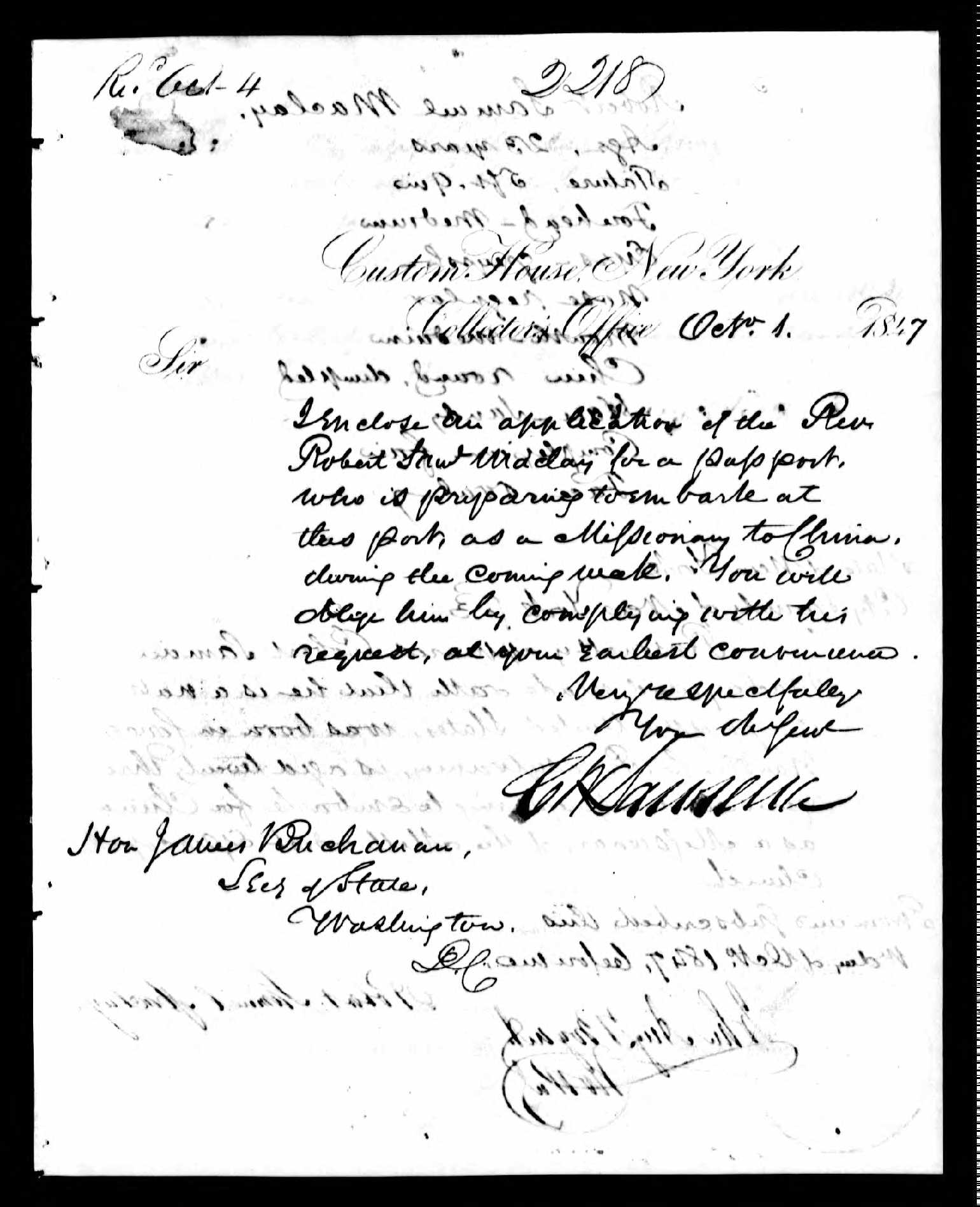
In addition to the 1900 census I also managed to find a letter to the Secretary of State asking for Maclay’s passport to be approved. While I couldn’t make out the signature at the end of the letter, I was intrigued by the fact that someone was writing directly to the Secretary of State in Washington asking for a passport to be approved. The letter suggests that there was some issue of time as the author says that Maclay was supposed to leave for China in the coming week, but it’s nevertheless interesting that they wouldn’t first go to someone lower down on the ladder.

USM1372_21-0297

Letter to the Secretary of State asking for approval for Maclay’s passport. Courtesy of Ancestry.

Beginning Research on the Dickinson College Class of 1860

When I first received the 1905 Alumni Record for the Dickinson College class of 1860, I was a bit overwhelmed.  To begin to start to understand more about this class and the individuals in it, I decided to make a data table to compile all the important information on each student. To start my data table, I simply counted all the graduates and non-graduates and added them up.  Following this, I briefly skimmed a few entries of the 1905 Alumni Record to see what kind of information it would have on each student.  It seemed that each entry could be categorized in fairly basic categories like home state, job field, campus life, etc.

Originally, I was frustrated that the Alumni Record did not have complete data for many of the students for each of my categories, so I would add and take away categories.  Eventually I decided on my columns and just put “unknown” if there was no information on a student.

Filling out the data sheet  was easy but time-consuming.  The most difficult and longest part was getting started and deciding exactly what data I wanted to record.  I’ve never done something like this before, so the initial process was somewhat difficult, but once I established a rhythm, it became much easier.  I decided to convert the data chart into a bulleted list because it made the data even easier to read and highlighted the most important information.  The data chart is good for seeing specific information for each individual student, but the bulleted list is designed to learn about the whole class and see what the class as a whole was involved in.

Once the bulleted list was finished, I chose a few individuals to research more in depth.  I decided on a few of the students that had the most information and seemed most interesting.  As with most research, the best way to start was with reference sources.  Considering that they are all former Dickinson students, I checked the Dickinson encyclopedia first.  I used the Dickinson encyclopedia to get more information of course, but also as a test.  If a student was not in the Dickinson encyclopedia, I decided to choose another one because it seems logical that if anyone would have information on Dickinson students, it would be Dickinson.  This eliminated a few options, and I ended up choosing to study David B Brunner, John Henry Grabill, and Clarence Gearhart Jackson more in depth.

Brunner Pic

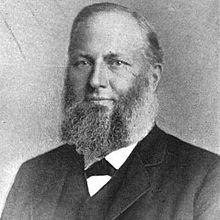
David B. Brunner, credit to Wikipedia.org

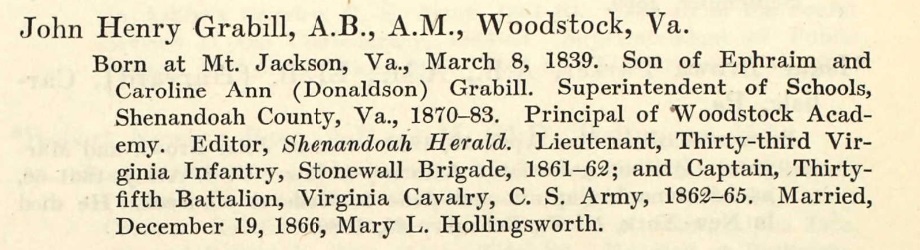
All these students were in the Dickinson encyclopedia, and there was a descent amount of background on them.  Brunner taught, was a congressman, and wrote Indians of Berks County.  Grabill was born in Virginia, fought for the Confederacy, had ten children, and was a school superintendent.  Jackson fought for the Union in the Civil War, was Vice President of Jackson and Woodin Manufacturing, and owned a mansion.

After learning this, I decided to check other sources, including American National Biography Online and Wikipedia, to find more.  American National Biography Online yielded no results, as none of the students were quite famous enough.  Wikipedia was a little more useful but only had an entry on David B Brunner, which is mostly because he was a congressman from 1889-1893.  Brunner’s entry was quite short, but it did mention that he was a Pennsylvania German poet, which was exciting to learn because this information was not in the Alumni Directory or Dickinson encyclopedia.

From here, I went to Google Books to see if more information on Brunner’s poems was available and to find more about the other students.  Through Google Books, I found a reference source, A Pennsylvania German Anthology, which contained an entry on Brunner and examples of his poems, which were entirely written in German, and a mentioning of “Goethe Von Berks” as some sort of alias or pen name.  His poems and alter-ego were greatly intriguing so I continued to look for more information on them.  I found virtually the same short biography on Brunner in Publications, Volume 26 by the Pennsylvania-German Society, but importantly, this source confirmed that Brunner used the pen name, Goethe Von Berks, when writing his German poetry.

Grabill Pic

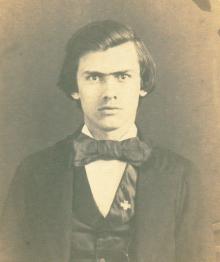
John Henry Grabill, credits to Dickinson Encyclopedia

Searching John Henry Grabill on Google Books yielded some information but nothing new.  He is in the Semi-Centennial Register of the Members of the Phi Kappa Sigma Fraternity, a reference source about the Phi Kappa Sigma Fraternity which he was a part of.  In search of more information  about his service in the Confederate Army, I  went to The American Civil War Research Database.  Grabill has an entry in it that gives a bulleted list that mentions his enlistment, marriage, and that he was a prisoner of war.  The database was a great reference source because it gave me basic information about Grabill’s life, and it made me want to learn more about his status as a prisoner.

Jackson Mansion

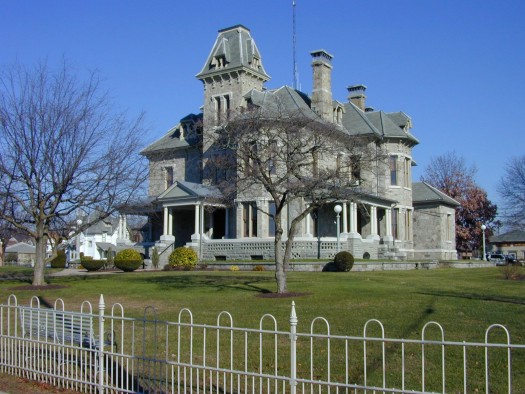
Jackson’s Mansion, credit to Berwick Borough

Finally, I searched for Clarence Gearhart Jackson, and I found some very interesting results.  In the Reports of the Heads of Departments to the Governor of Pennsylvania 1876, he is listed as an aide-de-camp to Governor Hartranft, but this is not a reference source because it is merely his name in a list, so it is not what I was looking for.  Intrigued by his mansion and in search of a reference source, I searched “Clarence G Jackson Mansion” on Google which led me to find a history of Berwick Borough, his home and the site of his mansion.   It is a reference source because it provides a brief overview of Berwick designed to give simply a starting point for further research.  This overview has an entry about him and more specifically his mansion, which was actually used as Berwick’s City Hall for almost 100 years after the death of Jackson’s wife, Elizabeth.  The mansion still stands today, though it’s no longer used as city hall.

Next, I decided to search for Clarence Gearhart Jackson on Ancestry.com to see if he appears in the census or other records.  I was very lucky to find him posted in someone’s family tree, meaning that someone else already collected a series of documents and connected it with Jackson.  This saved me a lot of time, and I only spent about an hour to go through the documents and report on my findings.  This collection included three censuses, a veteran burial card, and pictures of his headstone.

Jackson 1870 Census

Jackson’s Family in the 1870 Census, credit to Ancestry.com

I chose to include the 1870 census, as opposed to the 1850 or 1860 census, because it is the only one to have both of his kids, Jane and Henrietta Jackson.  It also includes Elizabeth Jackson, his wife.  Interestingly, none of this family’s real names are recorded.  Clarence is CG, Elizabeth is Lizzy, Jane is Jenny, and Henrietta is Ettie.  Jane appears to be named after Clarence’s sister, who’s also named Jane but goes by Jenny.  Interestingly, Clarence’s sister dies the same exact month that his daughter is born.

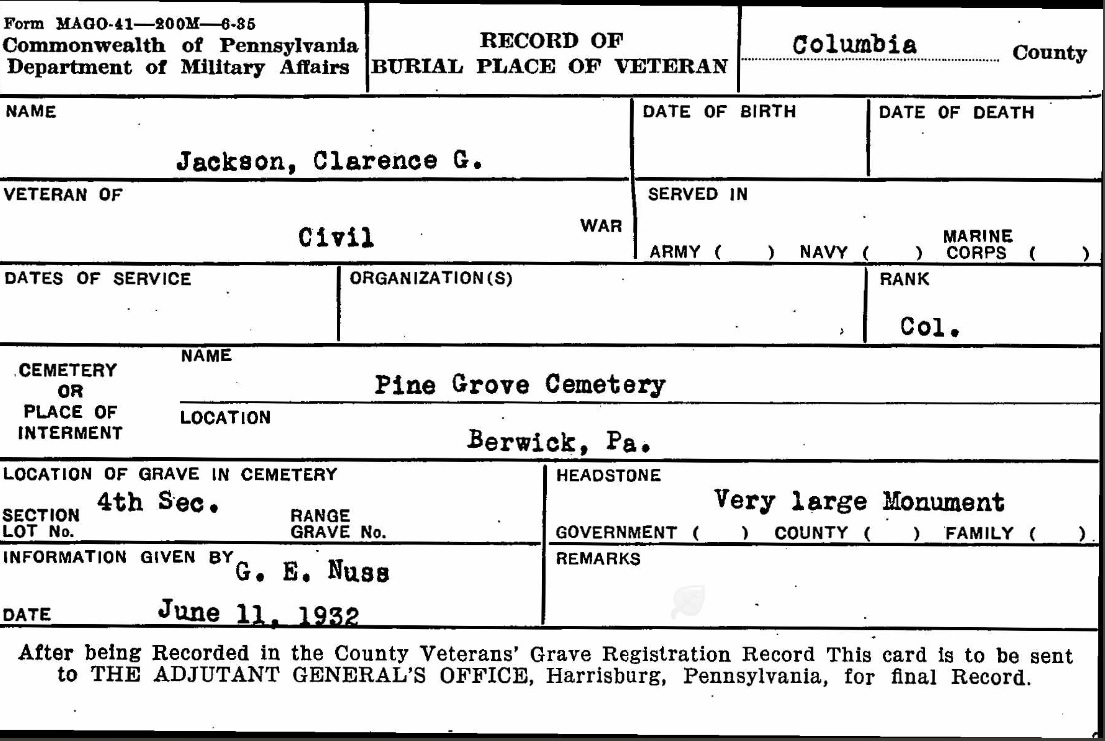
Jackson Veteran Card

Jackson’s Veteran Burial Card, credit to Ancestry.com

Jackson died in 1880.  Records of this can be found in a census mortality record, a New Jersey and Pennsylvania church and town record, and a Pennsylvania Veteran Memorial card.  I chose to include the veteran card because Jackson served in the Civil War and because it has more information than the other sources.

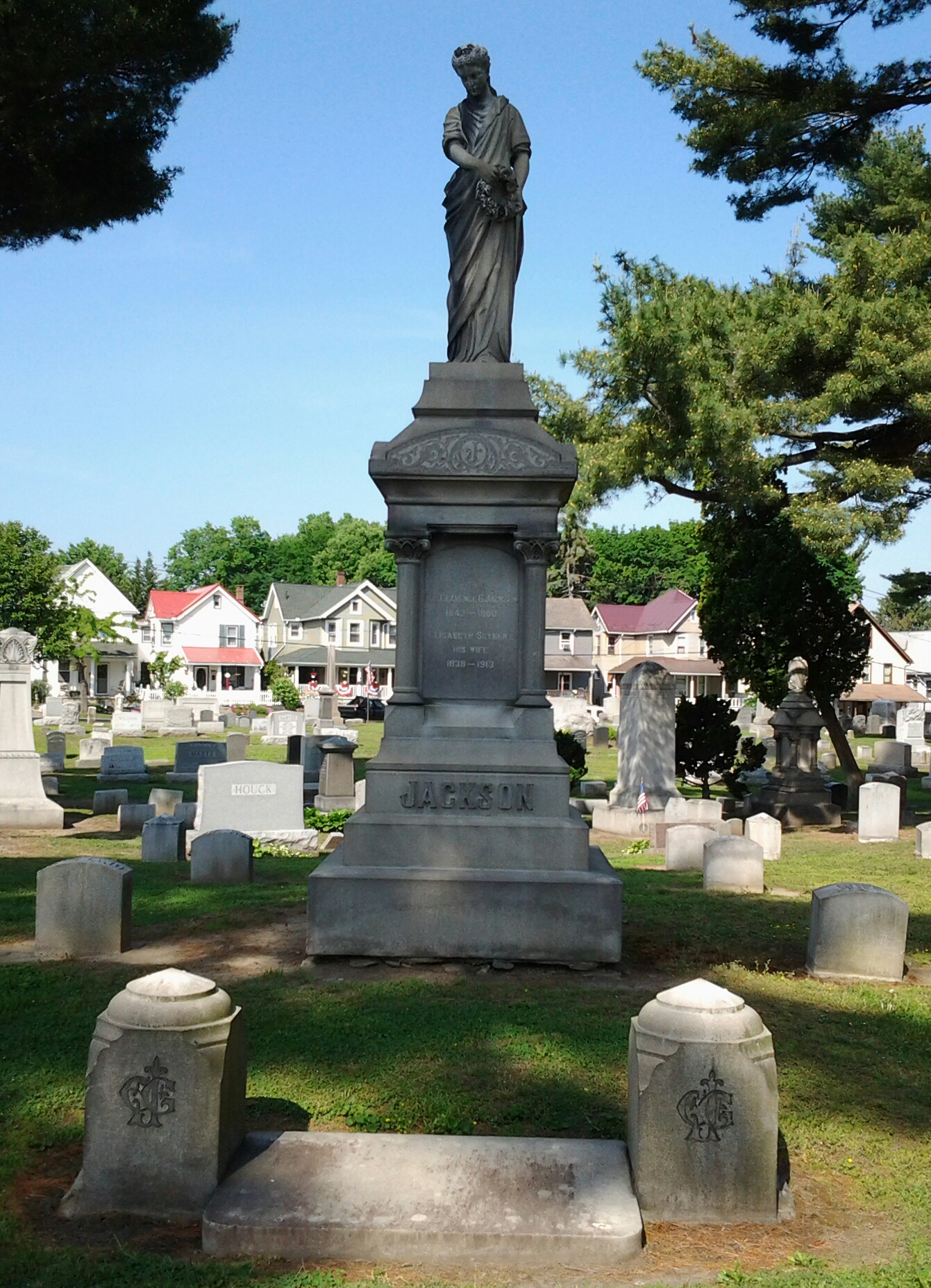
Jackson Headstone

Jackson’s Headstone, credit to findagrave.com

A picture of Jackson’s headstone, described as a “very large monument” on the veteran card, can be found on a link from findagrave.com on Ancestry.  Judging by this headstone and knowledge of his role as Vice President of Jackson and Woodin Manufacturing Company, Jackson was quite a wealthy man.

Because finding Clarence Jackson’s information on ancestry.com was so easy, I decided to take another hour to see if I could find census records or anything else on John Henry Grabill.  Again, I was lucky to find him to be a part of a family tree, but this one was not nearly as complete as Jackson’s.  It only had a record of Grabill being a Confederate prisoner of war.

Grabill POW

Grabill in Prisoner of War Records, credit to Ancestry.com

This was a very exciting find because it confirmed the information from the American Civil War Database.  Also, going into the search for Grabill I only had expectations to find census records, so this was quite the surprise.

Grabill School Record

Grabill in the U.S. School Catalog, credit to Ancestry.com

Another interesting find was an entry on him in a U.S. School Catalog.  He is in the catalog along with several other members of the Dickinson class of 1860, and they are all grouped together for their membership in the Phi Kappa Sigma Fraternity.  The catalog entry is very similar to the 1905 Alumni Record.

Grabill 1920 Census

Grabill in 1920 Census, credit to Ancestry.com

Finally, Grabill is in multiple censuses taken throughout his long lifetime.  Here he is in the 1920 census, taken just two years before his death.  He lives in an eleven member household, including his wife, six kids, a son-in-law, a servant, and the servant’s son.

To summarize, this research journal took many hours to complete and was frustrating at times, but overall it was fun to go from a data chart about a class of 48 students down to finding real records and primary source documents through ancestry.com on two students.

Assignment –Ancestry.com

Due Date

  • Friday, September 16, 2016 by 5pm (via course website)

Objective

Students in History 204 should create a short entry in their research journal (about 600-800 words, or 3-4 pages) that documents how they used Ancestry.com and other reference sources to help launch their investigation of their assigned Dickinson College class of students (1840-1880).

Grading

  • Entries will NOT be graded on prose or design elements (though both will factor into whether or not the journal entry will ultimately get published).  Instead, the focal point of grading will be on research effort and historical analysis.  Try to focus on communicating a deliberate and effective protocol for historical research.

Guidelines

  • DATA OVERVIEW. Begin by organizing the information about your class from the 1905 Alumni Record into some kind of useful datasets.  In other words: try to provide your readers with a general overview of the subject –how many students total, how many graduates, non-graduates, providing some breakdown of their origins, affiliations, and career choices, etc.  You may do this basic statistical analysis in sentence form, or through bullet points, or with some kind of table, chart or infographic.  It just depends.  But keep in mind that this overview might help uncover possible fruitful avenues for teaching and presentation in your later essays and projects.
  • OTHER REFERENCE. Then select some of your subjects for further investigation in reference sources beyond the 1905.  These reference sources might include:  Wikipedia, American National Biography Online (via Library databases), or nineteenth-century publications, such as county histories, regimental histories (for Civil War veterans), or various professional directories (like bench and bar guides, cyclopedias, or annual proceedings from Methodist conferences).  Typically, you will be able to research these published nineteenth-century sources most easily by advanced searching in Google Books.  Please note that you do not have to research ALL of your subjects in this manner, and certainly should not expect to have the space to report on all of these efforts in your post regardless, but look for opportunities to describe a few or several of them in your initial research journal entry.
  • ANCESTRY.COM.  Please conclude this initial journal entry by documenting with one or two good examples, how you can trace the lives of your subjects over time using Census records from Ancestry.com (via Library databases).  Make sure to include cropped page images from the relevant Census records and try to show some creativity with your interpretation.  Here is where, for example, you might look for opportunities to begin identifying the women important in the lives of your Dickinson subjects.

Reminders

  • Prose is not graded here, but writing with clarity and vigor should always be your objective.  Poorly written posts will not hurt your grade at this stage, but they will prevent you from getting your work published.  Quick note –these entries may contain first person pronouns, but try to keep the focus on “I” to a minimum nonetheless.
  • Design is not graded here either, but use this initial entry as a way to test out your WordPress skills.  Include images (with proper captions and credits) that have text neatly wrapped around, and provide occasional hypertext links to freely accessible outside sources.  Footnotes are not required in research journal entries, but you want to experiment with providing ways for readers to visualize and access your sources.

House Divided Got Punked, Lincoln Forgery-Style

Adapted from a recent post at Blog Divided:

Alexander Stephens (Courtesy of House Divided Project, Dickinson College)

It was bound to happen sooner or later.  Last week, sadly, we discovered that there was a forged document in the House Divided research engine.  David Gerleman from the Papers of Abraham Lincoln contacted us to point out that a letter supposedly written by Abraham Lincoln to Georgia politician (and future Confederate Vice President) Alexander Stephens, dated January 19, 1860, was a known Lincoln forgery.  The letter (since removed) was full of memorable and sometimes unLincolnian statements about the sectional crisis and ended with the line:  “This is the longest letter I ever dictated or wrote.”  Since Lincoln was not in the habit of dictating anything at all (especially in those pre-presidential days), this was a document that should have set off warning bells.  But it was published as part of a pamphlet that had been produced during the centennial of Lincoln’s birth in 1909 and even now remains in wide circulation on the Internet and elsewhere.  A recent scholarly article in the Tulane Law Review by John Inazu (“The Forgotten Freedom of Assembly” 2010) even began by quoting from it.  Yet there was no such exchange with Stephens. For a full discussion of the problems with the alleged January 19, 1860 document, see the article, “Four Spurious Lincoln Letters” in the Bulletin of the Abraham Lincoln Association 21 (Dec. 1930): 5-9, available online here). You can view the text of the forged document at the Internet Archive (where we apparently found it) inside a pamphlet edited by noted Lincoln collector Judd Stewart and entitled,  Some Lincoln Correspondence with Southern Leaders Before the Outbreak of the Civil War (1909).   Stewart was one of the so-called “Big Five” of early Lincoln collectors and was careless enough to fall victim to these types of scams (his collection, stripped of several other faked items, is now housed at the Huntington Library in California).  During the decades after Lincoln’s assassination, there was practically a land office business in Lincoln forgeries, and their ripple effects are still being felt today.  I exposed one of these problems in 1999 when actor Warren Beatty and journalist Jonathan Alter used a phony Lincoln quotation about the evils of big corporations that had originally been ginned up during the Populist era and continues to be quoted and re-quoted today despite numerous debunkings.  History News Network reprinted the piece in 2005 when author Kevin Phillips and historian Paul Kennedy both made the same mistake of admiring a Lincoln who sounded suspiciously like William Jennings Bryan.  What’s the lesson in all this for teachers and students?  Check your sources.  We never should have used a 1909 pamphlet for a Lincoln document when the Collected Works of Abraham Lincoln (8 vols., 1953; 1974, 1990) is the current gold standard in Lincoln’s writings (though the online Papers of Abraham Lincoln, where Gerleman works, will soon become the new AAA-rated repository for all things Lincolniana).  And always remember, when a story or document seems too “good” to be true … it just very well might be.


Page 7 of 7

Powered by WordPress & Theme by Anders Norén