Having previously examined several landmark Supreme Court cases at Dickinson, I initially felt confident in my research approach. My background stemmed primarily from Professor Pohlman’s Constitutional Law I class, which focused on the separation of powers and included substantial discussion of NLRB v. Jones and Laughlin Steel Corporation, one of the Supreme Court’s most consequential Commerce Clause cases. Because I was already familiar with the case and owned several related books, I began my research with a solid foundation. After reviewing my personal books, I turned to online databases such as EBSCOhost, American National Biography Online, JSTOR, America: History & Life, and various law review sites. However, I was disapointed to find that my own keyword and subject searches through these databases were not yielding very useful results.
I then began prompting ChatGPT to look for articles, book chapters, journals, and other reliable academic papers that focused on changes in major constitutional doctrines following the Court’s ruling. Although the application struggled at first, additional rounds of prompts uncovered several obscure but promising sources. I filtered through the results by opening each document, quickly analyzing the main content, and using keyword searches through “control + f.” This strategy removed the many sources that were only tangentially related to my topic, or that mentioned Jones & Laughlin briefly in passing. This experience reinforced for me the idea that most of the initial search results provided by AI are of only minimal value. Therefore, it has become abundantly clear that continually refining one’s results is essential to an efficient and effective research effort. This can be accomplished through using increasingly specific prompts in the AI program, keyword searches inside documents, and scanning the source for lengthy portions of text with a direct bearing on your final topic using the table of contents.

Cover Page of Constitutional Debate in Action: Governmental Powers by Harry L. Pohlman (Bloomsbury Publishing)
One of my first print source selections was Professor Pohlman’s Constitutional Debate in Action: Governmental Powers (2005), which we used repeatedly in class. It provides excerpts from the Court’s opinion and dissents, background context, and analysis of its effects on constitutional doctrines, interpretation, and federal action. Since it was while reading this book that I first encountered Jones & Laughlin, I revisited it for this assignment. Additionally, having previously read the chapter on the Commerce Clause, I was already convinced of its relevance and value heading into this paper. Although many of the citations were inaccessible or of marginal value, the facts of the case as laid out in the text along with Professor Pohlman’s advanced analysis will undoubtedly create a better final paper.
Next, I consulted Constitutional Law and Politics: Struggles for Power and Governmental Accountability (2023), another textbook from class. Each chapter in the book covers an area of constitutional law, provides a section with background information on an area of law, and offers a timeline that illustrates the evolution of relevant constitutional doctrines as a result of important case decisions. Its Commerce Clause chapter tracks the Supreme Court and constitutionalism through spikes in legal formalism, increases in Congress’s desire to regulate commercial activities, political conflicts that brought about interventionist economic policies, and the Court’s confrontation with the Roosevelt administration. The book explains how Jones & Laughlin helped pave the way for Congress and the Executive to capitalize on the Court’s broad 1937 interpretation of the Commerce Clause. From using this text repeatedly throughout the semester to examine dozens of cases, I also knew that it would be both a reliable and informative source from the beginning.
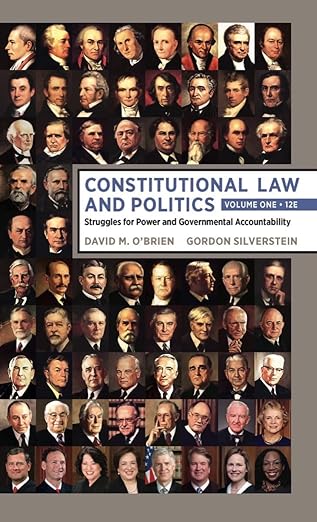
Cover Page of Constitutional Law and Politics: Struggles for Power and Governmental Accountability by David M. O’Brien and Gordon Silverstein (Amazon Books)
Upon retiring, Professor Pohlman left all of his books to the students at Dickinson. I was fortunate enough to get fourteen of them, which cover a range of constitutional and historical topics. Upon returning home for Thanksgiving break, I looked through them and found Peter Irons’s book, A People’s History of the Supreme Court: The Men and Women Whose Cases and Decisions Have Shaped Our Constitution (2000). It has multiple chapters covering the Court’s major cases relating to the Great Depression, the New Deal, and the Commerce Clause. However, the true value in this text will come from its exploration of the justices’ ideologies, how they shifted during the 1930s, and how those shifts resulted in rulings that were seemingly in conflict with one another. It will aid me in creating brief profiles for the justices so that their decisions can be better understood within the greater context of their judicial philosophies and opinions leading up to Jones & Laughlin. As I wanted to build a diverse group of sources, I settled on these three print sources and began my online research.
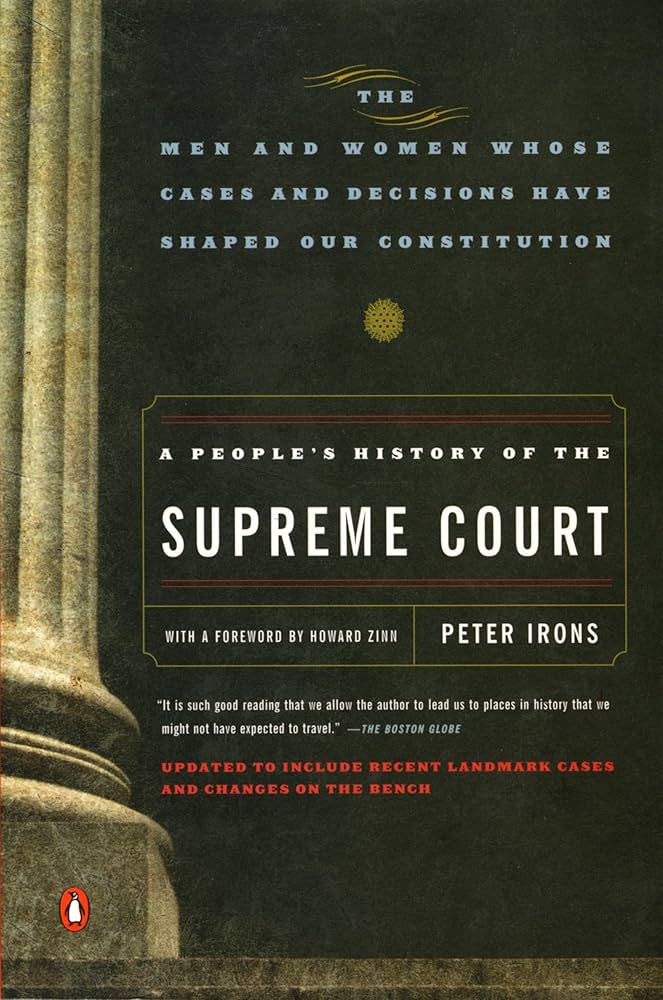
Cover Page of A People’s History of the Supreme Court: The Men and Women Whose Cases and Decisions Have Shaped Our Constitution by Peter Irons (Amazon Books)
After multiple rounds of inputting prompts into ChatGPT, I tasked the program with finding sources directly related to the case’s public impact, a major point in our paper. It immediately found a relevant article from the 2012 publication of the Cato Journal, titled “The Behavior of the Labor Market Between Schechter (1935) and Jones & Laughlin (1937)” (2012). To ensure that the piece would be beneficial to me, I read the first few and last paragraphs and conducted a keyword search to identify the frequency with which “Jones & Laughlin” appeared. After determining that the document’s introduction and conclusion would shed new light on this area of the project, I evaluated the sixteen results from my keyword search and discovered that all but one of the references to Jones & Laughlin were tied directly to its effect on the public sector. Specifically, they describe fluctuating levels of union activity and income increases that followed the ruling. At that point, I felt confident enough in the article to include it here.
Using the same process, I then began looking for sources that included some analysis of the doctrinal changes brought about by Jones & Laughlin. One of the provided sources was a 2003 edition of the Cornell Law Review titled “Unidimensional Federalism: Power and Perspective in Commerce Clause Adjudication.” It was evident by the introductory and concluding paragraphs that the article was focused on the alterations of existing constitutional principles by that time. It mentioned concepts such as the “stream” and “current of commerce,” an interpretation of the Commerce Clause established prior to Jones & Laughlin. Because the article addressed these areas of change and my keyword searches for contemporary understandings of the relevant constitutional clause were positive, I felt as though my paper would benefit from it. The article also contains a significant amount of analysis regarding the expansion of the federal government’s power following the ruling, creating another avenue of consequences to explore.
Finally, I began looking for a source containing information, in addition to Professor Pohlman’s book, about the case’s impact on substantive due process. After conducting the same “substantive due process” keyword search across multiple sources, I found Barry Cushman’s article, “A Stream of Legal Consciousness” (1992), which was published in the sixty-first edition of the Fordham Law Review. I read through the relevant sections and concluded that the article, along with Constitutional Debate in Action (2005), would prove beneficial in assessing this major constitutional shift.
Overall, this research process reaffirmed that AI programs have immense value as well as serious limitations. Although I still feel that I have a great deal to learn, especially regarding inputting effective prompts, I have found some shortcuts to ensure that irrelevant sources can be quickly put aside. By using multiple rounds of prompting to narrow in on relevant material, scanning those results with keyword searches, and skimming paragraphs at the beginning and end of articles for clues about general content, students can rapidly find some of the most relevant and informative articles available. I will absolutely continue to use this method while I expand my pool of secondary sources and begin my search for primary sources.
Bibliography
Cushman, Barry. “A Stream of Legal Consciousness: The Current of Commerce Doctrine from Swift to Jones & Laughlin.” Fordham Law Review 61 (1992): 105-160. EBSCOhost.
Irons, Peter. A People’s History of the Supreme Court: The Men and Women Whose Cases and Decisions Have Shaped Our Constitution. Penguin Books, 2000.
O’Brien, David M., and Gordon Silverstein. Constitutional Law and Politics: Struggles for Power and Governmental Accountability. W. W. Norton & Company, 2023.
Pohlman, Harry L. Constitutional Debate in Action: Governmental Powers. Rowman & Littlefield Publishers, Inc., 2005.
Shapiro, Robert A., and William W. Buzbee. “Unidimensional Federalism: Power and Perspective in Commerce Clause Adjudication.” Cornell Law Review 88 (2003): 1199-1277.
Neumann, Todd C., Jason E. Taylor, and Jerry L. Taylor. “The Behavior of the Labor Market between Schechter (1935) and Jones & Laughlin (1937).” Cato Journal 32, no. 3 (2012): 605-627.