The Limits of Public Domain: Challenges Researching Historical Figures Online
By: Natasha Sharnoff
Published: April 26th, 2026
Cassius Marcellus Clay’s trip to St. Petersburg as Minister to Russia was a small, but highly interesting chapter in the life of Kentucky abolitionist. Clay spent two terms, from 1861 to 1869 as Minister to Russia. Although a period as scant as this can produce hundreds if not thousands of primary documents, in research, accessibility is everything, and lack of public resources regarding Clay’s time abroad brought me great difficulty during my research. At such a low point, I reluctantly consulted ChatGPT for help and discovered that when dealing with vast and often difficult to navigate government archives, AI can be a valuable research partner and should be a part of even skeptical students’ toolkits.
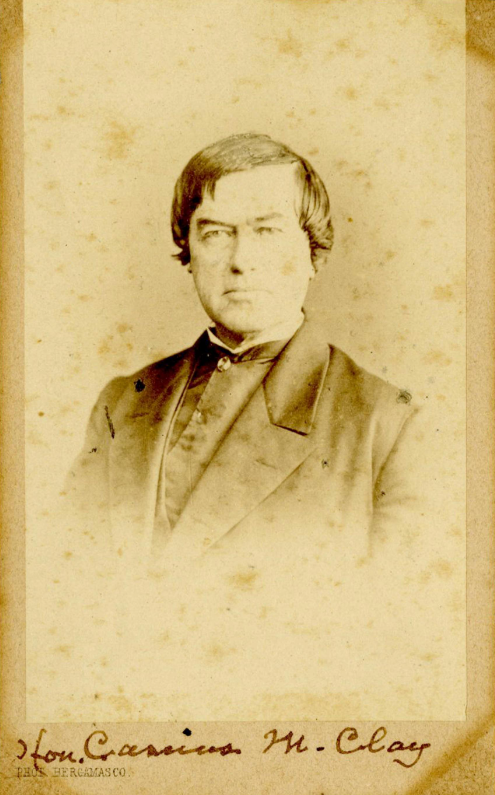
Cassius M. Clay, 1865.
My research began in the library, in the same section where I had found my secondary sources, which appeared to focus on Russo-American affairs. I searched for relevant dates and terms on the spines of books and read through them until I found a winner. The American Image of Russia, 1775-1917, by Eugene Anschel was a chronological collection of American views on Russia through primary sources such as essays from political figures. One such essay from Clay was included, titled “No Nation More Charitable and Humane”, it was written to an editor from the Kentucky Herald, Clay’s home state, defending the character of Russians and their country after harsh criticisms from the paper. This source does well to highlight Clay’s innate character and willingness to represent those who are voiceless.
I then turned to the Library of Congress, one of the less intimidating databases owned by the US government, and put in Cassius Clay’s full name. I was immediately inundated with sources, one of the largest being Clay’s memoir, The Life of Cassius Marcellus Clay. While I was thrilled at first to find his memoir, I knew it wasn’t considered a high level source and continued searching. I continued scrolling and found an address Clay had written for a global audience titled, Appeal of Cassius M. Clay to Kentucky and the World, and knew it would provide a well rounded context to how those outside the US might perceive Clay. My luck promptly ended there.
Afterwards, I prompted ChatGPT, asking it to find primary sources for Cassius Marcellus Clay as Minister to Russia, dates included. It generated a page from the Office of the Historian containing dispatches between Secretary of State Seward and Clay from 1861 that highlighted his duties as Minister and got into the technicalities of his role, something that was lacking from secondary sources. From there, I had to figure out how to find the dispatches from the next 8 consecutive years. Eventually, I found my way around the site and was able to obtain dispatches for each year.
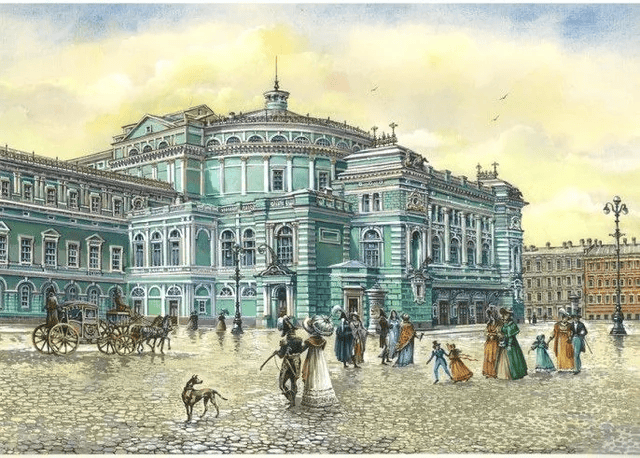
Mariinsky Theatre, St. Petersburg. Constructed in 1860.
ChatGPT then recommended me a site which contained personal letters to and from Clay. The site, ArchiveGrid, claimed to contain over “554 letters and documents”, that were only listed by title, and whose sole physical copies were housed in the Lincoln Memorial University Library, making them impossible to materialize for my use. I was frustrated that I couldn’t access them in whole, but the titles and short descriptions were actually somewhat helpful in getting an understanding for what Clay’s day-to-day correspondences looked like, even if I couldn’t use them as proper sources.
Concerned about the diversity of my sources, I mulled through my secondary sources and found something notable from “Cassius Clay’s Glimpse into the Future” by Albert Parry. It was an address to students of Berea College, where Clay proudly credited himself with orchestrating the purchase of Alaska. I frantically searched on Google for more sources, but only came across one final source from Rutgers University containing a personal correspondence between Clay and his acquaintance Moritz Pinner, that highlighting how men of his era conducted networking when abroad.
While the scarcity and inaccessibility of certain resources proved frustrating, the sources ranging from public addresses, private letters, and diplomatic dispatches offered a fragmented yet meaningful picture of Clay’s role abroad. As a researcher, this experience highlighted the need for adaptability and the willingness to use new tools like AI to enhance my search and bridge the gaps I could not cover with traditional methods. Though I was skeptical, I found that incorporating an AI model helped me move over the learning curve of navigating large databases faster, giving me more confidence and a large pool of resources that I likely would not have reached otherwise.
Bibliography:
- Anschel, Eugene. The American Image of Russia, 1775-1917. Frederick Ungar Publishing, 1974.
- “Cassius Marcellus Clay Papers, 1810-1903.” researchworks.oclc.org. OCLC Inc. Accessed April 27, 2026. [WEB]
- Clay, Cassius Marcellus, and True American. Appeal of Cassius M. Clay to Kentucky and the World. J. M. Macomber & E. L. Pratt, 1845. [LOC]
- “Cassius M. Clay, Integral U.S. Minister to Russia, Signed CDV.” universityarchives.com. Accessed April 27, 2026. [UA]
- Clay, Cassius Marcellus. The Life of Cassius Marcellus Clay. J.F. Brennan & Co. 1886. [WEB]
- “Minister to Russia Cassius Marcellus Clay.” loc.gov. Library of Congress. [LOC]
- “Mr. Seward to C. M. Clay. No. 4,” history.state.gov. May 21, 1861. [HIST] Suggested by ChatGPT.
- “Oration of Cassius Marcellus Clay before the Students and Historical Class of Berea College” Berea College. October 16, 1895. [WEB]
- “Transcript of a Letter from Moritz Pinner to Cassius Marcellus Clay.” Rutgers.edu. Accessed April 27, 2026. [WEB]
- “Untitled” Unknown [WEB] Illustration of Mariinsky Theatre. Accessed April 27, 2026.
Leave a Reply