Roadblocks and Resources: How Dead Ends Led to Primary Sources While Researching Jacqueline Kennedy Onassis
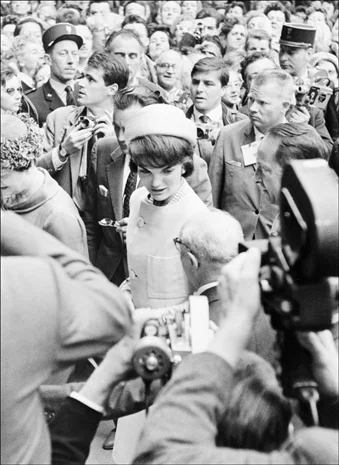
First Lady Jacqueline Kennedy is greeted by the press and public during her 1961 visit to Paris. [CBS News]
I started my pursuit of primary sources by further researching a potential lead I found while looking for images to add to my first journal post: Mark Shaw, a photographer who developed a close relation to the Kennedy family. The photos I found were taken domestically, but I hoped to find evidence that he accompanied the Kennedy family abroad – specifically to Paris – and that he published writing about those experiences. Sadly, after a Google search that led me to Shaw’s Wikipedia page and the Mark Shaw Photographic Archive, there was only evidence that the photographer accompanied the Kennedy family abroad once, on a vacation to Italy. Dead end #1.
Slightly disappointed but determined, I followed Professor Pinsker’s advice from class and created a list of source types I’d like to find to better narrow my focus and research efforts: letters or diary entries from Jacqueline Kennedy, government documents or notes about Jacqueline Kennedy’s diplomacy, French newspaper articles, domestic newspaper articles, interviews with Jacqueline Kennedy, and, if possible, material from people who disliked Jacqueline Kennedy. To hold myself accountable to the research process, I booked an appointment in the Writing Center with my friend Parker Lengle, a History major and research extraordinaire.
During the appointment, Parker helped me search databases such as Newspaper Source Plus and ProQuest. According to the Dickinson College Library website, Newspaper Source Plus has access to international newspapers, and TV and radio transcripts. However, despite using various search term combinations (“Jacqueline Kennedy” AND “Paris,” “Jackie Kennedy” AND “France,” etc.), I couldn’t find any French or American sources covering the First Lady’s European visit. Dead end #2. ProQuest proved more useful, specifically because it included an article that discussed Kennedy’s use of celebrity and quoted close personal friends. While I had found domestic newspaper articles, French sources proved more difficult to locate. Regrettably, I decided to use ChatGPT to aid my search. Despite my personal feelings about the use of AI in the writing process, I found ChatGPT’s results useful. The most useful source turned out to be an article by Claude Sarraute. Although half of the source is behind a pay wall (something I am trying to work around and currently labeling dead end #2.5), the half that is free to read still provides compelling insights.
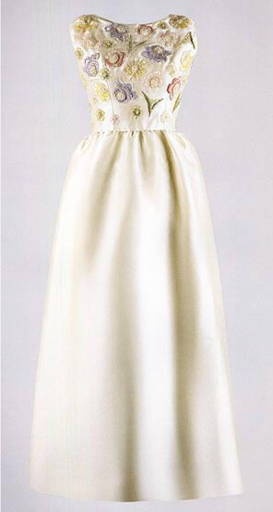
First Lady Jacqueline Kennedy demonstrated her appreciation for French culture by wearing an evening dress, designed by French designer Hubert de Givenchy, to a dinner at the Palace of Versailles on June 1, 1961. [National Archives]
Searching through bibliographies also led me to a source I am very surprised I hadn’t used yet, the John F. Kennedy Presidential Library and Museum. In hindsight, this is a no-brainer digital source with a large quantity of primary sources. One website page is dedicated to a special exhibit titled “In Her Voice: Jacqueline Kennedy, The White House Years,” which features information and quotes from a 1964 interview Kennedy did with historian Arthur Schlesinger, Jr. The interview discusses her visit to Paris and how members of the public thought she hated politics. The library also has an audio transcription of a news conference President John F. Kennedy did in Paris, where he famously said: “I am the man who accompanied Jacqueline Kennedy to Paris, and I have enjoyed it.” This source highlights Jacqueline Kennedy’s role in the Paris trip, but President Kennedy also contextualizes their visit, which will prove vital to my final paper.
I continued my research after my appointment, searching the John F. Kennedy Presidential Library and Museum website, but I still encountered roadblocks. While searching for the full documents referenced in the aforementioned museum exhibit, I learned that the items could only be viewed in person. Dead end #3. Eventually, I found the second-best alternative to letters by Kennedy: letters addressed to her. The most relevant letter was from a collection of correspondence between White House counsel Clark Clifford and Kennedy. In one of his letters, Clifford says, “You have rendered the most magnificent service to your country,” referring to the success the First Lady had in Paris. He further sings her praises, ending the letter by calling Kennedy’s skill an “asset to this nation.” This is when I began to feel a sense of achievement with my research; despite the tedious work I was doing, I was getting results.
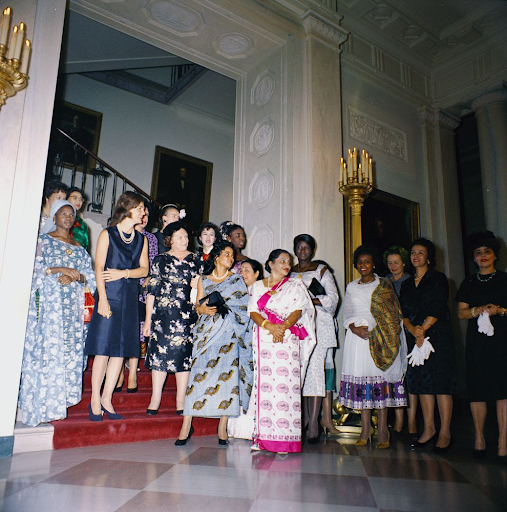
First Lady Jacqueline Kennedy poses with the wives of newly appointed ambassadors at a 1961 tea party, photographed by Robert Knudsen. [John F. Kennedy Presidential Library and Museum]
The most potent lesson I learned while searching for primary sources was that roadblocks are essential to the research process. Each dead end I encountered – whether it was that Mark Shaw didn’t go to Paris with the Kennedy family, unsuccessful database searches, or inaccessible archival materials – forced me to rethink my approach and refine my strategy. These challenges clarified which paths were unproductive, providing redirection toward available avenues, such as examining bibliographies. The setbacks I initially found frustrating became the most instructive moments of my research. Roadblocks revealed gaps in my knowledge and limitations in my approach, pushing me to ask better questions, use new resources, and think more critically about where and how to find evidence.
Bibliography
“120. Letter From Jacqueline Kennedy to Chairman Khrushchev.” Office of the Historian, 1 Dec,
- [WEB]
Birmingham, Stephen. “The Public Event Named Jackie: ‘Better than any Other Famous Woman
in History (Including Garbo), She has Mastered the Art of Managing Her Celebrity.’.” New York Times (1923-), Jun 20, 1976. [ProQuest]
Bohlen, Charles E. “268. Telegram From the Embassy in France to the Department of State.”
Foreign Relations of the United States, 1961–1963, Volume XIII, Western Europe and Canada, 16 Feb, 1963. [WEB]
“Correspondence with Jacqueline Kennedy, 1961-1965.” John F. Kennedy Presidential
Library and Museum, 1961-65. [WEB]
Department of State. “228. Talking Points.” Foreign Relations of the United States, 1961–1963,
Volume XIII, Western Europe and Canada, 27 May, 1961. [WEB]
“In Her Voice: Jacqueline Kennedy, The White House Years.” John F. Kennedy Presidential
Library and Museum, 1964. [WEB]
Kohler, Foy D. “223. Memorandum From the Assistant Secretary of State for European Affairs
(Kohler) to Secretary of State Rusk.” Foreign Relations of the United States, 1961–1963, Volume XIII, Western Europe and Canada, 24 Jan, 1961. [WEB]
Mailer, Norman. “An Evening with Jackie Kennedy.” Esquire Magazine, July 1, 1962. [Esquire
McBride. “230. Memorandum of Conversation.” Foreign Relations of the United States,
1961–1963, Volume XIII, Western Europe and Canada, 2 Jun, 1961. [WEB]
“News Conference 12, June 2, 1961.” John F. Kennedy Presidential Library and Museum, Jun 2,
- [WEB]
“President’s trip: Europe, 1961: May-June: De Gaulle briefing book: Volume I (3 of 3 folders).”
John F. Kennedy Presidential Library and Museum, 1961. [WEB]
Sarraute, Claude. “When Mrs. Kennedy throws a “party” for the press.” Le Monde, Jun 3, 1961
(Translated by Google Translate). [WEB]
Leave a Reply