When I initially did research on William Eaton, I found that there was much more information about him than I had previously expected. When I first encountered his name in Herring’s book, his lack of focus on Eaton seemed like a bad omen, but I found that he is a prominent figure when analyzing the U.S.’s relationship with the Middle East and North Africa. I was even more excited to see that, based on my secondary-source research, many of the footnotes were from letters Eaton himself had written. It was even clearer to me, upon further digging, that his correspondence was extensive, especially during his time as the U.S. consul in Tunis, leading up to and during the Tripolitan War.
I initially encountered this information when looking at the footnotes of a publication by Louis B. Wright and Julia H. Macleod. In these footnotes, it not only revealed that much of their information came from Eaton’s letters, but it also told me exactly where to find them – the Huntington Library. Upon further inspection of both the footnotes and the actual Huntington Library site, I found that they have an entire collection dedicated to Eaton’s letters, records, journals, and reports during his time as consul. This was also backed up by a quick search on ChatGPT about where I could find Eaton’s letters, the first recommendation of which was to look into the Huntington site. Unfortunately, venturing onto the extensive Huntington Library site seemed to be a bit of a dead end; that, or I just was not using it correctly. I was able to find Eaton’s name and catalog in the database, and it took me to listings with the document locations and call numbers. I was determined to try all I could to get access to these materials, so I found a link where I could request the materials I was searching for. This involved making an entire account with the library, but once that was done, I simply put in my request and explained my situation. Since the physical library is located in California, I requested a session to look at the documents through the Virtual Reading Room. As I am writing this, however, I have yet to hear back from them, so, naturally, I had to do a lot more digging.
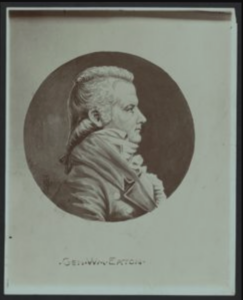
The Miriam and Ira D. Wallach Division of Art, Prints and Photographs: Print Collection, The New York Public Library. “Gen. Wm. Eaton.” New York Public Library Digital Collections. Accessed April 26, 2026. https://digitalcollections.nypl.org/items/922650c0-c555-012f-cc63-58d385a7bc34
I ran into a similar issue with my next attempt as I did with the Huntington Library. I found that the New York Public Library also had a collection of Eaton’s letters, and though not as extensive as Huntington’s, I was hoping to come out with something. But just like I had encountered before, I found myself sending an email to the Library asking for digital access to the materials if possible. I was lucky enough to get a response back the next day, but was disappointed to find out that the materials I was hoping to look at would not be available for 6-8 weeks if I continued with the request. At the end of the email, however, I was pleasantly surprised to see that the reference archivist who had responded to me was actually a Dickinson alum named Tal Nadan. In his email to me, he added links to other digital resources that might be helpful, including the New York Public Library’s Digital Collections, which I had previously missed. Here, I was able to find portraits of Eaton, as well as a scan of an original letter from Eaton to a Mr. Cathcart. It might take some time for me to decipher what exactly the letter says, but I was pleased to have something to work with.
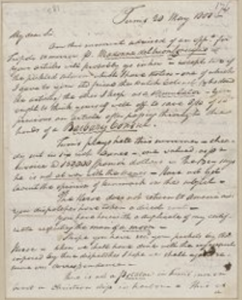
Manuscripts and Archives Division, The New York Public Library. “Eaton, William. Tunis. To Mr. Cathcart” New York Public Library Digital Collections. Accessed April 26, 2026. https://digitalcollections.nypl.org/items/b9070070-2e5e-0133-f829-58d385a7b928
I decided, then, to go back to the list of sources that ChatGPT had recommended to me, since I had already examined the first two recommendations to the best of my ability. It said that I might have some success looking at Dartmouth College’s Rauner Library’s databases. As I suspected, while I did find that they had quite a few letters, I ran into the same problem as before: they were not easily accessible online without explicitly requesting them. Before deciding whether or not I wanted to reach out again, asking for access, I decided to see if I could explore other primary source options that would be more successful. I figured that, since the Tripolitan war was the U.S.’s first foreign war, there must have been some domestic newspaper coverage of it. I started by simply searching up newspaper articles on William Eaton from the Tripolitan War and stumbled upon an article in the Kaplan Collection, originally published by the Political Observatory on January 21, 1806. In it was a letter from Eaton to the United States Committee on Claims. This was very exciting to discover, as it felt like my first successful attempt at finding a solid source from the period that could better inform my research. After this, I was really determined to find at least one other piece of correspondence from Eaton during his time in Tunis. I chose to search this up in Google to see what I could find (since other databases like the American National Biography did not have primary sources). After some digging, I found the Founders Online Archives, which had a letter from Eaton to Madison from June 1, 1801. This then took me to a link that gave me access to the full correspondence between the two. The last source that I was able to come up with was also very fruitful; the entire correspondence between Eaton and a man named Isaac Hull (whom I will need to do more research on), between 1804 and 1805, spanning 25 pages in length, which I found in a journal called the American Antiquarian.
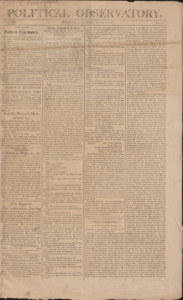
Arnold & Deanne Kaplan Collection of Early American Judaica. “Political Observatory: Newspaper, January 21, 1806,” 2026. https://www.kaplancollection.org/item/political-observatory-newspaper-january-21-1806-6422e1a8/.
Overall, I felt as though this round of research was substantially harder than my first time looking for secondary sources. It required much more technical ability and patience, especially since I struggled a lot with finding places where I could actually access the material. That being said, because of how long it took and how difficult the process was, it felt extremely rewarding when I finally found what I was looking for.
Bibliography:
“William Eaton to James Madison, 1 June 1801,” Founders Online, National Archives, https://founders.archives.gov/documents/Madison/02-01-02-0323. [Original source: The Papers of James Madison, Secretary of State Series, vol. 1, 4 March–31 July 1801, ed. Robert J. Brugger, Robert A. Rutland, Robert Rhodes Crout, Jeanne K. Sisson, and Dru Dowdy. Charlottesville: University Press of Virginia, 1986, pp. 247–248.]
Arnold & Deanne Kaplan Collection of Early American Judaica. “Political Observatory: Newspaper, January 21, 1806,” 2026. https://www.kaplancollection.org/item/political-observatory-newspaper-january-21-1806-6422e1a8/.
Dartmouth.edu. “Eaton, William, 1764-1811,” 2026. https://archives-manuscripts.dartmouth.edu/agents/people/6979.
“Hull-Eaton Correspondence during the EXPEDITION against TRIPOLI 1804-1805.” American Antiquarian, 105–28. Accessed April 26, 2026. https://www.americanantiquarian.org/proceedings/44806575.pdf.
Huntington.org. “The Huntington Library,” 2025. https://catalog.huntington.org/.
Huntington.org. “William P. Eaton Correspondence | Collections | the Huntington,” 2026. https://www.huntington.org/collections/lib-msseaton.
Nypl.org. “Archives.nypl.org — William Eaton Letters,” 2026. https://archives.nypl.org/mss/4358.