Up until this week, I assumed that primary sources, like most information today, would be readily available online if I spent enough time searching. That assumption proved wrong. The most frustrating moment in my research came when I found a reference to what seemed like the perfect source, a detailed interview with Henry Luce, only to realize it was locked in an archive inaccessible online and unavailable even with my student credentials. This obstacle forced me to rethink not just my topic, but my overall approach to research.
My project focuses on Henry R. Luce, the founder of Time and Life magazines and a major figure in shaping twentieth-century American journalism and political thought. At this stage, I shifted my attention to locating primary sources both by and about Luce. These included newspaper articles, speeches, and published collections of his writing. I also searched for interviews, personal letters, and other firsthand accounts, but quickly discovered that many of these materials are housed in physical archives, such as the Library of Congress or the Henry Luce Papers in special collections, which are only accessible to qualified researchers in person.
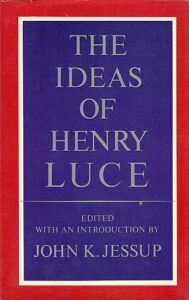
The Cover of the collection of Henry Luce’s speeches for Ideas of Henry Luce
Despite these limitations, I was able to find several valuable primary sources through Dickinson’s databases. Newspaper articles like “Henry Luce, 68, Dies in Phoenix” from The New York Times and “Sees Communism Failing” provided insight into how Luce was viewed publicly during and after his lifetime. Other pieces, such as “Henry Luce’s Policy” from The China Weekly Review, highlighted his influence on international affairs, particularly in relation to China. While these sources are less personal than letters or interviews, they still reveal how Luce’s ideas circulated and were perceived in real time. One of the most useful discoveries was a collection of his speeches in The Ideas of Henry Luce, which offered direct insight into his beliefs. His writings emphasized recurring themes such as the religious foundation of American democracy, the pursuit of truth, and the moral responsibility of the United States in global affairs.
Through this process, I’ve learned that primary source research is far more complex and constrained than I initially expected. Unlike secondary sources, which are often curated and easily accessible, primary sources require more effort to locate, interpret, and contextualize. One of the most important lessons I’ve taken away is that access itself shapes historical research. Because so many of Luce’s personal materials are restricted or only available in physical archives, my understanding of him is inevitably limited by what I can access. This realization gave me a greater appreciation for historians, who often need to travel, obtain special permissions, and spend significant time working through archival collections.
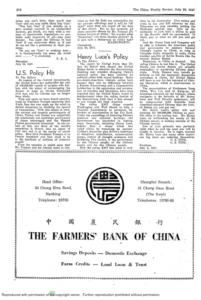
The newspaper containing the article “Henry Luce’s Policy” published in The China Weekly
Another key lesson is the importance of interpreting sources independently, which also exposed a gap in my own skills. In the past, I relied heavily on secondary sources to analyze historical figures for me, but working with primary materials forced me to engage directly with the evidence. Reading Luce’s own words about the “American Century” or his views on Christianity and communism required me to evaluate his intentions, biases, and historical context. At the same time, newspaper coverage revealed not just factual information but also public perception and contemporary bias. This experience made it clear that primary sources are not inherently more “truthful,” but they do offer a more immediate perspective that demands careful interpretation. It also showed me how little experience I have working with these materials and how often I depend on others’ interpretations, which is something I need to improve, especially given my interest in international relations, where analyzing original documents and reports is essential.
Overall, the search for primary sources has been both challenging and eye-opening. It has shown me that research is not just about finding information, but about navigating access limitations, making strategic decisions, and developing the ability to interpret evidence independently. Moving forward, I would begin primary source research earlier and explore archival access options sooner, rather than assuming everything I need will be available online. More importantly, I would prioritize engaging directly with primary materials, even when they are limited, to strengthen both my research process and my analytical skills.
Bibliography:
“Henry Luce, 68, Dies in Phoenix: Started a Publishing Empire with Time Began Life, Fortune, Sports Illustrated Henry R. Luce, Creator of Time-Life Magazine Empire, Dies in Phoenix at 68 Had Wide Impact In U.S. Journalism Helped Shape the Reading Habits, Politics and Cultural Tastes.” New York Times, March 1, 1967. https://dickinson.idm.oclc.org/login?url=https://www.proquest.com/newspapers/henry-luce-68-dies-phoenix/docview/118014658/se-2.
“Henry Luce; Clare Boothe.” The Observer (1901- 2009), Apr 25, 1943.https://dickinson.idm.oclc.org/login?url=https://www.proquest.com/newspapers/henry-luce-clare-boothe/docview/481725093/se-2.
Luce, Henry. “China to the Mountains.” Life Magazine, June 30, 1941. https://www.cbi-theater.com/life_063041/mountains.html
Luce, Henry R. “The American Century.” Life Magazine, Feb. 17, 1941. Reprinted in Diplomatic History 23, no. 2 (Spring 1999). https://news.harvard.edu/wp-content/uploads/2015/03/luce.pdf
Luce, Henry R. The Ideas of Henry Luce. Edited by John Knox Jessup. New York: Atheneum, 1969.
Ping, C. S. and C. S. Ting. “Henry Luce’s Policy.” The China Weekly Review (1923-1950), Jul 26, 1947.https://dickinson.idm.oclc.org/login?url=https://www.proquest.com/newspapers/henry-luces-policy/docview/1371516457/se-2.
“Sees Communism Failing: Henry R. Luce Says At Colgate It Is Losing In Western World.” New York Times, Sep 25, 1948. https://dickinson.idm.oclc.org/login?url=https://www.proquest.com/newspapers/sees-communism-failing/docview/108275688/se-2.

