From “Jacqueline” to “Jackie”: Improving My Approach to Secondary Source Research
Throughout Diplomatic History of the United States, topics related to culture and soft power interested me. As I read further about these themes and as they were discussed in class, I remembered a book I read in elementary school: Who Was Jacqueline Kennedy?, by Bonnie Bader. This children’s book discussed Kennedy’s life, but I specifically remembered learning about her charming personality and multilingual abilities, skills I would later see associated with cultural and soft power. While this early interest shaped my topic, the process of researching Jacqueline Kennedy quickly revealed that historical research depends less on prior knowledge and more on strategy. Who Was Jacqueline Kennedy? isn’t the type of source you’d cite for a college assignment. Thus, I began my research process by visiting my favorite History major in the Writing Center, Parker Lengle, who taught me that effective research can be a collaborative process, but it still requires precision and adaptability.
We started the appointment by searching for biographies of Jacqueline Kennedy in American National Biographies, a database Professor Pinsker recommended that provides tertiary sources. This built a foundational starting point for my research. Next, Parker helped me navigate various databases, such as America: History and Life, through JumpStart on the Dickinson College Library website. Although I have prior research experience, I quickly realized I had forgotten many of the more technical strategies necessary for efficient database searching. For instance, I used targeted search terms such as “Jacqueline Kennedy” AND “Foreign Policy,” relearning to use quotation marks and Boolean operators to narrow results. This was especially important, considering Jacqueline Kennedy was known by various names – Jacqueline Kennedy, Jackie Kennedy, Jacqueline Kennedy Onassis, etc. – which allowed me to discover different sources.
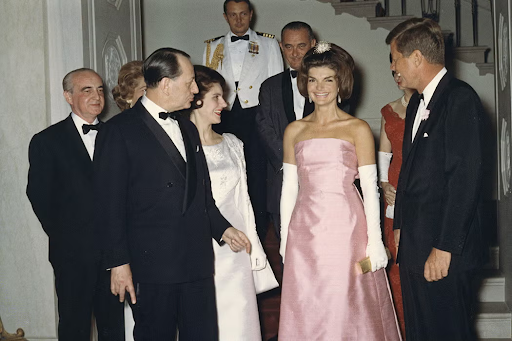
President John F. Kennedy and First Lady Jacqueline Kennedy attend a dinner (May 11, 1962) in honor of Andre Malraux, Minister of State for Cultural Affairs of France. [JSTOR Daily]
By searching through JSTOR, I encountered a variety of secondary sources. Some sources immediately jumped out as relevant to my probable focus on US-French relations due to their titles: “Jacqueline Kennedy, Frenchness, and French-American Relations in the 1950s and Early 1960s,” by Whitney Walton, and “Wives in the White House: The Political Influence of First Ladies,” by Karen O’Connor, Bernadette Nye, and Laura Van Assendelft. This demonstrated how refining my keywords led me to sources that directly addressed my specific research focus. I also found related sources, such as “Treatment of First Ladies in American Government and Presidency Textbooks: Overlooked, Yet Influential, Voices,” by Anthony J. Eksterowicz and Robert P. Watson. This source could be interesting to include in my essay because our class textbook, From Colony to Superpower: U.S. Foreign Relations since 1776, by George C. Herring, mentions Jacqueline Kennedy once, calling her “stylish,” and implying her use of celebrity.
After my Writing Center appointment, I continued researching, utilizing the methods Parker taught and reminded me of. Eventually, I took a break from databases and instead did simple Google searches, just to see what different types of sources might appear. One source I found using this method was Jacqueline Kennedy and the Architecture of First Lady Diplomacy by Elizabeth J. Natalie. I found the book’s abstract on ResearchGate, but the full text was behind a paywall. Rather than abandoning the source, I explored alternatives: searching JumpStart for the book, checking the Internet Archive, and even searching Reddit for a free PDF. My current solution is to attempt an interlibrary loan, but I have not yet completed the process. However, the book’s abstract alone demonstrates its relevance and potential to advance my research.
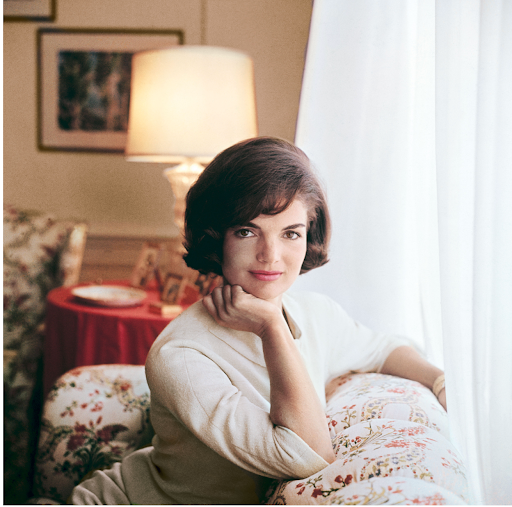
Portrait of First Lady Jacqueline Kennedy, photographed by Mark Shaw. [Real Art Press]
However, after sending a draft to Professor Pinsker, I learned I still had more to learn about the research process. He pointed out ways to improve my narrative writing (e.g., that I had to search through databases using Kennedy’s various monikers), but more importantly, he noted that some of my sources didn’t seem particularly relevant and that I had missed a source Herring cited while discussing the Kennedy family’s use of celebrity. Herring cites a book by Robert Dallek, which I later found on the Internet Archive. Given the context of the quote, some chapters should prove useful in researching Jacqueline Kennedy’s political and cultural influence.
For me, the beginning of my research reinforced the importance of seeking guidance early in the research process. My appointment at the Writing Center provided me with tools and strategies that I continued to use afterward, streamlining my subsequent research, and Professor Pinsker’s feedback allowed me to sharpen my focus and examine new sources. My experience demonstrates that successful research is not about immediately finding the ‘right’ sources, but about developing effective methods – such as refining search terms, following bibliographies, and navigating access barriers – to locate, evaluate, and connect information. Moving forward, I plan to approach research with greater intentionality, using targeted search strategies and actively engaging with the scholarly conversations.
Bibliography
Bradley, Richard. Onassis, Jacqueline Kennedy. American National Biography, 2000. [WEB]
Brown, Barbara Pascarell. “Pretty in Pink: Jacqueline Kennedy and the Politics of Fashion.” Legacy Theses & Dissertations (2012): 605. [WEB]
Cull, Nicholas J. “Auteurs of Ideology: USIA Documentary Film Propaganda in the Kennedy Era as Seen in Bruce Herschensohn’s ‘The Five Cities of June’ (1963) and James Blue’s ‘The March’ (1964).” Film History 10, no. 3 (1998): 295–310. [WEB]
Dallek, Robert. John F. Kennedy: An Unfinished Life, 1917-1963. London: Allen Lane, 2003. [INTERNET ARCHIVE]
Eksterowicz, Anthony J., and Robert P. Watson. “Treatment of First Ladies in American Government and Presidency Textbooks: Overlooked, Yet Influential, Voices.” PS: Political Science and Politics 33, no. 3 (2000): 589–95. [WEB]
Herring, George C. From Colony to Superpower: U.S. Foreign Relations Since 1776. New York: Oxford University Press, 2008. [PRINT]
Natalie, Elizabeth J. Jacqueline Kennedy and the Architecture of First Lady Diplomacy. Peter Lang, 2018. [RESEARCH GATE]
O’Connor, Karen, Bernadette Nye, and Laura Van Assendelft. “Wives in the White House: The Political Influence of First Ladies.” Presidential Studies Quarterly 26, no. 3 (1996): 835–53. [WEB]
Walton, Whitney. “Jacqueline Kennedy, Frenchness, and French-American Relations in the 1950s and Early 1960s.” French Politics, Culture & Society 31, no. 2 (2013): 34–57. [WEB].