Dickinson Blog for ENGL 222

Category: Afterlives (Page 2 of 2)

Baedeker’s Afterlife: Edition Evolution

Researching the afterlife of Baedeker’s Great Britain introduced me to an entire subsection of the book collecting world I had previously been unaware of. My intention was to try and track what I am calling the Edition Evolution of the Great Britain Guide, as my copy is the sixth edition, and given the scope of my guidebook (the table of contents spans several pages, and as I mentioned in my previous post, it covers content from geographic locations, floor plans, and popular activities within its area), it is not unreasonable to assume that there would be at least some form of significant change between editions. Luckily for me, I was not disappointed.

In my research, I was able to find out some of the history behind the legacy of Karl Baedeker, spanning several generations of Baedeker, and their guidebooks. Karl was born in 1801, into a family of bookseller and publishers. He started the “Baedeker” business in 1827, which coincidentally was around the time when tourism was really taking off (pun unintended). Following the foundation of this business, his first guidebook was published in 1832, 74 years before the publication of my own guidebook. The first edition was titled Rheinreise von Mainz bis Koln, as the Baedeker family was German – the first English edition guidebook wouldn’t be printed until 1861. This edition was called Baedeker’s Rhine, the first edition of which is currently being sold for a little over $5,000. As his company built its reputation, Karl travelled everywhere he could to gather the information to construct his guidebooks, until his death in 1859. He is hailed as the inventor of the formal guidebook according to at least a few people, including a chapter in a book titled Giants of Tourism by D.M. Bruce, R.W. Butler, and R. Russell, where they refer to him as “the perceived ‘inventor’ of the formal guidebook,” and his guidebooks themselves as a “bible” for 19th-century travelers. After Karl’s demise, his three sons continued his business, and it is still operating to this day.

As I gathered this information, I came across a wide variety of Baedeker’s guidebooks that are being sold online. First editions go for quite a bit of money, especially on rare book seller’s websites. But they are also being sold on places like Etsy, eBay, Amazon, and generally a good number of used bookselling platforms. Even when I narrowed my search down to just the Great Britain guide, there are still a lot of results. This surprised me – given the condition of my book, which implies that it was largely used a shelf piece or perhaps escapism on behalf of the owner, I had assumed that these books were pretty exclusively “collector” edition books. But the original intention of the books was for them to be actively used as convenient travel guides, so of course they were widely spread for tourism purposes. I also came across a lovely book called the Baedekeriana (2010) by Michael Wild, who was fascinated by the history of the Baedekers and wanted to compile it. It includes written accounts from people who worked with the Baedekers, and is an anthology of articles about past Baedeker guidebooks.

The Baedekeriana details the intense attention to detail and accuracy, as well as the impact that cultural differences and World War I and World War II had on the printing of guidebooks, especially for a German-based company. I am excited to spend more time understanding this history myself, but for now I turned my attention more avidly towards the specific evolution of the Great Britain guidebook. Initially, I was only able to find the editions that bookended my own – the 5th edition, printed in 1901, and the 7th printed in 1910. Given that my own book was printed in 1906, these dates only affirmed to me that the attention to detail referenced in my research on the Baedekers was accurate.
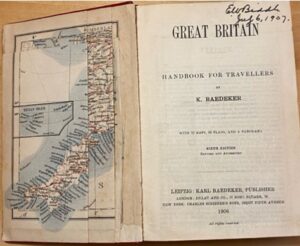
Fig. 1

My edition of the guidebook is described as having “22 maps, 58 plans, and a panorama” (Fig. 1). The 5th has “18 maps, 39 plans, and a panorama”; the 7th “28 maps, 65 plans, and a panorama.” The visible growth of content just in the frontmatter of each book is a testament to the attention to detail given to the content of each guidebook. Over just 9 years there is an increase of 10 maps in just one specific guidebook. How are other books growing? How did this specific guide change along with significant world events?

I was able to find an 1894 Baedeker’s Great Britain on eBay that showed some of the internal book – it has “16 maps, 30 plans, and a panorama.” Interestingly, the title page says it has 16 maps, but the list of Baedeker’s guide books behind the front cover lists the third edition of Great Britain as having 15 maps. I’m not sure why this discrepancy exists, and after taking a closer look at the other PDFs I found, the 5th edition describes the Great Britain guide book in that same list to have “16 maps, 30 plans, and a panorama”, the 7th doesn’t display that list at all, and mine is frustratingly obscured by a library identification card.

Something else I stumbled across while I was traipsing across the internet trying to find other editions of the Great Britain guide was the shocking discovery of just the Baedeker maps being sold. The very things that drew me in initially are apparently the main draw for a good number of interested parties. On Etsy some of them are being sold for $115, which is an unfortunate loss for those looking to find intact editions.


Works Referenced:

Wild, Michael. Baedekeriana: An Anthology. Red Scar Press, 2010.
The Many Lives of An Historical Account of the Incorporated Society for the Propagation of the Gospel in Foreign Parts Containing their Foundation, Proceedings, and the Succeses of their Missionaries in the British Colonies, to the Year 1728

Every book we read is a material item, and just like artifacts of the past, they have extensive histories often stretching back decades before we read their pages. An Historical Account of the Incorporated Society for the Propagation of the Gospel in Foreign Parts Containing their Foundation, Proceedings, and the Succeses of their Missionaries in the British Colonies, to the Year 1728 is no different. David Humphreys wrote the book to describe the royal-funded Society for the Propagation of the Gospel in Foreign Parts’ efforts to evangelize in the British North American colonies. Joseph Downing printed An Historical Account of the Incorporated Society (title shortened) in 1730 in his Bartholomew-Close, London, print shop. Downing was a close associate of the Society for the Propagation of the Gospel in Foreign Parts which provided him a steady income in the book printing industry in the first decades of the eighteenth century (Jefcoate, doi.org/10.1093/ref:odnb/53804). Outside of working for the Society, Downing was a prolific printer in his own right, even printing translated German texts. Downing died in 1734, but his work and connection to the Society in London continued under his widow’s supervision.

Downing’s printing of  An Historical Account of the Incorporated Society lived on past his death, with the work eventually travelling across the Atlantic Ocean to the Thirteen Colonies that David Humphreys investigated in when writing the work in 1730. Between the 1690s and his death in 1735, Philadelphia politician and merchant Isaac Norris collected an array of books, particularly about scientific works (Korey, 2). Given the fact that Norris Sr. died only five years after Downing printed An Historical Account of the Incorporated Society, the work likely came into the Dickinson College Library’s “Norris Collection” through his equally intellectually invested son Isaac Norris Jr. Born in 1701, Norris Jr. amassed a vast personal library by the 1760s, including prominent literary works such as John Milton’s Paradise Lost (Korey, 7). Norris accumulated scientific works as his father initiated, but also collected North American-specific works on the history of the Thirteen Colonies such as Humphrey’s book. In an indication of elite Enlightenment polyglotism in North America, Norris’ titles were primarily non-English books, written in French, German, Greek, Latin, Dutch, and Italian (Korey, 9). In his introduction for the 1975/1976 The Books of Isaac Norris (1701-1766) at Dickinson College, Edwin Wolf derides the few English works as “relatively unimportant theological works,” which undeniably includes the English theological work An Historical Account of the Incorporated Society. Most importantly, Norris Jr. collected contemporary works (those published in the mid-eighteenth century like An Historical Account of the Incorporated Society) in particular, ordering copies of freshly printed books. Norris held only a handful of pre-1700 works in English (Korey, 10). Norris read many of the 1,902 books (1,750 volumes) in his collection, etching notes in the introductory flyleaves (Korey, 13). No such notes exist in An Historical Account of the Incorporated Society, so it is difficult to assess if Norris read the 1730 work. However, once the book travelled to Dickinson College, it likely became a staple textbook of the institution.


After Norris’ death in 1766, the collection passed to his son-in-law John Dickinson (Korey, 8). Humphrey’s 1730 work was part of this, in the words of John Adams “very grand,” collection. In 1784 John Dickinson, the namesake of Dickinson College, donated the Norris Collection to Dickinson College (Korey, 21). The Norris Collection formed the core of the early Dickinson College Library, contributing to one of the most extensive educational libraries in the new nation, larger than those at more established institutions such as Yale. An Historical Account of the Incorporated Society was one of these 2,700 volumes that graced the normal shelves of the Dickinson College Library from 1784 to 1934 (Korey, 16, 19). However, by 1975/1976 An Historical Account of the Incorporated Society was in poor physical condition after centuries of use (Korey, 160). No front cover existed, an unusually prominent mark of damage compared with the reports of other Norris Collection works in generally average quality.

In the eighteenth and nineteenth centuries, Christian theology played a vital role in the pedagogy of Dickinson College. In fact, Benjamin Rush in part chartered Dickinson College to counter the intellectual supremacy of radical Philadelphia Presbyterians in Pennsylvania (Korey, 1). Given An Historical Account of the Incorporated Society’s placement on the regular Dickinson College Library shelves alongside more modern works for 150 years and the close connection between Dickinson College’s religious foundations and the book’s study of eighteenth-century religion, it is undeniable that Dickinson College students handled the work frequently even centuries after its publication.

The copy in the Norris Collection is not the only edition surviving today. According to WorldCat.org, Downing printed editions of An Historical Account of the Incorporated Society in 1720 and 1728 (search.worldcat.org/formats-editions/10536619?limit=50&offset=1). As late as 1967, an unknown printer re-printed a modern copy of the work in microfilm (search.worldcat.org/title/1127677992). Today, numerous copies of Downings’ 1730 printing abound in online stores. On the Bauman Rare Books website, the work has a sale price of $3,800 (baumanrarebooks.com/rare-books/humphreys-david/historical-account/91250.aspx). Even if the work no longer graces the shelves of the Dickinson College Library today, readers continue to purchase it across the globe.


Works Cited

“An historical account of the incorporated Society for the propagation of the gospel in foreign parts: containing their foundation, proceedings, and the success of their missionaries in the British colonies, to the year 1728.” World Cat. search.worldcat.org/formats-editions/10536619?limit=50&offset=1. Accessed 6 November 2024.


“An historical account of the incorporated Society for the propagation of the gospel in foreign parts: containing their foundation, proceedings, and the success of their missionaries in the British colonies, to the year 1728.” World Cat. search.worldcat.org/title/1127677992. Accessed 6 November 2024.


“Historical Account.” Bauman Rare Books. baumanrarebooks.com/rare-books/humphreys- david/historical-account/91250.aspx. Accessed 4 November 2024.


Jefcoate, Graham. “Downing, Joseph.” Oxford Dictionary of National Biography. 23 September 2004. doi.org/10.1093/ref:odnb/53804. Accessed 3 November 2024.


Korey, Marie Elena. The Books of Isaac Norris (1701-1766) at Dickinson College. Carlisle, PA, Dickinson College, 1975/1976.

Sandys’ Magnum Opus: The Afterlife Journey of Ovid’s Metamorphoses, 1632

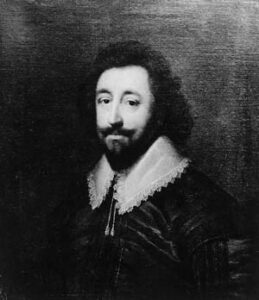
George Sandys’ 1632 publication Ovid’s Metamorphoses Englished, Mythologiz’d, and Represented in Figures was, at the time, only his most recent translation of Ovid’s epic. He first produced a shorter translation, only the first five books of Metamorphosis, in 1621, just before traveling to the Virginian colony of Jamestown (Ellison). Sandys was a prolific travel writer whose works were read by the likes of Francis Bacon, Michael Drayton, and John Milton, but perfecting his translations of Metamorphosis seemed to be a passion project for him.

Figure 1: George Sandys, courtesy of the Oxford Dictionary of National Biography

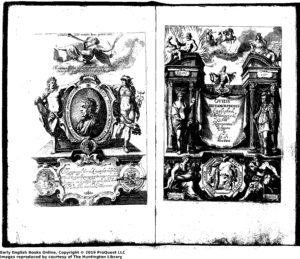
After the first illustrated translation of 1632, Sandys published a second illustrated version in 1640. John Legat published this edition in London as John Lichfield, the Oxford printer who published the 1632 edition, had passed away five years earlier in 1635 (Roberts). The differences between the two illustrated editions are unclear, aside from a portrait accompanying the frontispiece (Figure 2). The Latin inscriptions and Roman-style wreath on the subject’s head suggest the portrait depicts Ovid, the original author of Metamorphosis. Various other versions of Sandys’ Metamorphosis translations would be published long after his death in 1644. Not all were expanded editions of the illustrated versions—many were different versions of his earlier English translations. This was likely an economic decision, as illustrated books were considerably more expensive to produce. 

Figure 2: Portrait of Ovid alongside the frontispiece in the 1640 illustrated edition. Courtesy of Early English Books Online, scanned reproduction courtesy of The Huntington Library.

I

It is difficult to determine the true worth of a copy of Ovid’s Metamorphoses Englished, Mythologiz’d, and Represented in Figures, such as the one held in the Dickinson College Archives and Special Collections. Dickinson’s copy has extreme wear on the back cover, which would diminish its worth. Another copy of the same 1632 illustrated edition is listed online for $3,500 by Phillip J. Pirages Fine Books and Manuscripts. The seller’s description indicates slightly less damage to the binding, but similar levels of preservation to the Dickinson copy. However, it would be difficult to determine if the books were truly of a similar condition and therefore of similar value without comparing them side by side. Interestingly, Liber Antiques lists a copy of the 1640 second illustrated edition for $9,500. This difference in price begs questioning, but it is unclear why the two editions are valued so differently. It could be due to the conditions of the individual copies, or perhaps the second illustrated edition had fewer copies printed and is therefore more rare, but there is no way to be certain without a professional appraisal. Whatever the factor is, it is unlikely that the illustrations themselves contribute to the value. Copies of Sandys’ 1626 translation—not illustrated—can be found online ranging in price from $7,800-$9,000. While surprising, this indicates that the illustrations have little, if any, bearing on the worth of the book.

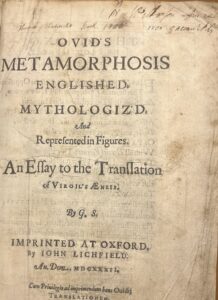
Discerning the actual fate of the Dickinson College Archives’ copy before it arrived in Carlisle proves a more daunting task. There are not many physical clues as to who owned the book over the years and how it was used aside from a few inscriptions in ink on the title page (See Figure 3).

Figure 3: Title page with handwritten inscriptions at the top of the page.

The phrase “Thomas Chadwick’s Book” can be made out alongside the year “1780.” About an inch to the right, the year “1730” is written. Other marginalia on the page, clearly from another time given the variations in handwriting and ink color, is illegible. The writing tells us that a man named Thomas Chadwick once owned this book. Perhaps he acquired it in 1780, or that was just the year he chose to claim ownership of it in writing. No results come up for Thomas Chadwick in the Oxford Dictionary of National Biography, so it is probable that Mr. Chadwick was by all accounts a regular man who enjoyed classical literature. There is also the possibility that he may have lived in the United States of America, which would have been in the middle of the Revolutionary War at the time Chadwick’s inscription implies that he owned it. There are no other identifying marks indicative of other previous owners of the Dickinson copy of Ovid’s Metamorphoses

While there seems to be scant information on the physical copies of the 1632 illustrated edition Ovid’s Metamorphoses Englished, Mythologiz’d, and Represented in Figures and its subsequent editions, the text itself continues to enjoy longevity. The University of Nebraska Press reprinted the original text in 1970 and other publishers have followed suit. A 2010 reprint by Kessinger Publishing is currently on sale on Amazon, for $54.60 instead of $59.95. In recent years, faculty at the University of Virginia have digitized the 1632 illustrated edition as an etext for free use. The permeation of Sandys’ work into the twenty-first century is a testament to his talent as a translator and writer. As a friend of King Charles I, Sandys enjoyed special privileges such as the exclusive publication rights to translations of Metamorphosis following the publication of his first full translation in 1626 (Bauman Rare Books). Though Sandys himself may not be a household name, many of his peers and the writers he inspired are well-known. He was a contemporary of Milton and Sir Francis Bacon, who read his work, and influenced the likes of John Dryden and Alexander Pope with the poeticism of his translations. He was revered for maintaining the qualities in translation that made Metamorphosis (at least in format) an epic poem, down to the number of lines in Ovid’s original Latin text. Given his poetic prowess and attention to detail, it is no wonder Sandys’ translation is one that stands the test of time. 


Works Cited

Ellison, James. “Sandys, George (1578–1644), writer and traveller.” Oxford Dictionary of National Biography.  January 03, 2008. Oxford University Press. 

Gordon, Laura. “SANDYS, George.” Database of Classical Scholars | Rutgers, The State University of New Jersey, https://dbcs.rutgers.edu/all-scholars/9091-sandys-george.

“Ovid’s Metamorphosis Englished – Ovid – Bauman Rare Books.” Baumanrarebooks.com, 2024, [LINK]. Accessed 7 Dec. 2024.

Roberts, R. Julian. “Lichfield, Leonard (bap. 1604, d. 1657), printer.” Oxford Dictionary of National Biography.  September 23, 2004. Oxford University Press.


Works Consulted

Frequently Asked Questions | ABAA. https://www.abaa.org/about-antiquarian-books/faq. 

Sandys’ Ovid 1632 (Linked Table of Contents)–Ovid Illustrated, University of Virginia Electronic Text Center. https://ovid.lib.virginia.edu/sandys/contents.htm.


Additional Links

Listing of illustrated 1632 edition by Phillip J. Pirages Fine Books and Manuscripts:

https://www.pirages.com/pages/books/ST17496-030/mythology-ovid/ovids-metamorphosis-englished-mythologizd-and-represented-in-figures

Listing of 1640 illustrated edition by Liber Antiques:

https://www.liberantiquus.com/pages/books/4781/ovid-george-sandys-abraham-van-diepenbeeck-artist-publius-ovidius-naso-43-bce-17-ce/ovid-s-metamorphosis-englished-mythologiz-d-and-represented-in-figures-an-essay-to-the

Kessinger Publishing’s 2010 reprint on Amazon:

https://www.amazon.com/Metamorphosis-Englished-Mythologized-Represented-Figures/dp/1169810470

Newer posts »

© 2025 History of the Book 2024


Academic Technology services: GIS | Media Center | Language Exchange

Theme by Anders NorenUp ↑