Reading The Legend of Auntie Po made me think a lot about the stories we grow up with and how we change them to fit who we are. Mei reshapes the Paul Bunyan myth into something that actually reflects her life. She thinks of a powerful Chinese woman who protects her community instead of the giant lumberjack everyone else talks about. What I love is that Mei doesn’t wait for permission to change the story, she just does it because she needs a version that makes sense to her.
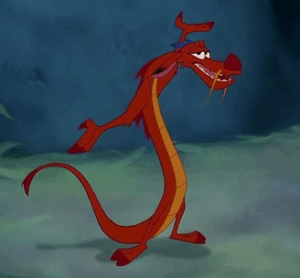
I related The Legend of Auntie Po to Mulan. Mulan is a movie I watched when I was little and loved mostly because she was brave and independent (and I was obsessed with the idea of cutting my hair and becoming a warrior). But after reading Khor’s novel, I started noticing how much Mulan is also a kind of reimagining but just on a much bigger scale and shaped by a company instead of by one kid in a logging camp.
Both Mei and Mulan deal with people telling them who they’re supposed to be. Mei is expected to stay quiet, help her father and accept the racism around her without pushing back. Mulan is expected to become the perfect daughter and fit into her society’s rules. Neither of them can really be themselves inside those expectations, so they turn to stories to add themselves in.
What stands out most, seeing these two together, is how powerful it feels to take a story that doesn’t quite fit you and change it. Mei isn’t trying to make the correct version of the Auntie Po myth but she’s trying to make one that helps her survive. And I think a lot of us watch movies like Mulan for the same reason. It’s not because they’re perfectly accurate but because they give us a way to imagine ourselves as stronger or freer than we actually feel.
The Legend of Auntie Po reminds me that stories are alive and they grow and change with us. They shift based on who’s telling them, what they need and what they want. And maybe the whole point is that we get to shape the stories that shape us.
We’ve been discussing storytelling in my seminar recently, and in every discussion we have about it, we always wind up talking about how storytelling is centered around discourse, and how our discourse is and has changed as we evolve and change.
We’ve also discussed how storytelling can be used as a sort of comfort or coping mechanism when dealing with heavy issues as a way of making them more communicable. We see this in Mei’s visions of Auntie Po when she has strong feelings of upset or something distressing happens in the graphic novel.
I really like your analysis of how stories are alive. I love the fact that you tied Mei changing the story of Paul Bunyan to her way of coping with the racism her and her father face. I never though of Mei’s story telling as a coping mechanism but after reading your analysis I can’t help but see it as one. I think it’s perhaps most apparent that her stories are her coping mechanisms after her father is forced to leave the camp to work in town. After he leaves Mei is thrown into a depression and fueled by anger. She keeps these emotions bottled up until she is asked to tell a story, at that moment Mei is able to release her anger and process her emotions through storytelling.
I like the way you connect Mei’s version of the Paul Bunyan story to Mulan. It makes a lot of sense how both characters deal with expectations and turn to stories to see themselves differently. Your point about Mei creating the version she needs really stood out, it shows how stories can shift depending on who’s telling them. Overall, your reflection highlights how both works use storytelling to make room for identities that don’t quite fit the usual mold.
I had this thought as well but honestly didn’t know if it would seem too immature a comparison. But this analysis does offer more than what I was intially expecting. It also makes me think of how selfless Mei and Mulan are and how they are both willing to do what it takes to survive, but that often lead to sacrifice for those around them. Mei is not able to explore her passion of reading and learning because of what the logging camp offers her and her father and Mulan takes her father place in the fights against the Huns. Both of these young women are admirable because of how they use their identities as a strength.
I think you all might really enjoy reading the book “The Woman Warrior, Memoirs of a Girlhood Among Ghosts” by Maxine Hong Kingston.
This is such a thoughtful reflection. I love how you highlight the connection between Mei and Mulan as girls who refuse to stay inside the limits others set for them. Your point about mythmaking feels especially powerful to me since stories aren’t fixed, they’re living spaces we remake to survive, to dream, and to see ourselves more clearly and I totally agree with you! The way Mei reshapes Auntie Po really shows how many of us latch onto characters like Mulan, not because they’re perfect, but because they let us imagine bolder versions of ourselves!
You talked a bit on how Mulan and Mei are taught to stay silent in situations, essentially to be seen and not heard. This instantly made me think of another story we had read throughout the year: Fun Home. During that story, Bechdel also references similar experiences she had with her father. Where she was told how to dress and how to act — to basically be a lady and different from herself. These three stories show ground-breaking women going against the wishes of those around them, so they can be themselves.