How do WE Relationship – and the many other manga I considered

During our class cultural artifact activity, I couldn’t decide what manga to bring, but I knew I wanted to bring a manga. (Manga read right to left)

I considered bringing The Whole of Humanity has Gone Yuri Except for me, (yuri is the japanese term for girls love) a book I picked up at barnes and noble because of it’s insane title. It turned out to be a somewhat camp, utterly insane, supernatural tale of a girl waking up and realizing that every single person in the world had been transformed into a lesbian woman.

I considered Bloom Into You, written by Nio Nakatani. I own every copy of this manga, and it’s super dear to my heart. This story features Yuu and Touko. Touko is outspokenly in love with – and wants to kiss – Yuu, and is fine if Yuu doesn’t reciprocate. Yuu is overwhelmed by this pressure, and feels like their relationship will lead nowhere, not because she isn’t attracted to girls, but because she’s not really sexually attracted to anyone, and never has been. She’s felt isolated from her peers her whole life, in this regard, atleast, and the story is about both of them coming to really love eachother and grow mutually as people.

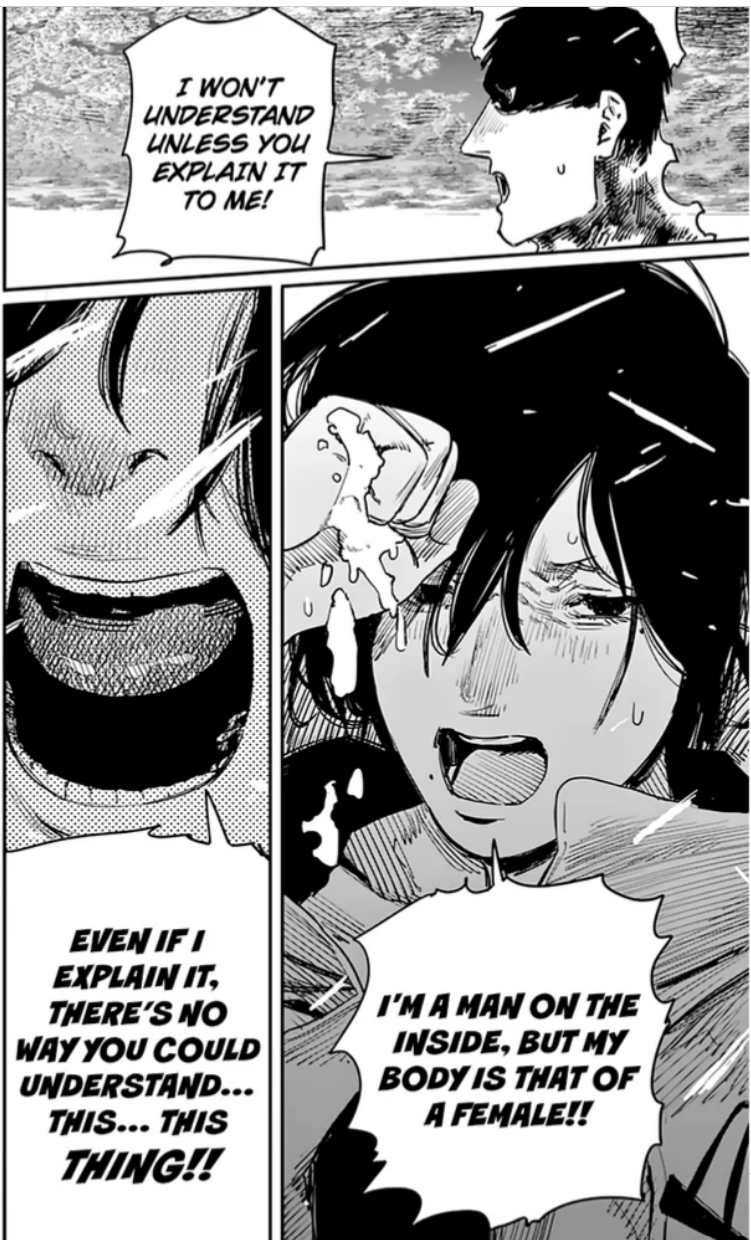
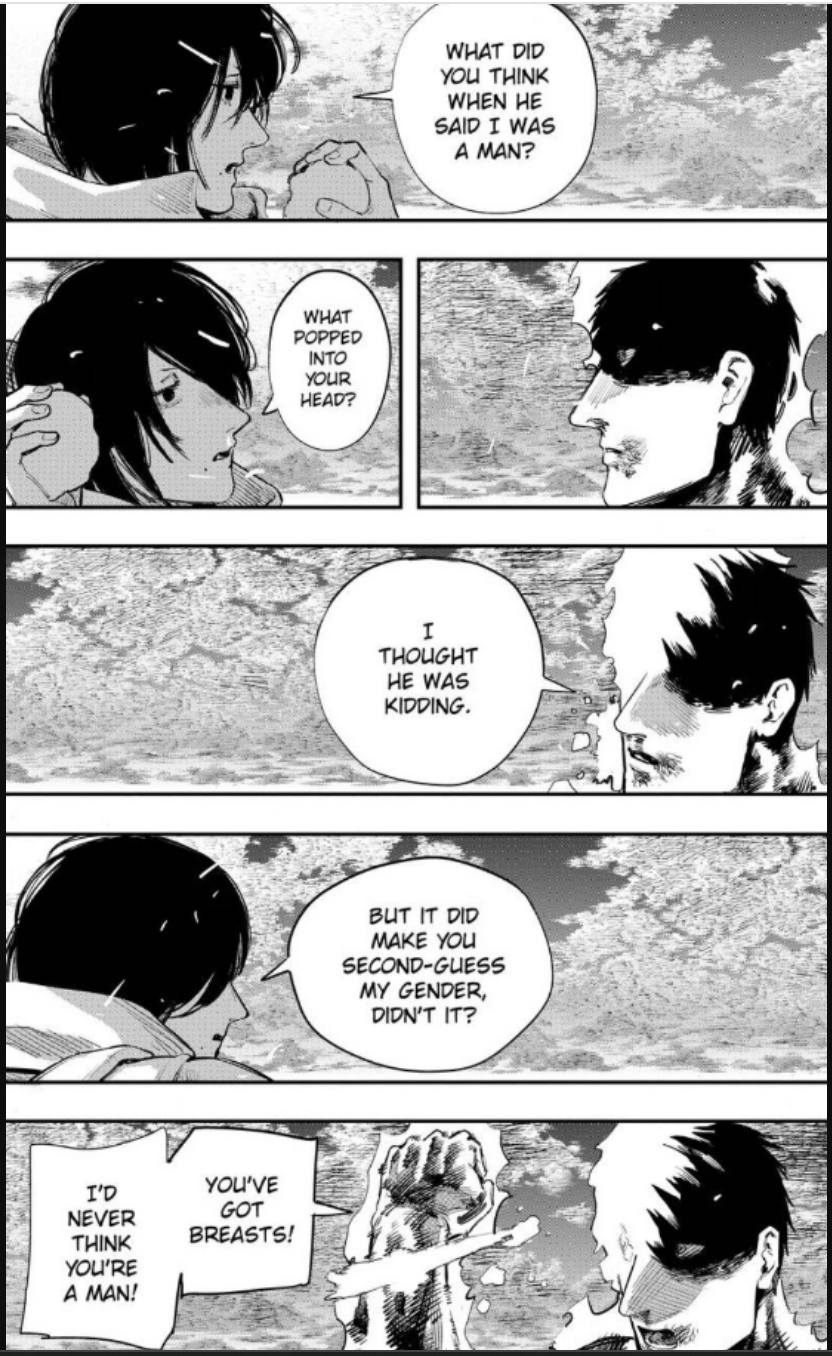
I even considered Fire Punch, written by Tatsuki Fujimoto. This work is very graphic and surreal in terms of themes and violence. The main character grows up in a dystopian wasteland, where few are cursed with and exploited for their supernatural regenerative properties. He is set on fire, early on, with flames that never go out, and since he cannot die, he walks the land a perpetual human torch. I almost chose Fire Punch, not for him, but for one of his companions that joins him on his journey. Togata is the deutragonist, who is rare in manga because he makes explicitly clear his gender dysphoria. Togata has a woman’s body, but confesses to Agni (the human torch) that he is a “man” on the inside. What makes Togata so tragic, is that he is also cursed with regeneration. Every time he dies (a constant device throughout the story) he must return to a body that he considers himself trapped in. A feminine body. Also related to our class is Togata’s role in the story. Togata is a self proclaimed director, and he orchestrates several events (and films them) throughout the story. It makes me think of diving into the wreck, returning to that dystopian land with a camera. But this time, Agni is the flashlight that Togata is using to explore the wreckage. (the following panels are not exactly page x and page y, there may be one sequence in between.)
 

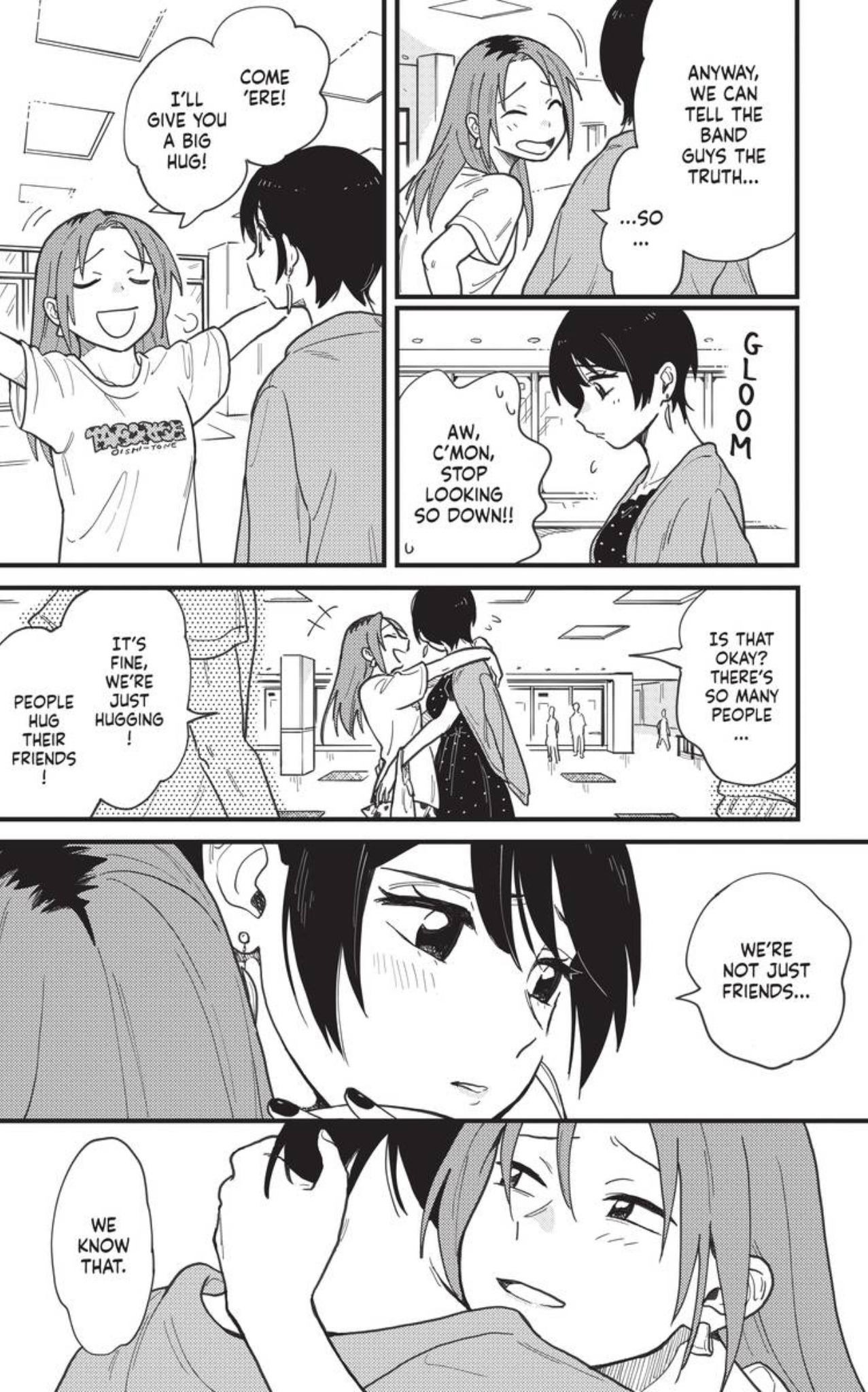
The manga I actually chose is How do we Relationship? By Tamifull. Like Bloom Into You, this is a super well known yuri manga in the community. How do we Relationship? is unique because the story starts when the two characters start dating. Most stories have the whole “will they/won’t they” through line, and while that does come into play because they break up once (or twice) having them meet and get together in the first chapter really sells the vibe that no, this is going to be a realistic portrayal of two people that love eachother, struggling to treat themselves right, struggling to treat eachother right, and struggling with the dynamics of a relationship. The character development is treated so well in this story, and I love how modern and well handled it feels. The characters, Miwa and Saeko, are openly lesbian, Saeko has a heterosexual friend that literally calls her on the phone while she’s having sex with a dude. They live actual lives, they have actual pasts, and the way Tamifull handles things like “visibility” is really nice. This manga feels super genuine to me, and I loved seeing Miwa and Saeko care for eachother. Misunderstandings feel believable and in character, not phoned in, you root for their growth and good communication, and you’re eventually rewarded. I think something powerful that How do we Relationship? touches on, is interconnectedness. While Miwa and Saeko are lesbian, and that’s a big part of their story, it’s not “how do lesbians relationship” it’s “how do we” and while that’s cheesy, I truly think anyone can learn and appreciate this story.

There isn’t a great “so what” here, I just wanted to talk about manga.

Denial is a River in Egypt, and Roy Cohn has definitely visited the pyramids

Roy Cohns confrontation with his doctor in Act 1 is a striking example of how Tony Kushner explores power and identity. When Roy insists that [he] “is not a homosexual.” But instead a “heterosexual man… who fucks around with guys” he’s stating that for him, and I would argue, a lot of white men in power, labels like “gay” or “homosexual” aren’t about reclaiming personal truth; they are about status. As he tells his doctor, “labels tell you one thing and one thing only; where does the individual so identified fit in the food chain” (pg 46.)

In this scene, Tony Kushner dramatized the consequences of politics fed by denial and self-preservation. – and Delusion. Roy Cohn’s insistence that “what I am is defined entirely by who I am”  turns identity, for him, into a performance of dominance where he is always top dog. While reading this passage, I began to consider identity not in terms of “who we are” but “who gets to define us.”

That idea, that identity is tied to hierarchy, gets to the heart of Roy’s worldview. He’s obsessed with power, and constantly measures his worth through access to connections and influence. “I can pick up this phone, punch fifteen numbers…” being gay, in his mind, isn’t about who he desires, but about whether he’s part of a “powerless” group. This is an important aspect to consider, that the denial of a label could be not just a political maneuver, but linked to clout as a form of political currency. Since Roy Cohn sees all his relationships as transactional, of course he would capitalize on this.

The irony of this, is that Roy’s attempts to weaponize identity and labels falls short of his moral and physical decay. (Well, he’s probably always been morally decayed.) His denial of his AID’s diagnosis as a “homosexual disease” runs counterpoint to his understanding and admittance that he knows how he contracted it. His rebranding of “liver cancer” and the idea that “powerful men don’t get AIDS” mirror the real world and broader social denial that allowed the AIDS crisis to worsen under the Reagan administration.

In Roy Cohn’s America, he has liver cancer, and isn’t a homosexual. But Tony Kushner reminds us that he’s dying of AIDS, and having sex with men. Not only that, but the body itself always calls the bluff.

Punching a Hole to Even More Darkness

Saeed Jones’ Boy Found Inside A Wolf has lived rent-free in my head since we first talked about it in class. This is partly because I was scared to share my reading of the poem, and I think it’s important to notice that. Simply put, I interpret this poem as a record of, the insidious consequences of, and a reckoning with the memory of childhood sexual abuse at the hands of a father figure. It is only in certain lines – and callbacks from later poems such as the last poem in the collection – that I am able to see hope in this piece.

So much of this poem comes alive to me through its use of enjambment. Every single line leads from the next, and specific words are carefully held separate for brief moments.

“Red is at the end of black. Pitch-black unthreads / and swings garnet” – this line was the hardest for me to decipher. The repetition of black and pitch-black conjures up a nighttime scene, something bottomless and unknowable taking place at night. The threads may refer to clothing being undone, or certain concepts (familial) coming undone. The red will come up later, and the garnet is especially interesting. In The Blue Dress, Saeed Jones mentions “crystal bowls and crystal cups” in an antique room. I believe that this is a room of memory, or the past. Red is a color associated with danger and with blood.

“in what I thought was home. I’m climbing / out of my father. His love a wet shine” – here we see familial ideas being tainted, a home no longer being a safe place, and a character climbing – at night and up the stairs. This paints a very grim picture, however, the choice of “climbing” and “out” alludes to this being over and done with, and that the character is ascending from their negative place. “His love a wet shine” is our first use of both word choice and enjambment that heavily implies sexual themes. I’d note, also, that it paints the picture of metamorphosis as well. Here, Saeed Jones holds sexually charged imagery with the act of transformation. A wet shine is what coats you when you are born, or when an insect is coming out of its cocoon. It also unfortunately alludes to his father’s semen.

“all over me. He knew I would come / to this: one small fist” – I mean these are lines you just can’t ignore. “come” is emphasized through enjambment. The choice of “he knew” and the fist being “small” are twisted.

“punching a hole / to daylight.” – is this a positive ending about the main character’s eventual rise from a traumatized past, transforming, and creating a new life for themselves? Yes! Is it also alluding to the sexual assault that continued until daylight when the main character was finally allowed to rise from their own, tainted bed, go downstairs, and continue on to school or wherever the day took them? I’d argue that that isn’t a reading we can ignore, despite how brutal it is.

I have run out of space to connect this to other poems, but I really wanted to go line by line here. Briefly, the motif of wolves shows up again in Last Portrait as Boy, stalking the character at the edge of the forest. I believe one of the things these wolves represent is dangerous, toxic, potentially codependent love between damaged individuals in the queer space. The first wolf is here, in Boy Found Inside a Wolf, the wolf is the father, and the main character is the little boy, the hurt inner child who has struggled, as seen in Insomniac, lines 8 and 9; and as corroborated by the unvoice “no” in Closet of Red, to create boundaries and to experience truly positive and fulfilling love.


Evolving Undercurrents in The Blue Dress

“is only the moon sees me floating through the streets, is me in a / blue dress / out to sea, is my mother is a moon out to sea.” (3)

As I gave The Blue Dress more and more time during our in-class freewrite, I was surprised by the layers beneath the surface, and the fact that each one changed my fundamental emotional response to the characters mother. These lines represent my initial reading, but in order to complete that picture, I also have to pull from an earlier set of lines: “is a good-bye in a flooded, antique room, is good-bye in a room of / crystal bowls…” – At first I fixated on the flooded, antique room as a dissolution of family-tied (assumed heteronormative) tradition(s), a metaphor that accompanied the dress. Then, in the final lines “is only the moon… is my mother is a moon” I connected the mother to the light of the moon, and gave primarily positive connotations to this mother daughter relationship. This createed the picture of a mother standing beside her daughter, who is wearing this new dress, and stepping out to sea as part of a new generation, a new identity. (lesbian/queer.)

I wrote in my free-write that this “does not give the impression of judgement.” But I also admitted that something wasn’t quite right, and the language surrounding her mother didn’t quite give the impression of complete acceptance, either. As I sat with the poem longer, I was drawn to the repeated sentiments such as “out to sea” “floating through the streets” and “crystal bowls.” I would really appreciate someone’s take on the repition of crystal bowls, but for me, the other two sentiments were enough to change my perspective on the poem. Being “out to sea” can go either way in terms of positive or negative connotations, but I think for most people it’s closely related to being “lost at sea,” and the poem has such a dreamlike quality that to me is also a red flag – you don’t want to be falling asleep at the wheel of a boat. You also get the dreamlike quality from “bed” in line 13. “Floating through the streets” is very important, especially when compared with one of the primary drivers of the poem: being watched. I’m not sure if all my build up was necessary or if it was just confusing, but it’s important to note that the main character, while aware that they are floating through the streets, is only seen by the mother. What’s more, the mother sees past the dress, sees the corporeal form of “me”, and the word “floating” is attributed to the way the mother sees.

The more I think about this poem, the more jumbled my thoughts get, honestly, there’s just so much going on and so many potential connections. There’s so many words that stand out as well, like how the dress the character wears belongs (or belonged) to her mother. – Does her mother being in the moon mean that she has passed? There’s so many things to point to this, the good-byes, the tears, the leaks. And now I’m moving even beyond the train of thought that asks “was the mother supportive.” Now I’m back with the hurricane (that drowned house – line 11) with the death of a mother and the items the main character kept (are the crystal cups and bowls heirlooms she’s leaving behind?) And what about the one very specific place mentioned, the Mississippi river? There’s just so much more to this poem than I initially gave it credit for, and I liked it on the first read.