“The Summer Hikaru Died”: Body Horror and Boys in Love

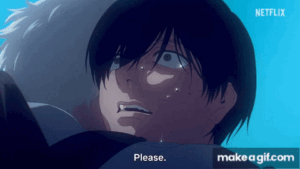
During our class cultural artifact activity, I brought two volumes of The Summer Hikaru Died by Mokumokuren. It’s a series starring a teenager named Yoshiki and his relationship with his childhood best friend. His best friend, Hikaru, dies in the woods and is replaced by a supernatural entity. The story (both the manga and the anime) has horror-esque abstract art with the anime taking a mixed media approach with the series (blending real-life backgrounds and objects with animated characters). The series itself means a lot to me due to how it caters to my interests (supernatural horror with romance and unique art). It mainly connects to the class due to how Yoshiki had a crush on Hikaru when he was alive, and how he refuses to leave Hikaru’s side even though he was replaced by a dangerous entity. It also takes place in a rural location where same sex relationships aren’t as common (the term “LGBTQ+” itself is referred to as “that L gee bee t thing” by a child Hikaru in the anime).  

Another interesting concept explored in the series is sexual exploration shown through “mixing.” “Mixing” refers to the entity inserting himself into Yoshiki (or vice versa), with the entity eventually becoming a part of him. A unique part of this approach is how the characters react to each other, with Hikaru initially prompting Yoshiki to reach into his abdomen and then pinning Yoshiki down (with the parts of the entity going into Yoshiki’s body giving him pleasure and feeling “nice” to him). The text that primarily reminds me of the series is Prelude to Bruise by Saeed Jones, as they both center around the sexual coming-of-age experience of a boy in a rural village, and how that boy is seen as an outsider (specifically someone that is “hard to understand”). I find it interesting how The Summer Hikaru Died has a similar setting yet contrasts the piece with the dynamic between the two main characters. The entity inhabiting Hikaru’s body isn’t socially adjusted/in tune with societal norms, which in a way prompts Yoshiki’s attachment to him (as he wouldn’t resist his affection or feelings for him like the real Hikaru). Even though being with the entity is dangerous and leads to body-altering consequences, Yoshiki prefers it to being alone in a place where nobody truly understands him (preferring to be oneself than to live a lie). 
American Dreaming

Angels in America by Tony Kushner explores the idea that marginalized communities (specifically those in the LGBTQ+ community) struggle with feeling accepted in a country that boasts freedom and opportunity (the US). America is often seen as an ideal place to live since it provides the “key” to a better life (specifically being able to find job stability or security). Despite how America is portrayed, the reality is that not all people are viewed as equal in the country’s eyes. If a person doesn’t fit into a box that matches pre-established social norms, they are othered. If the people in power don’t respect those who are othered or considered a minority, they will do nothing to support them or treat them like outsiders in a country they call their home. Kushner’s play critiques the notion of the “American dream” by creating multi-dimensional characters from backgrounds and identities specifically targeted by United States legislation. 

The people in marginalized groups can have an us vs them or us vs the world mindset that influences their perception of society (seeing themselves as targets of harmful legislation or the government, specifically the Reagan administration in the play). In the text Louis states “Children of the new morning, criminal minds. Selfish and greedy and loveless and blind. Reagan’s children. You’re scared. So am I. Everybody is in the land of the free” (77). Louis’s sentiment is characterized by a sense of cynical realism and dissatisfaction. He knows he is an outcast in society because he is a gay man, and that the current president has done little to improve the lives of LGBTQ+ individuals (such as by actively ignoring the AIDS crisis for a long period of time). He sees both the president and the people present in society as ignorant for pushing their harmful beliefs onto individuals who only want to be themselves.  

An interesting point of contrast in the play comes from Joe, who brings up a more optimistic perspective of America. In the text, he states, “It’s still a great country. Best place on earth. Best place to be” (201). This perspective can come from ignorance, as Joe hasn’t experienced being othered by society due to agreeing with those in power (the same people who actively try to take away the freedom of sexuality Joe tries to experience). If a person is not directly harmed or at risk due to their social standing, they may feign ignorance and be slow to realize the consequences of their own actions (mainly how the free country they value isn’t truly free for everyone. As Angels in America shows, those who conform to the harmful ideals of a society (Joe) struggle to see eye to eye with those actively struggling because they are expressing their true selves (Louis). 

Poison Touch

A part I find especially notable about Eli Claire’s “Pride and Exile” is the section that involves doctor’s treatment of kids with disabilities. Particularly, how the pursuit of a supposed “cure” or “answer” can lead to individuals being harmed. In the text Claire states, “take for instance public stripping, the medical practice of stripping disabled children to their underwear and examining them in front of large groups of doctors, medical students, physical therapists, and rehabilitation specialists. They have the child walk back and forth. They squeeze her muscles. They watch his gait, muscle tension, footfall, back curvature. They take notes and talk amongst themselves about what surgeries and therapies they might recommend” (Claire 103).

Disabled kids are treated like a spectacle; as if they are oddities or animals. They are forced to expose themselves to the judgmental glances of people who will only see them as people who need to be changed or “fixed.” They are meant to bend to the wills of superiors who only want to mold them in their image. In a similar fashion, people in the LGBTQ+ community are meant to prove their queerness. They break down their walls of protection and sacrifice their comfort to appease an audience. They must prove their otherness is real, but at the same time get judged for their otherness due to it not being socially conventional. Both disabled and queer people are seen as malleable. Whether it is with a miracle cure, physical force, or conversion therapy, institutions, the public, or higher ups only want to see marginalized communities be the “same as everyone else.” Even if there is no such thing as an ideal human being, there will always be notions made that everyone should fit into that box to preserve years of humanities built-up fragility and sensitivity.

The Caged Bird: Will My Cries Be Heard?

Those who are considered different are faced with the unfortunate reality that they will never fully be accepted for who they are, and that they must hide their true selves from the public to avoid judgment. The text, “History, According to Boy” by Saeed Jones places an emphasis on the ideas of entrapment and conformity with a coming-of-age narrative. The main character, the boy, struggles to fit in with others his age and isn’t entirely masculine leaning. His homosexuality leads to him being othered, and his inability to fit into the image of a “proper boy” causes him harm. An interesting section of the text involves the boy’s dad beating him after he snuck out to go to a gay dance club. The text states that, “boy’s father’s fist comes down like a war no one bothers to call a war” (Jones 95). The physical abuse the father inflicts on the boy comes across as a method to try to “beat the gay” out of him (with the mentality that he’ll stop displaying or acting towards his attraction to men if he continues to get hurt over it). In a way, it seems like a twisted form of mental conditioning that uses harmful behavior to try and promote “normal” behavior. An intriguing part about this section of the text is how physical abuse is framed. The focus on the term “war” justifiably frames the abuse in a negative light, yet it seems there is debate over how the term “war” should be defined. Even though harming a child over their identity isn’t right, trying to enforce socially acceptable behavior is considered reasonable to most. If the harm done to the boy now will lead to his protection in the future, is it truly harming him at all?