Class Blog

Corset still. On

The lines that I really focused one were from “Father in my room looking for more sissy clothes to burn” down to “column of smoke mistaken for Old Testament God.”(12) I think these lines are about religion’s role in homophobia and hatred as well as familial relationships. The fathers actions (searching, burning, believing the son is a whore) show a pretty intense attempt to enforce gender norms. The destroying of clothing is deeper than just the clothing, it seems he is trying to erase his son. The signs of religion (Sodom, Locusts, Old Testament God) try to justify the fathers hatred through his religion. As someone with a background in religion, I am aware that these are biblical symbols for punishment (aka divine wrath). By connecting the fathers cruelty to religious symbols, the poem seems to disagree with how religion is used as a cover up for prejudice. Now the corset is a huge part of this poem and I am really focusing on the line “Corset still on, nothing else, I’m at the window;… (12)”. The corset is restrictive (tight, bruising) but also empowering (his self identity). It carries physical pain but also defiance. The line “corset still on”(12) is so powerful because it shows endurance. I connected this poem to other poems by Danez Smith because their poems often talk about family, homophobia and religion. Also not to get WAYYY too deep but the bible. All in all, I think the poem suggests queer survival IS an act of resistance.


Returning to Boy’s Burning House

At the end of the poem, Jones paints a picture of his “burning house,” indicating that he must walk back to the place that causes him grief and struggle, (Jones 8). This fire serves as a metaphor for what his home life is truly like. Similar to a fire burning and causing destruction, that is what has happened inside Jones’ home. It is apparent that he is looking for an escape, as shown by him leaving the house in the first place. Earlier in the poem, the readers get the picture of two boys in the woods together. But the other boy left Jones “alone to pick pine needles from [his] hair,” (Jones 8). Jones is dirty from being in the forest, shown by his “mud-stained knees,” and he has been deserted by the other boy who is supposed to care about him (Jones 8). When putting these two images together: Jones being abandoned in the forest and his burning home; readers get the sense that he is unfamiliar with being treated well. When he was younger, learning from his parents set his expectations very low. So, as he is growing up, he continues to gravitate toward the people that treat him poorly. And despite all this, Jones still manages to return to his home. He knows something will happen if he does not. His father forces him to leave the house, but he returns because he knows he and his mother need each other. My question for the boy is why does he not try to put out the fire, solve his problems? Fires leave burn marks, but the less a fire burns, the less damage will be caused. How long has the boy’s house been burning? Does he even know how to put out the fire? Will he ever take action?

i have a secret… can you keep it?

After reading Insomniac by Saeed Jones, I knew I had to post something about it. Honing in on the second stanza, I was enthralled by the idea of locking something up or keeping something hidden. At first, I only believed it was surface-level; the idea of queerness or showcasing of a queer identity was hidden. Yet, after further reflection, I wonder if this “mother of sorrows” we hear of once was, or is actually a queer woman herself. “In a language,” I’m guessing, refers to the language of a minority. Of our kind. The history of ballroom. A facade given to the public and only seen in our spaces. What we swore we would never tell anyone.

This language that the “mother of sorrows” may be keeping from her son is one that she speaks herself. Her tongue may also be a queer one. I wonder if she knew the repercussions of this sacred language, but wanted to do anything and everything in her power to keep her son alive, and maybe one day see the world outside of that locked room he is banished to. The idea of gatekeeping queerness is fascinating to me, and it suggests to me that the mother has seen the hurt it causes firsthand. Was her husband an abusive man? Did he partake in hate crimes against LGBTQ+ people – maybe a law enforcer at that time? We will never know. We can only let our imaginations take us to unseen and unspoken places. What I am trying to say is that I think these lines are a commonly lived experience reference to masking queer identities and/or presentations within a traditional, non-accepting household. That’s all from your favorite literary icon’s favorite literary blogger. Para Scisccors out.

#masking #queer #facade

Loneliness in America

In “Angels in America”, characters Harper and Prior represent the loneliness many find themselves experiencing. Loneliness is an emotion particularly associated with queerness, especially during the era of the AIDS epidemic, when queer people were no less than abandoned. Even aside from that, being systemically separated from the norm creates distance between them and their peers that is difficult to pierce. Harper, a woman married to a man, nonetheless is in close association to queerness as she finds her husband Joe to be a gay man. Queer experiences can be expressed through outlets other than gay characters themselves.

One of the earliest things the reader learns of Harper is that she is addicted to valium. This is a means of escaping her reality, as she creates a friend, Mr. Lies, in her head to keep her company. She experiences such intense isolation that she turns to the imaginary, a theme throughout the play. She believes herself to be in Antarctica, telling Joe, “I can have anything I want here – maybe even companionship, someone who has… desire for me” (3.3.14). She exits the reality of everyone around her because to be surrounded by such loneliness, of others and hers, is ironically too much to handle. Harper being a straight woman represents that societal issues, that people such as Reagan like to fence up in a single community to be ignorable, cannot but escape those walls. Her intense loneliness illustrates that AIDS is an issue that society must deal with, because if empathy isn’t enough of a reason, it affects more people than imaginable.

Prior’s experiences, though vastly different from Harpers, mirror hers in his loneliness. His nurse suggests he see a therapist, for “loneliness is a danger” (3.8.116). Drawn to medicine and fever induced visions and abandoned by his society to die uncared for, he finds himself also barely able to deal. However, he embraces his ability to stand alone. He slips up and introducing himself, says, “I am… abandoned” (3.7.2.). He draws strength from his isolation. “Angels in America” represents the ways loneliness, especially among queer people, can create different experiences.

Relationships and Queer Self-Discovery

Patti Smith wrote her biographical nonfiction “Just Kids” about her experience growing up alone in NYC with her friend Robert Mapplethorpe. Patti goes through a lot of self discovery as a person and as an artist, while Robert does the same, learning to express his identity as a gay man in his art. He and his boyfriend end up dying of AIDS in the 80s. The book is about his journey, her journey, and their journey coming to terms with the barriers of sexuality. Smith describes the book as a sort of eulogy.
Opening this book I didn’t know much about either of the two and left it that way, taking it as it came in Patti’s own words. I rapidly attached to Robert’s character a mirror of understanding: my own discovery of my sexuality was pretty late compared to what feels like a lot of folks have so even reading his story in the past year was life-changing. Smith approaches him with such understanding and love I was blindsided, and to watch him fade away into another statistic hit my heart.
Angels in America’s image of AIDS-related celebrity death comes from a different perspective within the same era, a lack of acceptance in a wildly different environment. Robert became respected in his time in art and photography subcultures, and remained so, able to sell his collection to a famous museum before dying. I think it would be a good perspective on the cards different queer people are dealt and how they deal with their relationships. His with both Patti and both sets of parents reflect queer issues in fascinating and specific ways.

Poems and Identity

Various texts in this class have brought me back to the poetry collection Night Sky with Exit Wounds by Ocean Vuong. Many of the poems in this work grapple with Vuong’s identity as a gay Vietnamese American author who was the first in his family to learn how to read and write. Vuong was one of my first introductions to poetry and LGBTQ literature, and his poetry has stuck with me ever since.

Like many readings from this class, the collection highlights the disconnect that often occurs between people who identify as LGBTQ and their respective (though disrespectful) families. In Angels in America, Joe struggles with his sexual identity and its lack of acceptance in his family and upbringing. Night Sky continues this theme with the added isolation of being a first generation immigrant from Vietnam, having neither family nor community to turn to in moments of existential crisis. The poem “Someday I’ll Love Ocean Vuong” details Ocean’s specific struggle with his parents, communicated in lines such as “Your father is only your father / until one of you forgets.” Familial tension is a central feature to the queer experience, and it need not be between a queer child and their parents. Bechdel’s Fun Home illustrates this tension on the part of the father and his inability to reconcile his identity with the life built around him. Vuong’s attempts to grapple with these familial constraints on his identity shine brightly in Night Sky and would fit well amongst the background of other class readings.

Mountain

Clare gives a great metaphor for the mountain which is the societal patriarchy that crushes those who are marginalised and who only want to see the view from the top. The book raises great questions about how many of us have struggled up the mountain, lived in its shadow or measured ourselves against it. Life is hard no matter who you are people need to find work, do well in school and make friends, but not everyone needs to find their identities and actually feel comfortable in themselves to show people who they really are. The queer community struggles daily in just trying to figure out who they are but also figuring out where they fit when society often casts them aside. Clare does a great job of showing his own struggles and describing that people of minorities aren’t given respect and are often seen as weak, lazy or different and even when attempting to climb that mountain nothing on the way up is familiar. The people who are pushed down the mountain or even who aren’t given help to reach the peak find similarities with the other people who have been pushed away by society. It almost feels like why someone should who is pushed away so much even try to fit in should be with the people that truly do see them as a person and not an outlier. But this isn’t fair no one should be forced to find peace at the bottom and not be allowed to see the world like everyone else does.

Hidden Life

The Netflix show Grace and Frankie represents the idea of the hidden life of people’s queer identification, two men who spent most of their entire life being gay and never being able to show it and living the “normal” hetero lifestyle. This reminds me of Fun Home by Alison Bechdel whose story follows her father’s secret life that destroys his life and his home until he reaches a point of complete emptiness when he takes his own life. The two men Sol and Robert who are both married with children has a happier take on what if people choose to actually live the life which allows them to love the person they love and not whom society forces them to.


Although they hid their affair for years and were always afraid of what would happen if people found out they decided that they had spent all of their life hiding who they were and enough was enough. Bechdel alludes to the fact that her father often had affairs with men, but it was in secret and his wife was often miserable because of it. Well, Grace and Frankie have a similar approach with the two men deciding to both tell their wives who it was they were truly in love with but even though it breaks their wives’ hearts it allows them to be free and for both parties to stop living in a life that was all a façade. Both parties get to move on and find a new way to spend the remainder of their days. Perhaps if Bechdel’s mother and father had this conversation then her father would still be here today or perhaps it was never an option for him but this is something we will never know.

Girl Power


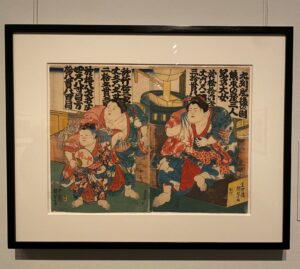
The legend of Auntie Po makes me directly think about this Japanese painting named “Girl power” that I saw in the National Museum of Asian Art, and I am surprised to find how many similarities they share.

This painting is created in 1856, around the same period as the story of Mei and Auntie Po, and it is demonstrating three female sumo wrestlers preparing for the match. The greatest similarity between this painting and the legend of Auntie Po is that they both try to show the power of women by letting them do something that men are supposed to do. Just like how logging is supposed to be male-dominated work and the legend of Paul Bunyan is a legend of a man, sumo wrestling is also considered a men’s sport in Japan. Moreover, in great contrast with the low social status of female in Japanese culture in history, sumo wrestler has high social status and is always respected by society as the symbol of power. By letting female be the myth of logging and doing men’s sport, both of these two works rebels against the traditional label of being weak women and shows that women can also be powerful.

Another similarity is that they all have an Asian background. Although discrimination against women is everywhere around the world, it is more severe in Asian culture, in which women are always supposed to be passive, be the ones waiting to be saved, and sacrifice themselves for men’s success. However, in these two works, we see that Asian women, dressing in traditional clothes, can be the hero! We can see Auntie Po saving people from the river, and the three strong girls ready to fight, and these are all opposite to what they are supposed to do in their culture. Indeed, they even surpass most men, as Auntie Po is the one who can log the greatest number of trees, and sumo wrestlers are considered to be the strongest group of people in Japan.

The last similarity they share is that although they are trying to show that females can be strong and powerful, they both show it through the male’s frame. They do it by drawing females with muscular bodies. Especially in this Japanese painting, all these girls are giants. In other words, they show women are powerful by making them like men, which might imply that only the figure of men is powerful.

Creating Your Own Spot

Fanfiction is the name given to works of literature that are derivatives of other works or concepts that are not a part of the canonical universe of the original. It can range from very short stories to works that have lengths much longer than the original work itself. A tool that is employed in most fanfictions is “shipping” where the author places two characters that are not in a canonical relationship into a relationship in the fanfiction. One way that fanfiction has been used is as a tool to create queer narratives in a universe where there may have not been an explicit queer narrative to begin with. Many works include characters that are queer coded, and are described in ways that are almost explicitly queer, but the author of the source material never confirms, and leaves the reader hanging. This act of carving out a storyline that was not initially there just to be able to see the storylines of people who are similar to you shows a deep aspect of why it is so necessary to include queer representation. If this representation was not necessary, it would be hard to believe that people would produce these works, some of which are longer than the source material itself, just to be able to see stories of people like them.

We can see a connection to The Legend of Auntie Po by Shing Yin Khor, particularly in the Authors Note and the final pages of the book. When Mei talks about going to form her own story (Khor, 282), implying that there are many more adventures to be had beyond the confines of her book, it is the exact concept that these fanfiction authors latch onto, that just because you have hit the final pages doesn’t mean that the characters cease to exist, that their stories must end. Where one story ends is just an opportunity for another story to begin, and when the initial author isn’t there to represent marginalized communities, in some cases fans of the work create representation that was not originally there. This connects to the Authors Note at the end of the book, particularly when Khor discusses making the story of a young Chinese American girl (Khor, 285). This is not unlike the how fanfiction creators will sometimes use their works as a tool to create more representation in the universes they love so dearly, so they can see a character just like them, and finding how in creating that little corner of the universes of their favorite works.