“One Of Your Girls” by Troye Sivan (banger) and Its Implications in This Class

“One of Your Girls” by Troye Sivan is a song about how a gay man (Troye Sivan) makes himself likeable to men who he’s attracted to. The line “Give me a call if you ever get lonely, I’ll be like one of your girls or your homies” enforces heterosexism and highlights the expectation of men (especially gay men) to fit a particular mold of either hyper feminine or hypermasculine. In the case of this song, Troye Sivan has chosen to feminize himself in order to gain favor of his suitor. These limitations, however, serve as an excuse for society to behave aggressively and controllingly towards marginalized people. This theme of society not accepting gay men for their sexual identity and/or how they present themselves (as well as anyone who deviates from the determined “normal”) is common in the literature analyzed in this class such as “Boy in a Whalebone Corset” by Saeed Jones in his collection Prelude to Bruise. In this selection, the speaker’s father beats him and burns the clothes which he deems “sissy clothes.” The speaker’s method of self-expression in this poem is his feminine clothing, and his father shows his disapproval for his son’s representation of himself by destroying them as soon as he finds them. This passage reflects society’s desire to control individuals who are different and not accept queer people for who they are and how they chose to present themselves. 

In the music video for this song, Troye Sivan is seen in drag dancing on a vision of masculinity (Ross Lynch) who is muscular, blonde, dressed in a wife-beater tank top, and sat manspreading in a chair in an empty, white room. This connects to the story in “Growing Up Gay, Growing Up Lesbian” wherein gay men in Little Havana, Florida felt more comfortable transitioning or presenting more feminine regardless of their authentic feelings surrounding their own gender. Because of the pressure from a heterosexist American society, people would prefer to have an inauthentic lifestyle if that meant feeling relatively safe or comfortable to love who they love. In the music video, Troye Sivan is just in drag, but it reminded me of the men who Jesse G. Monteagudo described as “unhappy and confused” who felt forced to live inauthentically in order to survive at all. 

Auntie Po, Mei, and Prior: Unlikely Prophets

In The Legend of Auntie Po, the character of Auntie Po is an unlikely prophet. In the masculine environment of a Sierra Nevada logging camp post-Chinese exclusion act, Auntie Po’s identity as an elderly Chinese woman contrasts the 1885 stereotypical young white male logger. She also contrasts late-1800s stereotypes of femininity, as her masculine blue pants and red flannel shirt resembles lumberjack clothing, specifically mirroring the image of Paul Bunyan, another mythical figure in the American northwest. Similarly, Prior is an unlikely prophet in Angels in America. As a gay man, his being chosen as a prophet is ironic because of Christianity’s view on homosexuality. Similarly to Mei’s role in her story, Prior’s role in Angels is partially to impart the wisdom he gleans from the Angels onto other characters. All three characters challenge the “norms” of who would stereotypically be chosen in such position of honor by men (loggers) or gods (the Angels) in America.

While Mei is not seen as a God-like figure herself, her role as a storyteller to the children in the logging camp makes her a prophet. From her visions of Auntie Po, she is able to impart the wisdom of the legend onto the children in the logging camp to act as reassurance during difficult times. Both The Legend of Auntie Po and Angels in America have significant characters that doubt the legends, particularly in the face of tragedy. Bee’s lack of faith in Auntie Po becomes clear after the logging accident: “No Mei! I don’t see Auntie Po!…I don’t see pretend Gods!” (197) This is a similarity between the two works, with many characters doubting Prior’s visions of the Angel because of his illness-induced mental state. This doubt ties into the significance of showing unlikely prophets and legends both on stage and in literature. Representation is important, especially in the context of legends which allow children to see themselves in stories told by people they can relate to.

The Legend of Negotiating Whiteness

Something that stood out to me in their interview with Rosie Knight was when Shing Yin Khor said:

“How much of the American story is shaped by clever marketing but built by the marginalized?” 

This strikes me hard. It then became a powerful lens for me when I think about Ocean Vuong’s On Earth We’re Briefly Gorgeous, a novel that, just like The Legend of Auntie Po, shows us the intersectionality of race, queerness, family, and marginalized lives shaped by American narratives. While Khor rewrites the Paul Bunyan myth to center a Chinese American girl, Mei, Vuong documents how the forces of whiteness structure everything from intimacy to labor for Vietnamese immigrants through his own story, a letter, to his illiterate mother.

In a world, the America’s world, where even myths are intertwined with the country’s history of colonization, marginalization and slavery, Vuong’s answer comes through his reframing of the Vietnam War. Rather than accepting the U.S. narrative of rescue or moral authority, he insists, “All this time I told myself we were born from war, but I was wrong, Ma. We were born from beauty. Let no one mistake us for the fruit of violence, but that violence, having passed through the fruit, failed to spoil it.” Just as Khor uncovers the erased labor of Chinese workers beneath the Paul Bunyan myth, Vuong reveals how the war’s mythology obscures the real Vietnamese lives shaped, and scarred, by it, even in our own language: “Ma, to speak in our mother tongue is to speak only partially in Vietnamese, but entirely in war.”

“A lot of the experience of being a non-white person in America is about trying to navigate whiteness.” Ocean’s relationship with his first lover, Trevor, is one of the clearest signs of this “whiteness navigation.”

“He was white. I was yellow. In the dark, our facts lit us up and our acts pinned us down.” 

The intimacy between them is always shadowed by racial difference. How even queerness can’t erase the imbalance of how both boys move through America. Trevor’s whiteness shapes the terms of desire, just as Mei must negotiate white expectations in the logging camp, or with Bee, her “bestfriend” who’s also white. 

Whiteness, in a way, also shapes labor. At the nail salon where Ocean Vuong’s mother works, the most repeated phrase is “I’m sorry,” spoken by Vietnamese women whose survival depends on appeasing white customers. This echoes Khor’s observation that marginalized people are forced to adapt themselves to white comfort simply to live. 

Ocean’s words mirror Mei’s imaginative rewriting of myth: “I’m angry that I have to make my own God,” she says, yet she creates Auntie Po as a way to protect herself, her family, and to seek for freedom, when institutions fail them.

But what both Mei and Ocean Vuong has in common, is their creativity as a form of resistance. Ocean himself enters the country without English, bullied for his difference, yet eventually turns the English language, once a tool of power, into his means of resistance. He said: 

“I am writing because they told me to never start a sentence with because… I was trying to break free.” 

Mei, who made up her own God, who speaks English under her dad’s word of how it made her more American, uses that same language to tell her own stories of Auntie Po, both stories that insist on the humanity and creativity of those who have long navigated the boundaries set by whiteness.


The Birdcage (1996) as a cultural artifact

One of my favorite queer movies of all time is The Birdcage (1996), starring Robin Williams and Nathan Lane as a gay couple who pretend to be a traditional, straight family in order to help their son get married to the daughter of a Republican senator. When I was a kid, The Birdcage was the first film centered around a queer couple presented as positive queer representation. While the movie always stood out to me for its humor (which I admit I did not fully understand until I got older), complex but lovable characters, and challenging of stereotypes, I remember most how normal their relationship and their queerness felt to me. I remember how much I loved their relationship and their individual characters, as well as how many times I yelled at the tv when I was frustrated with their son, the senator, and even Robin Williams’ character at times. I chose this movie as my cultural artifact because it highlights the unique struggles for acceptance faced by the LGBTQ community and celebrates various queer identities, something that is especially important during an era that positive queer representations of relationships and family dynamics were not really talked about. 

In our class, an important theme we have discussed is acceptance: in a society that prioritizes patriarchy, ableism, and heteronormativity, we have to learn to accept ourselves and love every aspect of our identities. We have also explored a variety of identities and how the intersections of social identities affect the writers and characters that we have read. For example, Prior in Angels in America is a queer man and former drag queen diagnosed with AIDs and author Eli Claire is a transgender man with cerebral palsy. In The Birdcage, the film explores many intersections of identity and their unique experiences, both positive and negative, such as a drag queen, queer male stepparent and Jewish queer male who have to perform the roles of a traditional family with “Christian and American family values” in order to make their child happy at the cost of masking who they really are. However, the movie ends with the son choosing the love for his parents by fully accepting his parents without hiding and stating that his stepfather is his real mom or real parent, ultimately leading to the families accepting each other. The movie reminds us the importance of us having acceptance and understanding for ourselves, our loved ones, and really just everyone we meet. 


Wearing Trust and Acceptance

Four pieces of jewelry. Two bracelets and two rings tell the story of three generations of fiercely string women. First, a pink diamond ring, set to look like three heart, and the second with a birthstone setting. Third, a secret message in the form of a bracelet and finally a shared symbol connecting us all. The first ring was given to me by my mother on my 10th birthday, the second by my grandmother on my 13th birthday. The bracelets were given to me by my mother for my high school graduation and 18th birthday respectively. These pieces don’t only serve as a symbol of our time together but also as a symbol of trust and love.

These relate to the our class as they were given to me by those who raised me much like how Hao in The Legand of Auntie Po passes on traditions and his love of cooking to Mei. Additionally, at the end of the book Hao wants Mei to have all that she wants in life and accepts that in order for her to do that she will have to stop working in the kitchen in order to focus on school. Similarly, my mother and grandmother want the best for me and my life. Further, their acceptance and support for what I want to do with my life continues to motivate me. Finally, their acceptance of who I am, what I want to do, and where I want to go, as reinforced by the jewelry, lets me know that I can and will always be able to talk to them about anything

Camp is in the Eye of the Beholder

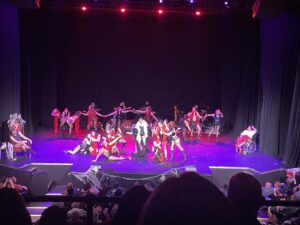
For my cultural artifact, I chose a photo I took at The Rocky Horror Picture Show Musical in Lititz, PA this past year. I’ve been going with my close friends for the past couple years, and it has become a cherished tradition between us. The Rocky Horror Picture Show in both its film and musical forms has become one of the most recognizable pieces of queer media since its release.

When we had our in-class discussion and readings on camp, The Rocky Horror Picture Show was mentioned in one of the articles. The most interesting part of our discussion, I found, was the classification of certain symbols, behaviors, media, etc. as camp vs. campy vs. kitsch. I will summarize the definitions below:

Camp: ““one way of seeing the world as an aesthetic phenomenon” (Sontag).

Campy: “as a style and sensibility, comprises a set of widely appreciated characteristics: frivolity, the celebration of the “so bad it’s good,” the overwrought, the histrionic, what Sontag calls ‘failed seriousness’” (Lowder).

Kitsch: “considered to be in poor taste but appreciated in an ironic or knowing way” (Oxford Languages).

The three terms appear to be intersecting, in that something can be described as one, or multiple, of these things; however, that description depends entirely on how it is being perceived. For instance, when I think of The Rocky Horror Picture Show, I think of it as an art piece-a way to have fun with the genre of science fiction while also acknowledging and giving in to the expression of sexuality and drama. I would describe it as camp. I showed my friend this same photo (keep in mind we had drastically different upbringings) and she said to me, “Oh… they’re not wearing a lot of clothes.” I believe that if she were in attendance with my friends and I that night, she may have become faint witnessing some of the choreography. She would most likely describe it as campy.

Writing this and thinking back on my discussion with my friend brought to mind the phrase, “beauty is in the eye of the beholder.” I think that is true in any case we are called upon to describe something, even when not describing its beauty. In this course, we often discuss intersectionality in terms of people’s identities, but I think intersectionality can also be applied to our descriptions and world views.

Was The Met Gala “Camp” Actually Camp?

When discussing camp, it is important to understand the incredibly complex definition of the word. Part of it requires, a lack of intention of being “camp,” meaning it must be natural and empathetic, not artificial or sympathetic. The Met Gala theme of being camp fulfilled the latter or those two situations. For the artificial side of the equation, the idea of being “camp” was entirely intentional and purposeful, not for the purpose behind being camp — the self fulfillment and self expression of it all — but for the twisted version of grotesque disembodiment of what being camp is. These incredibly wealthy people paraded around in (majorly queer) self-expressionist culture that represented being who they were, not what expensive brands of Gucci and Marc Jacobs tried to make them. The second part of the equation is being “sympathetic,” which at first glance seems to be a positive word, not one that is used negatively. In my personal observations and opinions, sympathy is for people who are unable to personally relate to a subject on a deep level, but find a vague understanding of it. There is a separation, while being empathetic is the opposite. There is closeness and the truth is bare. That is what part of being camp is — it is being laid bare in a truly dramatic and ostentatious way to be self-expressive and to scream to the world that this is me. The Met Gala was unable to meet this equation.

A nerdy theatre family and inclusive spaces for queer individuals

It was difficult for me to find a cultural artifact, so I chose to talk about something meaningful to me,  my family and is part of our dynamic. I chose a picture from when we went to see the revival of Into the Woods in 2022.  Theatre and performance has always been meaningful to me and it’s from how I grew up. This show has special meaning as well, but more so it is what it represents. It represents the environment where I feel the most comfortable. My sister and I were always singing together and were always putting on performances. We had large imaginations and lots of feelings so performance and theatre was a productive outlet Even more so, my parents were always encouraging us to go out for auditions and practice. They had respect for the performing arts that stemmed from their experiences as adolescent performers (it’s actually how they met!)

Theatre has been engrained in my life because of the reasons above, but also because it was the first space where I felt I could be completely myself. I have a loud, unapologetic communication style, which is an acquired taste for some. I always have no shame being ‘weird’ in public if it means I’m having fun. When I did my first show, I realized that I wasn’t the only one. In my opinion, a theatre community is one of the most welcoming and accepting communities you can be a part of. I am able to work intimately with individuals I would not typically interact with outside the space.

Furthermore, theatre has traditionally become a space for members of the queer community. Not only is it accepting but because it allows for creative expression differing from other forms of art. I am not queer, but I can imagine the relief of being in a space that is meant to uplift and foster connection. Even though there are a multitude of other spaces that can offer this, I know theatre is meaningful to the queer community through experiences that I cannot relate to. The amazing thing about art is how it can offer every person what they want from it. That can form communities through the similarities, but also leaves space for individual wants and needs to be heard. While we should always strive for community, a welcoming space should be able to offer benefits on an individual level as well.

Exile, Relationships, Summer Baggage

     To expand on Eli Clare’s chapter about “Losing Home” as the previous post showcased, there was a connection that shares some sentiments with Eli Clare’s experience of feeling lost, which was a show on Netflix called “The Summer Hikaru Died.”

     Using the discussions revolving around Eli Clare about complications about leaving their identity as well as using queer theory, the main character in “The Summer Hikaru Died” faces this similar dilemma as they had this ‘physical’ obstacle that is tying them down to their secluded town. Eli says, “I know that it is life-blood for me to live openly in relative safety as a dyke among dykes; to live thousands of miles away from the people who…[harmed] me as child…[but] I hate that cost” (Clare 46). Eli Clare talks about the life they had in their small urban home and how the dyke community was their safe space. Eli mentions how they wished there were ways to educate or support LGBTQ individuals to express themselves in small urban spaces. Yoshiki, the main character, suffers from a similar experience but instead of making the decision to leave the small town, they stay because of their love for Hikaru even after their death. 

     Yoshiki’s character in the show had them experience a ‘what-if’ situation in which Hikaru was still alive. In episode 1 of The Summer Hikaru Died, there’s a moment in which Yoshiki confronts Hikaru about his identity and Hikaru casually threatens Yoshiki to keep quiet by revealing his true form. In this shot as well, Hikaru can possibly signify the physical baggage that Yoshiki carries with them even after their crush’s death. This connection is likely what Eli Clare must have experienced along the way, although not physical, Eli expressed that memories tied them to their previous home which can be said about Yoshiki. Eli Clare says, “I didn’t know that in a middle-class town or neighborhood these things would have marked my family and me as something other than well-off” (Clare 38). Eli Clare comments on how class can vary depending on the size of the place, which is often overlooked if LGBTQ people have never lived in small towns. In this case, Yoshiki’s mother works in the city, already creating distances from other villagers as the town is wary of them. Eli Clare comments on this experience by calling out LGBTQ support groups to educate villagers on sexualities as well as individuals who are closeted.

“Replacement.” The Summer Hikaru Died, created by Mokumokuren, season 1, episode 1, CygamesPicturesJuly 2025. Netflix app.

Clare, Eli. “Losing Home.” Exile and Pride: Disability, Queerness, Liberation, Duke University Press, Durham & London, 2015, pp. 31–49. 

Beyonce = Gloria Anzaldua (confirmed!?) (why is Gloria everywhere!)

Renaissance has, and always will be, my favorite academic grind/self-love/vibe album. Is it bad that every song – in some capacity – I can relate to our lovely Gloria? Why has she overtaken all of my blog posts…

Whether it’s self or communal love, queer survival and expression, authenticity, etc., I swear Gloria and Beyoncé are the same person.

On page 169 of Speaking in Tongues, Anzaldua writes, “the act of writing is the act of making soul, alchemy. It is the quest for the self, for the center of the self, which we women of color have come to think as “other”- the dark, the feminine.”  I feel like this speaks so much to what Beyoncé writes in “COZY,” because it’s a self-love and confidence anthem for her, touching on the themes of Black excellence and womanism in America. (some lyrics below of “COZY”)

“She’s a God (ah-ooh), she’s a hero (ah-ooh)
She survived (ah-ooh) all she been through (ah-ooh, ooh)
Confident (ah-ooh), damn, she lethal (ah-ooh, ooh)
Might I suggest you don’t mess with my sis (ooh)
‘Cause she comfortable

Comfortable in my skin
Cozy with who I am

Been down, been up, been broke, broke down, bounced back
Been off, been on, been back, what you know about that?
Been the light, been dark, been the truth”

~~~~~~~~~~~

From “ALIEN SUPERSTAR”:

“We dress a certain way, we walk a certain way
We talk a certain way, we-we paint a certain way
We make love a certain way, you know?
All of these things we do in a different, unique, specific way that is personally ours”

Page 169, ” I write to record what others erase when I speak.” Touching on “we talk a certain way,” because Gloria will not change her language to appease white people…”nor the gags muffle your voice.” She’s a lesbian, so obviously making love in a different, certain way. Painting in the song is a reference to makeup/drag, however, I can change it to painting words… “write with your eyes like painters.”

~~~~~~~~~~~~~

Gloria on page 165, “we can’t transcend the dangers, can’t rise above them. We must go through them and hope we won’t have to repeat the performance,” I think of “I’M THAT GIRL” lyrics:

“I been thugging for my un-American life lights in these deep flawless skies.”

I feel like this connects so well because they both struggle so much as women of color in America and they only choice they have is to live through their life and they both write about it (in their own ways) so beautifully.

~~~~

These were just my quick thoughts – trust me, I could write so, so, much more. That’s all for now.

-Luv para <33333