Jillian Carlisle (’26) reads H of H Playbook (2021), Anne Carson’s daring, collage-like remaking of Euripides’ The Mad Heracles, and finds that both poets ask audiences to re-examine their understandings of heroism.
Heroism, especially in the mythology of Heracles, is often demonstrated through violence. Many of us grew up hearing as children that “violence is not the answer.” It is usually the answer for one of the most well-known heroes of all time. Five of his twelve labors, as canonically defined by Apollodorus, require Hercules to kill something or someone. If they are not killed, many of his other foes are wrestled or hurt by Hercules’ brute strength. The pattern of violent, hurtful victories in Hercules mythology makes him seem invincible and eventually leads him to be honored by the Greek gods of Olympus with immortality. But at times, this strength, especially when it is one of the key elements of his personality, becomes a fault rather than a virtue. In some less popular, less Disney-worthy versions of his story, Hercules’ own strength becomes his downfall.
In one of the best examples of this downfall, outside the setting of his well-known labors, there is a story about Hercules that has been adapted by many different authors in which he becomes crazy, frenzied, and violent (often referred to as Heracles Furens, or The Mad Hercules). Unlike the protective, heroic, calculated violence previously synonymous with Hercules, this frenzy is gory, shocking, and uncontrolled by the hero. Euripides’ Heracles is one of the most successful and detailed versions of this myth. In the Greek play, first performed in 416 BC, Hercules returns from his labors successful, saves his family from the persecution they faced without his protection, only to go mad and brutally murder his wife and three children after being possessed by Hera and madness. As tragic as they are, these manipulations of Hercules’ strengths are not necessarily ruinous to his character; in fact, Euripides affords the hero some peace after his murderous spree. His play approaches heroism, tyranny, and duty with much nuance, as strength becomes weakness.
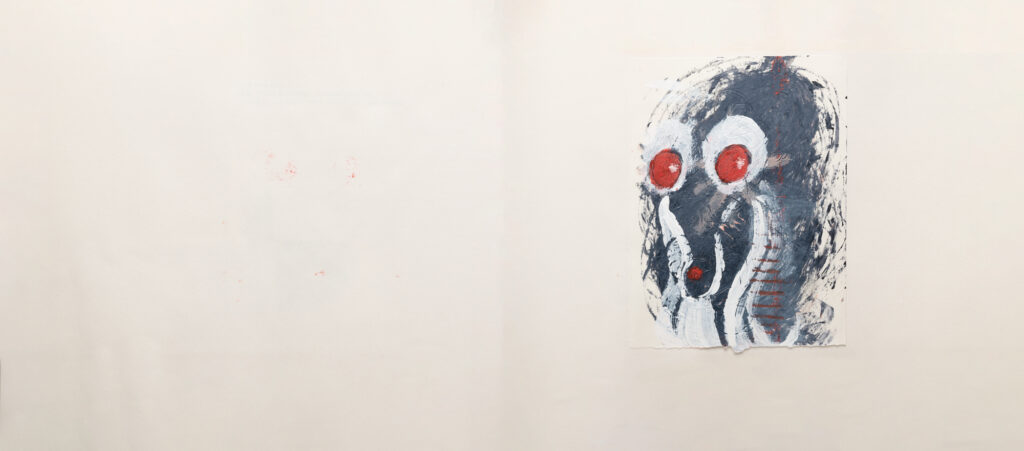
Poet and classicists Anne Carson adapts Euripides’ play for the modern audience in her work, The H of H Playbook, published by New Directions in 2021. Of the nineteen surviving plays by Euripides, Carson has translated seven into English. Her work has garnered her MacArthur and Guggenheim fellowships, the T.S. Eliot Prize, and two Griffin Poetry Prizes. The Playbook draws even more attention to Euripides’ complex depiction of Hercules and likens him to a soldier of the modern era. Carson moves the tragic elements outside of ancient contexts and combines contemporary positions on warfare and PTSD with the hero’s emotional break. In the 2022 edition of the Poetry Northwest Journal Dujie Tahat describes the work as a collage: “drawings and paintings, mostly abstract and some figurative, break up the text, which, page to page, ranges in size and length from a single word to multiple fully-justified 2” x 5” copy blocks.” In her fragmentary, somewhat abstract “collage,” Carson draws out further criticism of both Hercules and heroism generally by portraying his heroic fall as a personal struggle with self and duty, not just a shock of being manipulated by a higher power.
In the Euripides play, the chorus, Amphitryon (Hercules’ adopted dad of sorts), and Theseus (Greek hero famous for slaying the minotaur) do not place blame onto Heracles; they only lament for his great suffering. Involvement from higher powers (mainly the goddess Hera, who hates Hercules) are the main point of blame in the play, even by Hercules himself who asks, “When did madness’ sting attack me? When did it destroy my life?” (Euripides, Heracles 1144). Placing blame onto godly forces and onto uncontrolled fate is a common theme in ancient texts, but this isn’t particularly relatable to modern, non-pagan audiences. Carson blends old traditions with new techniques and creates a hero who, in between adventures, labors, and myth-worthy feats of greatness, also hitchhikes, swears, steals Corvettes, and most importantly, considers his own mental state. His unique nickname in the Playbook, H of H, “means Hera’s glory” as we are told by the goddesses who deliver madness to Hercules/ H of H. The pain inflicted on him by the gods does not disappear from Carson’s interpretation; instead, this misfortune and attack are only a further commentary on the strain and emotional trauma within H of H. Strain that is caused by the violent acts Hercules must continually enact and endure as a hero.
Although both works ultimately follow Hercules’ madness, the labors are an especially important part of Carson’s complex, strained hero. H of H’s first-person narration gives the hero a unique internal perspective unseen in previous ancient depictions and allows the audience to observe madness creeping into his demeanor before Hera causes the final snap. Hercules’ fourth labor, in which he must capture the Erymanthian Boar, also includes a story in which he slaughters a group of Centaurs who attack him. In mythology, this moment is not heavily dwelled upon; the Centaurs get mistakenly drunk, they attack Hercules, they are killed by Hercules; justice.
The nature of the labors as a public service requires the notion of making the world better, easier to live in. Carson wonders if being asked to make the world safer through violence is a contradiction that pushes the conscious and the psyche too far. The actions of H of H frequently do not align with his interests; yet he persists and continues to wrestle his way through his labors. In the versions of Carson, Euripides, and canonical myth, Hercules is instructed to complete the labors by the King Eurystheus; Hercules is essentially a servant to his demands. Although he has a task to complete, he does not see the Centaurs he is tasked with attacking as a threat at all.
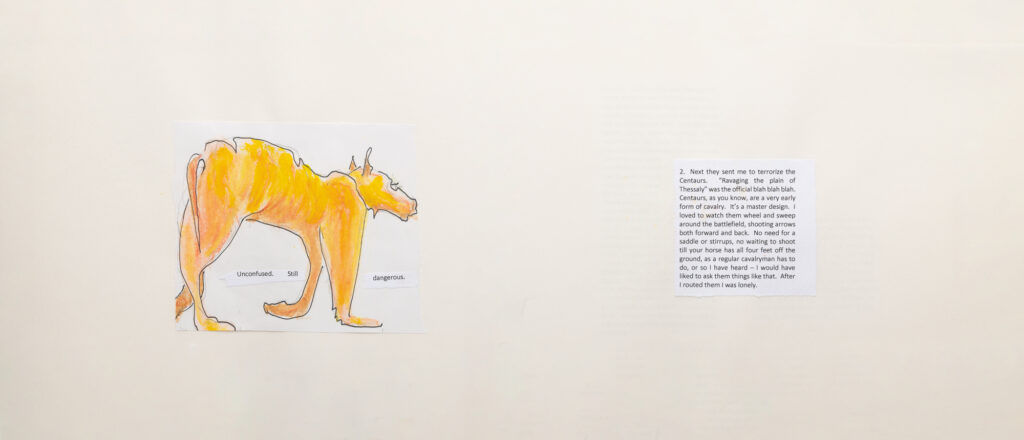
Next, they sent me to terrorize the Centaurs. ‘Ravaging the plain of Thessaly’ was the official blah blah blah. Centaurs, as you know, are a very early form of cavalry. It’s a master design. I loved to watch them wheel and sweep around the battlefield, shooting arrows both forward and back. No need for a saddle or stirrups, no waiting to shoot till your horse has all four feet off the ground, as a regular cavalryman has to do, or so I have heard – I would have liked to ask them things like that. After I routed them, I was lonely. (Carson, H of H Playbook, unnumbered page [42r]).
Heracles is akin to the Centaurs through their shared mastery of combat and weaponry. Although many would see them as a threat, Heracles observes grace and artistry in their precision. Being an archer himself, he is not so different from his “enemies.” The Centaurs, nonetheless, are targeted for their skill and strength, for disturbing, “ravaging,” the plain of Thessaly. Is Heracles not doing the same throughout the Mediterranean in his labors? He doesn’t regard the Centaurs as an enemy or his opposition, but instead as masters and a group he would be able to converse with.
His loneliness after he routs the Centaurs shows a lack of fulfillment and a lack of belonging. As H of H/ Hercules protects others and uses his strength for “good,” he loses himself and any sort of self-image outside of his heroism, outside of his strength. His actions appear good, but actually just serve the self-interested Eurystheus. He is praised, but for aggressive actions that hold consequences for H of H.
Hercules is often portrayed as a strong man with a club, a bow and arrow, and perhaps most importantly, the skin of the Nemean lion (a trophy from his first labor). The lionskin plagues him in the Playbook. “Do I keep smelling lion? Of course I do, the skull is right next to my face […] It wasn’t even fair.” H of H frequently interrupts his thoughts by noticing the lion’s skin. The repeated instance of this distraction often brings his own moral voice into labors he otherwise seems complacent in. The lion is such a famous indication of Herculean strength that it was even adopted by Alexander the Great in his portraiture. The skin was used on multiple statues and Macedonian coinage. But for H of H, the lion skin is not a proud marker of strength. In fact, it stinks, it’s a bit ugly, and it weighs on his conscience. The things that make him identifiable across the world are not things that he takes any comfort in. His heroism overshadows the self.
His inability to live for himself or escape the emptiness he feels as a hero is also apparent in Euripides through his marriage with Megara (who is very different from the ‘Meg’ of the 1997 Disney adaptation). Heracles uses possessive pronouns to refer to his father and children, indicating that he acknowledges them as his own, a part of his family (Euripides, Heracles 544–546); but none are given for Megara in their interactions aside from only one speech when he first sees his family from afar and calls her “my wife” (Euripides, Heracles 526). Megara uses similar language, referring to her husband as “the man”, their children as “my children” (line 516 and 537). The inconsistent use of possessive pronouns is a purposeful omission of an honest, personal relationship with Megara. It is only when Megara or Hercules soliloquize or talk without the other spouse present, that they will recognize the other as a lover or a familiar person. But while Heracles is in dialogue with Megara, he is actively plotting to save the family’s life; he is a hero in this scene, not a father or husband. He demonstrates love for bloody justice, rather than his own wife, who loves him best of all (Euripides Heracles 514; τἀμὰ φίλτατ’). Megara receives little acknowledgement outside of her position as a victim in need of a hero, rather than a beloved who has missed her lover.
But as troubled and empty as he is portrayed, why must he lose it all? Carson gives an abundant social response to this why,” Euripides explains it as a troubling fate. Nevertheless, the aftermath of the madness requires Hercules to leave his home for Athens with the hero Theseus. He disappears into a future that only propels him further into heroic expectations, rather than forcing him to connect deeper with himself or his family. His acceptance of his madness is both a realistic and heartbreaking continuation of his previous responses to events like his encounter with the Centaurs. He is left lonely, but this time he must consciously reflect upon his actions, his feelings, and his strength.
The madness of Hercules is an absolutely shocking and sorrowful turn within the play. It completely shatters all heroic, perfect imagery surrounding the hero. The tragedy tears Hercules away from his family, his trust in his own strength, and his home. Yet, Carson and Euripides bookend the madness with an intricate observance of the pressures Hercules faces throughout his heroic journey. Their expansions of the slightly predictable, brawny hero ask audiences (still invested in Hercules hundreds of years later) to examine their praise and understandings of such seemingly simple characterizations of heroism.