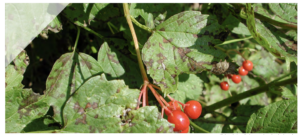
Beckerman, J. (2022). Downy Mildew [photograph]. Purdue University. https://www.extension.purdue.edu/extmedia/bp/bp-68-w.pdf
The European Union has set a goal to reach 25 percent total agriculture as organic by 2030 (European Environment Agency, 2025) and the winemakers are the force behind the shift to organic agriculture. Grapes are a sensitive crop; they are greatly impacted by sudden shifts in temperature and weather patterns. These climate conditions appear in the final wine produced, which lends to the significance of each wine vintage as it represents a specific moment in time and climate. Organic viticulture not only is better for the soil and vine health of the crop, but the chemicals in traditional viticulture can be tasted in the final wine. Grand Cru designation Alsatian wine producer André Ostertag recounted that while consumers might not seek out biodynamic, a subsection of organic, viticulture for environmental consciousness, there is a significant improvement in taste (Negro et al., 2022).
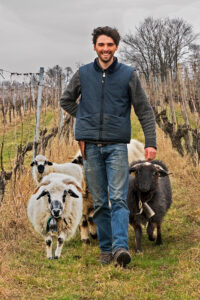
Kermit Lynch Wine Merchant. (n.d.). Domaine Ostertag [Photograph]. Kermit Lynch Wine Merchant. https://kermitlynch.com/grower/domaine-ostertag
As Negro, Hannan, and Olzak (2022) argue organic wines occupy a segment of the wine market that depends on recognition and credibility. Organic viticulture depends on the ability of producers to meet the demands of policy regulators, critics, and consumers as it is typically smaller, less industrialized operations. The copper ban will have a larger impact on the small shareholder operations because not only are they more susceptible to the larger market factors, smaller profit margins and minimal bailouts if there is critical failure, but they will be unprotected against natural struggles like downy mildew or other fungus. Potentially, without access to effective fungicide, the organic winemakers could abandon organic practices in totality. This shift could signal higher prices given that winemakers will need to ensure a certain level of security in the instance that there is an unpredictable growing season.
Although insulated from the contradictions around organic viticulture, whether policy initiatives or if organic wine does have a superior taste profile, consumers buy out of environmental responsibility and sensory qualities. The average wine consumer is not motivated by technical knowledge of viticultural inputs; instead they shop for a story or through subjective taste. If organic winemakers can create a narrative of concern for their livelihoods, then consumer support will rally in favor of lifting the fungicide bans.
Donner, P. (2025). French organic winegrowers confront copper ban. Wine Spectator. https://www.winespectator.com/articles/french-organic-winegrowers-confront-copper-ban
European Environment Agency. (2025). Area under organic farming | France | Europe’s environment 2025. https://www.eea.europa.eu/en/europe-environment-2025/countries/france/area-under-organic-farming
Jez, E., Pellegrini, E., & Contin, M. (2023). Copper bioavailability and leaching in conventional and organic viticulture under environmental stress. Applied Sciences, 13(4), 2595. https://doi.org/10.3390/app13042595
Ministère de l’Agriculture et de la Souveraineté alimentaire. (2014). Nearly 25 million acres in France committed to organic agriculture. https://agriculture.gouv.fr/nearly-25-million-acres-france-committed-organic-agriculture-2014
Negro, G., Hannan, M. T., & Olzak, S. (2022). Wine markets: Genres and identities. Columbia University Press. https://www.jstor.org/stable/10.7312/negr20370