GMOs and the Public
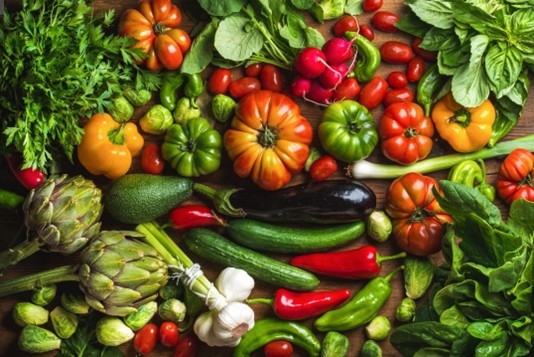
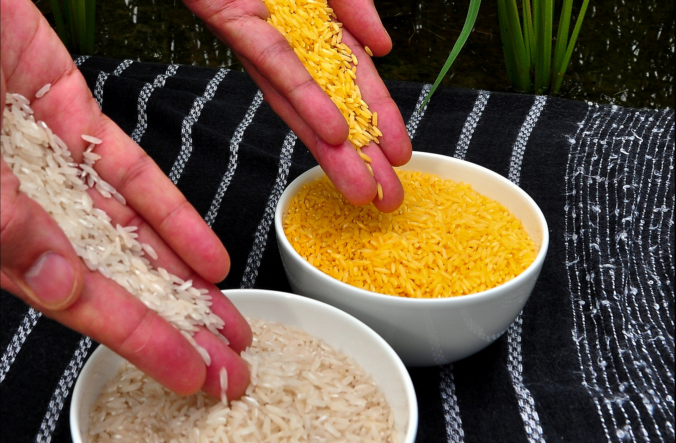
Genetically modified organisms (GMOs) are organisms whose genomes have been bioengineered for specific desirable traits. In agriculture, genetically modified crops have been used in the past few decades to increase yields, create resistance to pesticides, alter nutritional profiles, and more. GM foods were first approved for human consumption in the US in 1994 (Brittanica). GM foods have long been controversial among consumer groups and scientists. One study from 2004 found that GM foods tended to elicit higher levels of fear and uncertainty than organic and regular foods. The authors hypothesized that much of the consumers’ fear surrounding GM foods were due to negative representation of GMOs in the media (Laros, 2004). These are trends that I have observed remain much the same in 2026; GMOs are often perceived as “Frankenfoods” created by scientists who are tampering with nature
Health Research
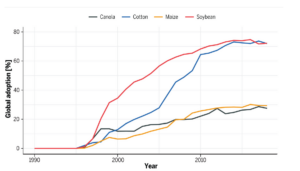
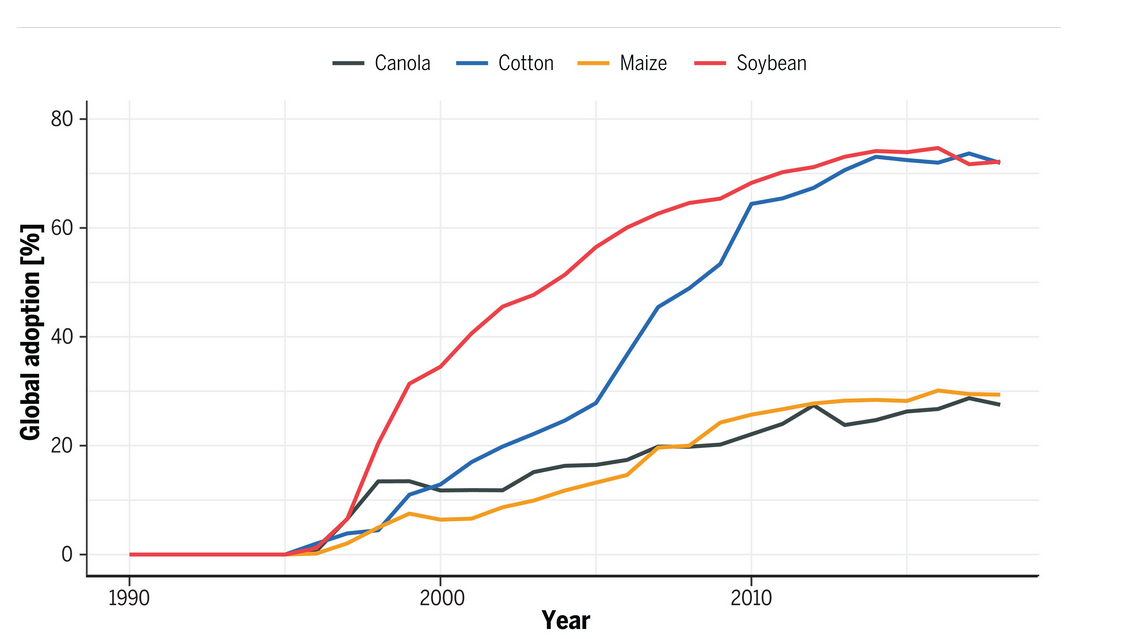
GM crop adoption over time
Are these fears supported by scientific evidence? The answers are inconclusive. Human health effects are difficult to study, especially with so many possible confounding factors. GMOs may have the potential to enhance allergens or pass on antibiotic resistance, but these factors (along with nutrition content differences) are ambiguous based on current research (Bawa, 2012). Agri-biotech companies and their investors argue that GMOs are the solution to food shortages and that GMOs are proven to be safe for human consumption. Many consumers, environmental advocates, and independent scientists argue that GMOs could pose risks which have not been properly examined. GM advocates point to research and safety testing of GMOs, but many studies on the topic have been industry-funded or improperly performed (Maghari, 2011), which discount them as useful and cast suspicion on their motives for publishing.
GMOs and the Environment
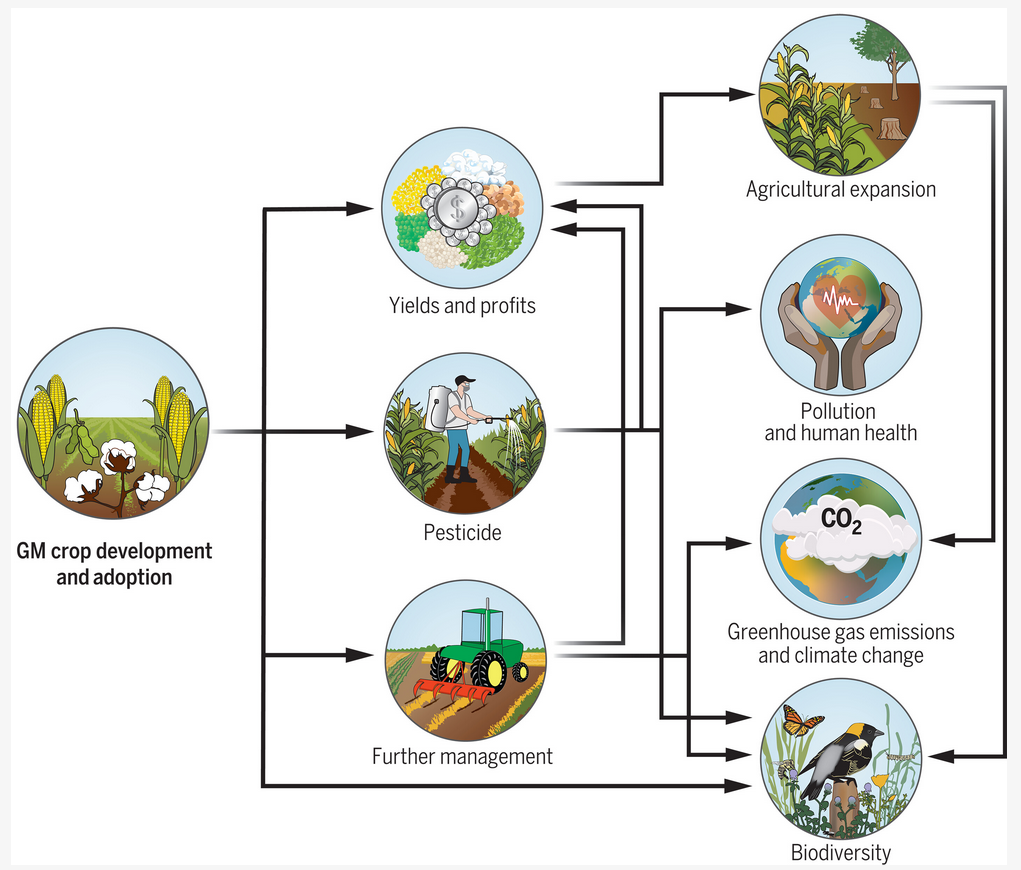
A topic less prevalent but equally important is the possible environmental risks and effects of GMOs. Supporters of GMOs point to increased yield, increases in farm incomes, and lower costs of production as a result of developing biotech, including GM crops (Zhang, 2016; Bawa, 2012). Agri-tech companies also say that GM crops could reduce inputs, plowing needs, and broad-spectrum pesticide use. From 1996-2012, GM crops helped contribute to a massive increase in agricultural yields, and to “achieve an equal increase in yield as delivered by GM crops, it is estimated that an addition of more than 300 million acres of conventional crops would have been needed” (Zhang, 2016). If GM crops can increase yield while preventing additional land from being plowed and deforested, that could be an excellent resource in land preservation. On the other hand, we don’t know how such intensification might affect the land already in production—if such intensive planting of GM crops drains soil nutrients as much as regular crops, additional agricultural land might be needed anyway ten years down the line, rendering the effort net neutral.
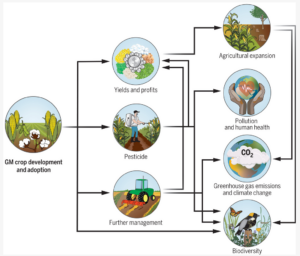
Environmental impacts of genetically modified crops
Reliance on GM crops engineered and sold by Agri-biotech companies would also increase reliance on those companies and on conventional industrial agriculture. If farmers can apply broad-spectrum pesticides without worrying about damaging the crops, these crops may lead to an increase in chemical use. Independent scientists bring up concerns about selection of resistance and GM crops shrinking biodiversity, shifting insect populations, disrupting the food web, and leading to the evolution of superweeds and superpests (Maghari, 2011).
As is the case with the introduction of any new species to any environment, extreme caution must be exercised. We do not know what effects GM crops could have on ecosystems, ecological balance, and the global food system. GM foods could have the potential to help us address worldwide nutrition crises and the strain that climate change and population growth have already put on agriculture. However, many experts are not convinced that the evidence for the safety of GM foods for humans, animals, and the environment is sufficient, and I believe that it is important to pay attention to the work of these independent scientists who dispute the claims of Agri-biotech. More independent research must be funded and strict testing guidelines put in place to prevent Agri-tech from pushing a product that may not be ready.
References
Bawa, A. S., & Anilakumar, K. R. (2012). Genetically Modified foods: safety, Risks and Public Concerns—a Review. Journal of Food Science and Technology, 50(6), 1035–1046. National Library of Medicine. https://doi.org/10.1007/s13197-012-0899-1
Behrokh Mohajer Maghari, & Ardekani, A. M. (2015). Genetically Modified Foods and Social Concerns. Avicenna Journal of Medical Biotechnology, 3(3), 109. https://pmc.ncbi.nlm.nih.gov/articles/PMC3558185/
Diaz, J. M., & Fridovich-Keil, J. L. (2018). Genetically Modified Organism. In Encyclopedia Britannica. Britannica. https://www.britannica.com/science/genetically-modified-organism
Noack, F., Engist, D., Gantois, J., Gaur, V., Hyjazie, B. F., Larsen, A., M’Gonigle, L. K., Missirian, A., Qaim, M., Sargent, R. D., Souza-Rodrigues, E., & Kremen, C. (2024). Environmental impacts of genetically modified crops. Science, 385(6712). https://doi.org/10.1126/science.ado9340
Palmer, A. C. (2025). Golden Rice: a quarter-century of innovation, challenges, and the promise of better nutrition. Journal of Nutrition, 155(9). https://doi.org/10.1016/j.tjnut.2025.06.025
Un Jan Contreras, S., & Gardner, C. M. (2022). Environmental fate and behaviour of antibiotic resistance genes and small interference RNAs released from genetically modified crops. Journal of Applied Microbiology, 133(5), 2877–2892. https://doi.org/10.1111/jam.15741
Wikipedia Contributors. (2026, February 4). Genetically modified food. Wikipedia; Wikimedia Foundation. https://en.wikipedia.org/wiki/Genetically_modified_food#/media/File:Golden_Rice.jpg
Zhang, C., Wohlhueter, R., & Zhang, H. (2016). Genetically modified foods: a critical review of their promise and problems. Food Science and Human Wellness, 5(3), 116–123. Science Direct. https://doi.org/10.1016/j.fshw.2016.04.002