Dickinson College Food Studies Certificate Program

Tag: food studies

Lycée des métiers de l’hôtellerie et du tourisme d’Occitane and Cartoucherie Neighborhood Tour

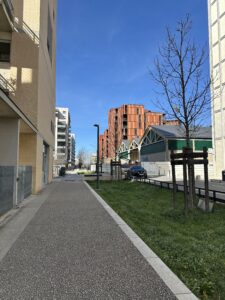
Image of the Cartoucherie Neighborhood

(Image taken by Miles Avery, 3/18/2025)

One of the places we visited in Toulouse was the Lycée des métiers de l’hôtellerie et du tourisme d’Occitane. This school is public and free to anyone who is above the B2 level in French. Since the beginning of the semester, we have been communicating by email with some of the students that are currently enrolled in one of the schools English classes. The students, who are around the same ages as us, were very excited to meet us. So, when we arrived at the school, we were able to meet with the students and have them give us a tour of the school. I was paired with two students from the school who spoke a good amount of English but seemed pretty nervous about the tour. We ended up talking about what their classes were like, and they showed me the different classrooms and kitchens they used. Every student there was well dressed, as they had a dress code that appeared to be business casual or moderately formal compared to US schools.
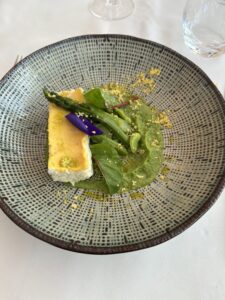
image of the entre from the culinary school lunch

(Image taken by Miles Avery, 3/18/2025)

The students at the school end up working long hours. On top of all the gen-ed classes that they are taking, they also have around ten hours of hands-on kitchen work, bartending, or hotel management that they need to complete. Which equals about two days of practical work per week for the students. This means that their days are from about eight in the morning to sometimes ten at night. The school starts at the equivalent of 10th grade, and at that point students live in dorm housing at the school until they are 18 (Isabella Heckert’s Fieldnotes, 3/19/2025). Older students are allowed to find apartments in Toulouse or live at home if they are local, but a lot of students travel from farther to get to school every day.

After the tours we got of the school, we visited the in-school restaurant where the students cooked and served our meals for lunch. We had a very good lunch that was skillfully prepared and professionally served by the students. While we ate, we talked to Dickinson and other university students who were participating in the Dickinson in France program.
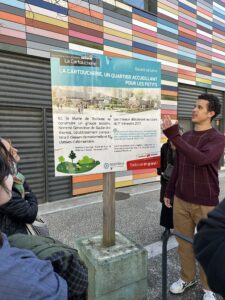
Student reading to the group off a poster

(Image taken by Miles Avery, 3/18/2025)

After the lunch, we got a tour of the Cartoucherie Neighborhood by Madame Carnine who is one of the teachers in the Dickinson program. She gave us a small tour of the “new” area of housing that has been rebuilt after the factory explosion in 2001. This neighborhood focuses on diversity of all kinds, focusing on economy, people, class, and age. While walking around the neighborhood and food court/market building, I saw a large amount of diversity, which positively reflected the hopes of the neighborhood. While on the tour, we looked at the six good reasons why someone should live in the neighborhood, we talked them through with Madame Carnine and relayed how their values reflected a lot of what we have been learning throughout both our classes and our France trip.
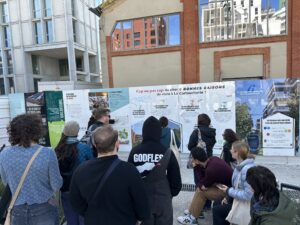
(Image taken by Miles Avery, 3/18/2025)

Toulouse City Kitchen

In Toulouse, the City Kitchen (CK) plays a very important role in supplying students from nursery and elementary schools with daily nutritious lunches. As well as providing meals for some senior centers and food-insecure communities. We were told that every day, there are about 35,000 meals that are sent out to 211 different schools in the Toulouse area by 11am. These meals, focused on quality, sustainability, and waste reduction are the essentials to nutrition showcase the core principals of Frances dedication to food education and nutrition

View of the city kitchen in Toulouse

(Image taken by Miles Avery, 3/17/25)

The dedication to quality is supported by Toulouse’s mayor and local officials. The EGalim law in France is what governs what foods the city kitchen is allowed to serve to the children in the city (Landon Davis’s Field Notes 3/19). This law requires that 52% of their ingredients are certified organic and they achieve that by having 31% of their food contain the AB label and the other 21% have different certification’s like Label Rogue, Bleu Blanc cœur label, etc. (Eliette Whittaker’s Field Notes 3/18). In addition to that requirement, they also have to make sure that 30% of their ingredients come from the Occitanie region and that all of their meat must come from France. All of these requirements are to ensure that the people that are receiving the meals are getting the best food and nutrition that they can.

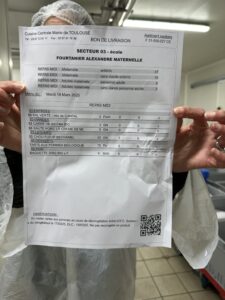
Image of a meal plan sheet

(Image taken by Miles Avery, 3/17/25)

The kitchen hosts 96 employees and has two different 7 hour shifts a day. The workers are city employees, some have culinary experience, but it is not required. The city workers are paid minimum wage, but have opportunities to move into higher positions within the organization. The meals are prepared in the large industrial kitchen spaces, using specialized machines and equipment. To ensure the cleanliness and safety of the space, we were required to wear hairnets, shoe covers, and a plastic “jacket” to ensure we didn’t contaminate anything. The workers also follow strict health and safety protocols by wearing uniforms, hairnets, and specific shoes to ensure hygiene within the industrial kitchen.

Finished meals packed and ready to be delivered

(Image taken by Miles Avery, 3/17/25)

Food is delivered daily to the kitchen to ensure food safety and regulations. They store meals in refrigerators to cool them gradually, following the strict guidelines required by law—meat and dairy can be stored for three days, and other foods for up to five. Any surplus food is given to organizations or programs like Too Good to Go as well as local food banks. They have also been working for the last few years to completely eliminate single use containers, implementing reusable metal containers. Required by the government and paid for by Toulouse, the city kitchen has spent 4 million euros to invest in these new containers.

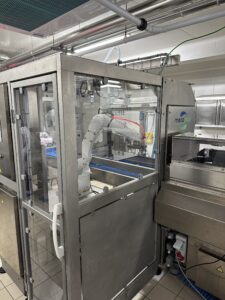
New machine required for new metal containers, utilizes a robotic arm to place covers

(Image taken by Miles Avery, 3/17/25)

They have had to get all new machines to accommodate these new containers, as well as new dishwashers to clean the reusable containers. Although it has created new jobs, meaning they now have 7 new employees on each shift.

© 2025 Food Studies


Academic Technology services: GIS | Media Center | Language Exchange

Theme by Anders NorenUp ↑