Decoding the Course Banner Image

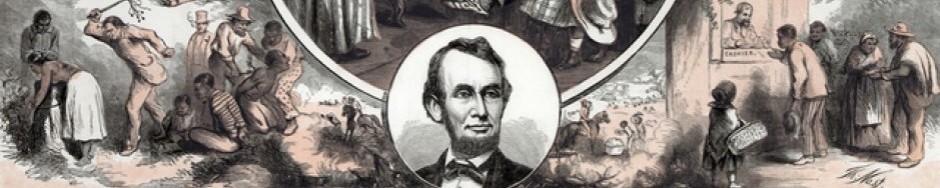
Print-makers and illustrators in the nineteenth-century could be quite creative and calculating. In fact, the banner image from this course website provides a good example of what might be called pre-photoshop photoshopping undertaken by a commercial printer in Philadelphia following Abraham Lincoln’s assassination in 1865. Here is what the image looked like that year:

Emancipation Banner

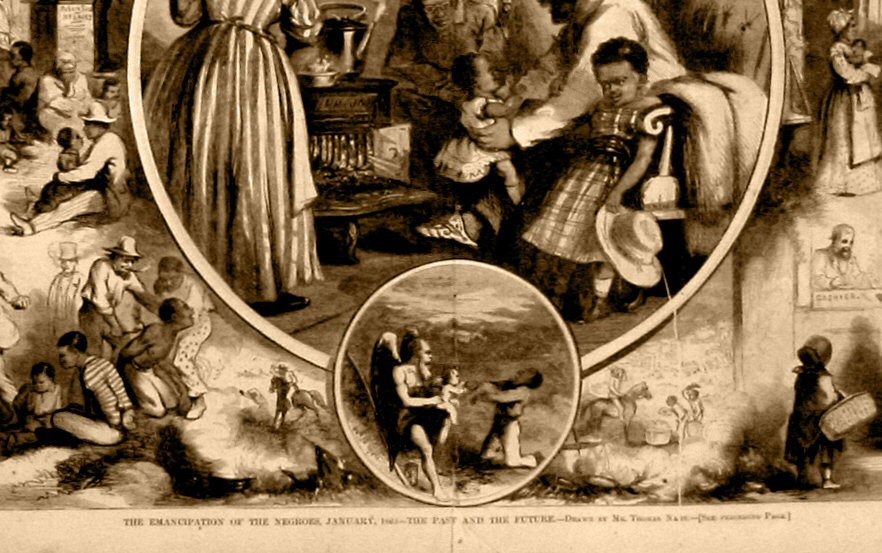
Yet here is what the original illustration looked like in January 1863 when Thomas Nast first drew it for Harpers Weekly:

Emancipation OriginalThe difference is more than just color.  Nast’s allegory for emancipation has now been subtly altered to give the martyred president a greater role.

cropped-cropped-cropped-cropped-emancipation.jpgEmancipation DetailThis discrepancy appears to have slipped past most scholars, or at least they have not commented on it in print.  Yet at a teacher’s workshop in 2013, an educator from Utah discovered the contrast while working on a project about Lincoln’s emancipation policy.

Posted in Discussion | Leave a comment

Underground Railroad

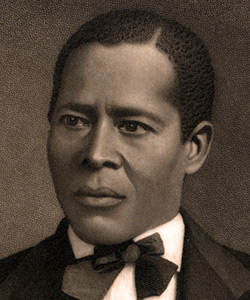
William Still

William Still

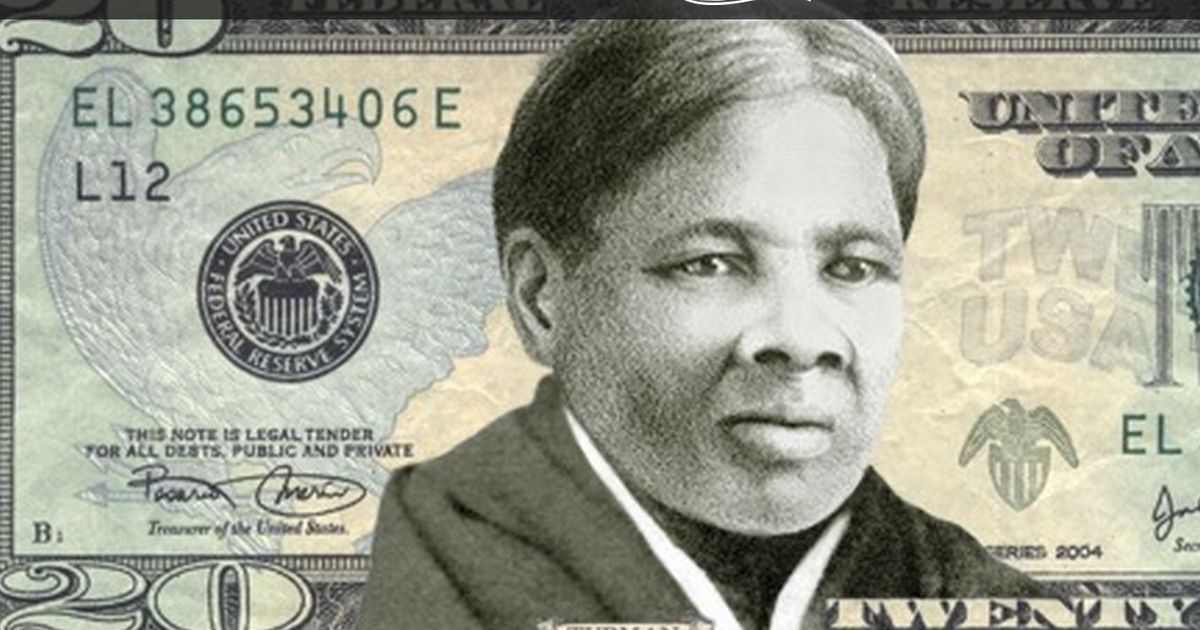
The Underground Railroad was a metaphor used by antislavery activists to describe and publicize efforts at helping runaway slaves during the years before the Civil War. While secrecy was essential for particular operations, the movement to help fugitives was no secret at all. Northern Underground Railroad operatives were often openly defiant of federal statutes designed to help recapture runaways. Agents used state personal liberty laws, which aimed to protect free black residents from kidnapping, as a way to justify their fugitive work. Vigilance committees in northern cities such as Philadelphia, New York, Boston and Detroit formed the organized core of this effort. These committees often worked together and provided legal, financial and physical protection to black people threatened by kidnappers or slave-catchers. Notable vigilance leaders included black men such as William Still in Philadelphia, David Ruggles in New York, Lewis Hayden in Boston and George DeBaptiste in Detroit. There were also thousands of other individuals, often white and usually motivated by religious belief, who helped fugitives during the antebellum period. Though most of these Underground Railroad figures operated with relative impunity in the North and across Canada, southern operatives faced grave dangers and thus maintained a much lower profile. This is one reason why Harriet Tubman, an escaped slave herself, was such a courageous figure. Her repeated rescues inside the slave state of Maryland during the 1850s became the basis for her legendary post-war reputation as “Moses.” Though Underground Railroad agents such as Tubman freed only a fraction of the nation’s slaves (probably no more than several hundred each year out of an enslaved population of millions), the widespread reports about their actions infuriated southern political leaders and helped bring about the Civil War and the end of slavery in the United States.

Additional Resources

Posted in Uncategorized | Leave a comment

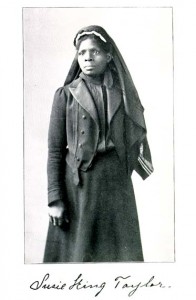
Susie King Taylor

Susie King Taylor, Reminiscences of My Life in Camp with the 33rd United States Colored Troops  Late 1st S.C. Volunteers:, (Boston 1902).

taylofp

Courtesy of Doc South

In a time of chaos and confusion, it is hard to stay optimistic. However for Susie King Taylor optimism came naturally. Her determination in life inspired others, and allowed her to be an educated, independent, veteran in a time of oppression. Susie Taylor was born into slavery, but lived a life far less oppresses than the standard slave at the time. Susie’s mother worked as a domestic servant for the Gress Family on a farm in Liberty County Georgia, but Susie and her brother were treated almost as part of the master’s family. Susie recalled, “I had often been told by mother of the care Mrs. Grest took of me. She was very fond of me, and I remember when my brother and I were small children, and Mr. Grest would go away on business, Mrs. Grest would place us at the foot of her bed to sleep and keep her company.”[1] 


c32_0003350b

Courtesy of TheAtlantic

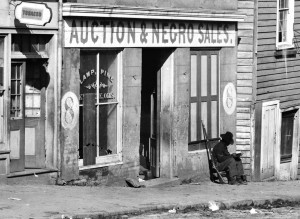
At the age of seven Susie was allowed to go and live with her grandmother. While living with her grandmother in Savannah Georgia, Susie received an education in secret. At that time African Americans were not supposed to receive formal educations in the south. She was so determined to receive an education that she covertly went to school at odd hours of the day and had her books wrapped in paper so no one could see them. She would study as often as she could. Susie even asked close friends to tutor her at night. Although her home life was less oppressive than others, Susie still experienced oppression, and racism in the world around her. In her autobiography she said, “I have seen many times, when I was a mere girl, thirty or forty men, handcuffed, and as many women and children, come every first Tuesday of each month from Mr. Wiley’s trade office to the auction blocks, one of them being situated on Drayton Street and Court Lane, the other on Bryant Street, near the Pulaski House. The route was down our principal street, Bull Street, to the courthouse, which was only a block from where I resided.” [2]

When the Union Army invaded the South, Susie volunteered to assist the army in any way possible. She served as an aid in hospitals, a cook, a launderer, a tutor for the men in literacy and a friendly ear to talk to. She traveled with the army and as a result saw the devastating effects of war. She learned to fire a rifle and was fired at herself. While with the 1st S.C. Volunteers she experienced racism at every southern town she visited. Even when she helping to save the homes, and lives of Charlestonians in the aftermath of the attack on Charleston the inhabitants thanked her with sneers and insults. After the war she returned to Savannah Georgia where she opened a school for African American children.

Later in life she moved to Boston, where she worked as a maid. Her son became mortally sick and so she returned to the South to care for him. As she traveled through the south she was shocked at the rampant racism and treatment of blacks. Susie heard horror stories of murders and lynchings against blacks, and she herself faced blatant racism. Despite her obstacles she visited her son and buried him. One example that she recalled in her journey to the south was when she was in Cincinnati. She wrote, “I reached Cincinnati on the eighth, where I took the train for the south. I asked a white man standing near (before I got my train) what car I should take. “Take that one,” he said, pointing to one. “But that is a smoking car!” “Well,” he replied, “that is the car for colored people.” I went to this car, and on entering it all my courage failed me. I have ridden in many coaches, but I was never in such as these. I wanted to return home again, but when I thought of my sick boy I said, “Well, others ride in these cars and I must do likewise,” and tried to be resigned, for I wanted to reach my boy, as I did not know whether I should find him alive”[3]  Despite all of the adversity Susie Taylor faced she carried on in a dignified manner and always lent a hand to those in need. She wrote her autobiography as a testament to the valor of the men who fought, and as a guide for understanding the life of an African American in the south.

[1] Taylor Susie King, “Reminiscences of My Life in Camp with the 33d United States Colored Troops Late 1st S. C. Volunteers: (Boston: By Author, 1902), 2.

[2] Taylor Susie King, “Reminiscences of My Life in Camp with the 33d United States Colored Troops Late 1st S. C. Volunteers: (Boston: By Author,1902), 65.

[3] Taylor Susie King, “Reminiscences of My Life in Camp with the 33d United States Colored Troops Late 1st S. C. Volunteers: (Boston: By Author, 1902), 69.


Posted in Uncategorized | 1 Comment

Backcountry


GougingBackcountry, n. –a rural area or wilderness

Traditional US history textbooks typically focus on North-South sectionalism, because of the overriding importance of the Civil War.  However, students must never forget that other types of regional divisions also seemed quite powerful to American contemporaries, such as East and West, or tidelands and piedmont, or lowlands and backcountry.  The idea of the backcountry, in particular, was an especially potent one during the era of the early republic.  This was a time of rapidly changing social mores, and vast territorial expansion.  And yet it was also a period marked by relative isolation in communications and transportation.  Waterways still connected people and places faster than any other means.  The result was a society in turmoil as its leaders groped their way toward a new, post-revolutionary stability.  Few academic articles capture that moment, or the essence of the backcountry better than Elliott Gorn’s, “Gouge and Bite, Pull Hair and Scratch”: The Social Significance of Fighting in the Southern Backcountry,” which appeared in the American Historical Review in 1985.  Gorn depicts a practical orgy of violence through the stories of the rough-and-tumble fighting culture of the Southern backcountry.   Students should be able to explain what gouging was and why it was significant. Why would Americans, especially white men in the southern backcountry, engage in such behavior and what does it suggest about their changing culture?  Both Andrew Jackson and Abraham Lincoln, the two most important American politicians of the mid-nineteenth century, grew up in the backcountry culture dominated by southern plainfolk.  How does their background help explain their political success?  In an even larger sense, how does the rise and fall of gouging in the backcountry help explain the story of nineteenth-century America?  Finally, how does the culture of rough-and-tumble fighting compare to the social dynamics of modern America?


Posted in Discussion | 2 Comments

Recommended Slave Narratives

The two most famous published ex-slave narratives were produced by Frederick Douglas and Booker T. Washington.  Students can choose to write about Douglass’s Narrative (1845) (or one of his two other subsequent autobiographies, My Bondage and My Freedom from 1855 or Life and Times from 1892) or Washington’s Up From Slavery (1901), but here are about two dozen more choices from among the significant (and teachable) ex-slave narratives that have been published in American history, available full-text online from “North American Slave Narratives,” in Documenting the American South.

Posted in Discussion | Leave a comment

Founding Mothers

Martha Ballard’s diary, September 11-25, 1787

The same week in September 1787 that the Framers “delivered” their Constitution to the American people, midwife Martha Ballard was busy caring for and delivering real babies in Hallowell, Maine.  To the right, one can view an image of her diary from that very week.  Compared to James Madison’s notes of the Constitution Convention, this journal might seem insignificant, but it better represents the lives and concerns of the four million Americans who resided in the country at that time.  Most of them, whether male or female, could probably relate more easily to the terse, businesslike entries in Ballard’s diary than to the fierce but often abstract political debates over sovereignty, republicanism and governance that the Framers were having in Philadelphia.  Students in History 117 should read historian Laurel Ulrich’s account of Martha Ballard’s life and ask themselves if Ulrich has explained the case for remembering this particular midwife.  What do we learn from this account of medical care in the early republic?  How can we explain Martha Ballard’s place in a survey of American history?  And finally, what do we need to know about ordinary lives in order to better understand the context of the past?  Students should also experiment with the Do History website devoted to Martha Ballard and her story.  See especially the transcription engine and the Magic Lens.  Also, a good reference website is available from PBS “American Experience,” which did an episode about Ballard a few years ago.


Posted in Uncategorized | 1 Comment

Slavery and the Constitution

WedgewoodWhat do Dickinson College history majors and Bernie Sanders have in common?  Lately, they’ve both been involved (albeit indirectly) in a pretty bitter academic debate over whether or not the original US Constitution should be considered pro-slavery or anti-slavery.   The story behind how this unlikely argument has escalated in September and October 2015 can be found in a series of blog posts from the History 404 seminar on the US Constitution.

Students in History 117 will be especially interested in that first post (Arguing Over Slavery), which includes a video clip of Senator Bernie Sanders speaking about the “racist principles” behind the founding of the US, the response in the pages of the New York Times from historian Sean Wilentz, and comments from Prof. Pinsker about how this debate might play out in our classroom.

Posted in Uncategorized | Leave a comment

The AP and the American History Battleground

Valuable corrective or politically correct?

Valuable corrective or politically correct?

Not every student in a course like History 117 realizes that they are entering a political battleground. Party factions and interest groups have always lobbied to influence the way the national past gets taught, but this fight has erupted again over the last year because of major changes to the Advanced Placement (AP) US History framework.

There’s a pretty good summary of the debate about the original changes in Lindsey Tepe’s article for the New America Foundation.  She quotes Prof. Pinsker as claiming that the new emphasis on historical thinking skills “should be embraced by all sides,” but then provides a litany of comments from other experts who suggest he’s being painfully naive.  Chester Finn, a leading conservative scholar, calls this “historical thinking” business, “the collegiate version of U.S. history—warts and all, with emphasis on the warts” and suggests that high school students at least would do better to “internalize basic chronology, fundamental events, key people, and major accomplishments.”  James Grossman, executive director of the American Historical Association (AHA) says that striking the balance “is an especially difficult task.”

Grossman seems to have a good point, since things have only gotten worse since October 2014 when Tepe published her piece.   This past summer, the College Board issued a revision to its previous APUSH framework, in an effort it said, to make things “clearer and more historically precise.”  As you can imagine, that kind of happy talk set off alarm bells on all sides, and Rebecca Klein from The Huffington Post recently provided a lively recap about where things stand now as we head into the new academic year.

For those students who haven’t yet considered the political ramifications of a course like History 117, they should probably start doing so.  They don’t need to take sides, by any means, but they should be able to explain how framing narratives, favoring certain historical figures or excluding terms (like “American exceptionalism”) can have unexpected political repercussions.

Posted in Uncategorized | Leave a comment

Lincoln Close Reading – Letter to George Meade (July 14, 1863)

Portrait of George Gordon Meade, credit to Wikimedia Commons

By Devon Caldwell

Dated only eleven days after the end of the Battle of Gettysburg, this “never sent, or signed” letter by President Abraham Lincoln voiced his displeasure with General George Meade, the commander of the Army of the Patomac. The Union was victorious during the three days of battle which took place between July 1-3, 1863. The battle was table-turning, so much so that Richard F. Welch explains that following the battle, “Lee’s army, dangerous as it was until the very last, would never again have the punch — in numbers, morale, quality and quantity of officers — that it took into Pennsylvania in June 1863.”

The 4th of July, 1863, saw the Confederate Army (led by General Robert E. Lee) retreat south toward Virginia. Lee’s plan was to cross the Potomac River, but there was a certain problem: the river had flooded at Williamsport, Maryland, and following the destruction of Lee’s pontoon bridge by Union General William H. French, the South was trapped (Wittenberg, et al, 160-161).

Left in Williamsport for nine days quite literally trapped, Lee and his men were finally able to cross the Potomac over the night of the 13-14. Lee had escaped back into Virginia and Lincoln was greatly displeased when he heard this news. Lincoln believed that by following Lee and his army, the Union could “have ended the war” (Lincoln, 14 July 1863). A letter sent by Lincoln only a few days earlier to Major General Henry Halleck confirms this belief, as Lincoln felt the “rebellion would be over” if “Gen. Meade can complete his work…, by the litteral (sic) or substantial destruction of Lee’s army…” (Lincoln, 7 July 1863). Of course, Lincoln soon learned that this would not happen.

A letter from Halleck — who himself had previously written to Meade to urge an attack on Lee and the remainder of his forces — to Meade written July 14 conveyed Lincoln’s “dissatisfaction” with Meade’s hesitance (Halleck, 14 July 1863). Meade’s same-day response to Halleck offers his own resignation: “the censure of the President…is…so undeserved that I feel compelled…to ask to be immediately relieved from the command of this army” (Meade, 14 July 1863).

From this point began Lincoln’s letter to Meade on July 14. Lincoln immediately attempted to soothe relations between he and Meade, and noted that he is “very — very— grateful” for Meade’s success at Gettysburg and rushed to apologize for the “supposed censure” that gave Meade “pain” (Lincoln, 14 July 1863). Using a form of empathy, Lincoln then compared the pain that Meade felt to his own “distress” that he felt must be “expressed.” Lincoln explained that he had evidence to believe that Generals Meade, Couch and Smith  had no plan to pursue Lee insofar as to fight another battle, only to “get him across the river without another battle.” (Lincoln, 14 July 1863). Lincoln felt that all 3 Generals shared the blame for Lee’s successful retreat and later, criticized Couch and Smith for arriving too late to the Battle of Gettysburg.

Invasion of Maryland – General Meade’s army crossing the Antietam in pursuit of Lee, July 12, engraving for Frank Leslie’s illustrated newspaper by Edwin Forbes, Credit to Wikimedia Commons

Continuing on, Lincoln proceeded to defend his feelings very much as if he were in a courtroom, he even went so far as to use “the case” in his terminology (he will shortly hereafter use the terminology of “prossecution (sic)”, as well). Lincoln’s defense followed this logic: following the conclusion of the Battle of Gettysburg, as Lee and his men retreated, it seemed to Lincoln that the Union did not “pressingly pursue [Lee]” and while Lee and his men were “detained” by the flooded Potomac, although the Union army was able to be “upon” Lee again with “twenty thousand veteran troops” and “many more raw ones within supporting distance, all in addition to those who fought with you at Gettysburg…”, Lee was able to “move away at his leisure” (Lincoln, 14 July 1863) without an attack from the Union side. Meanwhile, Lincoln knew Lee received no new men, and therefore felt the Union soldiers had a decided advantage.

But was this the case? By this point, the Civil War had raged on for over two full years. Although the Battle of Gettysburg was a Union victory — a victory that Lincoln felt had the potential to end the war altogether — the casualties for both sides were tremendous. Modern figures have the total Confederate casualty figure at 28,063 (3,903 fatalities, 18,735 wounded and 5,425 missing) while the Union figure is 23,049 (3,155 fatalities, 14,529 wounded and 5,365 missing). So while the Confederate had a much higher aggregate total, the losses of the Union should not be discounted. It is very possible that General Meade felt that his army was in no shape to pursue Lee and fight another battle. Lincoln was merely a bystander to the death and destruction wrought at Gettysburg and as such, it is quite impossible that he had the firsthand knowledge like that of the Union generals. Although Lincoln may have felt that one final attack on Lee and his men at Williamsport could spell the end for the Confederacy, the Union general may  not have felt that an attack was worth the risk or even at all feasible in its current battered state.

Regardless, Lincoln continued his letter by explaining the “misfortune” of “Lee’s escape” and the consequences thereof, while not neglecting the opportunity to once again assert that Lee was within the Union’s “easy grasp.” Lincoln feared that Lee’s retreat would prolong the war “indefinitely,” especially so as he knew that Meade would no longer have the same amount of troops available to him (“…few more than the two thirds of the force you had…”) as he pursued Lee back into Virginia.  The President felt it “unreasonable to expect” a better opportunity for an attack to present itself “South of the river” than the one Meade had “last monday (sic)”.

Escape of the Army of Virginia, commanded by General Lee, over the Potomac River near Williamsport, painting by Edwin Forbes, Credit to Wikimedia Commons

Lincoln’s final short paragraph explained his purpose of writing: he learned that Meade learned of Lincoln’s own dissatisfaction second-hand, and wanted to personally explain why he felt such a way. Lincoln also wanted to be sure that Meade did not feel prosecuted or persecuted.

Again, it should be pointed out at this point that this letter went unsent by Lincoln and Meade remained in command of the Union army as Lincoln denied his resignation and furthermore, defended and supported Meade as shown in his letter to General Oliver O. Howard in which he wrote, “Gen. Meade has my confidence as a brave and skillful officer, and a true man” (Lincoln, 21 July 1863). This however, did not come before Lincoln seemingly admitted that his letter to Meade was written rashly: “A few days having passed, I am now profoundly grateful for what was done, without criticism for what was not done (emphasis author’s)” (Lincoln, 21 July 1863).  Perhaps it was for this reason that the letter remained unsent. The President realized how emotionally and impetuously he had written this letter to Meade, and after a few days had passed, Lincoln realized it would be better if the letter were not sent at all.  And so, the letter remained — as written on the envelope containing the letter — “never sent, or signed.”

References

“George G. Meade,” Civil War Trust. 2014. <http://www.civilwar.org/education/history/biographies/george-meade.html/>.

“July 14, 1863,” Shenandoah Valley Battlefields. 2013. <http://www.shenandoahatwar.org/150-Years-Ago-Today/1863-Entries-150-Years-Ago-Today/July-14-1863/>.

“Letter to Oliver O. Howard, July 21, 1863,” Collected Works of Abraham Lincoln. University of Michigan. <http://quod.lib.umich.edu/l/lincoln/lincoln6/1:722?rgn=div1;view=fulltext/>.

“Letters from Union General George Gordon Meade,” Gettysburg College. Archived PDF. <http://www.gettysburg.edu/dotAsset/4a24eaf8-8a64-4d64-9f1e-12a6a2be2631.pdf/>.

“Lincoln’s Unsent Letter to George Meade,” Civil War Trust. 2014. <http://www.civilwar.org/education/history/primarysources/lincolns-unsent-letter-to.html/>.

“Lincoln Message Discovered at the National Archives,” National Archives. 7 June 2007. <http://www.archives.gov/press/press-releases/2007/nr07-108.html/>.

“Retreat from Gettysburg,” Civil War Trust. 2014. <http://www.civilwar.org/battlefields/gettysburg/gettysburg-history-articles/battle-of-gettysburg-finale.html/>.

Wittenberg, Eric J., J. David Petruzzi, and Michael F. Nugent. One Continuous Fight: The Retreat from Gettysburg and the Pursuit of Lee’s Army of Northern Virginia, July 4–14, 1863. New York: Savas Beatie, 2008
Posted in Uncategorized | 1 Comment

George Read: An Influential But Forgotten Founder

GeorgeRead

Portrait of George Read, Chief Justice of Delaware (Courtesy of the Wikipedia website)

George Read had many political strengths and used them in his quest to rise and become a leader in the development of the United States.  However, his name is not recognized by most. In fact, only his contemporaries and Delaware residents recalled his significant contributions to the founding of the United States. At the Delaware Constitutional Convention in 1776, he was “the most influential delegate in the state constitutional convention” (Munroe). He rose to political standing as a self-made man, using all the resources in his path to success.

Read was born in Cecil County, Maryland on September 18, 1733. He was the son of the Irish immigrant John Read, a planter from Dublin, Ireland, and Mary Howell, an immigrant from Wales. His parents were not well-educated and his family-name was not recognized. Read was determined to bring pride to his family name. Unlike his parents, he received a classical education at the Reverend Francis Allison’s academy in New London and at age fifteen studied law in Philadelphia (Monroe). The education would not have been possible without the support of Reverend Allison, his caretaker while in New London. His law education was a major asset that aided his knowledge of the judiciary. In 1780, he served as a judge in Delaware. Not only did he read over legal documents carefully, but he also saw the practical applications of them: how they directly impacted the people. Those abilities made people recall him as a “deep-read lawyer and versed in special pleading, the logic of law” (Read, 15). In 1797, he compiled the two-volume collection of the Laws of Delaware. 

He was called a Founding Father because he was one of the state delegates who signed the

Colonial Delaware (Courtesy of examiner.com)

Colonial Delaware (Courtesy of examiner.com)

Declaration of Independence, the Articles of Confederation, and the US Constitution; thus he assisted large-scale government decisions. However, the majority of his political occupations focused on issues at the state-level, small-scale government decisions, rather than at the national-level. For example, the main reason he supported the Alexander Hamilton’s notion of a strong central government was that the government would regulate the power of larger states. Delaware was a small state; hence if the states gained control of the government,  larger states would most likely receive the upper-hand in establishing legislative measures.

Read started out as a man who was concerned with the public impact of government decisions. During the Revolutionary Period, he was the “leader of the moderate party in Delaware” (Monroe) and “member of the Delaware Committee of Correspondence” (Read, 330). He was a key individual involved in the repeal of the Stamp Act in 1765 and “secured compliance with Philadelphia nonimportation agreements in 1768” (Monroe). He was said to be “active in patriotism” (ushistory.org), but he did not want to fight off the British. Similarly to his colleague, John Dickinson, he did not have a desire to break free from the Royal Crown. The British structure provided a platform for stability in 18th century America while the country

Stamp Act 1765 logo (Courtesy of http://www.cr-cath.pvt.k12.ia.us/)

Stamp Act 1765 logo (Courtesy of http://www.cr-cath.pvt.k12.ia.us/)

learned to govern itself. Additionally, he respected the Royal Crown, since he thought Britain was a well-established nation and was treating the American colonies properly. The British knew Read was a loyal supporter to their political policies. They even offered him an office position under British government in which they promised him a share in the financial benefits (Read, 21).  However, this position came at a time when Read was beginning to realize that the disturbances between the colonies and the Royal Crown were problematic. The British began to repress the rights of the American people and pass taxes without the consent of the people. As a result, Read refused the British offer. His patriotism and integrity overpowered the potential economic rewards from the job offer. Although patriotism was not the main reason he made his decision, it was due to protecting his reputation and character.

According to historian Gordon Wood, 18th century character was a concern of the Founders, which meant they were “preoccupied with their honor or their reputation, or, in other words, the way they were presented and viewed by others” (Wood, 23). Read’s actions do not follow Wood’s definition of character, since Read’s actions were private. It can be debated that Read fits the mold of a modern character, since he seems to have “inner personality that contains hidden contradictions and flaws” (Wood, 23). Read does not have any memorable speeches or public announcements throughout the 18th and 19th centuries. Even as a representative at the Annapolis Convention (1786) and Philadelphia Convention (1787),  he did not make any noteworthy remarks. In order to understand his position on political topics, the information was gained through letter exchanges. These letters revealed Read’s perception of the government’s direction. During the Philadelphia Constitutional Convention (1787), Read wrote a Letter to John Dickinson that focused on smaller state’s rights. He proposed that larger states should be watched over carefully or else they will potentially suppress the rights of the smaller states. It can be argued that his character was achieved in the state of Delaware, but would not be identified by everyone.

His lack of character explained how he shifted from public to private regarding government decisions. First, he never verbally expressed that he was against the new independence resolution devised by the other delegates on July 2, 1776. He essentially “Thought it (Declaration) premature, the people, and especially many of his own constituents, not being ripe for it” (Read, 334). Congress was not giving the citizens enough of an advanced notice about the changes that would happen in the government. He even criticized in a published 1871 newspaper article that the document “did not have a Table of Contents nor an Index” (Life and Correspondence of George Read Signer of the Declaration of Independence). Despite his inward objection, at the Second Continental Congress on July 4, 1776, he along with fifty five other delegates approved the document (Monroe). He concluded he did not want to risk his reputation on account of political disagreement. He would lose all his supporters and followers that have been by his side. His intentions were to maintain good character, yet his actions did not match those intentions. He kept his opinions hidden and made his political decisions on behalf of Delaware. John Dickinson voiced his disagreement of the new independent resolution; he did not even sign the Declaration of Independence. Dickinson showed adequate character, since he had an image publicly known. Colonel Bedford questioned Read’s character.

Even though Read did not demonstrate good character he did possess the other qualities of the Founders including disinterestedness, republicanism, and virtue. Read was a follower of moral code and classicism. He was a man of honor, he would never break a rule. Additionally, he was know for his understanding in human nature similar to Benjamin Franklin. Other Founders knew of his high honor and sought him out for advice on their own policies. Dickinson asked him in a letter for advice on a land ownership issue (Dickinson Archives). He became disinterested, since in 1779 he temporarily retired from politics, but in 1780 he was appointed to be the “Judge in the Court of Appeals” in Delaware (ushistory.org). He helped create Delaware legislative policies. His focus on state politics rather than federal politics caused him to not build up his reputation. He was an important founding father, but not remembered.

 References

Dickinson, John. Letter to George Read. Wilmington, VA: 16 December 1785. Dickinson College Archives.

Munroe, John. “Read, George“; http://www.anb.org/articles/01/01-00772.html; American National Biography Online Feb. 2000. Web. 7. November 2014. 

Munroe, John. Nonresident Representation in the Continental Congress: The Delaware Delegation of 1782. The William and Mary Quarterly, Third Series, Vol. 9, No. 2  (1952): pp. 160-190. Web. 1. November 2014.

“Life and Correspondence of George Read a Signer of the Declaration of Independence” with notices of some of his contemporaries. Historical Magazine Post Jan 1871: Print.

Read, William. Life and Correspondence of George Read A Signer of the Declaration of Independence. Philadelphia: J.B. Lippincott and Company, 1870. Print

Read, George. Letter to John Dickinson. Philadelphia: 21 May 1787. http://teachingamericanhistory.org/library/document/letter-to-john-dickinson/

Wood, Gordon. Revolutionary Character What Made the Founders Different. New York: Penguin Group, 2006. Print

Posted in Uncategorized | 1 Comment