
“Pearl Harbor commenced a revolution in American foreign policy, and the Truman Doctrine and the Marshall Plan continued it. The essence of the revolution was the belief that the United States could not afford to leave the world to its own devices, as it had done during the 1930s, and that disorder and aggression even in distant locales would eventually endanger the American way of life.” –Opening line, Chapter 3
Brands, Chapter 3: Agnostics and Believers, 1949-1954
- Institutionalizing the Revolution (pp. 45-48)
- The China Syndrome (pp. 48-49)
- Tail Gunner Joe (pp. 50-55)
- Redefining the Perimeter (pp. 55-58)
- Liking Ike (pp. 58-61)
- The Quiet Americans (pp. 61-64)
- The Shadow Lengthens (pp. 64-67)
Image Gateway (1948 // 1952)
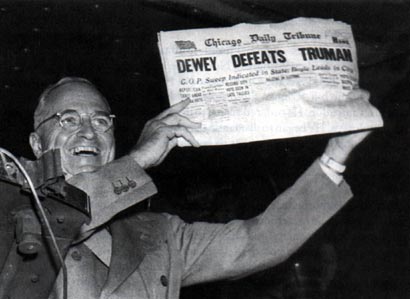
Harry Truman holding the Chicago Tribune following his reelection in 1948
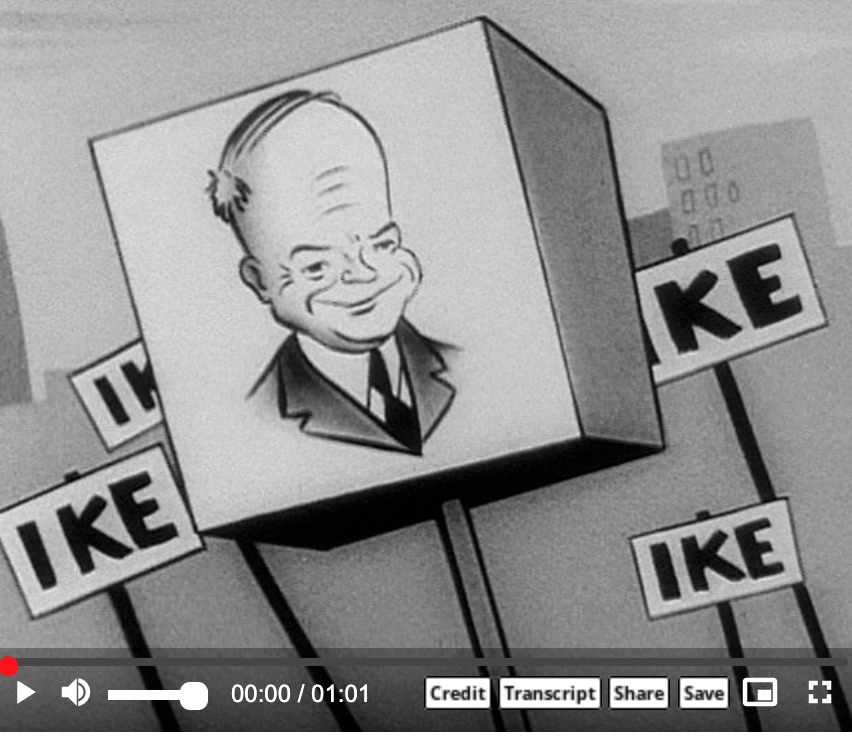
Try to analyze these 1952 Eisenhower commercials courtesy of The Living Room Candidate.
Timeline
- 1946 // Iron Curtain Speech
- 1947 // Truman Doctrine
- 1947 // National Security Act
- 1947-48 // Marshall Plan
- 1948-49// Berlin Airlift
- 1948 // Truman wins second term
- 1949 // NATO
- 1949 // Soviets test atomic bomb (fission)
- 1949 // Communist China
- 1950 // McCarthy claims communists have infiltrated US State Department
- 1950-53 // Korean War
- 1953 // US tests hydrogen bomb (fusion)
- 1954 // US Army – McCarthy hearings & then censure vote
- 1954 // Break up of French Indochina
- 1954 // Doolittle Report
Cold War Terminology
- Containment (Kennan) and Cold War (Lippmann)
- Isolationism (hemispheric defense) vs. Interventionism (forward defense)
- Unilateralism (Monroe Doctrine) vs. Multilateralism (UN / NATO)
- Realism (balance of power) vs. Idealism (international rules)
America and Dickinson College Confront McCarthyism
- 1954 Debate over Censure for Sen. Joseph McCarthy (R-WI)
- 1956 Firing of Dickinson professor and subsequent AAUP censure
