History 211: History of US Elections

Dickinson College, Spring 2024

Election of 1936: A Shift in Hereditary Politics

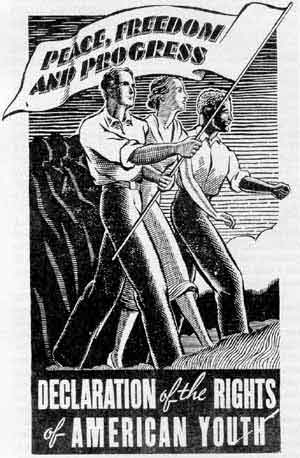
American Youth Congress poster, 1930s

The election widely considered the most one-sided in the history of presidential politics coincided with a shift from hereditary politics. Mass political student organizing ascended in 1936. But such a surge didn’t necessarily correlate with Franklin Delano Roosevelt’s decisive victory over Alf Landon, the Republican Governor of Kansas. Instead, students rallied behind Norman Thomas, the Socialist candidate. During the American Left’s peak years (1936-39), the movement mobilized at least 500,000 collegians—roughly half of the American student body. In unprecedented numbers, female students were leaving the ideologically conservative party of their parents to join Thomas’s Socialist movement.

During the Great Depression, the majority of female students came from conservative middle-class families. Yet cultural changes caused students to stray from their parents’ conservative values. A study of college students’ social attitudes in 1936 found that many began to adopt a more liberal mindset, and accept dispositions formerly forbidden. Social changes such as “a decline in religious interest,” and “the lifting of taboos among women on sex attraction” caused women to reevaluate their beliefs. Such changes had repercussions on the political sphere leading up to Election Day.

A 1935 autobiographical sketch by Alice Dodge revealed that despite her conservative upbringing, she ultimately joined the Socialist organization, Student League for Industrial Democracy. Her father nearly always voted Republican, as did her mother to display loyalty to her husband. Yet, Alice did not share the same compulsions as her mother. “One by one my parents have seen their four daughters emerge from Vassar no longer Republicans,” Alice explained, saying she personally “belongs to the Socialist Party.”

November 3, 1936, Election Day, signified a sharp shift in inherited politics. In a letter to the editor in LIFE magazine, a female voter reflected on the rise of student momentum. “The first time, in 1932, I voted for [Herbert] Hoover because my mother did,” she said, yet, “the second time, in 1936, I voted for Norman Thomas because at that time I was in a fever of youthful zeal to change the world overnight.”

In hindsight, it is easy to correlate Roosevelt’s triumph with student organizing in the 1930s. However, Roosevelt was not the candidate who galvanized students in ’36. And since Roosevelt became the first Democratic presidential candidate in more than a decade to capture the majority of student voters—48.3 percent—it’s natural to associate him with the mass student movement. This assumption is flawed.

Although Thomas only received 187,720 votes, his ability to mobilize students had a symbolic impact. In a letter to the editor of The New York Times the day after the election, one voter expressed fear of the sudden influx of Socialist views at the College of the City of New York. “When one considers,” he argued, “that Mr. Thomas got 261 from a total of 2,233 votes, it can be well realized that the charge of communism and socialism today is well founded.”

Thomas agreed, and when he was notified of Roosevelt’s overwhelming win, he said, “never was our Socialist message more necessary than today.” The student movement during the mid-1930s served as a precursor to the anti-war student movement of the 1960s. Norman Thomas attributed his 1936 loss to the fact that “too often we vote our fears, not our hopes.” However, the 1936 election signified the moment that many college students began to vote with their hopes, by proving they did fear leaving the party of their parents.

The 1936 Presidential Election in New York City.

The 1936 Presidential Election in New York City.

Posted on October 11, 2010 by bradmeisel

     A Gallant Leader

   http://www.legacyamericana.com/servlet/the-19914/Pinback-button-promoting-Franklin/Detail Copyright, Legacy Americana, LLC.    

   On election day, November 3, 1936, “a crowd estimated by the police at ‘a million’ persons kept Times Square and the theater district in continual uproar last night as news of the President’s reelection flashed from The Times tower” (“Election Crowd in a Merry Mood.” New York Times. 4 November, 1936, 5).            

The 1936 Presidential election pitted Democratic President and former New York Governor Franklin D. Roosevelt and Vice President John Garner, who were elected in a landslide four years prior, against the Republican ticket of Kansas Governor Alf Landon and Chicago newspaper publisher Frank Knox.  According to historian Michael J. Webber, President Roosevelt’s first term in office saw the emergence of a “new welfare state,” as a result of his agenda of sweeping reforms, known as the New Deal, which were aimed at alleviating the Great Depression.  As a result, the Presidential election “was, in many ways, a referendum on the activist role taken on by the federal government since the inception of the New Deal.”   (Webber, Michael J. New Deal Fat Cats: Business, Labor, and Campaign Finance in the 1936 Presidential Election. New York: Fordham University Press, 2000, 127). 

The New Deal included the creation of Social Security, which provided financial assistance to elderly Americans, the Works Progress Administration, which employed people who were previously unemployed to participate in public works projects, and agencies such as the Federal Deposit Insurance Corporation, which served to regulate business and protect consumers. 

            On Election Day, the American electorate, comprised of men and women over the age of 21, delivered a clear statement of support for President Roosevelt’s agenda.  The next day, voting returns across the entire nation implied “that more Americans than ever went to the polls” (“A Record Vote.” New York Times. 4 November, 1936, 30). 

In the New York metropolitan area “the President maintained a 3 to 1 ratio” over Landon with heavy turnout, allowing him to carry his home state by one million votes despite “an upsurge of Republican votes” upstate (“President Piles Up 1,000,000 New York Lead.” Associated Press. 4 November, 1936, 1). 

            In the late afternoon on Election Day, throngs of Roosevelt supporters congregated in Times Square to watch as the incoming returns were displayed on The Times Building.  “By 6 P.M. Times Square was comfortably filled,” and within two hours, the crowd spilled out “north of the square.”  When it became evident that the Democratic ticket had emerged victorious, a jubilant celebration erupted, and “streamers flew.”  New York Police Deputy Chief Inspector Patrick Murphy was quoted as saying that “Never in all my years of experience have I seen such a mob of cheering, shouting spectators” (“Election Crowd in a Merry Mood.” New York Times. 4 November, 1936, 5). 

            A similar scene unfolded in Chicago, where “several thousands of Democrats staged a wild victory celebration.”  Democratic campaign workers joined enthusiastic citizens in the festivities after the results became evident.  Revelers “built bonfires in the streets, halted traffic,” and tore “trolley wires off several street cars.”  The swarm of people celebrating the President’s reelection grew so raucous that “extra police were sent to the scene,” in order to prevent “further damage” (“Wild Jubilee Held in Loop by Democrats.” Chicago Tribune, 4 November, 1936, 1). 

            The emphatic affirmation of the New Deal by the electorate in the Presidential Election of 1936, as demonstrated by the avalanche of voter enthusiasm in the New York metropolitan area, was emblematic of the emergence of a new Democratic voting bloc.  According to historian Michael J. Webber, Roosevelt’s landslide victory was a result of the formation of a “New Deal coalition,” which consisted of “organized labor, religious and ethnic minorities, the urban poor, liberals and progressives” (Webber, Michael J. New Deal Fat Cats: Business, Labor, and Campaign Finance in the 1936 Presidential Election. New York: Fordham University Press, 2000, 127). 

The President’s New Deal policies supported organized labor and established welfare programs to assist the urban poor, many of whom were members of the minority groups referred to by Webber, thereby solidifying these individuals’ fervent support for the Democratic party.  As New York and Chicago were two of the nation’s largest metropolitan areas and home to a plethora of ethnic groups and many working and lower class individuals, the President’s enthusiastic support in these cities was a strong indication of the emergence of the New Deal era Democratic constituency, the fruit of which continues to manifest itself in American electoral politics.

1912: Women for The Bull Moose

“How do the women of New York, who think they are—to put it moderately—at least equal to those of any other state in the Union, like the idea of being classed with idiots, insane, convicted criminals and boys under twenty-one on every Election Day?” –Ida Husted Harper in the New York Tribune

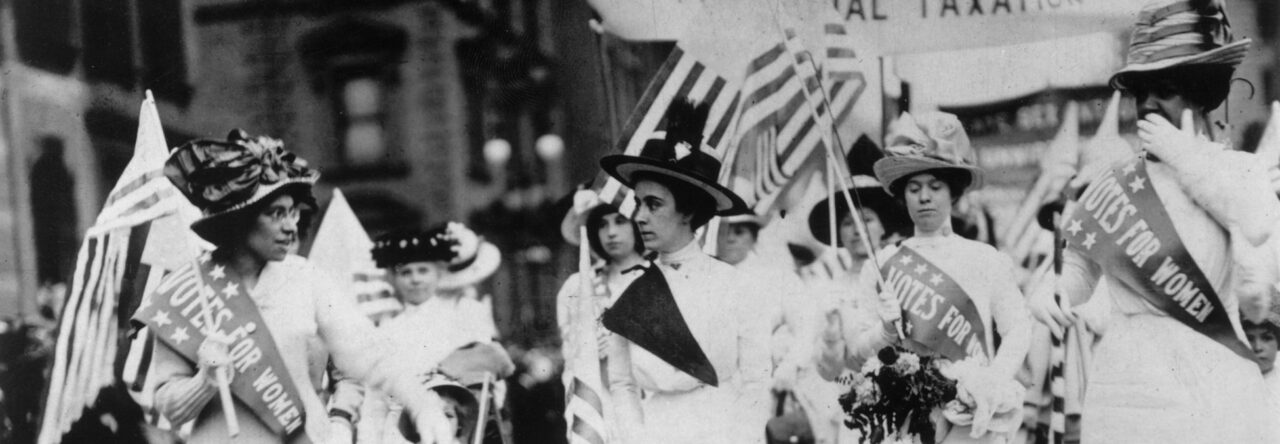
The year was 1912 and just like in New York, women in most states still did not have the guaranteed right to vote.  With the upcoming presidential election, these women, as well as those who could vote, found a voice in Theodore Roosevelt’s Progressive Party, the first to adapt a woman suffrage plank.  As suffragist Ida Husted Harper declared, “Women had taken a larger part in the political campaign…than ever before and one of the officers and many of the delegates present had spoken and worked for the Progressive party because of the suffrage plank in its platform” (p. 342).  The platform stated, “We pledge our party and its candidates to support loyally and work for the women’s suffrage constitutional amendment at all stages.”

Historian Jo Freeman argued the reason many women backed Roosevelt and his ‘Bull Moose’ ticket as opposed to Wilson or Taft is because they “found a warmer welcome in the Progressive Party than they had ever had from the Democrats or Republicans…Roosevelt urged that women gave a voice in party affairs even in states where they could not vote.”  For these women who could not vote, this voice was a way that they could influence the political campaign and prove they did have reason for needing the vote.

On Election Day, of the 1.3 million women who were eligible to vote, nearly half did so.  According to the New York Times, “Women played even a more important part in California than was expected…many women who own autos used them to gather aged and infirm voters and carry them to the polls, as well as workers in shops and stores who had limited time.  Many of the women workers in this city who were ardent Progressives appeared at the opening of the polls, at 6 o’clock, and remained throughout the day.”  It was also observed that most women filled out the ballots quicker than men because they had “studied sample ballots more closely.”

When the results came in, Roosevelt had lost the election to Wilson even with the support of many women.  Even so, there is no denying the importance of the election of 1912 had to women’s suffrage.  The woman’s suffrage plank that the Bull Moose Party advocated empowered women to fight for their natural rights.  Just as a protester wrote to the New York Times editor, “I venture to suggest the right to protection…as one right that woman does not possess that she sorely needs, and that the ballot is, so far as I know the only means of her obtaining”, women would not stop fighting for full enfranchisement until the 19th amendment was passed in 1920.

1912: Roosevelt and the Bull Moose Party

“The trumpet call is the most inspiring of all sounds, because it summons men to spurn ease and self-indulgence and timidity, and bids them forth to the field where they must dare and do and die at need.”- Theodore Roosevelt

After serving two terms as President of the United States from 1901-1909, Theodore Roosevelt decided against running for reelection in 1908.  But as historian Patricia O’Toole suggests, in reaction to “the wrenching events of 1912…he persuaded himself that the trumpets of patriotic duty were calling for him to run for president,” once again.  Historian H.W. Brands argues that Roosevelt was upset with the current direction the Republican Party was headed and “felt forgiving, if condescending, towards Taft.” Roosevelt returned from retirement to run against Taft but ultimately failed to win the Republican nomination (The American National Biography).

Instead of accepting defeat, Roosevelt formed the Progressive Party to run as a third-party candidate.  He used his influence to gain support from disenchanted Republicans and on September 5, 1912, the National Progressive Party documented their platform focusing on “the rule of the people” and “realized the birth of a new party…unhampered by any corrupt political past, or by that ‘invisible government,’ which has so long coerced legislation to serve special and private interests.”  Roosevelt established new views for reform and succeeded in becoming a formidable opponent against Taft, his former party member, as well as Wilson, the Democrat candidate.

Unfortunately for Roosevelt, one man was not so happy with his choice to run for a third term and on October 14, 1912, John Schrenk attempted to assassinate the former president.  The incident made headlines across the nation and the New York Tribune reported:

“A desperate attempt to kill Colonel Theodore Roosevelt failed to-night, when a bullet aimed directly at the heart of the ex-President and fired at short range by a would-be assassin spent its force in a bundle of manuscript containing the address which Colonel Roosevelt was to deliver to-night and only slightly wounded the third party candidate.”

The New York Times further explained how Roosevelt insisted on continuing with his speech, “succeeded in making himself heard and talked for nearly an hour.” Only then was he taken to hospital.

October ended and November brought the much-anticipated Election Day.  The Washington Times detailed Roosevelt’s day at the polls:

“After a busy morning at his correspondence, Colonel Roosevelt was driven in his automobile to the place at the little engine house at Oyster Bay, arriving there at five minutes after 12 o’clock…Followed by a crowd of villagers, half a dozen photographers and the members of his party, the colonel entered the polling place and signed the book.  His ballot was No. 265.”

When the results came in, Roosevelt’s Progressive Party had not mustered enough support and Wilson won the election with 400 electoral votes.  Even so, Roosevelt won six states and beat Taft out in nearly all of them.  The Bull Moose Party may not have won the election but it came a strong second and proved to upset bipartisan politics.

Mugwumps and Mudslinging: The Bitter Election of 1884

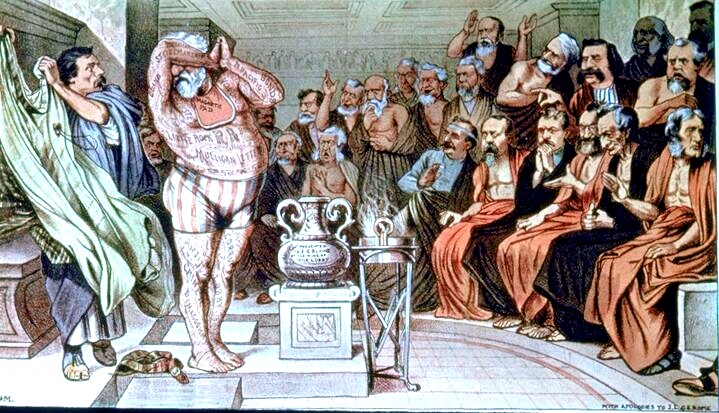
This 1884 cartoon from the periodical "Puck" depicts James Blaine as being tattooed and unable to escape the scandals of his past. Note "Mulligan Letters" written on his torso.

On November 4, 1884, John Kelly awoke to grey clouds and political uncertainty hanging over New York City. Mr. Kelly, the boss of New York’s notorious Tammany Hall, had gone to bed the night before election day having optimistically told supporters of Democratic nominee Grover Cleveland that “everything politically looks most encouraging. I have no doubt of Cleveland’s election.”** The Republicans, who were counting on James G. Blaine to extend their stay in the White house into its twenty-fifth year, were equally confident: “I think now what I have always thought – that we will carry all the Northern States without exception . . . Blaine is as good as elected,” boasted B.F. Jones, the chairman of the Republican National Committee.

But the party leaders’ public certainty belied the race’s closeness. Out of about ten million votes cast, Cleveland won the national popular vote by just over 25,000 votes. Not only was the voting close, turnout was high nationwide. The Milwaukee Daily Journal reported record turnout and Boston saw a large turnout by Harvard students. Of course, elections are won at the state level and in 1884, New York was crucial. Over a million New Yorkers voted and Cleveland captured the pivotal state (and all 36 electors) by a margin of only 1,047 votes.

Cleveland’s victory capped what was an unusually personal campaign for the time. Historian Mark Summers argues that voters in 1884 “sensed a political system breaking apart” and were beginning to care less about loyalty to party and more about individual candidates and their stances on issues. Considering that the bulk of campaign coverage focused on the integrity (or lack thereof) of the candidates, the conventional narrative that stresses the impact of scandal rather than issues is more convincing. What is clear – and Mr. Summers would likely agree – is that candidates and their personalities, stances, and mistakes were becoming increasingly important as individuals.

There certainly was no shortage of mistakes or scandals when it came to Grover Cleveland and James Blaine. Blaine, during his time as a U.S. Representative from Maine (later Speaker of the House) was an active participant in patronage politics. Eight years earlier, during the 1876 election, a Boston bookkeeper named James Mulligan uncovered letters that strongly suggested Blaine’s involvement in the issue of fraudulent public bonds and other forms of corruption. Blaine angrily demanded that the “Mulligan Letters,” as they became known, be returned on the grounds that they were private correspondence. On top of questions about his integrity, he failed to condemn Reverend Samuel D. Burchard who referred, at a Blaine campaign event, to the Democratic party as the part of “rum, Romanism, and Rebellion.” His seemingly trivial failure to reject this caricature likely lost him the votes of any previously sympathetic Irish Catholics, many of whom lived in New York.

Cleveland, the governor of New York, had issues of his own. He fathered an illegitimate child in 1874 with a woman named Maria Halpern; this came to light during July of 1884. This accusation was magnified by the allegation that the Governor had forced Ms. Halpern into exile. Cleveland had built his public image around trust (“Public office is a public trust,” he said) so he admitted having had improper relations with the woman, while denying that he had forced her into exile.

Evidently, Cleveland’s private scandal proved less damaging than Blaine’s impropriety in public office and carelessness on the campaign trail. A group of reform-minded northeastern Republicans known as Mugwumps supported Cleveland on the grounds that Blaine was too corrupt to serve. Blaine’s inability to effectively counter charges of corruption and his failure to condemn Rev. Burchard’s remarks cost him New York. Without New York, he could not win the election, and Cleveland won by the slimmest of margins.

By the end of the year, John Kelly, his health failing and influence curtailed, retired. The Democrats had broken the 25 year-old Republican stranglehold on the White House, ushering in an increasingly competitive era in American politics.

**It is possible that Kelly’s public message was inconsistent with his work outside the public eye. He had proudly opposed Cleveland’s nomination, and The New York Times suggested on more than one occasion that Kelly continued to work against him. But no Democratic source can support the Republican Times, so the truth of these accusations is suspect. (Examples one, two, and three)

Election 1872: Old White Hat’s Bad Luck

On election day, 1872, The Atlanta Constitution urged its readers “Democrats, turn out and vote this evening. There is danger of the Radicals repeating. Give the afternoon to your country.” The joint Democratic and Liberal-Republican candidate, Horace Greeley, won the state of Georgia by thousands of votes, but his showing nationwide was not strong – his additional victories were limited to Kentucky, Missouri, Maryland, Texas, and Tennessee.

Greeley was seen as a coalition candidate, a Republican who was first nominated by the Liberal-Republican faction, then endorsed by the Democrats in an attempt to defeat General Grant. He had personally become “disaffected with the Grant administration because of its corruption and indifference to civil service reform, and also because of its continued enforcement of Reconstruction measures in the South” and fit well as an anti-Grant candidate. Despite the efforts of both parties behind Greeley, Grant won re-election that year by an overwhelming majority. On November 6th, the day after the election, The New York Times reported him carrying thirty of the thirty four states that had reported, receiving three hundred estimated electoral votes to Greeley’s forty nine (The final results were thirty one states to six, 55% to 44% of the popular vote, respectively).

Horace Greeley was the well known editor of the daily paper The New York Tribune, which he first began publishing in April, 1841. Greeley was well known for advocating western settlement, particularly the quote “Go west, young man, go west.” He had “not only promoted the western movement but urged as well that Americans be continually willing to uproot themselves to seek a better life.” He had a rather caricature appearance, which was made fun of in cartoons by Thomas Nast, but viewed rather affectionately by the public. This earned him the nicknames  “Old White Hat,” and “Uncle Horace,” among others.

The electoral defeat was yet another blow to Greeley after a line of tragedies in for him and his family. Out of his seven children with his wife Mary, only two lived through childhood. On October 30, 1872, Greeley’s wife died. He went pack to the Tribune but “following his defeat in the election of 1872, Greeley found that control of the paper had passed out of his hands. Shocked by his electoral repudiation, the recent death of his wife, and the effective loss of his editorship, Greeley suffered a breakdown of both mind and body, and died on November 29, 1872.”

His death came after the popular vote, but before the Electors made their choices. Because Greeley was no longer a viable candidate, for obvious reasons, most of his electoral votes were split among other candidates for president, eighteen specifically going to his running mate, Benjamin Gratz Brown. Greeley still managed to get three electoral votes, though they were not counted, from electors in of all places, Georgia, the state that had supported him so enthusiastically in the general election.

Page 7 of 8

Powered by WordPress & Theme by Anders Norén