The Decorative Other

The 19th century witnessed a dramatic expansion of the British Empire, bringing with it not just military and economic power, but also a fascination with the cultures of the conquered territories often referred to as the “East”. This fascination found substantial space in the arts, where Orientalist painting emerged as both a reflection of imperial ambition and an imaginative reworking of exotic “otherness.” One powerful example of this is Fête of the Prophet at Quad-el-Kebir by Fredrick Arthur Bridgeman, a richly detailed work that encapsulates the Orientalist gaze.

Orientalism, as defined by Edward Said, refers to the depiction of Eastern societies as exotic, mysterious, and often inferior to the West. In this painting, Bridgman portrays a religious festival emphasizing the exotic nature of the scene. The composition, featuring richly adorned figures and elaborate architecture, caters to Western fantasies of the East as a land of mysticism, particularly as it pertains to women in their cultural clothing. 

Relating this idea to the artist, Bridgeman, an American, travels to North Africa in 1872 and marks a pivotal moment in his career. He journeyed through Algeria and Egypt, producing approximately 300 sketches that would serve as the foundation for many of his subsequent paintings. These works, characterized by their depictions of Eastern life, earned him recognition in both Europe and America. 
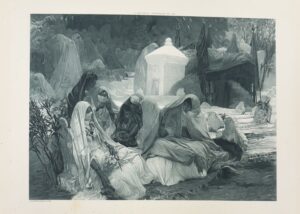
While based on a real event, the celebration of the Prophet Muhammad’s birthday, Bridgeman amplifies its suspense to create a visual experience steeped in drama. The viewer is invited not to understand the meaning of the ritual but to consume it as exotic entertainment. This is further supported with the women in the background of the painting, fading into one another, lacking individual identity. Bridgman’s depiction of these figures supports the Orientalist narrative of Eastern society as a faceless, homogenous mass, especially in regard to gender roles. In this context, Muslim women are not portrayed as active participants in their own cultures, but rather as passive, decorative elements in a scene interrupted by the Western gaze. This marginalization reflects a broader Western tendency to view Muslim women as silent, oppressed, and mysterious

Here, Bridgeman projects Victorian fantasies onto the Islamic world. In the painting, there are no hints of colonial interference, creating a fixed world, stuck in the past, thus needing Western guidance. Additionally, there is little theological focus in the figures, showing that religion in the East is portrayed not as a moral system but rather as ecstatic, tribal, and emotionally charged. Ultimately, beauty, strangeness, and emotional intensity are prioritized over cultural understanding making it an example of the Victorian orientalist imagination.

Reading between the lines and walking across intersections,

JAY WALKER


A Rather Trodden Ground

Mona Caird’s The Yellow Drawing Room is less about a room and more about a woman who refuses to stay within one; socially, intellectually, or ideologically. Through the character of Vanora, Caird crafts a subtle but powerful portrait of the New Woman: a figure who, by the fin de siecle, had come to symbolize both possibility and threat in a rapidly shifting cultural landscape.

Vanora is introduced in a way that immediately sets her apart from the other women in the story. While the other female characters uphold the “feminine traditions admirably,” Vanora declines to participate in what she sees as a performance of outdated gender roles. She remarks, “They are keeping up the feminine traditions admirably. Don’t you think it would be a little monotonous if I were to go over exactly the same ground? It seems to me that the ground is getting rather trodden in” (Caird 107). This statement strikes at the heart of the New Woman ideology. This “trodden ground” is a metaphor for the repetitive actions women are forced to follow, generation after generation, without space for reinvention (or pants for that matter). 

According to the Victorian Web’s overview of the New Woman, this figure was “intelligent, educated, emancipated, independent and self-supporting.” Vanora embodies each of these qualities, yet her nonconformity is not embraced. The narrator remarks, “I suppose I must have been in love with her, yet all the time I seemed to hate her” (Caird 108). This admission speaks volumes. His love-hate feelings encapsulate what scholars describe as ambivalent sexism: the simultaneous idealization and hostility directed at women who refuse to conform. Vanora is not dismissed or ignored; she is desired and resented in equal measure. This emotional whiplash reflects the cultural climate of the Victorian Era. Just as Vanora provokes confusion and discomfort in the narrator, the New Woman unsettled Victorian society by refusing to play her part quietly. In this way, Vanora exposes the systems of power and control of sexuality that the New Woman threatened to undo.

In The Yellow Drawing Room, Vanora does not need to make a grand speech or stage a revolution. Her very existence, the way she speaks, thinks, and refuses to “go over exactly the same ground”, is an act of resistance. And through her, Caird has us reconsider the price of nonconformity and the courage it takes to claim one’s individuality in a world that demands quiet conformity.

Wondering through words,

JAY WALKER

Victorian Expectations and Contradictions

“Jack: …You have seen me with it a hundred times, and you have no right whatsoever to read what is written inside. It is very ungentlemanly thing to read a private cigarette case.

Algernon: Oh! it is absurd to have a hard and fast rule about what one should read and one shouldn’t. More than half the modern culture depends on what one shouldn’t read” (Wilde 124-130).

In this scene, Algernon confronts Jack about the inscription inside his cigarette case that reveals Jack’s true identity and status as Cecily’s uncle. A point of importance in scene is how the judgement of their actions reflects Victorian values of the time but also sets up the hypocrisy and double standards that exist. This moment demonstrates how Wilde structures his criticisms of Victorian double standards.

For instance, Jack calls out Algernon for not being “very gentlemanly” by snooping on his private cigarette case while not being the exact picture of perfect gentlemanliness himself. Jack emphasizes the need for privacy and implicitly connects it with the moral alignment of gentlemanliness. While Jack is enforcing the standards of Victorian society, he is simultaneously being made as of example of the hypocrisy that exists. He calls on Algernon to behave in acceptable manner while carrying out a deception of his identity and name to carry out frowned upon behavior and actions.

A conduct guide for men like Mrs. Humphrey’s Manners for Men demonstrates the kind of expectations placed on Victorians but more specifically men. Humphrey writes that men must be mindful of the needs of the women in tea time. They should “rise every time a lady enters or leaves, opening the door for her exit if no one else is nearer to it” (Humphrey 171). These rules provide insight into the structure and expectations that rules are set on. For the Victorian values, there is an expectation of control and awareness as demonstrated in the rules around tea time. The emphasis on instant reaction leaves no space for a freer sense of self. There is much focus on strict, instant adherence to expectations of propriety, a minor mistake can be seen as indicative of a larger moral failing. This strict dichotomy makes little space for nuance or forgiveness.

Wilde continues the criticism of Victorian society and expectations through Algernon’s remark in response to Jack. He resists the idea that there are things acceptable to read and things that are not, essentially arguing against Jack’s offense. He states that much of Victorian society is defined by what should not be read. This reflects a continuous theme of talking about certain topics through taling about the avoidance of it. By remarking about these rules, Algernon points out the larger contradictions that exist in Victorian values and the enforcement of them.

Wilde levels his criticism of Victorian societal values and expectation on 3 levels. He uses the contradictions within character values and behavior, contradiction on a larger cultural context along with ones that exist in specific settings like tea time. Through this, he is able to create a multiple faceted critique and demonstrates on how these contradictions and hypocrisy exist in real life situation. By not just using a straight forward critique (like Algernon’s statement in the last line), Wilde is able to show how these ideals are integrated and enforced on the levels of  large, medium and small scale rather than a general overall critique that does not show the complexities that lie in expectations existing on multiple levels. The existence of multiple levels emphasizes the impossibility of the numerous expectations and how overwhelming dominant they are in determining the social experience of people.