Growing Up(wards) in Alice’s Adventures in Wonderland

Lewis Carroll’s Alice’s Adventures in Wonderland explores the dream-world experiences of seven-year-old Alice, where she is constantly pulled around into different hectic situations and physically changed in order to match each one of them. In the first two chapters alone, she shrinks and grows and shrinks again. Alice’s physical body goes through so many disorienting changes, and throughout them, her young mind can’t seem to keep up. Once she grows large, she begins to cry out of frustration before scolding herself, saying “You ought to be ashamed of yourself, a great girl like you to go on crying in this way!” (Carroll 9). This way of speaking to herself shows the confusion Alice is experiencing, because she’s both upset at the circumstances and yelling at herself for being upset. She cannot keep up with what’s been happening, thus dividing herself into functionally two beings: the more mature, responsible, “big” Alice, and the emotional, immature, “small” Alice.

This idea of her identity as tied to her physical form continues with her growing and shrinking. When she meets the caterpillar, he asks her who she is, to which she replies, “I hardly know, Sir, just at present––at least I know who I was when I got up this morning, but I think I must have been changed several times since then” (34). Even though nothing has actually changed Alice’s mind, she finds herself unable to believe that she is still the same Alice because of the changes in her physical size that she has experienced in Wonderland. Her body as her identity is also reinforced with her interaction with the pigeon, who tells her that because of her long neck, a consequence of eating the size-changing mushroom, she cannot be a little girl any longer. Rather, he decides that she must be a serpent (40). This is upsetting to Alice, because now she is not just unsure of her identity but is being adamantly told that she cannot be herself. By literally, physically growing up in size, Alice is becoming a different person, someone who she does not recognize, nor do those around her.
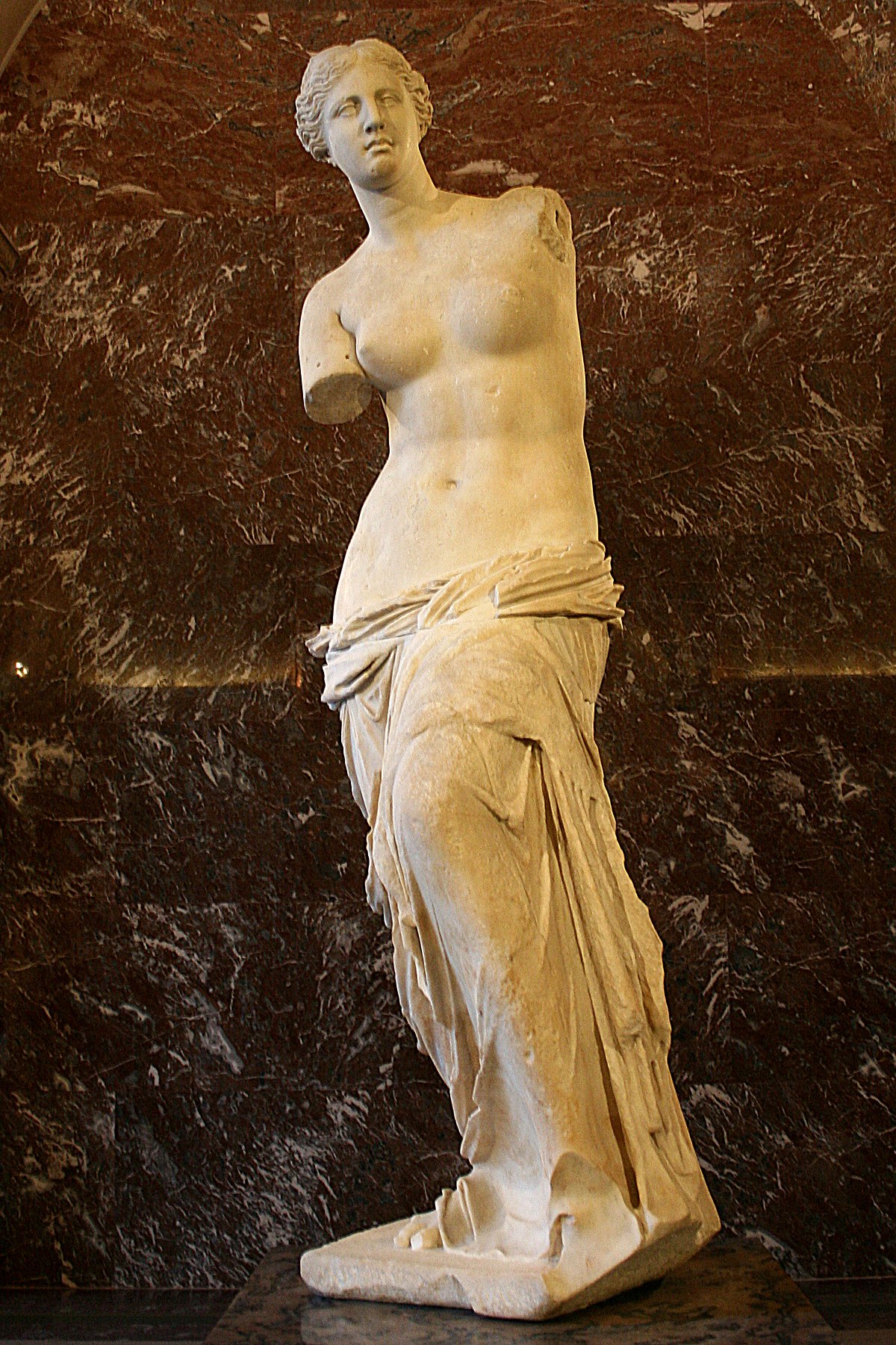
Limbless Aphrodite-Venus: Worshipping the Goddess of Beauty

Eugene Lee-Hamilton’s poem “To The So-Called Venus of Milo” explores the famous sculpture from the Hellenistic period of Ancient Greece, depicting Aphrodite, the goddess of love, sex, and beauty. The Venus de Milo is a beloved statue which resides in the Louvre in Paris and has been extraordinarily well-protected throughout history by the French and lovers of the statue at large. It is also, and perhaps most importantly, not a perfect statue. Both of the goddess’ arms have broken off over time, both before its discovery and excavation in 1820. And yet, Bettany Hughes refers to it as “the most replicated of all Aphrodite-Venuses around the globe” (135) in her biography Venus and Aphrodite. The Venus de Milo is an amputee, taking away the all-powerful allure of the gods and goddesses of Olympus. This becomes all the more important with the lens of Lee-Hamilton’s own disability, neurasthenia, which was the physical manifestation of leg paralysis, in his case, from severe mental illness.

In the first part of Lee-Hamilton’s poem dedicated to the statue, he references the widespread praise of this particular statue. He writes, “Embraceless Beauty, Strength bereft of hands; / To whose high pedestal a hundred lands / Send rent of awe, and sons to stand beneath” (3-5). The acknowledgement of just how popular this particular reference of Aphrodite had become is also interesting considering how relatively recently it had been discovered by the time that Lee-Hamilton was writing. Hughes refers to the Venus de Milo as “cherished with extraordinary care and chivalry” (135). She, meaning Aphrodite, was cared for by the society that discovered her in a way that she was not by the society that created her. Even without her arms, she was a show of strength and a source of awe and wonder. In fact, it may even be argued that her allure came indeed from her very lack of arms. Her body had wondrously survived the ages, even if all of her limbs could not.

This fascination with Venus de Milo not in spite of, but in light of her disabled body, is well explored. Hughes writes, “[C]ivilization is reveling in her castration––the armless Venus feeds a ruin-lust” (136). In the second part of Lee-Hamilton’s poem does just this, although it may take a different tone than the “reveling” that Hughes refers to. He imagines a variety of locations the arms of Venus de Milo may be in, all of them filled with hope and cultural significance. He writes of them lying “where the Greek girls reap” (17), tying in the importance of Aphrodite worship to ancient Greek girls and women. Alternatively, he wonders if the arms have been used to create mortar “for some Turkish tower / Which overshadowed Freedom for a time” (24-25), much like the body that we do have was used as infill for a Roman wall (Hughes 135). By not just seeing these missing arms as a loss for the Venus de Milo and those viewing her, but rather as pieces that must have served some great purpose in the world, Lee-Hamilton is allowing himself to imagine the lack of limbs as something still worthy of praise and adoration.

Fair as the Moon and Joyful as the Light: Laura Fairlie Through the Lens of Christina Rossetti

Laura Fairlie is the beautiful object of the affection of many men and women across The Woman in White. Her introduction at the hands of Walter Hartright presents us with a heavenly image. In describing her eyes, he writes, “The charm – most gently and yet most distinctly expressed – which they shed over the whole face, so covers and transforms its little natural human blemishes elsewhere, that it is difficult to estimate the relative merits and defects of the other features” (Collins 51). To the reader, Laura is given this angelic quality that is certainly super-human. Now, what does it mean that she is described most often at the hands of Walter? He is a character introduced to us, before all else, as an artist. The epithet given to Walter in the title of the first section of the novel’s body is “Teacher of Drawing” (Collins 9). Sent to Limmeridge to teach Laura and her sister how to improve their watercolor painting abilities, he was always intended to be viewed as an artist who himself was seeing the world with an artistic lens. Thus, we are given an artist’s vision of who Laura Fairlie is, a question that becomes very literal and central to our story by the end of the narrative.

Christina Rossetti’s “In the Artist’s Studio” offers a woman’s perspective on the Victorian male artist. The sister to Pre-Raphaelite Dante Gabriel Rossetti, Christina would have been herself very absorbed in the artistic movement, both as a model for several of his paintings and a friend to the other members. Dante Gabriel Rossetti often used his wife, Elizabeth Siddal, as not just a muse, but as the model for nearly all of his paintings that depicted women. Christina responds to this constant depiction of the same woman, the same face, in “In the Artist’s Studio”. She writes that “every canvas means / The same one meaning, neither more nor less” (Rossetti 7-8). By constantly using the same model, her brother is effectively deifying Elizabeth, making her into his own object with the image of her face and body. It removes her autonomy, in a way, instead making her his canvas to project any image or connotation onto.

Walter Hartright, although he does not use Laura Fairlie as a model for widely spread or praised artwork, does something of this sort to her in his writing of her. Of her brother’s subject, Rossetti writes, “A nameless girl in freshest summer-greens, / A saint, an angel . . .” (6-7). This reflects Hartright’s first descriptions of Laura, where he writes, “. . . there dawns upon me brightly, from the dark greenish-brown background of the summer-house, a light, youthful figure . . .” (Collins 51). In describing her hair, he refers to it as “not flaxen, and yet almost as light; not golden, and yet almost as glossy” (Collins 51). He’s making her seem like an angel, almost taking away her normalcy and humanity, much in the way that Dante Gabriel Rossetti did to Elizabeth in his paintings. In the words of Christina Rossetti, Laura is appearing in Walter’s narrative “Not as she is, but as she fills his dream” (14). Laura is not a person in Walter’s writing. She is simply a dream, an object of his affection, a blank canvas for him to paint the woman that he wishes for.

Sir Percival Glyde: A Fiancé and a Doppelgänger

Walter Hartright introduces Anne Catherick to the reader with an almost obsessive lens of modesty and infantile descriptions. This is continued when he reencounters her at Mrs. Fairlie’s grave, where he treats her the way one might treat a small child. He reassures her constantly throughout their conversation, speaking slowly and gently to her (Collins 95). One may think that Walter’s love for Laura Fairlie, who so resembles Anne, may cause him to see Anne in a different light than he did on his first encounter with her. However, when he observes Anne more carefully, he finds all of her dissimilarities to Miss Fairlie, referring to her “worn, weary face” (97). This makes clear to the reader that Walter is still viewing Anne in a patronizing light. Walter’s idea of Anne as a chaste being, however, is unfounded, in my opinion. To look at page 105 and Anne’s reaction to hearing about Sir Percival Glyde, it is clear that she has had unfavorable encounters with him. Walter uses this to conclude that Sir Percival is responsible for locking Anne up in the asylum. While this makes sense and seems to be the correct conclusion for Walter to draw, he also does not seem to ruminate on what may have caused this series of events in Anne’s life. Based on the striking resemblance between Anne and Laura Fairlie, who is to be married to Sir Percival, my immediate assumption of Anne’s hatred of him was that he had forcefully expressed interest in her.