The Decorative Other

The 19th century witnessed a dramatic expansion of the British Empire, bringing with it not just military and economic power, but also a fascination with the cultures of the conquered territories often referred to as the “East”. This fascination found substantial space in the arts, where Orientalist painting emerged as both a reflection of imperial ambition and an imaginative reworking of exotic “otherness.” One powerful example of this is Fête of the Prophet at Quad-el-Kebir by Fredrick Arthur Bridgeman, a richly detailed work that encapsulates the Orientalist gaze.

Orientalism, as defined by Edward Said, refers to the depiction of Eastern societies as exotic, mysterious, and often inferior to the West. In this painting, Bridgman portrays a religious festival emphasizing the exotic nature of the scene. The composition, featuring richly adorned figures and elaborate architecture, caters to Western fantasies of the East as a land of mysticism, particularly as it pertains to women in their cultural clothing. 

Relating this idea to the artist, Bridgeman, an American, travels to North Africa in 1872 and marks a pivotal moment in his career. He journeyed through Algeria and Egypt, producing approximately 300 sketches that would serve as the foundation for many of his subsequent paintings. These works, characterized by their depictions of Eastern life, earned him recognition in both Europe and America. 
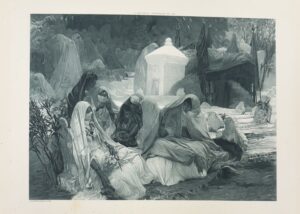
While based on a real event, the celebration of the Prophet Muhammad’s birthday, Bridgeman amplifies its suspense to create a visual experience steeped in drama. The viewer is invited not to understand the meaning of the ritual but to consume it as exotic entertainment. This is further supported with the women in the background of the painting, fading into one another, lacking individual identity. Bridgman’s depiction of these figures supports the Orientalist narrative of Eastern society as a faceless, homogenous mass, especially in regard to gender roles. In this context, Muslim women are not portrayed as active participants in their own cultures, but rather as passive, decorative elements in a scene interrupted by the Western gaze. This marginalization reflects a broader Western tendency to view Muslim women as silent, oppressed, and mysterious

Here, Bridgeman projects Victorian fantasies onto the Islamic world. In the painting, there are no hints of colonial interference, creating a fixed world, stuck in the past, thus needing Western guidance. Additionally, there is little theological focus in the figures, showing that religion in the East is portrayed not as a moral system but rather as ecstatic, tribal, and emotionally charged. Ultimately, beauty, strangeness, and emotional intensity are prioritized over cultural understanding making it an example of the Victorian orientalist imagination.

Reading between the lines and walking across intersections,

JAY WALKER


A Rather Trodden Ground

Mona Caird’s The Yellow Drawing Room is less about a room and more about a woman who refuses to stay within one; socially, intellectually, or ideologically. Through the character of Vanora, Caird crafts a subtle but powerful portrait of the New Woman: a figure who, by the fin de siecle, had come to symbolize both possibility and threat in a rapidly shifting cultural landscape.

Vanora is introduced in a way that immediately sets her apart from the other women in the story. While the other female characters uphold the “feminine traditions admirably,” Vanora declines to participate in what she sees as a performance of outdated gender roles. She remarks, “They are keeping up the feminine traditions admirably. Don’t you think it would be a little monotonous if I were to go over exactly the same ground? It seems to me that the ground is getting rather trodden in” (Caird 107). This statement strikes at the heart of the New Woman ideology. This “trodden ground” is a metaphor for the repetitive actions women are forced to follow, generation after generation, without space for reinvention (or pants for that matter). 

According to the Victorian Web’s overview of the New Woman, this figure was “intelligent, educated, emancipated, independent and self-supporting.” Vanora embodies each of these qualities, yet her nonconformity is not embraced. The narrator remarks, “I suppose I must have been in love with her, yet all the time I seemed to hate her” (Caird 108). This admission speaks volumes. His love-hate feelings encapsulate what scholars describe as ambivalent sexism: the simultaneous idealization and hostility directed at women who refuse to conform. Vanora is not dismissed or ignored; she is desired and resented in equal measure. This emotional whiplash reflects the cultural climate of the Victorian Era. Just as Vanora provokes confusion and discomfort in the narrator, the New Woman unsettled Victorian society by refusing to play her part quietly. In this way, Vanora exposes the systems of power and control of sexuality that the New Woman threatened to undo.

In The Yellow Drawing Room, Vanora does not need to make a grand speech or stage a revolution. Her very existence, the way she speaks, thinks, and refuses to “go over exactly the same ground”, is an act of resistance. And through her, Caird has us reconsider the price of nonconformity and the courage it takes to claim one’s individuality in a world that demands quiet conformity.

Wondering through words,

JAY WALKER

Return of the Repressed and the Hat Man?

“The outside of the man you were marrying was fair enough to see. He was neither tall nor short—he was a little below the middle size. A light, active, high-spirited man—about five-and-forty years old, to look at. He had a pale face, and was bald over the forehead, but had dark hair on the rest of his head. His beard was shaven on his chin, but was let to grow, of a fine rich brown, on his cheeks and his upper lip. His eyes were brown too, and very bright; his nose straight and handsome and delicate enough to have done for a woman’s. His hands the same. He was troubled from time to time with a dry hacking cough, and when he put up his white right hand to his mouth, he showed the red scar of an old wound across the back of it. Have I dreamt of the right man? You know best, Miss Fairlie; and you can say if I was deceived or not. Read next, what I saw beneath the outside—I entreat you, read, and profit.”

I was really drawn to Freud’s understanding of dreams, and, as it pertains to the text, I was interested in the letter written by Anne Catherick to Miss Fairlie. Here, I’ll analyse the Freudian influences of Victorian understandings of dreams, which adds another layer of complexity to the already suspenseful reading of the letter. Anne’s description of Sir Percival Glyde as “fair enough to see” but urging Miss Fairlie to “read next, what I saw beneath the outside” is laden with both conscious and unconscious insight. It provides an essential clue to the tension between appearances and hidden truths, an idea central to the narrative of The Woman in White. Anne’s letter can be seen as an attempt to reveal the truth, which is something that has been deeply buried by Sir Percival. Anne, as a character, embodies the struggle of the repressed voice fighting to break free. In her letter, she is not just offering a description of Sir Percival; she is, in fact, attempting to expose the hidden, unconscious layers of his identity that she knows are dangerous and deceitful. Freud’s theory of the return of the repressed is relevant here. Anne herself is a repressed figure, in the literal sense of being confined to an asylum, so her experiences with Sir Percival result in the suppression of her truth. In the letter, Anne seeks to break that silence, demanding that Miss Fairlie “read next, what I saw beneath the outside.” This can be seen as a call to confront the repressed truths about Sir Percival, which, like all repressed material, will inevitably return. I feel that Freud would point to Sir Percival Glyde’s scar on the back of his hand as a sign of a repressed past, an evident manifestation of his guilty past that cannot be hidden completely. Here, Freud would likely argue that there’s a danger of ignoring psychological truths that lie beneath the surface, which is a topic that the novel itself seeks to explore. In Anne writing the letter, she mirrors the novel’s broader thematic concern with the return of repressed elements: those aspects of the self or the past that cannot remain concealed forever. With this understanding, the letter isn’t her describing Glyde’s physicality, but rather represents an unconscious struggle to bring forth the repressed truth. The dream is explained by Freud’s idea that what is repressed will eventually find a way to surface. Or who knows, maybe she took Benadryl and saw the hat man instead of Sir Percival Glyde! 

I’m walking away, but don’t worry, I’m still following all the rules… kinda.

JAY WALKER


Signed, Sealed, and Sorrowed: Mr. Gilmore is Lawfully Bound and Emotionally Tied

“My task is done. My personal share in the events of the family story extends no farther than the point which I have just reached. Other pens than mine will describe the strange circumstances which are now shortly to follow. Seriously and sorrowfully I close this brief record. Seriously and sorrowfully I repeat here the parting words that I spoke at Limmeridge House:—No daughter of mine should have been married to any man alive under such a settlement as I was compelled to make for Laura Fairlie.”

What drew me to this specific section of the reading is his tone after signaling the conclusion of his role in the specific legal matter that he has been asked to complete. “My task is done” shows that he has provided his side of the story, and acknowledges that others are now to take over the storytelling. His awareness of the story’s absurdity is incredibly interesting, especially in the line, “Other pens than mine will describe the strange circumstances” which is a clever way of distancing himself from the future events and shifting the focus to other characters. The repeated emotional language (shoutout to Freud here) of “Seriously and sorrowfully” emphasizing his emotional state implies regret or guilt, particularly in regard to the marriage settlement he was forced to make for Laura. The repetition of these words underscores his emotional disquiet, and foreshadows the troubled nature of Laura’s marriage. 

Mr. Gilmore represents the legal and financial realities of Victorian society, and his reflection on the marriage settlement is crucial in understanding the inequities of that system. The line, “No daughter of mine should have been married to any man alive under such a settlement,” is a key indication that he recognizes the settlement as deeply flawed and unfair. The marriage settlement is a key plot device in the novel, symbolizing the financial control placed over women, particularly in terms of property and inheritance. Mr. Gilmore, while not entirely a villain, is part of the system that enforces these structures. He may feel sorry for Laura, but his legal role means he cannot act on that sorrow to make a tangible difference in her circumstances. 

This is the most important part to understand in the context of this section of the novel, as Mr. Gilmore’s sorrow also highlights the theme of powerlessness, particularly for women in Victorian society. While he expresses regret, he ultimately cannot change the situation, and his inability to act is a key reflection of the way that social and legal systems constrained individuals like Laura. She is effectively powerless within the structures that Mr. Gilmore, as a lawyer, enforces. His professional detachment is paired with his personal acknowledgment of the injustice done to her, reflecting a broader theme in the novel about the limitations of legal and societal systems.

Bringing this idea back to the very start of the novel itself, “But the Law is still, in certain inevitable cases, the pre-engaged servant of the long purse.” This proves this passage reveals Mr. Gilmore’s internal conflict and highlights his unease with the constraints placed on Laura. It also reinforces the novel’s critique of a legal system that, while seemingly neutral, often perpetuates gendered inequalities. 

Thank you, I’ll be crossing a street near you!

JAY WALKER