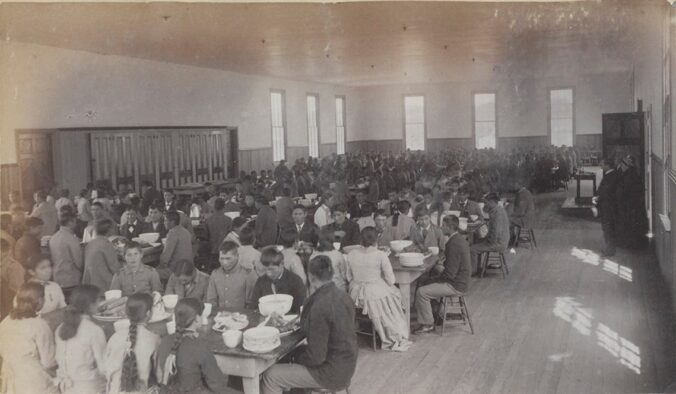
By John N. Choate, c. 1885. Carlisle, PA.
Figure 1. Image of the interior of the Dining Hall. The female and male students are sitting on opposite sides of the tables.
What is an Indigenous Foodway?
An Indigenous foodway is the way an Indigenous tribe hunts, gathers, and prepares food. These foodways often differ depending on the region due to what resources are readily available. An example of differing indigenous foodways could be how unalike Pueblo and Seminole diets are. The diet of the Pueblo tribe, in the New Mexico and Arizona area, involves the three sisters of agriculture which is corn, beans, squash and wild game such as rabbit and elk. The diet of the Seminole tribe from the Florida area consists of alligator, turtle, tropical fruits, berries, and nuts. These differences represent how Indigenous foodways were shaped by available resources, geography, and cultural traditions of each community.
The Carlisle Indian Industrial School
The Carlisle Indian Industrial School opened in October of 1879 founded by Army Captain Richard Henry Pratt. Located in Carlisle, Pennsylvania, the school was the first federally managed off-reservation Indian boarding school. One of the purposes of the school was to forcibly assimilate indigenous teens into mainstream Christian American culture. The school’s approach was to strip away the children from their families and known culture so that they would adopt American customs. The school made the kids cut their hair, march to and from places, wear uniforms, and speak only in English. The students were made to follow a strict daily schedule that was a mix of academic instruction and manual labor. By forcing a separation between the children and native american culture, the passing down of cultural beliefs and customs is threatened. This often includes the foodways of their tribes.
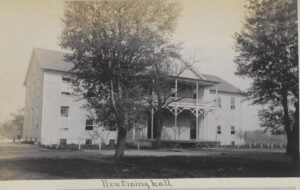
By John N. Choate, c. 1885. Carlisle, PA.
Figure 2. Image of the Dining Hall. This was the newly built building made to replace the original that was built in 1879.
Food at the Carlisle Indian School
In an excerpt from the Carlisle Indian School Digital Resource, “Who would not be enthusiastic to these one hundred and eighty youths gathered from sixteen different Indian tribes, many of whom have been from time immemorial been deadly enemies to each other, three times a day marching in order from their different quarters, entering the dining hall quietly, and when seated reverently bowing the head while thanks are given for the food prepared? It is true, giving of thanks is no new thing to the Indian, for what tribe forgets to offer the first fruits of the field or the chase to Him of whom they have craved success. But to come to God through Jesus the Son, is the new thought to them, and as some are Christians, it stirs the soul with fresh fervor to hear from different tribes the breathed amen.” Excerpt from Our Dining Hall (Eadle Keatah Toh.) Carlisle Barracks, PA., May 1880.
As seen in the excerpt above, food at the Carlisle Indian Industrial School played a role in the assimilation of Indigenous students and separation from their traditional native cultures. Students from sixteen different indigenous tribes gathered in the dining hall three times a day (Toh, 1880).They were expected to sit quietly and bow their heads while praying to Jesus Christ before dining. For many Indigenous children, this went against the beliefs they had grown up with.
From an excerpt from, Indian Boarding Schools – Research Guides at South Dakota State University it states, “Of all the changes we were forced to make, that of diet was doubtless the most injurious, for it was immediate and drastic. White bread we had for the first meal and thereafter, as well as coffee and sugar. Had we been allowed our own simple diet of meat, either boiled with soup or dried, and fruit, with perhaps a few vegetables, we should have thrived. But the change in clothing, housing, food and confinement combined with lonesomeness was too much, and in three years nearly one half of the children from the Plains were dead and through with earthly schools. In the graveyard at Carlisle most of the graves are those of little ones. Luther Standing Bear (Oglala Lakota), attended Carlisle Indian Industrial School 1879 (age 11) to 1885.” Excerpt from American Indian Boarding Schools: Health.
In this excerpt one can see how the traditional foodways were greatly disrupted. The speaker states how awful it was on their bodies to consume foods that they were not used to. As the school replaced the students’ food related culture with unfamiliar meals they stripped away part of their identity. The students were given bread, sugar, and coffee often but were not able to consume enough protein like they had before they started the assimilation process.
Why Examining Food in the Assimilation Process Matters
Examining and understanding Indigenous foodways is important not only because it’s what people consumed, but because it reflects their culture, traditions, identity, and relationship with land. For many Native American communities, traditional food practices were a way to preserve their culture and connect generations. Sadly, assimilation disrupted the preservation of these cultural practices in many tribes. The Carlisle Indian Industrial School is one of many examples of the government’s efforts to Americanize Indigenous people. As they quickly separated the children from family, erased their known culture from their lives, changed their diets, and altered their looks, the Indigenous children’s identities were stripped away. Through looking at the relationship between assimilation and foodways, one can see the importance of recognizing and protecting any Indigenous foodways left. By preserving these foodways, Indigenous communities can connect to their ancestors and culture as well as have the ability to educate future generations.
I personally believe that it is very important to look back on history to ensure it does not repeat itself. What I cherish most about the United States is the vast amount of different cultures the country has to offer. Through stripping the Indigenous culture away, we have lost a piece of the heart of the United States.
Questions to Think About?
How does losing access to traditional foods affect one’s connection to their culture?
To what extent would preserving natural foodways help to ensure indigenous culture is protected?
In what ways can everyday activities such as eating be used as a control tactic?
What is something society can learn after seeing the importance of Indigenous communities’ relationship with food?
References
Dining Hall, c.1885. Dining Hall, c.1885 | Carlisle Indian School Digital Resource Center. (n.d.). https://carlisleindian.dickinson.edu/images/dining-hall-c1885
Dining Hall with students, c.1885. Dining Hall with students, c.1885 | Carlisle Indian School Digital Resource Center. (n.d.).https://carlisleindian.dickinson.edu/images/dining-hall-students-c1885
Hill, C. G. (2016). Pre-Colonial Foodways. In The Routledge history of American foodways (pp. 9-22). New York, NY: Routledge
Publications of the Carlisle Indian Industrial School. Publications of the Carlisle Indian Industrial School | Elizabeth V. and George F. Gardner Library. (n.d.). https://gardnerlibrary.org/encyclopedia/publications-carlisle-indian-industrial-school
Research guides: American Indian Boarding Schools: Health. Health – American Indian Boarding Schools – Research Guides at South Dakota State University. (n.d.). https://libguides.sdstate.edu/c.php?g=1410783&p=10458202
U.S. Department of the Interior. (n.d.). The Carlisle Indian Industrial School: Assimilation with education after the Indian Wars (teaching with Historic Places) (U.S. National Park Service). National Parks Service. https://www.nps.gov/articles/the-carlisle-indian-industrial-school-assimilation-with-education-after-the-indian-wars-teaching-with-historic-places.htm