Dickinson College, Spring 2025

Year: 2015 Page 2 of 3

Protests –What Were They Good For?

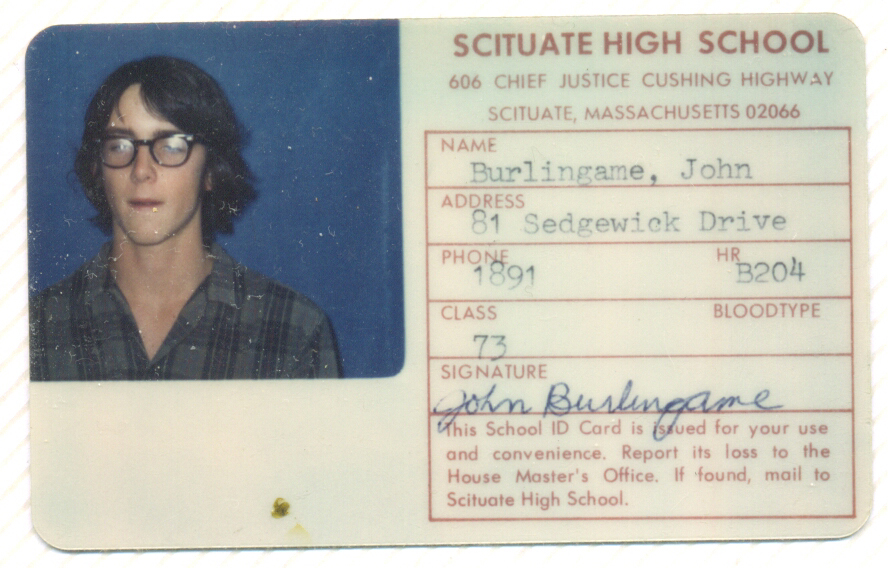
Burlingame's high school ID card from the year he went to the D.C. protest.

Burlingame’s high school ID card from the year he went to the D.C. protest.

By Isabel Burlingame

Jack Burlingame attended the May 9, 1970 Vietnam War protest in Washington D.C. “I traveled from Massachusetts to Washington D.C. on a chartered bus with other high school and college students,” he remembers. “I and my friends were probably the youngest people on the bus – 15 years old at the time….we had been encouraged by our history teacher to attend.”[1] In 1970, Nixon widened the war into Laos and Cambodia in order to reinforce the image of American interest in Southeast Asia after withdrawing from parts of South Vietnam. According to H.W. Brands in his book American Dreams, “Whether or not these efforts conveyed to the communists the message Nixon intended, they got the attention of the antiwar movement in America. The Cambodian invasion sparked the largest protests of the war.”[2] The protests to which Brands refers took place largely on college campuses, but also included those in major cities where people from all demographics of the population, such as 15-year-old Burlingame, spoke out against the Vietnam War. Both Brands and Burlingame agree that the protests had an important role in influencing the government to end the war, but neither seem to discern any lasting impact beyond that. Despite the influence that the protests had on the American government at the time and their immense prevalence across the country (with some ending in tragedies such as the Kent State shootings), their effect did not last beyond the immediate context of the war.

The Vietnam War protest movement began long before Burlingame attended the 1970 protest in Washington D.C. The Students for a Democratic Society (SDS), led by Tom Hayden, was one of the first antiwar groups to emerge around 1960. Their efforts did not have a noticeable impact for the first five years.[3] In 1965, however, President Lyndon Johnson expanded America’s involvement in the war by increasing troops and funding, which “caused membership [of the SDS] to mushroom”.[4] The SDS subsequently split into moderate and radical factions, the latter of which sometimes turned to violent protest tactics such as bombings.[5] The mid to late 1960s also saw the beginnings of the peaceful protest movement. Marches in major cities, such as the one in D.C. that Burlingame would attend a few years later, grew in numbers and included a wide variety of Americans, ranging from students to hippies to white-collar businessmen.[6] While some viewed the protests to be successful, they did little to change the direction of the war as controlled by the government. According to Brands, “Ronald Reagan, then running for California governor, dismissed the antiwar protests in three words– ‘sex, drugs, and treason'”[7] The protests allowed the portion of the population that opposed the war to express their views, but their effect on the rest of the country and much of the government was unclear. However, both Brands and Burlingame contend that the protests had a cumulative effect that swayed the government’s decisions. Brands references Thomas “Tip” O’Neill, a Democratic congressman from Massachusetts, who was one of the first House leaders to change his position on the war.[8] Burlingame pointed out that “as public sentiment inexorably tilted against the war, politicians were acutely aware of the shift and its potential implications at the ballot box.”[9] As the protest movement increased, those running for office were forced to consider the views of the protesters.
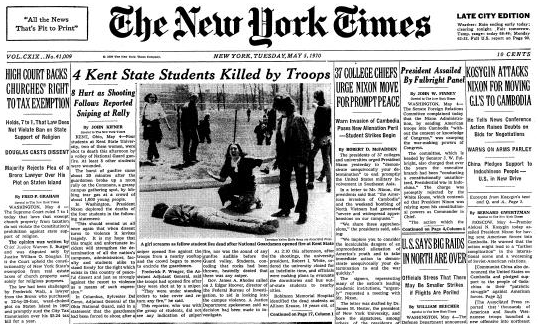
The May 5, 1970 New York Times front page article about the Kent State shootings.

The May 5, 1970 New York Times front page article about the Kent State shootings.

By May of 1970, the protest movement had grown considerably. On and around May 9, protests occurred in major cities and on college campuses across the country, including the march in Washington D.C. that Burlingame attended. Burlingame remembers a sense of camaraderie among the protesters, all working towards a common goal, although with a variety of motivations. Many of the protesters had been angered by Nixon’s covert invasion of Cambodia, and others by the Kent State shootings, which had occurred less than a week before. Burlingame cites both of these events as reasons for his participation in the protests, as well as “the expansion of the draft with the elimination of several categories of deferments, including those for college students. The fact that I was just a few years from my 18th birthday and eligibility for the draft certainly captured my attention and heightened my awareness of the war and its consequences.”[10] The draft policies had changed two years earlier, in 1968. Previously, students attending graduate school or planning to attend the next year were exempt from the draft, as were those in certain occupations. Removing these exemptions increased those eligible for the draft by roughly 430,000. This decision led to a surge in the protest movement, drawing in educators who contended that many bright young minds that were essential to the country’s future would be needlessly lost in the war.[11] Even high school students like Burlingame feared the effect that the new policy would have on them and joined the movement.

There is little doubt, however, that the Kent State shootings on May 4, 1970 dramatically increased participation. Burlingame recalls the May 9 march in D.C. having been planned before the shooting, but “the massacre undoubtedly led to an increase in the number of students taking part.”[12] In a front-page New York Times article the day after the shootings, President Nixon was quoted as urging protesters towards “peaceful dissent and just as strongly against the resort to violence as a means of such expression.”[13] Burlingame recalls the protest that he attended as reflecting this wish for peace. “Despite Kent State, I experienced no feeling of impending violence or fear that a riot might break out.”[14]

American involvement in the Vietnam War came to an end in January of 1973 when Henry Kissinger bargained the withdrawal of US troops for Le Duc Tho’s agreement to a ceasefire.[15] Two years later, in 1975, once American troops had been withdrawn, North Vietnam launched a successful attack and captured South Vietnam, bringing the entire country into communist rule.[16] The United States had essentially failed in its attempt to keep communism out of South Vietnam, wasting years and thousands of lives in the process. Burlingame believes that the protests did ultimately decrease the duration of the war, and speculates that “without them, the war would have dragged on several years longer and resulted in significantly more casualties and destruction.”[17]

Perhaps the protests were successful in their immediate goal: bringing about the end of the Vietnam War. But neither the protests nor the Vietnam War itself left a prominent legacy on the United States, judging by American involvement in future conflicts such as the First Gulf War, the War in Afghanistan, and the Iraq War. As Burlingame eloquently puts it, “I struggle to discern any lasting impact from the Vietnam War protests, other than to give aging hippies something to reminisce about…In the years since, the U.S. has experienced no shortage of legal and illegal wars, covert actions, extraordinary renditions, illegal arms sales, state-sponsored torture, POW abuses, both ‘collateral’ and criminal killings of civilians in war zones, imprisonment without trial, military profiteering, drone strikes of dubious legality and morality, and other deplorable acts carried out in our name using our tax dollars. Would the rogue actions of the U.S. over the last 40 year have been even worse if the Vietnam protests had never happened? Perhaps, although it’s hard to imagine.”[18]


[1] Email Interview with Jack Burlingame, March 23, 2015.

[2] H.W. Brands, American Dreams: The United States Since 1945 (New York: Penguin Books, 2010), 170.

[3] Ibid, 153.

[4] Ibid.

[5] Ibid, 154.

[6] Ibid.

[7] Ibid, 155.

[8] Ibid.

[9] Email interview with Jack Burlingame, April 30, 2015.

[10] Email interview with Jack Burlingame, March 23, 2015.

[11] “Resist Or Fight!” Bay State Banner, Feb 22, 1968 [ProQuest].

[12] Email interview with Jack Burlingame, March 23, 2015.

[13] John Kifner, “4 Kent State Students Killed by Troops: 8 Hurt as Shooting Follows Reported Sniping at Rally 4 Kent State Students, 2 of Them Girls, Killed by Guardsmen.” New York Times, 5 May 1970, 1.

[14] Email interview with Jack Burlingame, March 23, 2015.


[15] Brands, 174.

[16] Ibid, 175.

[17] Email interview with Jack Burlingame, March 23, 2015.

[18] Email interview with Jack Burlingame, March 23, 2015.
The Civil Rights Movement of the 1960s: Life in Birmingham

By Rachel Glick

In 1963, Birmingham, Alabama was at the center of the revolutionary Civil Rights movement. However, Melvin Glick’s testimony shows that this “revolution” was hard to actually see in daily life. Glick, as an observer and participant, saw first hand the effects of the Civil Rights movement in Birmingham. On the surface, the political successes and famous marches and protests seemed to change little. H. W. Brands’ book, The American Dream, does a good job of summarizing the key moments of the movement, noting the hardships and struggles on the way, but he only briefly mentions frustration that many people felt during this time. Glick’s testimony adds depth to Brands’ account, offering an illustration of the ways segregation and discrimination persisted despite the advances of the Civil Rights movement.

Glick grew up in rural Pennsylvania, where he knew no black people until high school. He recalls that despite being taught by his Mennonite parents that “all people were to be treated with respect, and that there was no difference between races,” he had little understanding of race and racial slurs.[1] Pigeon, Michigan, where Glick and his wife taught at a church school, was just as detached from the world of racial tension as Parkesburg, Pennsylvania had been. They moved to Birmingham in 1963 so Glick could work in the University of Alabama hospital laboratory and attend the Medical Technology School. “For me this was like moving to a different culture in another part of the world,” Glick remembers. “I immediately noticed that all the black people lived in one area of Birmingham, mostly in the Bessemer, Alabama area…Driving through Bessemer was an ordeal because it was so difficult to breath, and from the chocking smell of sulfur from the iron smelting going on continuously.”[2] He learned not to hold the door for a black woman, as she would simply wait for him to go through first and got used to the phrase “separate but equal.” A few months after they moved, four little girls died in the 16th Street Baptist Church bombing. The victims rode segregated ambulances to the hospital.[3] The possibility of integrated neighborhoods had white families contemplating “to move over the mountain into the next ring of suburbs…”[4] This snapshot of life in the south is typical of the 1960s, but Birmingham was especially bad. The “particularly ugly form of racism” of police and officials launched the city into the spotlight, setting the stage for many of the historical moments of the Civil Rights movement to take place.[5]

Glick quickly noticed the “separate but equal” mentality that many people had. Everything was separate: separate doors, waiting rooms, water fountains, and schools. Even the courthouse was segregated. However, equal was another matter. Glick drove past a black school everyday on his way to work. The playground was gravel and children had to walk outside to get to different classes or the restroom.[6] The nearby white school was a “modern brick building” with “plenty of playground equipment plus baseball diamonds, basketball courts, and soccer fields.”[7] The famous Brown v. Board of Education case was in 1954. This was 1963. The ruling to desegregate public schools was flawed because of its demand that states do this “with all deliberate speed,” a rather ambiguous phrase.[8] Brands notes that this resulted in “foot-dragging” by the Jim Crow south.[9] As “momentous” as the decision was, it did little to help immediately.[10] Even when schools were officially desegregated, they were not necessarily integrated. Paul Mokrzycki makes the distinction between the desegregation of schools and integration: “Integration…entailed a complete and seamless incorporation of African Americans into every facet of academic life…”[11] This was still a problem in 1972, when Glick and his family moved to Indianapolis. He recalls seeing the beginning of integration of white neighborhoods and the subsequent “white flight.”[12] As blacks moved in, whites moved out.[13] Schools remained mostly desegregated, even if it was not legal desegregation.

Glick enrolled in the Medical Technology School at the University of Alabama in Birmingham in 1964. This was just a year after George Wallace famously (and literally) attempted to stand in the way of the desegregation of the university in Tuscaloosa.[14] Vivian Malone and James Hood were the first black students enrolled in any University of Alabama classes. Glick’s 1964 Medical Technology class had only ten people; one of them was Wilma Ann Barnes, the first black woman attending the university in Birmingham. “On the first day of school, all of us agreed to go as a group, with Wilma, into the white section of the University Hospital dining room,” Glick remembers.[15] Barnes was the second to last student in the line, followed by Glick. First, the other students sat down at a table together, followed by Barnes and then finally, Glick beside her. “The order was deliberate. We knew we were breaking a taboo in that room. The others could appear to have no choice in the matter, because Wilma chose to sit down at their table after they were already seated. However I could have chosen to sit elsewhere and it was obvious what was happening. I heard the hisses and mutterings as I sat down, and saw the glares of hatred from some of the people facing me.”[16] They continued this routine for several days and after awhile no one paid them any attention. There is hardly any information on Barnes available, even though she was technically the first black student to graduate from the University of Alabama. The Medical Technology program was only twelve months long, so she graduated alongside Vivian Malone in 1965. A short article was written about the event in the magazine Jet. It mentions Barnes by name but she was a “Mystery Girl” then and still is now.[17] The integration of the cafeteria was apparently a success. No one bothered them, as Glick said. But they still made sure Barnes was not alone at lunchtime, an indication that although the new status quo would not be challenged openly, it was not entirely accepted.

Brands’ summary of the Civil Rights movement and incidents like the integration of the hospital cafeteria seem to point to the success of the movement, yet Glick stated outright that he could see no improvement in the treatment of black people in Birmingham. Brands focuses on struggle to pass legislation, like the Civil Rights Act of 1964, which would end legal discrimination based on race. President Johnson’s “promise,” as Brands puts it, seemed “distant” and “irrelevant” to many black people.[18] Glick remembers witnessing a bowling alley employee refuse a black man trying to rent shoes. “The black man asked, ‘what about the court ruling?’ The bowling alley employee said, ‘we have no court ruling against us and we’re not going to rent to you. Now why don’t you just leave and not create any trouble?’”[19] This incident illustrates the frustration that Brands mentioned. Changing the laws did not erase people’s prejudices, so discrimination continued.

Glick did not attend any of the demonstrations or marches in Alabama, but he did have a sense of the danger in Birmingham. In one instance, his job at the university hospital required him to run medical tests on a black man “castrated and left lying along the road” by the KKK.[20] Bombings often occurred in places he had been recently. These were sobering reminders that the city was not entirely safe. But that violence was not restricted to the south. “I hadn’t realized that the heart of the KKK movement was in the small towns around central Indiana,” Glick remembers.[21] In a 1975 article for the Chicago Tribune, Michael Hirsley describes a Klan picnic in rural Indiana. He ends with a chilling quotation from a young boy contemplating a burning cross: “Looking at the cross, he said, ‘All we need are two niggers on the ends, you know it?’”[22] The corruption of many southern governments and the police force made the height of the civil rights movement no safer for blacks than they had been in the decades after the Civil War, when lynching was publicly accepted. “Black residents expected to be harassed by white police officers…” Brands notes.[23] Unfortunately that statement is still true in many areas of the United States today.

Glick’s recollections seem to contradict the popular interpretation that the Civil Rights movement radically, and quickly, changed in the daily lives of black Americans. “In discussions with neighbors there was just as much prejudice against blacks as there had been before, but there was a fear that changes were coming and that they would need to adjust to the changes.” Glick recalls.[24] The Civil Rights movement made huge leaps in the demolition of legal discrimination and segregation, but the system of oppression persisted for many years on its own. Laws were easier to change than the prejudices that had been instilled in the population for decades, a fact that is still relevant today.

Footnotes

[1] Email interview with Melvin Glick, March 20, 2015.

[2] Ibid.

[3] “Bomb Victims Rode Segregated Ambulances to Hospital, Morgue.” Chicago Daily Defender, September 18, 1963. [ProQuest]

[4] Email interview with Melvin Glick, March 20, 2015.

[5] H.W. Brands, American Dreams: The United States Since 1945 (New York: Penguin Books, 2010), 111.

[6] Email interview with Melvin Glick, March 20, 2015.

[7] Ibid.

[8] Brands, 86.

[9] Ibid, 86.

[10] Ibid, 86.

[11] Paul Mokrzycki, “After the Stand Comes the Fall: Racial Integration and White Student Reactions at the University of Alabama, 1963-1976,” The Alabama Review 65, no. 4 (2012): 290-313

[12] Email interview with Melvin Glick, March 20, 2015.

[13] Brands, 151.

[14] Ray Abrams, “Air of Nervous Peace Hangs Over U. of Ala. Campus.” Afro-American, June 22, 1963. [ProQuest]

[15] Email interview with Melvin Glick, March 20, 2015.

[16] Ibid.

[17] “Second Negro in Alabama Graduation A ‘Mystery’ Girl,” Jet 28, no. 2 (1965): 43 [Google Books].

[18] Brands, 148.

[19] Email interview with Melvin Glick, March 20, 2015.

[20] Ibid.

[21] Ibid.

[22] Michael Hirsley, “Klan in Indiana Dishes Out Beans, Hate at Picnic,” Chicago Tribune, July 19, 1975. [ProQuest]

[23] Brands, 148.

[24] Email interview with Melvin Glick, March 20, 2015.

The Impact of the Vietnam War on The Civil Rights Movement

By Christina Braxton

           Black men, like Dennis Braxton, the subject of my interview, served their country during the Vietnam War only to return home to be treated like second-class citizens. This was the recurring theme throughout my interview. We also discussed the anti-war movement, the civil rights struggle and his involvement in the Black Panther Party.

Mr. Braxton, now 67 years old, decided to enlist in the Navy in 1967 and served until 1971. For three consecutive years, he spent about three months each year in Vietnam. By the time Braxton had enlisted, major Civil Rights legislation had already been passed. However, laws were one thing, implementation was another. When telling the story of how he ended up in Vietnam, Braxton explains:

“I went into aircrew training and anti-submarine warfare and I did real good in my training. I went into the West Coat anti-submarine squadron again because since Viet Cong didn’t need any submarines, I didn’t think I’d be in an area that was fighting a war anytime soon. I got assigned to my squadron of choice after finishing my training and I was flown into a duty station in the Philippines. It turns out that part of my squadron was rotating through Vietnam because they had changed the mission of the squadron to drop the submarine equipment into the jungle and check for Viet Cong. So I ended up in Vietnam anyway. [1]

Braxton also explained that discrimination in the navy was just as bad as discrimination outside of the navy. Before serving, Braxton was a student in Bluefield, Virginia, which was an extremely segregated part of the country. As an electronics technician, he was truly in the minority because most blacks served as cooks, mechanics, and deck workers. Blacks were constantly looked down on and were assumed to be “dumb, ignorant, and uneducated”. [2] Braxton goes on to explain that “There was a built in resentment from the white folks because they thought they were smarter, better, and more sophisticated and thought they were superior to black folks.” [3] When I asked Braxton what the hardest thing to deal with , he answered, “The hardest thing to deal with was the fact that people were giving me orders that were dumber than I was and they didn’t have the vision, common sense, or level of education that I did. They had the same fears and had the same limitations that I did but back then, no one looked into that in detail.” [4]

In 1964, the movement against the involvement of the United States in the Vietnam War began and many were peaceful protests on the campuses of universities across the United States but some became violent. This movement also incorporated civil rights, free speech, and the women’s rights. Anti war protests increased in frequency once Americans became aware of the violence that was happening overseas due to growing television coverage. As the death toll rose, many Americans began to question the country’s role in the war and in the draft, specifically. Many American’s saw the country’s involvement as immoral and unnecessary. In the book Chronicles of a Two-front War: Civil Rights and Vietnam in the African American Press, the author, Lawrence Allen Eldridge states, “the President was allowing his calendar to be monopolized by the Vietnam War, and the far-off war was pulling the attention of the American people away from the vivid stories of the civil rights struggle.” [5] H.W. Brands claims that many Americans “asked whether the status of a small country far away justified the expenditure of American blood and treasure.” [6] This made black participation in the war more difficult because blacks were not accepted as citizens in the United States and to make matters worse, they were participating in a war that was increasingly unpopular. Braxton remembers feeling conflicted:

“On one hand, I’m a representative of the United States of America. On the other hand, I’m not getting the full benefits of citizenship. And what made it even worse was that most citizens were against the Vietnam War. So for black men it was a little bit different. When we wore the uniform wanting to be respected as a black person, the country didn’t respect us as a people of color. And to make things worse, we were fighting in a war that people didn’t agree with in the first place. So it made it weird. [7]

Braxton returned to the United States in February of 1971 and was honorably discharged from the Navy on March 11, 1971. When he returned to California in 1971, he describes the area as “hippie-land.” [8] Peaceful protests were now extremely common but movements like the Black Panther Party also rose in popularity. One of the first things Braxton did when released from the Navy was to join the Black Panthers. They were not always a violent organization, but they would use violence as one of their tools. In American Dreams: The United States Since 1945 by H.W. Brands states that “ Even as King and other civil rights leaders were advocating nonviolence and urging blacks to work within the existing political system, Stokely Carmichael, H. Rap Brown, and a cadre of militants declared the system incurably corrupt and told African Americans to take their grievances to the streets.” [9] Braxton stated bluntly that, “they didn’t have any tolerance for peaceful protesting.” [10]


[1] Phone Interview with Dennis Braxton, Carlisle, PA, March 26, 2015

[2] Phone Interview with Dennis Braxton, Carlisle, PA, March 26, 2015

[3] Phone Interview with Dennis Braxton, Carlisle, PA, March 26, 2015

[4] Phone Interview with Dennis Braxton, Carlisle, PA, March 26, 2015

[5] Eldridge, Lawrence Allen. Chronicles of a Two-front War: Civil Rights and Vietnam in the African American Press. Columbia [Mo.]: University of Missouri, 2011. eBook Academic Collection (EBSCOhost), EBSCOhost (accessed April 26, 2015).

[6] H.W. Brands, American Dreams: The United States Since 1945 (New York: Penguin Books, 2010), 148-151.

[7] Phone Interview with Dennis Braxton, Carlisle, PA, March 26, 2015

[8] Phone Interview with Dennis Braxton, Carlisle, PA, March 26, 2015

[9] H.W. Brands, American Dreams: The United States Since 1945 (New York: Penguin Books, 2010), 148-151.

[10] Phone Interview with Dennis Braxton, Carlisle, PA, March 26, 2015

Audio snippet from Braxton interview:


Vietnam War Campus Protest: A History of Resistance

By Patti Kotrady

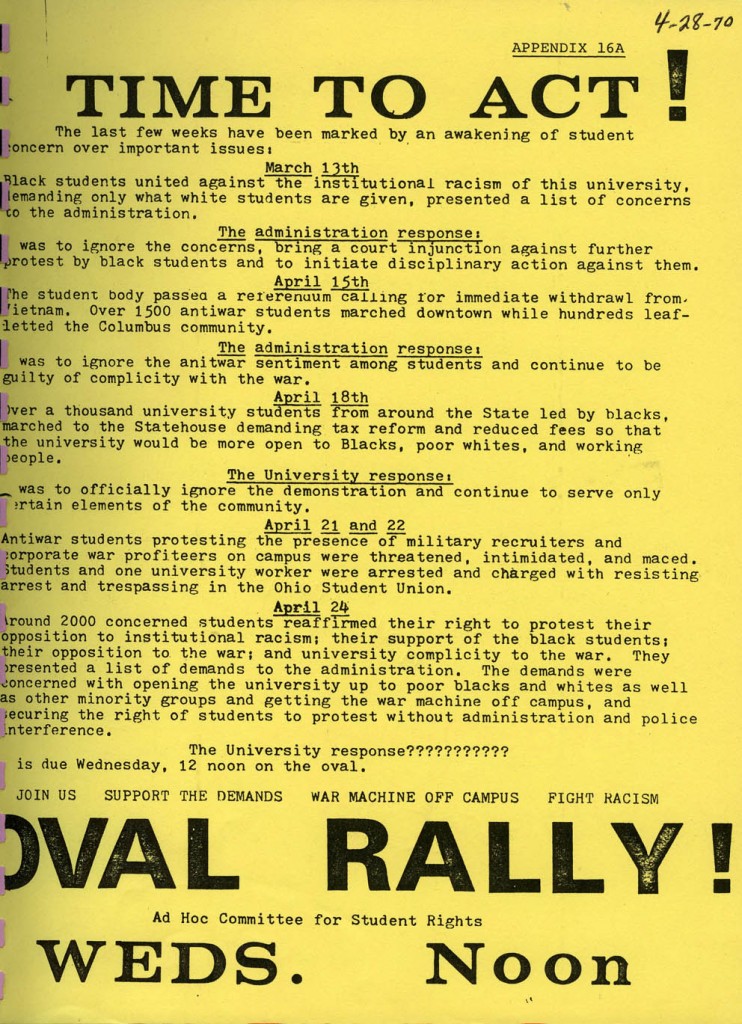
Marc Weinberg, a 67-year-old photographer and retired lawyer from Frederick, Maryland, played a significant role in the anti-war movement during the Vietnam War. From 1968 to 1970, Weinberg spent the last two years of his undergraduate college career at Ohio State University participating in campus protests. He recalls, “Whenever there was an opportunity to get involved, I would gather and make my voice heard. I didn’t believe in violence…We wanted to end the war.” [1] Particularly, Weinberg remembers a campus-wide protest during the spring of 1970 that gained momentum partially in response to the United States invasion of Cambodia. During the spring of 1970, in an attempt to attack North Vietnamese refugees, President Richard Nixon ordered an American occupation of Cambodia as well as the bombing of Laos. [2] According to H.W. Brands, “The Cambodian invasion sparked the largest protests of the war. On hundreds of campuses across the country students boycotted classes and faculty suspended teaching in favor of discussions—which was to say, condemnation—of the war.” [3] Although Weinberg’s narrative of protest certainly resonates with Brand’s description, his experience expands significantly on Brands’s terse explanation. Ohio State University’s 1970 protests were about more than just the Vietnam War—they also confronted larger issues of racism, student power, and police brutality.

According to Brands, “Some Americans had objected to the war in Vietnam from the outset. They asked whether the status of a small country far away justified the expenditure of American blood and treasure.” [4] As a Reserve Officer Training Corps (ROTC) student during his first two college years, Weinberg was not a part of the initial anti-war activism. He instead fit into what Rhodri Jeffrey-Jones categorizes as the third stage of campus protest from 1969 to 1972 in which students were “idealistic,” yet understanding of the importance of legislative politics. [5] By the late 1960s, students such as Weinberg became upset with the seemingly unjustified nature of violence in Vietnam and were willing to do all they could in order to end the war. In this effort, various groups on campus, including the Afro-American Society, the Women’s Liberation Front, the Anti-War Ad Hoc Committee, and the School of Social Work, submitted a series of demands to the Ohio State University Administration. [6] These demands included “that the University support the views of its students and condemn the continuation and expansion of the war in Southeast Asia,” “that ROTC courses not receive academic credit, and that ROTC instructors not have faculty status.” [7] In addition to these war-related demands, Ohio State students demanded “a degree-granting department in the field of ‘Afro-American Studies’ be established…,” “fees be lowered for all in-state and out-of-state students,” and “the establishment of a Planned Parenthood Center within the campus area.” [8] Yet, the administration refused to meet many of these demands. According to University Vice President James Robinson, “most demands have reflected only the concerns of self-appointed groups and have neither proposed nor suggested constructive programs that recognize what is already being done by the University to work toward our common objectives…” [9]

Students at Ohio State were not only concerned with issues regarding the Vietnam War, as Brands seems to suggest. They also advocated for racial inclusivity, women’s reproductive rights, and student liberties. Weinberg recalls, “We had a protest going for two things. One thing was a protest against racism on campus because black students on campus weren’t getting the same opportunities as white students were given, and the other thing was the war.” [10] Although Weinberg mentions that they had a “protest going for two things,” the student demands suggest that they advocated for rights of women and students as well. This can be further exemplified through a 1969 study by the Urban Research Corporation of Chicago. According to Jeffrey-Jones, researchers “surveyed 232 campuses and found that the draft was a major issue in less than 1 percent of protests. Whereas antimilitarism was a main issue in 25 percent of cases, two other issues counted for more: racial issues, at 59 percent, and student power, at 42 percent.” [11] Although Brands fails to mention African American, feminist, or student rights motivations for campus protests, these factors played a significant role in the activism of students at Ohio State University and other college campuses across the United States.

1970_OSU_Demonstrations_Flyers_Ad Hoc Com2

Ad-Hoc Committee of Ohio State University. “Time to Act!” Flyer, April 28, 1970. from the Ohio State University Library Archives

In addition to the Vietnam War, racism, and student rights, police brutality became a key concern of Ohio State students. When demands were not met, students fought back through both violent and non-violent protest. For example, Weinberg recalls a protest in April of 1970 in which students expressed their concerns: “To show that we believed in a closed campus, we decided that we would literally close the gates of the campus. And I was in that group, of course…the police came and said ‘Open those gates, dammit, or else.’ We didn’t open the gates, and they came busting through those gates, and that was the first time that I ever saw a police riot. They went ape…they were catching people and beating them over the head with their sticks. It was nasty and it was bad…From that moment on, that campus was in complete and absolute turmoil. [12] Due to the “turmoil,” administration put a dawn to dusk curfew on the campus [13]. Weinberg recalls, “I had no freedom…The police were running around in police cars with the police numbers taped black. They took off their badges and any identification. They had helicopters so if anybody gathered anywhere they dropped teargas from the helicopters.” [14] Historian Melvin Small further emphasizes the role of police on college campuses when he states, “during the academic year 1969-70, 7,200 young people were arrested on campuses.” [15] Weinberg’s story of police retaliation to student activism combined with Small’s statistic of general police involvement demonstrates the intensity and violence that arose from anti-war protests on college campuses.

In regards to police brutality on college campuses, Brands focuses on the shootings at Kent State.  He writes, “At Kent State University in Ohio, protesters clashed with National Guard troops, who fired on the crowd and killed four students. Days later a similar tragedy occurred at Jackson State in Mississippi, where two students were killed by police fire.” [16] When the shootings at Kent State occurred, Weinberg and his peers were in the midst of a protest on their own campus. As news of the student deaths spread through the crowd, Weinberg remembers, “We were just shocked. They’re killing us. They’re killing us. It was very sobering. My friends and I, we were all gathered around and thought, ‘Is this the time to take up arms?’ I mean, it’s the army. How can you fight the army? You can’t do it…It felt like we were at war.” [17] As evident through Weinberg’s recollection, the shootings at Kent State represented a larger issue in which students and police forces were “at war” with one another. Weinberg even remembers that, when police forces charged the students, they shouted “kill, kill, kill, kill, kill.” [18]. As students resisted oppressive actions and beliefs, police forces, along with the National Guard, retaliated with force and intimidation. A Ohio State University peer, Don T. Martin, also remembers police activity during the 1970 campus protests: “Throughout the student Anti-Vietnam War Movement much was said about the ‘theatrics’ displayed by student protesters in their resistance to authority; yet what was not appreciated was the fact that the authorities in their counter-resistance efforts possessed and utilized far more theatrical resources than did the student resisters. For example, to walk through the night emptied by curfew and patrolled by carloads of policemen armed with shotguns and gas-grenade launchers, to be hit with searchlights from overhead helicopters, to see tanks and armed authorities putting on their gas masks with some jeeringly gesturing at students with hippie-type dress and demeanor created a surreal setting.” [19] Although Brands mentions shootings at Kent State and Jackson State, police and National Guard occupation, intimidation, and violence occurred on various college campuses, including the Ohio State University, ultimately resulting in a “war” between students and authorities.

Eventually, overwhelmed by the growing number of student protesters, increased violence, and mass boycotts of class, the President of the Ohio State University made an announcement on May 6th, 1970 that the University would shut down for a short period of time. [20] Students disbanded with demands unmet as they were forced to leave their campus. When students returned on May 19th, security measures tightened, but activists continued to rally, establishing a 2,000-person protest on the day of return. [21] Despite this continuation of activism, graduation commenced and momentum eventually waned. [22] According to Weinberg, “We wanted to change the world…but we failed” [23] Although student activists at Ohio State University may not have achieved most of their goals as documented through their demands of the administration, they experienced some victories. For example, an Afro-American Studies department was established and efforts were made to start a daycare service free to University women. [24] In order to understand the experiences of student protesters at Ohio State University and elsewhere, their efforts must be viewed outside of the context of anti-Vietnam War boycotts. Although the anti-war effort was certainly important to people such as Weinberg, students also advocated for the rights of African Americans, women, and the general student body in the wake of immense resistance from university administration and police forces.

Clip from Marc Weinberg’s interview:


Footnotes

[1] Video Interview with Marc Weinberg, Frederick, MD, March 14, 2015.

[2] H.W. Brands, American Dreams: The United States Since 1945 (New York: Penguin Books, 2010), 170.

[3] Ibid, 170.

[4] Ibid, 152.

[5] Rhodri Jeffreys-Jones, Peace Now! American Society and the Ending of the Vietnam War (New Haven, CT: Yale University Press, 1999), 43.

[6] Novice G. Fawcett and The Ohio State University Administration, “University Administration Responds to Student Demands,” September 29, 1970 [Ohio State University Archives].

[7] Ibid.

[8] Ibid.

[9] “Diary of a Dilemma, The Ohio State University Alumni Monthly, June 1970, 9 [Ohio State University Archives].

[10] Video Interview with Marc Weinberg, Frederick, MD, March 14, 2015.

[11] Jeffreys-Jones, 85.

[12] Video Interview with Marc Weinberg, Frederick, MD, March 14, 2015.

[13] Ibid.

[14] Ibid.

[15] Melvin Small, Antiwarriors: The Vietnam War and the Battle for America’s Hearts and Minds (Wilmington, DE: Scholarly Resources Inc., 2002), 102.

[16] Brands, 170.

[17] Video Interview with Marc Weinberg, Frederick, MD, March 14, 2015.

[18] Ibid.

[19] Don T Martin, “Reflections of a Graduate Student at Ohio State University During the Anti-Vietnam War Movement, 1965-1970,” American Educational History Journal 30 (2003): 1-5 [ProQuest].

[20] Diary of a Dilemma,” 15.

[21] Diary of a Dilemma,” 18.

[22] Martin, 1-5.

[23] Video Interview with Marc Weinberg, Frederick, MD, March 14, 2015.

[24] Fawcett and The Ohio State University Administration. “University Administration Responds to Student Demands.”

The Cold War Gets Warmer: A Former Member of the Air National Guard Recalls the Era of the Berlin Crisis

By Jessica Snydman

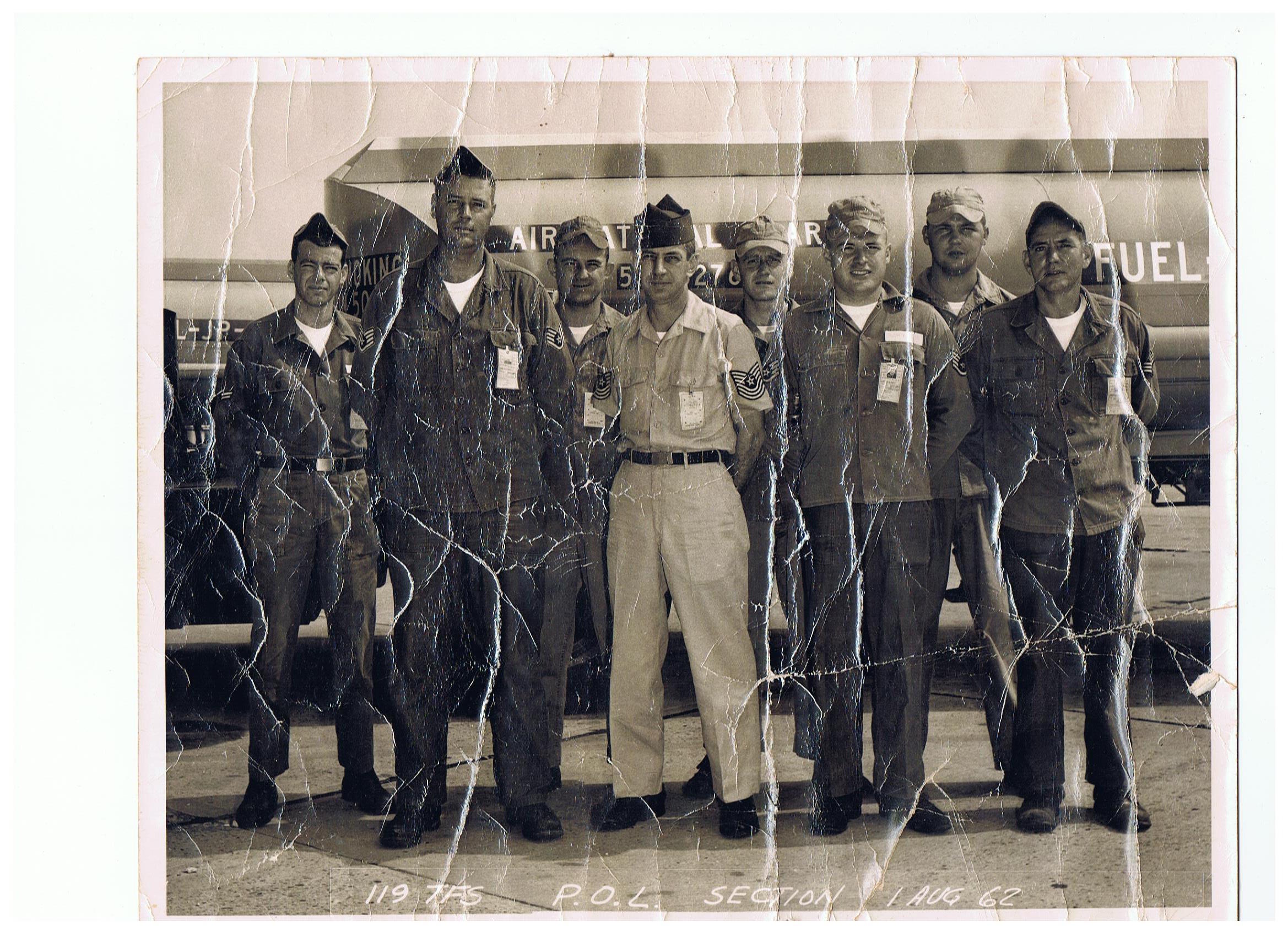
The New Jersey Air National Guard 177th Tactical Fighter Squadron. Matthew Snydman is on the far left.  Courtesy of Matthew Snydman.

The New Jersey Air National Guard 177th Tactical Fighter Squadron. Matthew Snydman is on the far left. Courtesy of Matthew Snydman.

Matthew Snydman joined the New Jersey Air National Guard (NJANG) in his early 20’s. He was young, recently married, and working at a sweater factory in Philadelphia, PA.[1] It was the late 1950’s and at the same time, the United States found itself in a nuclear arms race with the Soviet Union.[2] In 1957, the Soviets shocked the West when they launched Sputnik, the world’s “first artificial earth satellite.”[3] The advancement proved the Soviets were developing military technology at a faster rate than expected. [4] As Matthew Snydman recalls, “the Sputnik satellite was different [from other developments in outer space and missile technology at the time] because we really didn’t want to hear anything good about the Russians and especially them beating us on anything.”[5] In response to Sputnik, the United States increased their efforts in building new military and space technology, but advancements on both sides of the conflict did not come without a price. As historian H.W. Brands explains, “the paradoxical effect of the arms race was that the more weapons the two sides deployed, the less secure they were.”[6]  Snydman’s experience in the Air National Guard confirms the wisdom of that insight.

Two years after the launch of Sputnik, Snydman enlisted in the NJANG .[7] When asked why he decided to enlist he said, “There may have been a draft at that time but most of my friends were joining the NJANG as a chance to fulfill our obligation to our country and at the same time, begin our families and working careers. I think the choice of the Jersey Guard was because there were more openings available at the time than in Pennsylvania [his home state] and also the Air Force seemed a little more glamorous than the Army.”[8]

In June of 1961, Kennedy met with Soviet Premier Nikita Khrushchev in Vienna, where they discussed the looming issue of what to do about Berlin.[9] The city of Berlin was divided between the free, NATO-occupied Western half, and the East German and Soviet controlled, communist Eastern half.[10] Because the city of Berlin was situated “110 miles behind the Iron Curtain” in East Germany, “surrounded by Soviet troops,” the stakes were high for NATO and Western powers in West Berlin.[11] Therefore, when Khrushchev threatened “to make a peace treaty with East Germany, which would end Western access to Berlin,” Kennedy reacted firmly.[12]  Soon after the meeting in Vienna, Kennedy addressed the nation in regards to how the United States would react to the Soviet Union, declaring he would increase military forces to prepare for conflict if need be, including the Air National Guard.[13]

Matthew Snydman’s unit, the 177th Tactical Fighter Squadron (177th TFS), was called into active duty that summer as a result of the speech. He remembers there being “mucho, mucho excitement!” at the prospect of being activated into the regular Air Force, saying he was “happy to finally [be] doing something more productive”.[14] Stationed at a base in Atlantic City, NJ, the 177th TFS was never actually deployed during their active duty, however. Snydman describes his work as “a refueler, the guy who, after the plane was down and positioned, plugged in my tank truck line to a port under the wing, watched the gallon counter and filled the plane with gas (JP4 fuel),” adding, “I drove a 10,000 gallon tank truck back and forth, back and forth.”  He admitted it was “Boring as hell”.[15] For the most part, however, he remembers the time as being enjoyable. He sarcastically described it as a “tough life, living on or near the beach, water skiing and drinking a little beer and going to work and driving a truck and not thinking about much except if and when we were leaving for Germany which we never did”.[16]

Fortunately for Snydman, and the world, the combat deployment never came.


FOOTNOTES

[1] Email interview with Matthew Snydman, March 25, 2015.

[2] Unknown, “The Widening Conflict, 1953-1963,” in Cold War: An International History, (New York: Westview Press, 2014). [Credo Reference]

[3] H.W. Brands, American Dreams: The United States Since 1945 (New York: Penguin Books, 2010), 95.

[4] Unknown, “The Widening Conflict, 1953-1963”. [Credo Reference]

[5] Email interview with Matthew Snydman, March 25, 2015.

[6] H.W. Brands, American Dreams, 96.

[7] Email interview with Matthew Snydman, March 25, 2015.

[8] Email interview with Matthew Snydman, March 25, 2015.


[9] Unknown, “Kennedy, John Fitzgerald (1917-1963),” in A Dictionary of Contemporary History – 1945 to the Present, (Oxford: Blackwell Publishers, 1999). [Credo Reference]

[10] John F. Kennedy, “Radio and Television Report to the American People on the Berlin Crisis, July 25, 1961,” John F Kennedy Presidential Library & Museum (accessed March 2015). http://www.jfklibrary.org/Research/Research-Aids/JFK-Speeches/Berlin-Crisis_19610725.aspx

[11] Kennedy, “Radio and Television Report.”

[12] Unknown, “Kennedy, John Fitzgerald (1917-1963).” [Credo Reference]

[13] Kennedy, “Radio and Television Report.”

[14] Email interview with Matthew Snydman, March 25, 2015.

[15] Email interview with Matthew Snydman, March 25, 2015.

[16] Email interview with Matthew Snydman, March 25, 2015.

The Hydrogen Bomb: Keeping Us Safe

By Patrick Meier

My grandfather, Stephen Patrick Meier, participated in the creation of the deadliest weapon of its time.  One could say that the Cold War was fought not with guns, but with science and political maneuvering. H.W. Brands focuses on the political debate surrounding the hydrogen bomb, but my grandfather’s story is about the science and actual creation of the hydrogen bomb.  In the end, however, Stephen Meier’s opinions on the matter reinforce Brands’s interpretation about the development of thermonuclear weapons.  Some have called it a dangerous escalation in the Cold War.  Others, my grandfather included, think of it as a necessary evil, one that “kept us safe” despite its danger.

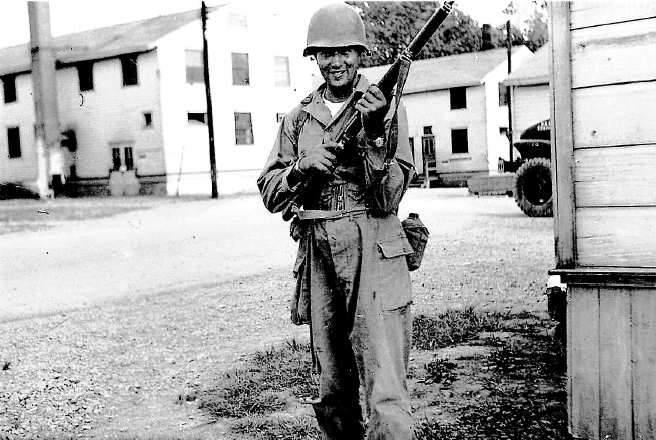
Stephen Patrick Meier graduated Earlham college in 1952 with a bachelor’s degree in physics.  After a year in Indiana working for RCA, he was drafted into the Army.

Stephen Meier in 1953

Stephen Meier in 1953

Basic training occurred that year at Fort Knox, after which Meier was assigned to Aberdeen, Maryland.  From there he was transferred to Edwards Air Force Base, and transferred yet again a few months later to Kirkland Air Force Base.  In the span of only a few months Meier went from basic training in Kentucky, to the Aberdeen Proving Ground in Maryland, to the Aberdeen Bombing Mission outside of Los Angeles, and finally to Kirkland AFB in Albuquerque, New Mexico as part of the Aberdeen Bombing Mission Special Weapons Liaison Group.

Being a physics major, Meier’s main role was creating bombing tables for the new hydrogen bombs.  In layman’s terms, he conducted tests to determine how the fallout from bombs would disperse in the air.  In his own words, “depending on the way the bomb acted when it was released we would put numbers into the bombing system to make the sure the bombs went toward the target.  Of course if you’ve got 8 and half megatons it doesn’t make a whole lot of difference!” [1]

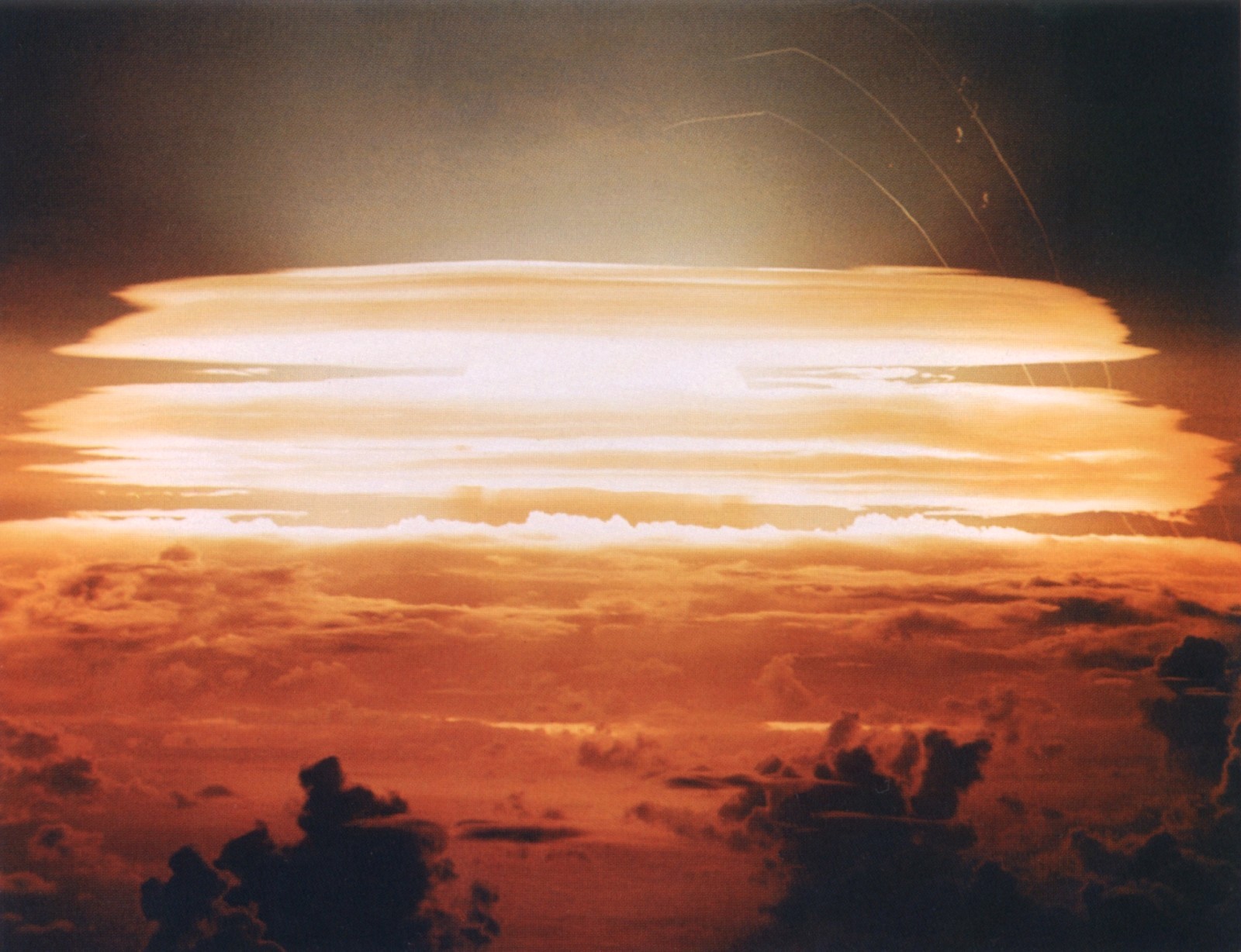
Meier’s involvement with the hydrogen bomb began in 1953, an entire year after the United States’ first detonation of a fusion device, and months after the Soviet Union’s creation of a weaponized hydrogen bomb [2].  At the time of his involvement, the Soviet Union had already successfully created a hydrogen bomb that could be dropped from a plane.  The Cherokee test (which Meier had worked on), according to nuclearweaponarchive.org, “was the first U.S. air drop of a thermonuclear weapon. This… was intended to gather weapon effects data for high yield air bursts, but also was a political demonstration of the United States capability to deliver H-bombs by air to pressure the Soviet Union.” [3].

Cherokee test

Cherokee test

His work then ended in 1955, so while important and interesting work, his story itself says little about the political concerns that factored into President Truman’s decision to go ahead with development of thermonuclear weaponry.  When asked about what he thought of his project at the time, Meier said, “Politics didn’t enter into it as far as we were concerned.  It might have somewhere else but not for us.” [4]

That somewhere else was Washington, where debate over whether or not to even create fusion weapons had raged for years previously.  The General Advisory Committee to the Atomic Energy Commission was a panel made up of scientists tasked with helping to decide what course of action the United States should take in terms of nuclear weapons.  The panel published the Acheson-Lilienthal Report on October 30, 1949.  Their report was split into two sections, signed by two different groups within the committee, as each side could not agree unanimously on certain issues.  One thing, however, was clear.  “Although the members of the Advisory Committee are not unanimous in their proposals as to what should be done with regard to the super bomb,” explains the report, “there are certain elements of unanimity among us. We all hope that by one means or another, the development of these weapons can be avoided.” [5]

In this report, they condemned the creation of the hydrogen bomb, on the basis that current weapons were sufficient for destroying military targets.  The hydrogen bomb, on the other hand, seemed too dangerous for civilians. They wrote:

“It is clear that the use of this weapon would bring about the destruction of innumerable human lives; it is not a weapon which can be used exclusively for the destruction of material installations of military or semi-military purposes. Its use therefore carries much further than the atomic bomb itself the policy of exterminating civilian populations.” [6]

The project was meant to be a secret.  Meier says, “security wise I was top secret and q-clearance, which was atomic energy clearance.  Actually I think the q-clearance was higher than top secret.  And really it was pretty well contained right on the base.  We didn’t talk about it.” [7] Brands says little on the actual development of the hydrogen bomb, choosing instead to focus on the debate surrounding its creation and the impact its construction had on the relations between the United States and the Soviet Union.  Brands states that although the debate over the hydrogen bomb was meant to be secret, it didn’t stay that way for long.  Details were soon leaked to the press and public opinion was not one-sided.  One expert, Ralph Lapp, even claimed that “for America to build the bomb would be like ‘the man who lives in a tar paper shack and develops a flame thrower to defend himself’.” [8]

Meier’s stance, then and now, is that creating the hydrogen bomb was the right thing to do at the time.  However, he is not without his qualms.  He says, “it was such a dramatic increase in destructive capability.  And you know you had to be thinking long and hard, I don’t care what kind of madman you were, to even unleash such a thing.  It was terrible.” [9]

We can see hints of this uneasiness in this letter written by Chief Herman Miller, Meier’s supervisor at the Aberdeen Bombing Mission Special Weapons Branch.  This letter was sent to RCA notifying them of the end of Meier’s military service and return to work at RCA.  He says in the letter that “Cpl Meier has proven himself to be an outstanding individual who has placed duty far above his own personal feelings and comforts.” [10]  In hindsight however, during my interview with him, Meier decided that “I think we should have [created the hydrogen bomb] to be honest about it.  It kept us safe.”  [11]

He was not the only one with that opinion.  Lewis Strauss believed that “the United States must be as completely armed as any possible enemy.” [12]  Essentially, the United States was obligated to create fusion weapons just in case the Soviets were creating them too.  This eventually motivated President Truman to go ahead with development of the hydrogen bomb.  Additionally, the fear of the Soviets being able to make a hydrogen bomb turned out to be justified.  The Trinity Test at Alamogordo in July 1945 predated the Soviet’s first atomic bomb by almost four years.  [13] America’s first hydrogen bomb, however, beat the Soviet’s first hydrogen bomb by only one year.  The gap was closing.  However, The United States had one more card to play yet in the race for thermonuclear superiority: Turkey.

The eventual incorporation of Turkey into NATO lent the United States a distinct advantage at this stage of the war.  Turkey’s airfields and America’s new, powerful, deliverable thermonuclear bombs kept pressure on Soviet borders. [14] The Cold War, however, was only beginning.


[1] Stephen Meier, phone interview, March 21, 2015.

[2] H.W. Brands, American Dreams: The United States since 1945 (New York: Penguin Books, 2010), 66.

[3] “Operation Redwing.” Operation Redwing. Accessed March 25, 2015. http://nuclearweaponarchive.org/Usa/Tests/Redwing.html.

[4] Phone interview with Stephen Meier.

[5] PBS, American Experience, Race for the Superbomb. Accessed April 28, 2015.

http://www.pbs.org/wgbh/amex/bomb/filmmore/reference/primary/extractsofgeneral.html

[6] Ibid

[7] Phone interview with Stephen Meier.

[8] Brands, 66

[9] Phone interview with Stephen Meier.

[10] Herman Miller to W.F. Warrender, June 2, 1955.

[11] Phone interview with Stephen Meier.

[12] Brands, 66.

[13] Ibid, 66.

[14] Ibid, 67.


The Span of Power of the United States: From France to the Life of a Navy Man

By Charlotte Heroux

The aftermath of World War II defined a new era for not only the United States, but also for the world. The world powers had shifted and the once strong European governments were suffering immense economic and industrial troubles from fighting the war on their own soil. One of these countries was France, who emerged from World War II with a series of problems. The United States Secretary of State George Marshall spoke at Harvard University in June 1947 and called for “an ambitious program to aid Europe to stabilize and ameliorate the situation there, in the interests of the Europeans and the world…the Europeans must cooperate with America and among themselves.” [1]

This aid ultimately came in the form of what is known as the Marshall Plan, which planned to give about 13 billion dollars in aid to European economies, both dollars and goods. One European country that was to receive a significant amount of aid was France, which is where Pierre Heroux served as a French interpreter in Villefrance, France while serving in the Navy, and experienced first hand accounts of post World War II France and how it was affected by the Marshall Plan.

Heroux recalls, “I joined the Navy immediately after high school in July 1954. At the time, military service was mandatory for all males. Since I did not wish to join the Army, but rather see the world, I volunteered for the Navy.” [2] But while Heroux was still in high school, the Marshall Plan was taking effect in Europe.

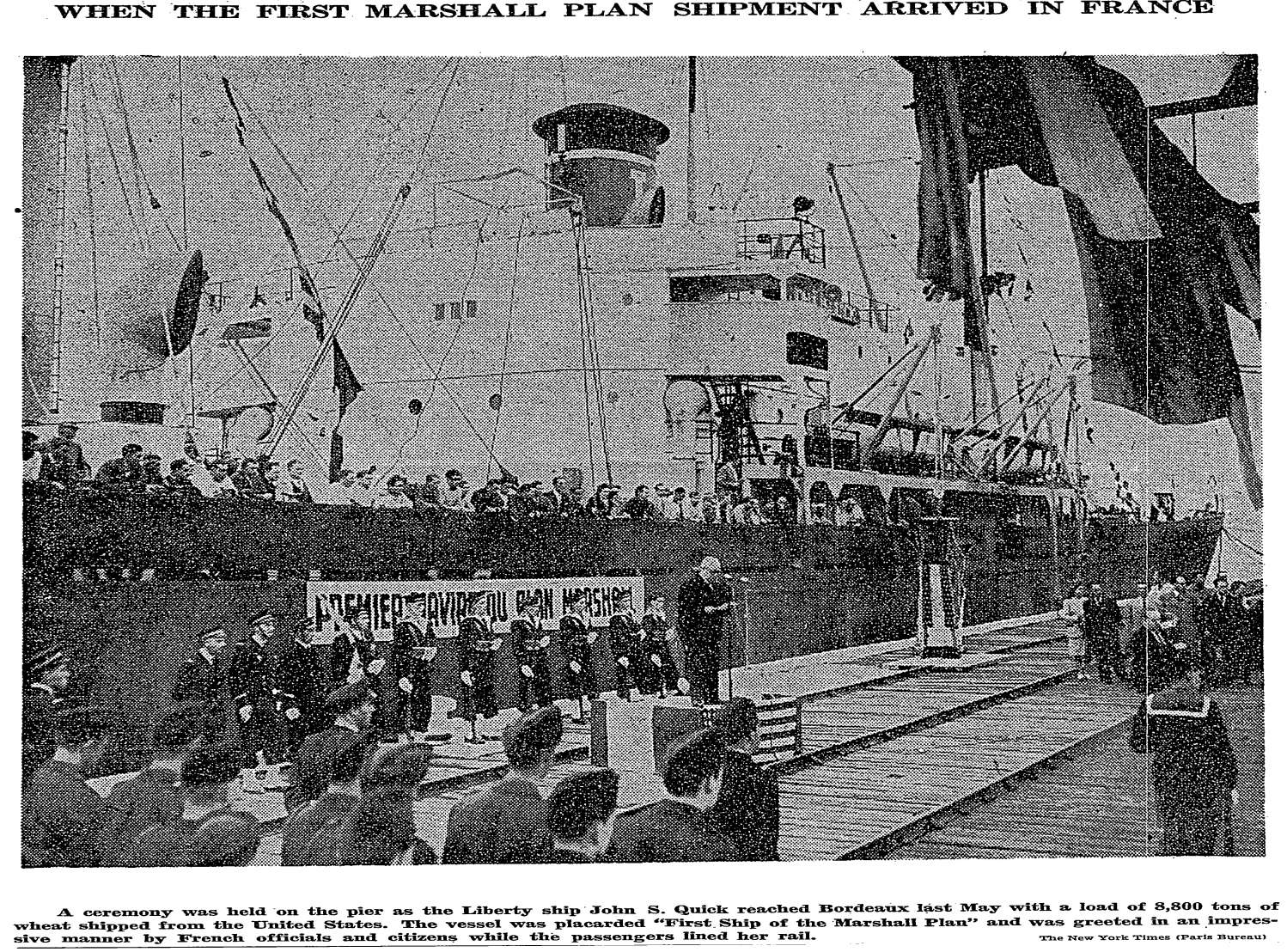
Screen Shot 2015-04-30 at 10.44.03 AMThe aid to France began in April 1948, and marked a significant change for the lives of Europeans. The picture published in the New York Times in January of 1949 displays “a ceremony that was held on the pier as the Liberty ship John S. Quick reached Bordeaux last May with a load of 8,000 tons of wheat shipped from the United States. The vessel was placarded ‘The First Ship of the Marshall Plan’ and was greeted in an impressive manner by French officials and citizens while the passengers lined her rail.” [3] This symbolizes the adjusting attitudes towards the United States in European countries, and what was to come in the ongoing and future battle against communism. Over the next couple of years, the aid continued to France, and continued to improve the lives of French citizens and the economy. By December 1950, “France…is a dramatic illustration of how the pump-priming of Marshall plan money – in combination with the will, work, and ingenuity of the people – put one country back on its feet economically. France is not only recovered. It is thriving.” [4]. In only two years, France was once again a fully functioning European economy and society, and was now prepared to take on the challenges of post World War II involving the containment of communism. In 1948 when the United States rolled out the Marshall Plan, “…the Kremlin announced the Molotov Plan, named for Marshall’s Soviet counterpart and intended to accomplish for Eastern Europe, on socialist principles, what the Marshall Plan would do, on a capitalist base, for the West.” [6] These actions escalated the division of Europe, with Germany at the center. Fear of communism expansion in the United States heightened to an all time high, and it became even more important for relationships to be solidified between the United States and Western Europe.

During this pivotal time, Heroux was serving active duty in the navy, and during this time of his service, he was able to experience living in France and witness first hand the effects the United States aid had on the country. “When I was there,” Heroux recalls, “the French people were appreciative of the United States role in conquering Nazi Germany. They treated American servicemen with great respect and friendship.” [6] With the growing relations of Western Europe and the United States, it became even more important to oppose the growth of communism, and the United States was at the forefront of this battle. This fight came in part as the Marshall Plan, as it helped the countries that would be on the ground potentially opposing the communist spread. This worked as a two way street, the United States helped European economies recover, so that these countries could assist the United States in combatting communism. These once demolished countries were returning to full functioning world powers, and this was something the French people did not take lightly. Heroux recalls, “while I was on shore patrol duty and interfacing with the local gendarmes (police) the sargent I was dealing with mentioned to me that if it were not for the U.S.A. aid via the Marshall Plan, the local police would not have been able to become operational in a timely fashion after the war. Such things as equipment, organizational assistance, and financial assistance in his opinion was what allowed local police forces throughout France to become functionally operational as quickly as they did.” [7] France was able to regain its status as a world power because of the help of the United States, and the United States proved that it not only was powerful enough to help other countries, but able to be of immense support to its own citizens.

The United States Navy played an instrumental role in Pierre Heroux’s life, as well as countless other men just like him. After serving his active duty as an electrician’s mate, Heroux remembers, “I was happy to return to civilian life…[and I pursued] a degree in Electrical Engineering…I returned to active reserve Navy duty after acquiring a degree. I was fortunate enough to find a position in the utility field as an electrical engineer.” [8] The Navy, as well as the Army, provided careers and life paths for men throughout the United States. It also provided life experiences these men would not have otherwise experienced, and Heroux’s case is a perfect example of this. While he helped the United States combat communism, he got to experience living in another country and numerous other unique experiences. As he recalled the most important events, he remembered, “cruising to the top of the world and crossing the Artic Circle [and] surviving two hurricanes at sea.” [9] While, these might not have been instrumental in the history of the United States, they were important life events for Heroux and the other men he served with. The United States time and time again proved its immense power not only with dealing with foreign world powers, but providing the best lives for its citizens, and it seems as though the United States power has not limits.


[1] H.W. Brands. American Dreams: The United States Since 1945. New York: Penguin Books, 2010, 38.

[2] Email interview with Pierre Heroux, March 21, 2015.

[3] “When the First Marshall Plan Shipment Arrived in France.” New York Times. 04 January 1949, 41.

[4]”Marshall Plan Has Put France Back on Its Feet, Economically.” Daily Boston Globe. 17 December 1950, 1.

[5] Brands, 39.

[6] Email interview with Pierre Heroux, March 25, 2015

[7[ Email interview with Pierre Heroux, April 23, 2015

[8] Email interview with Pierre Heroux, April 23, 2015

[9] Email interview with Pierre Heroux March 21, 2015

Understanding US History Through Political TV Ads

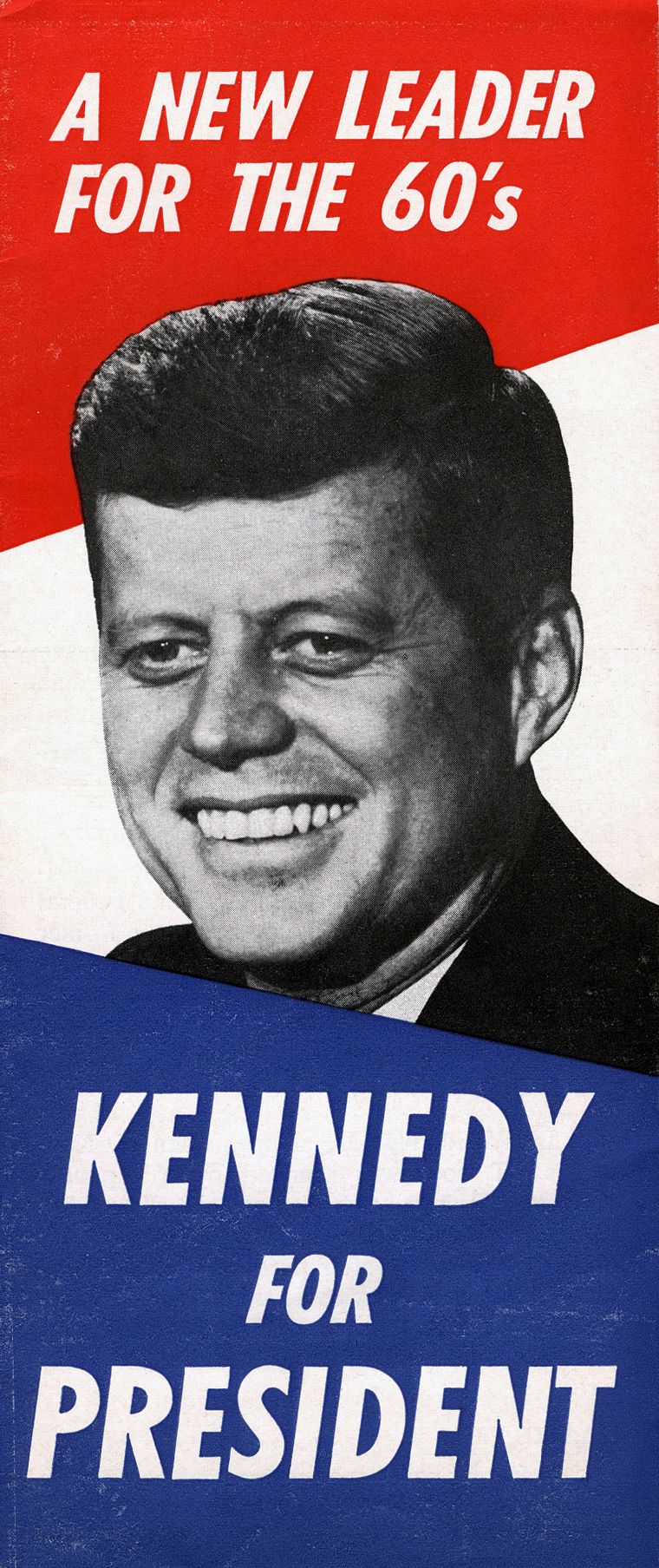
KennedyThe Living Room Candidate website, courtesy of the Museum of the Moving Image, has collected televised presidential campaign advertisements from 1952 to the present day. They offer a great window for understanding some key trends in US history since 1945.

Here is a pioneering TV ad from the 1952 campaign, presented in what was then popular movie newsreel style, for the Republican campaign of Dwight D. Eisenhower.  Think carefully about what the commercial is emphasizing –and also what it omits.

Compare that 1952 effort to this more polished, 1960 John F. Kennedy campaign ad, designed to invoke some of the more popular TV jingles of the 1950s.

Perhaps the most famous (or infamous) ad in the history of modern presidential campaigns appeared as a paid advertisement on TV only once –the so-called “Daisy ad” from 1964. Students should be able to explain what this ad was about, and why it was so powerful and controversial.

The Richard Nixon campaign in 1968 revolutionized the use of TV commercials in presidential contests, relying on them more than any other previous campaign organization. These two notable examples show some of the new techniques of advertising and also help highlight the shift in national climate since 1952.

The foreboding nature of those 1968 ads helps explain the strategy of calculated optimism behind this biographical short from the 1976 Jimmy Carter campaign.  What’s also especially useful about this effort is how it captures several political and social trends from modern US history.

In the 1984 presidential election, Ronald Reagan won 49 out of 50 states. This commercial, known popularly as the “Morning Again in America” ad helps illustrate the broad appeal of the reelection campaign –and the sophisticated selling techniques of modern presidential politicking.

Cronkite on Vietnam

Here are video clips of Walter Cronkite’s original February 27, 1968 CBS Evening News Broadcast on the Tet Offensive and also an oral history from Cronkite about that pivotal TV moment recorded in 1999.  Explain why this was such a pivotal moment in the history of US involvement in Vietnam.

The result of rising anti-war sentiment in the Democratic primaries and clear signposts of mainstream concern from sources such as Cronkite’s February special report convinced President Lyndon Johnson to announce on March 31, 1968 that he would not seek reelection after all.  Here is the full broadcast of his address to the nation that evening.  His remarks on quitting the presidential race begin around the 38 minute mark.

Was the Fifties a Golden Age?

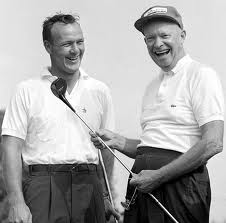
Arnold Palmer (left) and President Eisenhower

Arnold Palmer (left) and President Eisenhower

H.W. Brands labels his chapter on the 1950s as “The Golden Age of the Middle Class,” but even Brands seems unsure how much to believe in this label.  Were the Fifties a “Golden Age,” or a new “Gilded Age,” or more ominously, still the “Dark Ages” for race and gender discrimination?  There were certainly real signs of widespread growth and prosperity for the American nation in this defining post-war decade, but also significant underlying tensions and growing social problems.  Trying to fit all of these trends into a single narrative is challenging, but students in History 118 should be able to explain the contours of the period with a series of notable examples.

The starting point might well be a consideration of population growth and the cultural consequences of the celebrated “Baby Boom.”  US population soared between 1940 and 1960, from about 132 million people to over 180 million.  The country gained about 30 million people during the 1950s alone –roughly equivalent to the entire population of Civil War era America.  During this era of limited immigration (between the 1924 National Origins Act and the 1965 Immigration Act), the vast majority of these demographic gains came from an increased national birthrate.  By 1964, Brands reports, four out of every ten Americans were Baby Boomers (born between 1946 and 1964).  The question for discerning students is how did all of these new children affect what Brands labels the “child-based culture” of the 1950s?  One way to answer that question is by pointing to various trends in television, entertainment, music, sports, and other aspects of an emerging mass culture.  But how much of this was a by-product of demographics or of new technologies remains an issue worth discussing.

Another way to interpret the period is by focusing on the economics of the Baby Boom, and considering how changing living and working patterns spurred important developments in post-war America.  The 1950s certainly marked an era of industrial supremacy, big cities, interstate highways, and general stability for American capitalism, but also showed signs of a new more turbulent, suburban-oriented and service-based economy.  During the early years of the post-war period, this combination of economic factors seemed to work wonders, with a greater equality of income than had been true across recent American history, but still, all was not equal in the society.

The most obvious inequality of the period was racial.  The 1950s marked the resurgence of civil rights protests for the roughly 17 million American blacks who still endured Jim Crow in the South or faced other forms of persistent discrimination in the North.  Brands illustrates the post-war civil rights movement by focusing on the impact of the two monumental Supreme Court decisions in the 1954 and 1955 Brown cases, and also on the 1955-6 Montgomery Bus Boycott.  Students should be able to explain the significance of these milestone events.

Many historians, including Brands, also find a revealing linkage between the domestic civil rights movement and the international Cold War.  In particular, during the late 1950s and early 1960s, the struggle to contain communism seemed to migrate toward what was increasingly called the “Third World,” as American policymakers sought (often unsuccessfully) to influence events in Africa, Asia and Latin America.  Thus, questions of race and geopolitical strategy often overlapped.  Regardless of the regional challenge of the moment, however, leading the globalized Cold War proved to be an enormous burden for American policymakers.  Brands ends his sprawling chapter on the 1950s by quoting from President Dwight Eisenhower’s now-famous farewell address (January 1961), which invoked a warning about the rising “military-industrial complex.”  Yet this warning, however “sobering” in Brands’s words, was complicated, because Eisenhower, the former general and sometimes belligerent commander-in-chief, was by no means prepared to stand down in the global fight against what he termed in that speech a “hostile ideology … ruthless in purpose and insidious in method.”  Clearly, whatever had been so golden about 1950s was also competing against many ominous shadows.

Page 2 of 3

Powered by WordPress & Theme by Anders Norén