History 211: History of US Elections

Dickinson College, Spring 2024

1900: The McKinley-Roosevelt Ticket A Winner

The Presidential election of 1900, between Republican President William McKinley (and his running mate, future president Theodore Roosevelt) and DemocratWilliam Jennings Bryan, was the first presidential election of the Progressive Era. Coming on the heels of the Spanish American War in 1898 during the economic boom following the end of the 1893 recession, the race would feature some of the early Progressive trends that would dominate the coming decades.
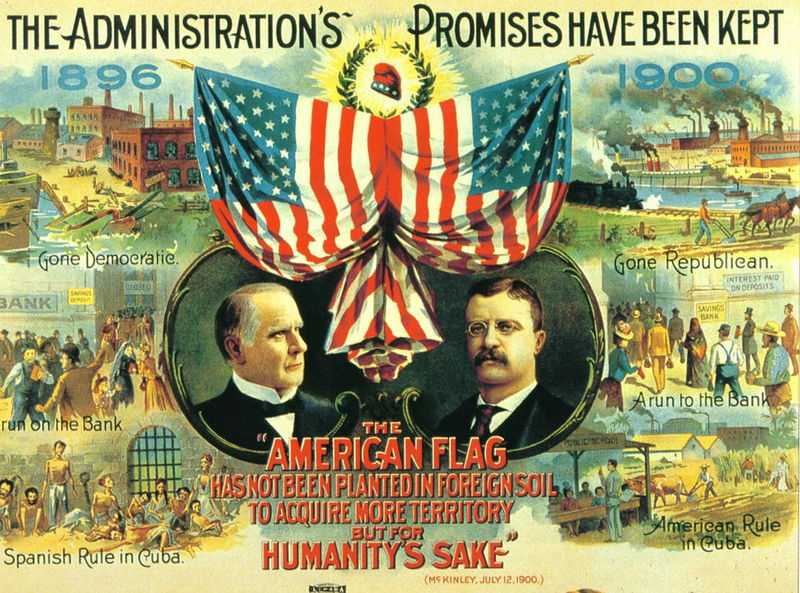
In keeping with Progressive ideals, the 1900 election began to see a strong backlash against the corruption of the political process. As Dr. Leighton Coleman, Bishop of Delaware said, “We are on the eve of a great election, which has significance and deep interest for every true church-goer.” It was through this election that they would begin to “sweep out political dishonesty and corruption.” The need for this kind of reform was painfully obvious, as just the day before a scheme to ship repeat voters into Manhattan from Jersey City was uncovered.

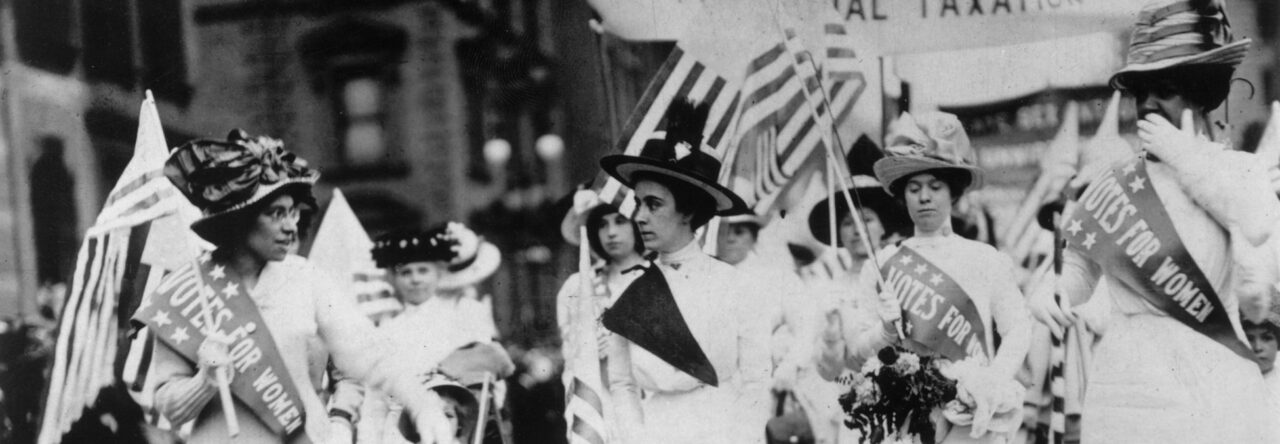
This election also saw several small, but notable, incidents among the disenfranchised of the day. In Ohio, a small group of politically aware women gathered in support of McKinley. It was by no means comparable to the sort of large-scale movement that would follow in the quest for the 19th amendment , however it was, as the New  York Times described it, “a political innovation in this section of the country (my italics).” Meanwhile in Philadelphia, a group of African-Americans, enfranchised by law rather than practice, rioted when their ballots were not accepted. As the Times reports, “they drew revolvers and a number of shots were fired.”

It was under these circumstances, on a sunny and temperate day, that the American people ventured out to cast their first vote of the new century. While the masses would come out in force (with participation topping 80% overall), the voting of society’s notables was taken note of by most of the papers. For example, when Benjamin Harrison cast his vote, “the crowd made way for the Ex-President” who was reportedly “only inside the booth for a short time.”

In the same vein, the voting of each candidate was also covered. Bryan, famous for his prolific rail travel around the country during the campaign, first went to city hall to certify that “he had failed to register because of absence from the city.” From there he proceeded to the voting place, where he cast a straight ticket, claiming “the electoral candidates are all friends of mine.” Similarly, McKinley cast his vote “so as to vote the entire Republican column.” The accounts of both candidates voting experience was given a prime spot in the day’s paper, printed side by side on page two.

By the next morning it would be officiated that McKinley and Roosevelt had carried twenty-seven states with 284 Electoral Votes, including Mr. Byrans’ home state of Nebraska.
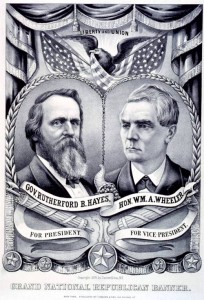
Election of 1876: Down to One Vote

Republican Nomination in the 1876 Election

“Another danger is imminent – a contested result. And we have no such means for its decision as ought to be provided by law. This must be attended to hereafter. We should not be allowed another Presidential election to occur before a means for settling a contest is provided.” – Governor Rutherford B. Hays in October 1876

The election of 1876 has been agreed upon to be one of the most disputed elections in the history of the United States. On that Election Day, November 7, 1876, both political parties assumed that the Democratic Party had secured victory for the presidential race. The election was between two major politicians, Governor Samuel J. Tilden on the Democratic side and Governor Rutherford B. Hayes as the Republican nomination.

As a Whig, Governor Hayes’ platform stood for conservative and traditional values. He had been a defender of slaves and joined the Republican Party. His platform became vital as he served on Congress and supported the Southern Reconstruction. However, prior to 1876 and after many defeats in the political world, Hayes opted to retire from politics. The Republicans had a different plan for him though, and nominated him as their presidential ticket in the 1876 election with the running mate of William Wheeler.

On the one hand, Tilden had carried much of the South and his home state of New York; on the other hand, Hayes had held much of New England, the Midwest and many of the Western states.On the evening of the election, Hayes went to bed believing he had lost the presidency to Tilden quite handedly. He wrote in his diary, “I never supposed there was a chance for a Republican success.” Unaware to both candidates, the executive office was torn between just one electoral vote. Headlines across the country had even stated that Tilden had secured the victory. For many days, Hayes was not sure of the outcome of the race. Rumors of electoral fraud raged throughout the nation. The final electoral vote was Tilden with 184 and Hayes with 185. Without this knowledge, both parties considered themselves the winners. Both Hayes and Tilden lay low as their representatives dealt with the anticipating public.

The Disputed Election: Who Will Win?

To combat these growing controversies, the House and the Senate created an Electoral Commission with a company of fifteen people: seven Republicans seven and seven Democrats. Of these fifteen people, the makeup was: five senators, five house members and five Supreme Court justices.

Though Tilden had won the popular vote, the Commission swung in favor of Hayes. On March 2, 1877, the Commission finally announced that Hayes, with his running mate William Wheeler, were to be the new President and Vice President elect by an electoral vote of 185-184. But on that day of March 5, 1877, when President Hayes was finally inaugurated into office, he knew that his struggle was far from over. The Southern Democrats threatened radical action to be taken if Hayes did not meet their needs. In what C. Vann Woodward titled “The Compromise of 1877,” Hayes agreed to withdraw troops from the South, thus ending Reconstruction.

The Election of 1876 is extremely important to the electoral history of the United States. As one of the most disputed elections of recent history, it enabled the politicians of America to take action in the Post-Civil War era. Rurtherford B. Hayes’ role was subtle yet powerful as he stepped his way into the presidency over Samuel Tilden and the strong Democratic Party. Hayes kept calm and stayed in the background until he emerged and accepted the presidency after almost four months of debate.

McClellan and the Election of 1864: Election Amid the War

Republican Lincoln vs. Democratic McClellan

“Conscious of my own weakness, I can only seek fervently the guidance of the Ruler of the Universe, and, relying on His all-powerful aid, do my best to restore Union and peace to a suffering people, and to establish and guard their liberties and rights.” – General George B. McClellan

The Election of 1864 was one of the few elections to take place amid a wartime setting. The two candidates were friends on opposing sides. The Republican Party nomination went, of course, to Abraham Lincoln for reelection and he ran under the National Union Party.  The Democratic Party went a different route in nominating General Gorge B. McClellan, a “young Napolean” war general and one of the leading men of Lincoln’s Union Army.

The Democratic Party was torn between the War Democrats and the Peace Democrats. This duality placed a certain strain onto the Party, thus dividing it and making it all the more weaker in comparison to the united Northern Republicans. At the Democratic Convention in August of 1864 brought McClellan to the forefront of the Democratic Peace Party, also known as the Copperheads. Though he stood for much of what the political group represented, an immediate cease-fire and negotiation with the Confederacy, McClellan was more pro-war did not agree altogether with the cease-fire. He instead promised a stronger effort for the Union to stop the war in the hopeful near future. Unfortunately for the Peace Party, his pro-war stance worked against the Democratic Party and sent more votes Lincoln’s way. McClellan attempted to keep himself at a distance from the strong anti-war sentiments of the Peace Party. In his acceptance speech for his nomination he wrote, “The Union must be preserved at all hazards.” He did not believe in attempting to bring peace into a country where there was no immediate, peaceful resolution.

As the Election grew nearer, Lincoln’s campaign gained momentum as the McClellan Democratic Party continued to lose supporters. The War raged on in the North and the South. On September 2, Atlanta fell to the Union Army. This victory almost so close to the election date brought further motivation for Republican votes and “boosted Union morale.” Lincoln’s re-election seemed more certain with each passing day.

Finally on Election Day, McClellan realized his loss. It was rather inevitable with the events leading up November 8, 1864. The Republican Abraham Lincoln defeated General McClellan a whopping 212-21 in the Electoral College votes. McClellan won in merely three states, Kentucky, Delaware and his home state of New Jersey. It was a sound victory for Lincoln, as he became only the second president in the history of the United States since Andrew Jackson to be victorious for a second election. On that day, the defeated and, albeit exhausted, General McClellan wrote to his friend, “For my country’s sake I deplore the result, but the people have decided with their eyes wide open and I feel a great weight has been removed from my mind.” On that same day he wrote his letter of resignation from the Union Army. General McClellan went happily into retirement.

The Election of 1864 is significant in the elections of United States history. Not only does it occur during wartime, but it also provides insight into the politics of the Civil War. The race between Lincoln and McClellan was not close. McClellan was placed into a tight spot with his divided party and unique views. Though unsuccessful in his quest, he put up a valiant effort against the popular and famous Abraham Lincoln.

“Ring the Bell Twice:” Honey Fitz and the 1905 Boston Mayoral Election

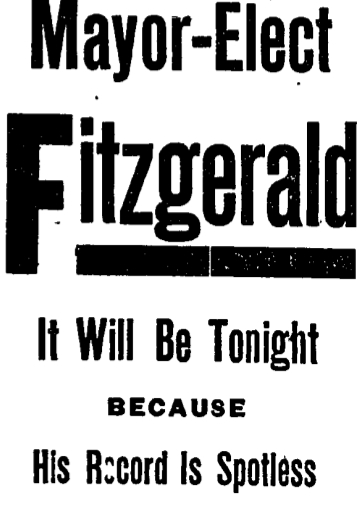
An Advertisement Placed in the "Boston Daily Globe" on December 12, 1905

As he took the oath of office in the shadow of a snowy United States Capitol, John F. Kennedy stood for far more than the ascendance of one man to the office of the Presidency. Rather, his inauguration laid a capstone in the story of a family steeped in American political life for more than a half-century; a story that begins with John “Honey Fitz” Fitzgerald.

55 years earlier, a car carrying John Fitzgerald’s brother James and a representative from the Boston Daily Globe arrived at the Fitzgerald residence on Welles Avenue in Dorchester. As later recounted in a Globe story, James Fitzgerald and his reporting companion were greeted at the door by overwhelming elation: John would be elected Mayor of Boston.

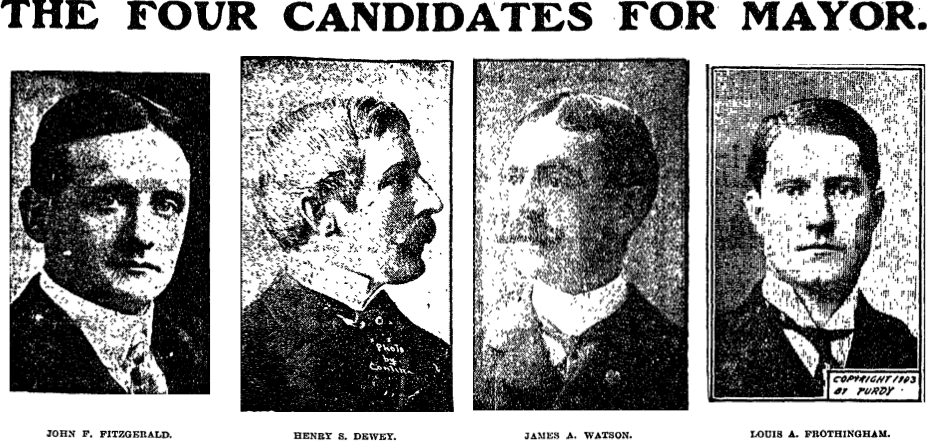
Historian Doris Kearns Goodwin tallies Fitzgerald as having won 44,174 votes out of more than 92,000 cast; because his nearest opponents – a Republican and independent identified by Kearns Goodwin as having split the same demographics of voters – drew 35,028 and 11,628 votes respective, “Honey Fitz” had won a plurality victory in Boston. The Boston Daily Globe described the rousing cheers in Dorchester’s Codman Square as Fitzgerald made his way towards Democratic Party headquarters in downtown Boston, marking his first public appearance as Mayor-elect. As described in another Globe piece, a Fitzgerald supporter called out in the gallery of City Hall (which had never recorded a larger election night crowd), “what’s wrong with the old North End?”

The victory was likely quite gratifying for Fitzgerald. Kearns

Photographs from an article in the "Globe."

Goodwin asserts that the Mayorship was a position that intrigued him for some time, but it had not seemed to be the right opportunity until 1905. It was a race in which he had worked incredibly hard, up to and including election day. The Boston Daily Globe reported that Fitzgerald began December 12th with a “whirlwind” campaign through each of Boston’s 25 wards, followed by meetings with his campaign staff that lasted a significant part of the day. As the day waned, Fitzgerald focused on a ground campaign in his tougher wards, even having an encounter with a hostile ward boss, described in the same Globe article:

“Cheer up Martin. Don’t be discouraged,” said Mr. Fitzgerald, his remarks evidently being designed to carry with them the impression that the battle was all over but the shouting, but Martin failed to see the humor of the situation and scowlingly looked defiance as the democratic standard bearer was whisked away in his automobile.

As much as it was victory for Honey Fitz, it was equally sweet relief for other members of the Fitzgerald family, some of whom had trouble concealing their nervousness on election day. “Miss Rose,” as the eldest daughter of Honey Fitz and future mother of John Kennedy is described in the Globe, was so nervous that she “visited her church and offered up a fervent prayer for the success of her father” on election day. More than a century later, it is clear from Boston’s political and ethnic landscape that she did not have cause for great concern.

The late-19th and early-20th centuries were as transformative for Boston as for the United States as a whole.

A photograph of Copley Square in downtown Boston, circa 1912. The building on the right is the Boston Public Library, which still stands.

The 1900 Census shows that between 1850 and 1900, the number of people living in Massachusetts’ capital city more than quadrupled from just over 130,000 to over half a million, a number propelled upward by an influx of Irish immigrants. The Harvard Encyclopedia of Ethnic Groups, compiling several decades of Census data, reports that Boston saw 45,000 Irish-born residents in 1860 and 71,000 by 1890, or 12 percent of the entire city’s population.

The transition from a bastion of Brahmins to a center of immigration was not easy for Boston. Kearns Goodwin shows that with the swell of Irish Bostonians came the blight of slums and poverty, a trend that slowly edged the wealthier families out of the North and South Ends and into the Back Bay and Beacon Hill. While this separation likely served to propogate discrimination, it also helped to generate a formidable and cohesive political machine. Combined with voting regulations that were comparatively equitable (as Virginia Harper-Ho reports in Law and Inequality), Irish Bostonians were able to assume major influence on their city’s political process.  In 1885, just 30 years after Irish immigration reached its peak, Boston had elected its first Irish mayor. A few months after John Fitzgerald walked the streets of Boston’s wards on election day 1905, an official guide to Boston’s mayors had four Irish-Americans within its pages.

44 years later, John Fitzgerald passed away. An Alderman, Congressman, and Mayor, his obituary in the New York Times hailed “one of the most colorful figures in the history of Boston politics.” A product of an oft-painful chapter in the history of Irish-Americans, he never lost sight of that sense of attention to people that was honed so carefully across decades of election days. His grandson, the late Senator Edward M. Kennedy, would recall in his autobiography that, as late as 1947, Honey Fitz would tip a hotel bellman to ring the bell once for a guest from Massachusetts and twice for a guest from Boston. Every time the bell rang twice, any guest at the hotel could hear, in a great booming Irish brogue, “you’re from Boston, aren’t you!”

Election of 1864 – Soldiers and Absentee Voting

In 1864, the nation was in the midst of civil war and Lincoln was fighting for re-election. With half the nation not voting, this was unlike any other election in American history. And, for the first time, the government had to address the problem of absentee voting for soldiers in the field.

The two main candidates for the election of 1864 were General George McClellan and the current president, Abraham Lincoln. This election was of pivotal importance to the soldiers fighting in the Civil War. A strong commander in chief of the army could be a matter of life or death. Campaigners tried to depict their opponent as a weak military leader as in The Gunboat Canidate comic shown here. Lincoln was aware of how much the right to vote would mean to soldiers, and to his successful candidacy, so he worked hard in the months leading up to the election to insure that soldiers in the field would have their votes count.  In previous off-year elections the military proved to be one of Lincoln’s largest demographics. This advantage was not one he was about to let go of. According to the New York Herald, as the winter approached, fighting started to cease and the election “kept our brave army in almost comparative idleness for two weeks.” The nation turned its focus onto the campaign between Lincoln and McClellan. In the days leading up to the election, voting became the most important battle for the Union.

Simply delaying fighting was not enough to ensure that every soldier, many of whom were far from home, would get the opportunity to cast their ballots. At the start of the war absentee voting was unnecessary and almost unheard of. Many worried that such a system would lead to fraud and corruption. Governer Horatio Seymour claimed that absentee voting was unconstitutional, and he tried to prevent its passage into law. However, most politicians knew that they needed the support of soldiers to win. They began to think of ways in which their votes could be counted from the field.  According to historian Alexander Keyssar, “for the first time, states were obliged to contend head-on with the issue of absentee voting…nineteen states enacted laws allowing soldiers in the field to vote” (Keyssar, The Right to Vote, 83). Different political groups lobbied for a variety of strategies to ensure that their candidate would receive representation. These strategies included passing out pamphlets and ballots to soldiers, sending representatives to the field to make sure votes were counted, and a system called vote by proxy. Voting by proxy allowed soldiers to mail their ballots home. This was the form of absentee voting that was eventually turned into law in April of 1963.

John Hay was with Lincoln in D.C. on a rainy election day in November. While they waited for updates on the election throughout the day Hay reported that in many cities the voter turnout “can only be accounted for by considering the great influx, since the war, of voting men from the country into the State centers where a great deal of army business is done.” As soldiers returned home to vote absentee ballots were counted across the nation, Lincoln began to see that his victory was inevitable.

About 78% of all the Union soldiers who voted, voted for Lincoln. Most historians credit his victory over McClellan to this. The influence of this election is one that still lives on today. Absentee voting is legal across the country and is an unquestioned part of voting rights in America.

Dickinson College and the Election of 1856

In the fall of 1856, Horatio Collins King was a junior at Dickinson College in Carlisle, Pennsylvania.  As such, for King and the rest of the Dickinson community, it was an exciting time, for one of their own was running for president.  James Buchanan, a native Pennsylvanian and Dickinsonian of the class of 1809, was running on the Democratic ticket against the Know-Nothing incumbent Millard Fillmore, and John Charles Frémont, the representative of the fledgling Republican party.  Because of the polarizing views of the opponents on the grave issue of slavery, the presidential election of 1856 held great potential to decide which direction the nation was headed.

“Free soilers, Fremonters, Free niggers and Free booters,” a well-known derision of Republican John C. Frémont’s slogan of “Free Soil, Free Men, Frémont for Victory”may have been one of the slogans that King or his buddies in the Democratic Club in Carlisle may have shouted as they strolled down High Street.   These young men were ecstatic over their practice victory in an impromptu poll that had taken place on the evening of Saturday, September 20th, 1856, as King describes in his journal:

“Held an election, viva voce, at 5 P.M….  The Poles remained open about 2 ½ hours. There was tremendous excitement: each party running for their men. At 7. Pm. the Poles closed, and shortly after, it was announced. 60 for Buchanan, 60 for Fillmore, and 13 for Fremont. Several Fremont men voted for Fillmore, in order to defeat Buchananists.”

As November crept ever closer, Horatio Collins King and his friends looked forward to the official national election that would take place on November 4th.  Far more so than the musings of disenfranchised school boys playing politics, this election would help decide the fate of the nation.  Indeed, that disenfranchisement must have bit harder than the nippy air on that November morning, when King yearned to participate in an election that was so dear to him, especially as a Dickinsonian:

“Arose at 6. College exercises are suspended in consideration of the importance of the day. On this day, we Democrats hope to make Buchanan Presd’t of the U.S, and I think we will succeed in doing so. Went down to Polls, and loafed around for awhile. Borous— because I have no vote.”

Although King and his fellow classmates could not participate in this election, the country’s election results followed suit to Dickinson College’s mock vote and James Buchanan won the bid for the Presidency, which resulted in delaying the American Civil War for at least four more years.  The election of 1856 was a crucial one in American history, and if Frémont had won, and put the Republicans in power, the American Civil War may have started earlier, with possibly much different results in store for the nation.  However, the following presidential election in which King did participate would have a profound and lasting impact upon himself, as well as the entire nation.

Page 5 of 8

Powered by WordPress & Theme by Anders Norén