History 211: History of US Elections

Dickinson College, Spring 2024

1864 Soldiers’ Election Day

“Well, we ‘voted’ and the ‘Little Mackerals’ are nowhere.  Uncle Abe is ’round’ some,” explained Captain W. F. D. Bailey, Co. G, 32d Wis. Vols., to the editors of the Wisconsin State Register on November 19, 1864.  The results were in and, at least in Co. G of 32d Wisconsin, the incumbent Abraham Lincoln had won a landslide against the “Little Napoleon,” George B. McClellan:  508 in his favor, and 73 against.  All across the country, results were being tallied after the November 8, 1864 presidential election.

The election that pitted sitting president and Republican Abraham Lincoln against the Democrat George B. McClellan was extremely crucial in American history.  Indeed, some were calling for there to be a recession of the presidential election, but Lincoln saw so much at stake that he could not allow this, and defended himself two days after the election took place: “We cannot have free government without elections; and if the rebellion could force us to forego or postpone a national election, it might fairly claim to have already conquered and ruined us.” Lincoln clearly so deeply loved the Union, that even though his loss to the “Peace Democrat” George McClellan would mean a dissolution of the United States, he knew that if there were no elections, the country would equally be destroyed by his own hands.  The direction of the country hinged on the results of this critical election, and soldiers knew it, those both in the north and the south.

Soldiers clad in blue and gray knew the power of the coming election, such as one Confederate Sergent Connor, who observed “If thay Succeed in electing a peace man I do not think the war will Last Long but Should thay elect a war candidate God alone knows when we will have peace.” Just as the Johnny Rebs down south saw the consequences of what an election would bring, so did the Billy Yanks who began to use the first absentee ballots, or tickets as the soldiers called them in United States history.

Throughout October and early November, the soldiers of all Union armies began to cast their ballots.  While marching through Georgia, on October 11, Colonel Oscar Jackson of the 63d Ohio Volunteers began accepting ballots:

We have polls opened at my headquarters. 1:00 P. M. Move and carry election with us. Have a camp kettle with paper pasted over it for a poll box. The officers march at head of the regiment and every few minutes halt and take in tickets. We are in the same county still, and as my headquarters are in the saddle the voting is strictly legal being at the quarters of the commanding officer.

As these votes from regiments in all of the Union armies poured in, the results soon became clear:  Lincoln won 78% of the soldiers’ votes. The soldiers who had enlisted to save the Union voted to continue fighting the Confederates until the end:  “The soldiers are fighting for the suppression of the Rebellion, and they vote the way they fight –– They are the friends of no man who is not the friend of his country, and for that reason they visited upon George B. McClellan the most withering rebuke ever any man received.”

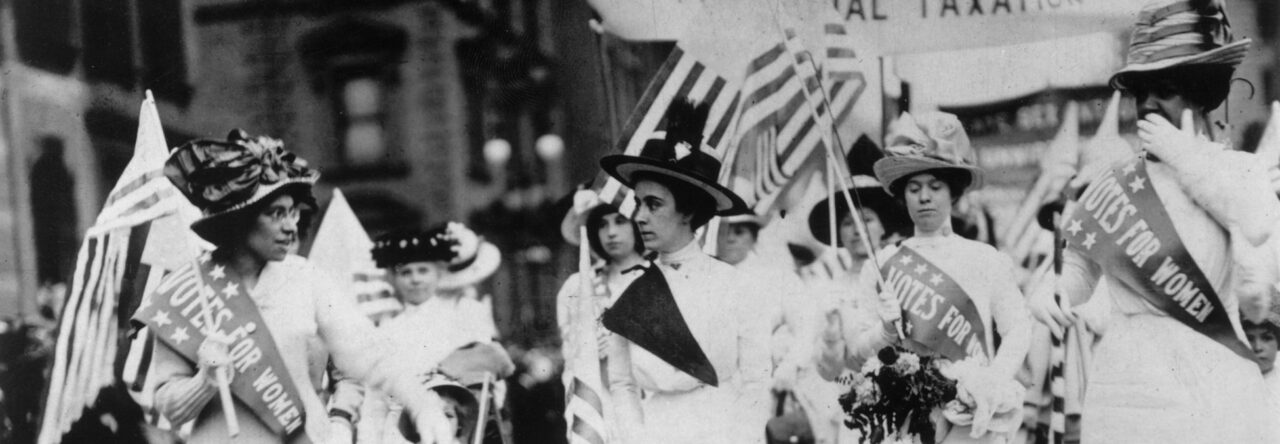
1920 Election Day in Boston and New York City.

Women out in force http://www.loc.gov/pictures/resource/cph.3b23344/, this photo is a public domain image from the Library of Congress. 

“Wherever one went, it was impossible not to notice the predominance of women voters during the forenoon,” the Boston Daily Globe reported on November 3, 1920.  The previous day, the first Presidential election was held since the Nineteenth Amendment to the United States Constitution granted women over the age of 21 the right to vote earlier that year (“Women by Thousands Pour Into Polling Places in the Bay State.” Boston Daily Globe. 3 November, 1920, 20.).

The 1920 Presidential Election, the first since the conclusion of World War One, pitted Ohio Republican Senator Warren G. Harding and his running mate, Massachusetts Governor Calvin Coolidge against Ohio Democratic Governor James M. Cox and former Assistant Secretary of the Navy and future President Franklin D. Roosevelt.  Harding and Cox vied to succeed two term Democratic President Woodrow Wilson (“The Presidential Election of 1920.” United States Library of Congress. http://memory.loc.gov/ammem/nfhtml/nfexpe.html).  According to historians William Binning, Larry Esterly, and Paul Sracic, the election was “a referendum on the Wilson administration,” especially in terms of the outgoing President’s ardent support for the nation’s entry into the new League of Nations, the unpopularity of which led many voters to favor Harding’s calls for a return to normalcy (Binning, William, and Larry Esterly and Paul Sracic. Encyclopedia of American Parties, Campaigns and Elections. Westport, CT: Greenwood Press, 1999, 66).  Unlike his Democratic opponent, Harding took a firm stand on the other major issue of the campaign when he “pledged to enforce” the Eighteenth Amendment to the United States Constitution, which the previous year prohibited alcohol, according to historian David Kyvig (Kyvig, David. Repealing National Prohibition. Chicago: University of Chicago Press, 1979, 29). 

On Election Day, November 2, 1920, many women rushed to exercise their newfound right to vote.  The Boston Daily Globe reported the following day that when the polls opened in the morning in many towns outside the city “women, old and young, married and single, most of them under no compulsion to vote at that daylight hour, had come forward with pride and eagerness to be among the first.”  The Boston Daily Globe also reported that a number of women voters initially failed to grasp the concept of the anonymous secret ballot, as evidenced by a woman asking the warden at a polling place “Do I sign my name on the back of the ballot?” (“Women by Thousands Pour Into Polling Places in the Bay State.” Boston Daily Globe. 3 November, 1920, 20.).   The New York Times reported that “Women showed intense interest in the election.  In many districts, more women than men went to the polling places in the morning.  In the first hour, it was not uncommon to see when on their way either from or to the grocery” (“Thousands Carry Lunches to the Polls.” New York Times. 3 November, 1920, 11). 

This influx of motivated women voters, which was seen throughout the nation, likely contributed to Harding’s landslide victory, the largest since “the Republican landslide of 1904,” in which Theodore Roosevelt won his second term.  (“Cox and League Buried Under Huge Majority.” Chicago Daily Tribune. 3 November, 1920, 1). 

This conclusion is supported by statisticians Malcolm Wiley and Stuart Rice, who studied voting records in the state of Illinois, where male and female ballots “were separately recorded,” in addition to simultaneous local elections where social issues played prominent roles.  Rice and Wiley determined that women voters, “especially in the northern states” trended more Republican than their male counterparts because women tended to be on the “’moral’ and conservative sides in local elections,” and “Harding of the two candidates was widely believed to be the more conservative,” on social issues such as prohibition.  (“Rice, Stuart, and Willey, Malcolm. “A Sex Cleavage in the Presidential Election of 1920.” Journal of the American Statistical Association 19, no. 148, (1924): 519-520.)

The Irish and the 1916 Election

“If the Democrats desire even a sporting chance at the next election their policy must be, “any one but Wilson” These words, spoken by Robert Ford, editor of New York Irish World, an influential periodical, pertained to the purported imminent defeat of Wilson at the hand of Irish Democrats.

The source of Irish dismay was the bloody Dublin “massacre,” in which 16 leaders of the Irish revolt against England were massacred on April 29 1916. The reason for the massacre was a revolt led by Irish dissidents in reaction to the passing of the third Home Rule Bill, which gave British Parliament the right to rule every aspect of Irish life.

The source of disdain for Woodrow Wilson branched from his support of Great Britain during World War 1. Roman Catholic Irish also disliked Wilson for his Mexican policies and alleged mistreatment of Mexican Catholics. Robert Ford Was later quoted, “The election of the next president will, in all probability, depend on our vote. There is not a congressional district in which we are without influence.”

the Irish press followed with a “lesser of two evils” approach to the election and chose to endorse GOP cantidate Charles Evan Hughes, claiming, “He surely cannot be as bad as Wilson, For he is at least a man of honor.” In addition, Wilson had been implored, at the mercy of the Irish community to help save the life of an Irish traitor, but the White House failed to act quickly and he was executed.

In late August, the Irish situation had gotten so bad that it had become apparent that the Democratic party had given up on the Irish entirely. When the climate seemed the darkest for the Democrats, one particular slip-up occured that led to the “unraveling” of the Irish anti-Democrat sentiment. Jeremiah O’Leary, president of the American Truth Society sent a cutting telegram to Wilson, claiming Wilson had been “truckling with the British Empire,” and that he had a “dictatorship over Congress.” Wilson’s response simply read, “Your telegram received. I would feel deeply mortified to have you or anybody like you vote for me. Since you have access to many disloyal Americans and I have not, I will ask you to convey this message for me.”

This correspondence was a blessing in disguise, as many Irish publications proudly published it with intent on harming Wilson. Instead, as Wilson’s closest advisor Edward House explained, “At what time will Charles E. Hughes send such a message to the disloyal Americans who cheer him when he utters his careful platitudes.” By publishing the Leary-Wilson correspondence, the Irish media effectively made voting for Hughes un-American.

As the months dragged on towards the election, Hughes began to lose steam in the race, as lackluster editorial pieces done by the Irish media could not prove him to be a good leader at all, just better than Wilson. On November 7th the popular votes had come in; Wilson, 9,129,606, Hughes, 8,538,221. Wilson had won in a popular vote so close, not another would be seen until the 2004 election. Wilson took the election with 277 electoral votes beating out Hughes 254.

While evidence does show that Hughes carried 6 of the 8 states with the highest concentrations of Irish Americans in the country, it does little to explain states the Wilson had won with large populations of Irishmen. Many cite that anti-Democrat Irishmen failed to account for the third and fourth generation Irish-Americans who were pro-American and defended Wilson.

Regardless of the facts surrounding Irish-American voter turnout (as they were not measured at the time) the 1916 election provides ample evidence of what a minority group, when properly organized, can do to swing an election away from a cantidate running from their own party.

Election of 1948 – Pollsters and the Press

On the night of the election of 1948 presidential candidate Thomas Dewey, and the majority of the American public felt sure that Dewey was the new president of the United States. The candidacy of his competitor, Harry S. Truman, who was running for his second term, was cast aside as a long-shot. Newspapers and radios alike endorsed Dewey’s presidency and discussed his inevitable victory in the days and hours before the final election results were announced. According to many contemporaries, “Harry Truman was the only man who truly believed he could win. And he was right.” News of Truman’s victory shocked a nation of non-believers.

Polls leading up to the election showed that Dewey was far ahead of the competition. With the creation of the Gallup Poll in the 1930’s, an effective way of predicting election outcomes and determining public opinion was created. Politicians and the public  relied on Gallup Polls to get an understanding of where the nation stood on important issues. Prior to the election of 1948 Dewey was quoted as saying, “never argue with the Gallup Poll. It has never been wrong and I very much doubt it ever will be”( Thomas E. Dewey 1937-1947: A Study in Political Leadership, Beyer, pg 73).  The American media was just as quick to put all of its faith in pre-election polls. Washington Post journalist Drew Pearson wrote that “Governor Dewey had conducted one of the most astute and skillful campaigns in recent years” and that Truman “cannot possibly win this election.” Another Washington Post article put enormous faith in polling representative voters and said that the likelihood of these representatives being wrong would be a great surprise to the nation. The most famous example of the unquestioning faith the media put in pollsters was the infamous Chicago Tribune headline that read “Dewey Defeats Truman.” 15o,ooo copies of this inaccurate headline were printed.

Americans were shocked at the inaccuracies of the polls that had predicted Dewey overwhelmingly as the favorite candidate. Actual election results showed quite a different story. Dewey was unable to obtain the majority he needed to defeat Truman in key states like Illinois. There are a majority of factors that can account for the inaccuracy of these poll results. First of all, Dewey under-estimated the importance of the African American vote and failed to campaign strongly towards this demographic. In addition, many historians believe that Dewey got lazy in campaigning because of his unwavering faith in the polls, and others believe that the the prediction of an overwhelming victory for Dewey kept some from seeing the need to go out and vote (Simon Topping).

Since then, polling has undergone changes to increase its accuracy. Despite these efforts, the polls often fail to be an accurate indicator of future results. However, no polling innacuracy has ever been quite as dramatic in the eyes of the American public as that of 1948. On November 4, 1948 Truman drove into St. Louis, Missouri after winning the election holding a copy of the mistaken Chicago Tribune headline claiming his defeat. The picture of this event in one of the most iconic photos in the history of American politics and its legacy lives on today.

War, Women, and the West: Wilson’s 1916 Presidential Victory

Democrat and Incumbent Woodrow Wilson defeated Republican nominee Charles Evans Hughes in 1916 in one of the closest presidential elections in American history. Three main contributors to Wilson’ssuccess were women voters, Western states, and the Democratic stance on pacifism from WorldWar I.                                             Picture

Wilson ran on a platform of preparedness for war, in the event the US was justifiably called to join, domestic prosperity, and peace. Wilson’s campaign was reinforced, most notably in the West, by William Jenngings Bryan, who despite having lost in three presidential elections, retained considerable influence. In fact, it was Bryan who coined the phrase at the Democratic Convention, “He kept us out of the war” a reference to Wilson’s ability to exclude the US from World War I. The phrase caught fire with Democrats at the Convention and became the primary slogan of the Democratic campaign.

The slogan was so effective in driving home a message that Teddy Roosevelt, who was campaigning for Hughes addressed it directly: “President Wilson’s ignoble shirking of responsibility has been misclothed in an utterly misleading phrase, the phrase of a coward, “He Kept Us Out of War.” In actual reality, war has been creeping nearer and nearer. . . and we face it without policy, plan, purpose, or preparation.” The irony of this is that Wilson was not in favor of the slogan in the first place for he agreed with Roosevelt that the possibilities of entering the war were ever increasing. This forward thinking led Wilson to deliver speeches expressing the importance of a “preparedness” for war, in the event the nation had to participate. Nonetheless, he came across as a pacifist. “Politically, Wilson’s Preparedness tour was a great success; but the ovations of the crowds who came out to hear him, particularly those in the Middle West, were in large measure for the President’s emphatic pledge to the United States out of the European war.”

Bryan contributed more than a phrase to Wilson’s cause, “…it is well to note that wherever Bryan campaigned, there the Democracy won. He is the miracle man of this year. He is a new Bryan of complete self-abnegation,” reported The New York Times. Although this statement is not completely accurate, in that Wilson did not win every state in which Bryan campaigned, it captures the essence of Bryan’s contribution to Wilson’s campaign. Bryan ran and lost in three presidential elections yet out of the 19 states in which he campaigned, Wilson won 18. He created the slogan “He kept us out of war” and helped establish the West as a dominant factor in presidential elections.

Another key contributor to Wilson’s victory was the role of women voters. Although the 19th Amendment granting universal women suffrage was not enacted until 1920, women could vote in 12 states by 1916, 11 of which went to Wilson. Women played a pivotal role in Wilson’s winning California, whose 13 electoral votes decided the outcome of the election. Wilson won California by only around 3,000 votes, with San Francisco proving to be the difference maker. “The women and the Progressives did the trick: the women in San Francisco voted for Wilson three to one,” noted the New York Times.

This election saw Bryan finally succeed in his efforts, women vote in a decisive manner in a Presidential election, and the West demonstrate it can make an impact. This election truly was a proving ground for many.

Election 1912: A Physically Divisive Contest

In The Washington Post on November 6th, 1912, the day after the election, it was reported that “A score and more of men and boys were arrested in the downtown section last night. Most of them were charged merely with disorderly conduct. Eleven peanut vendors were arrested for blocking traffic with their push carts.”

In several instances across the city, police responded to disorderly conduct that ranged from disruptive to violent with several instances of voters going to the hospital after suffering physical assaults. Eliza Thomas was suffered a blow to the head with a pipe and dispute between two young men resulted in a fistfight. This behavior was not isolated occurrence, in Kentucky, two men were killed in arguments while at the polls, as reports The Atlanta Constitution. In Lee County, the town constable was shot and killed by two brothers, who were arrested, and in Anderson County, the county magistrate shot a voter and was charged with his death.

Election day was not the only point during the season where surprisingly distressing events took place, it was merely the culmination of a rowdy period of campaigning. Only a few weeks before in Milwaukee, WI, on October 14th, there had been an assassination attempt on Theodore Roosevelt during an address. Despite being wounded, Roosevelt still gave his speech, willfully remarking “it takes more than that to kill a Bull Moose”.

Of any contest of the era, the 1912 elections were perhaps the most contentious. The Boston Daily Globe stated that “few campaigns have run through a longer period of heated controversy.”  In a three way race, Democrat Woodrow Wilson emerged triumphant after Theodore Roosevelt and William Howard Taft split the Republican vote (Chace pg 3). Wilson won overwhelmingly in the electoral college, with 435 electors, but won the popular vote with only 41%. Though formerly a Republican, Roosevelt was running under the banner of the Progressive Party, and received the most votes of a third party candidate in any presidential election, with 27%.  Taft won Utah and Vermont, and 23% of the popular vote, but as historian James Chace put it, he then gratefully headed back to New Haven to teach law at Yale, happy that he had not been elected for another term.

The participation rate of the electorate was expected to be very high, and this contributed partially to to amount of disruption. Though 1912 was several years before the passage of the nineteenth amendment, quite a few western states had granted women the right to vote, and in those states their influence on the results was expected to be important. In contrast to the events which took place elsewhere in the country, women were reported to be responsible, and well behaved voters. As The New York Times described the scene in Boise, Idaho, “the majority walked to the polls, cast their ballots intelligently, quietly and extremely businesslike. All were optimistic and chatted pleasantly with their friends and argued very little, seeming content to wait patiently for the returns.” What a great difference this was to Washington D.C. and Kentucky.

Page 6 of 8

Powered by WordPress & Theme by Anders Norén