When Does Adaptation Become Tradition?
“Food has a culture. It has history. It has stories, it has relationships, that tie us to our food.”
— Winona LaDuke (2012)
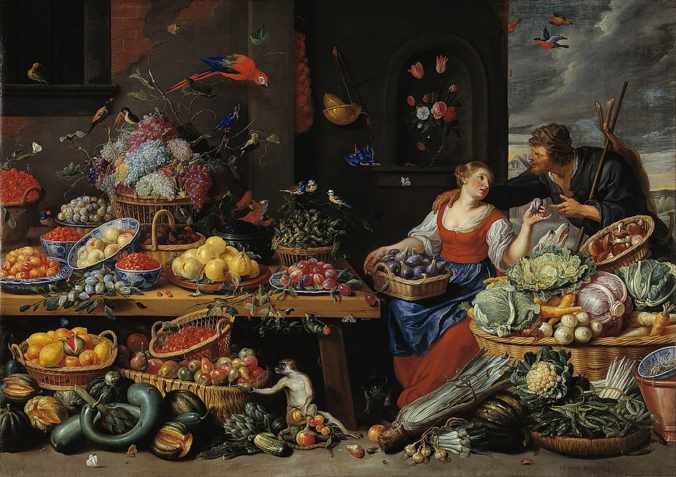
Fruit and Vegetable Market With a Young Fruit Seller
Figure 1
Note. Figure 1 depicts Jan van Kessel the Elder’s Fruit and Vegetable Market With a Young Fruit Seller (1650–1660), presenting food within a social and cultural setting. From Fruit and Vegetable Market With a Young Fruit Seller [Painting], by J. van Kessel the Elder, 1650–1660, Statens Museum for Kunst. CC0.
Food and Identity
Food encompasses the human experience unlike anything else. Massimo Montanari (2006) compares food to language because both communicate culture, tradition, and collective identity. Yet food, much like language, is not simply inherited and kept unchanged. It moves with people, encounters new cultures, and changes with the circumstances available to those who make it. LaDuke’s point that food carries stories and relationships is what makes the question of change feel so personal (see Figure 1).
This complicates what we mean when we call food “authentic.” We often imagine authenticity as a connection to an original version of a dish. Yet what we inherit as tradition may itself have once been adaptation. What feels traditional to one generation may simply be an adaptation that an earlier generation chose to accept and carry forward. If yesterday’s adaptation can become today’s tradition, then when does that transformation happen?
This becomes especially important when thinking about foodways, the practices and traditions surrounding how people produce, prepare, and consume food. Montanari (2006) challenges the idea that cultural identity must come from a pure beginning, focusing instead on how traditions spread and develop (pp. 134–135).
Centers of Origin and Primary Regions of Diversity for 151 Crops
Figure 2
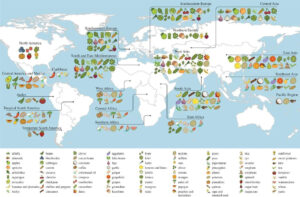
Note. Figure 2 depicts the centers of origin and primary regions of diversity for 151 food crops, demonstrating the geographic origins of crops now consumed around the world. From “A Map of Where Your Food Originated May Surprise You,” by J. Cherfas, 2016, NPR. Map credited to The Royal Society.
When the Foreign Becomes Familiar
Pasta demonstrates how complicated this boundary can become. Pasta now seems inseparable from Italian cuisine, yet its history is not confined to Italy. Montanari (2006) explains that Arabs introduced dried pasta to Sicily, while Hebrews were also spreading it throughout Europe. As he writes, tradition can develop “very far from its places of origin” (p. 135). This does not make pasta’s place within Italian cuisine less authentic. Origin serves as a record of where something began, but tradition tells us what people chose to do with it.
At the same time, adaptation cannot mean that preservation no longer matters. Colin (2017) describes su filindeu, or “threads of God,” a rare Sardinian pasta passed down through generations and traditionally prepared for an annual pilgrimage. With only a few people possessing the skill to make it, su filindeu presents the opposite problem. Food survives because people not only adapt but also remember. The two pull against each other, since changing a dish risks losing what made it distinct, and freezing it risks losing the dish altogether. Tradition seems to live in managing that tension.
A World Already Mixed
The Columbian Exchange makes the scale of adaptation even clearer. Tomatoes traveled from the Americas before becoming central to Italian cuisine, while chili peppers became embedded in cuisines such as those of India and Korea (Nunn & Qian, 2010). Cherfas (2016) reports that foreign-origin crops account for 69% of national food supplies globally. If nearly 70% of what a country eats came from somewhere else (see Figure 2), then authenticity cannot mean original, because very little food is original to the place that claims it.
When Adaptation Becomes Personal
I am firmly pro-adaptation, and I think this matters for our generation because we encounter other cultures through food. Many of us are living away from home for the first time, and food is often the easiest way we meet someone else’s culture. That also makes us the ones deciding what gets kept, what gets borrowed, and who gets credited. That is something worth celebrating, but it also comes with a responsibility. Adaptation should not mean forgetting where something came from or removing the culture that gave it meaning.
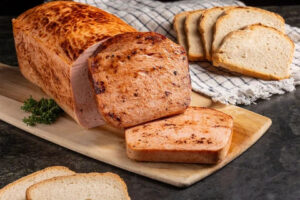
A friend of mine, who is half Nepali and half German, made this idea real for me. At their house, pretzels are served with Nepali chicken stew, while German dishes like Leberkäse (Figure 3) are eaten with achaar (Figure 4). The first time I encountered these combinations, they seemed strange, yet eating them changed that completely. Neither culture felt erased or diluted. Both remained recognizable while creating something that belonged naturally to the family eating it.
Leberkäse
Figure 3
Note. Figure 3 depicts Leberkäse, a Bavarian specialty used to represent the German side of the German-Nepali food pairing. From Leberkäse, by GermanDeli.com, n.d.
Momo Achar
Figure 4
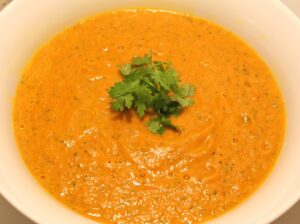
Note. Figure 4 depicts momo achar, a dipping sauce used to represent the Nepali side of the German-Nepali food pairing. From “Easy MOMO Achar (Requested Recipe)!!,” by nepalitummy, 2013
If that combination is eaten repeatedly, remembered, and eventually passed down, at what point does it stop being “fusion” and simply become family tradition?
For me, adaptation becomes tradition when people give something meaning, make it part of their lives, and choose to carry it forward. Authenticity should not require food to remain frozen in time. Something unfamiliar enters a kitchen. Someone decides it belongs there. Another person grows up with it. Eventually, what once looked like adaptation simply turns into tradition.
With all of this in mind, I leave you with two questions to ponder:
- Where do you see different cultures coming together in your own life, especially through food, and has that fusion changed the way you think about what makes a tradition “authentic”?
- If adaptation and cultural exchange have shaped human history for centuries, how important is our ability to adapt in keeping cuisines and traditions alive rather than simply preserving them unchanged?
References
Cherfas, J. (2016, June 13). A map of where your food originated may surprise you. NPR.
https://www.npr.org/sections/thesalt/2016/06/13/481586649/a-map-of-where-your-food-originated-may-surprise-you
Colin, C. (2017, September 22). On the hunt for the world’s rarest pasta. Saveur.
https://www.saveur.com/worlds-rarest-pasta-sardinia/
GermanDeli.com. (n.d.). Leberkäse.
https://germandeli.com/products/leberkase
LaDuke, W. (2012, March 4). Seeds of our ancestors, seeds of life [Video]. TEDx Talks. YouTube.
https://www.youtube.com/watch?v=pHNlel72eQc
Montanari, M. (2006). Food is culture (A. Sonnenfeld, Trans.). Columbia University Press.
nepalitummy. (2013, August 18). Easy MOMO achar (requested recipe)!! Nepali Tummy!!.
https://nepalitummy.blogspot.com/2013/08/easy-momo-achar-requested-recipe.html
Nunn, N., & Qian, N. (2010). The Columbian exchange: A history of disease, food, and ideas. Journal of Economic Perspectives, 24(2), 163–188.
https://doi.org/10.1257/jep.24.2.163
van Kessel, J., the Elder. (1650–1660). Fruit and vegetable market with a young fruit seller [Painting]. Statens Museum for Kunst.
https://collection.smk.dk/#/en/detail/KMSsp299
You make so many great points in your post, Shiv, but I especially like the section where you talked about your experience with your German and Nepali friend’s unique family traditions. I totally agree with your point about adaptation becoming tradition as people imbue new foodways with meaning. I think we should think of adaptation as creating more foods to enjoy, instead of reducing the number of traditions we can uphold. Why can’t both the old and new traditions coexist? At the same time, I do think preserving some old ways of doing things, such as the su filendeu you discuss, or the churro sheep we discussed in class, is still important. Even as we mix and match ingredients and ways of doing things, there is still value in the artistry of our ancestors, especially when those ancestors have been historically not allowed to practice their traditional foodways, like the Diné who herded the churro sheep. To answer your questions, my German roots collide with my family’s new vegetarian foodways every New Year’s when we substitute pork for vegan sausage and sauerkraut. It feels authentic to me, because the spirit of the thing is still there. I think this sort of adaptation is essential to keeping traditions alive – what if a certain crop struggles to grow outside its country of origin? Should people who leave that country give up on cooking recipes that involve it, or should they find a similar crop and make a new foodway? I think the latter.