History 211: History of US Elections

Dickinson College, Spring 2024

1912 Election: An Elephant divided by a Bull Moose equals a Donkey

“From the moment that the very first returns were received there was never a minute of doubt that Gov. Wilson had made a clean sweep of the country […] From that time on the only interest manifested was as to whether Col. Roosevelt or President Taft would run second.” – New York Times

For Taft supporters, the election results had only demonstrated one thing: Theodore Roosevelt’s selfish crusade had handed Wilson the presidency with only 42% of the popular vote. As Chairman of the Republican National Committee, Charles D. Hilles argued, “the responsibility for [Wilson’s victory] must rest squarely and solely upon Mr. Roosevelt. But for Mr. Roosevelt’s action in deserting the Republican Party Mr. Taft would have been elected.” Hilles also promised that “the Republican Party will pursue and maintain its policies with undiminished confidence,” while the publisher of the Baltimore American and Baltimore Star, Gen. Felix Agnus assured Republicans that Taft had only finished in third because:

“the fear of Roosevelt was so great that we could not control our Republican vote.  While many remained loyal, the great majority, fearing that Roosevelt and radicalism would prevail, voted for Wilson en masse: and while it is a blow and defeat to the Republicans, they preferred the less of two evils, thereby saving the Republican Party, which they feared Roosevelt would overturn.”

At the same time, the Progressives claimed to see victory in defeat. It was the first time in the history of the United States that a third party candidate would finish second in a national election. Thus Chairman Francis W. Bird of the New York County Committee declared, “within three months we have founded a party and have decisively defeated the Republicans in this country.” The Chairman of the National Bull Moose Party, Senator Joseph M. Dixon further suggested, “the result of today’s balloting makes the Progressive Party the dominant opponent of the Democratic Party. Today the old Republican Party becomes ‘the third party’ in American politics.”

John Callan O’Laughlin of the Chicago Daily Tribune concluded, “it was a day of victory for the Democrats, a day of satisfaction for the Progressives, a day of gloom for the Republicans.” According to historian James Chace, “had the charismatic Roosevelt received the Republican nomination, he almost surely would have won [the general election]” (Chace, 6). However, once Roosevelt lost the nomination and decided to run as a third party candidate against his own former party, a divide in the Republican base was created that was simply too large for either Taft or Roosevelt to overcome. As Paul Rorvig writes, the 1912 election proved that “an Elephant divided by a Bull Moose equals a Donkey.” (“Clash of the Giants”, 46)

1928 Election: Women for Hoover

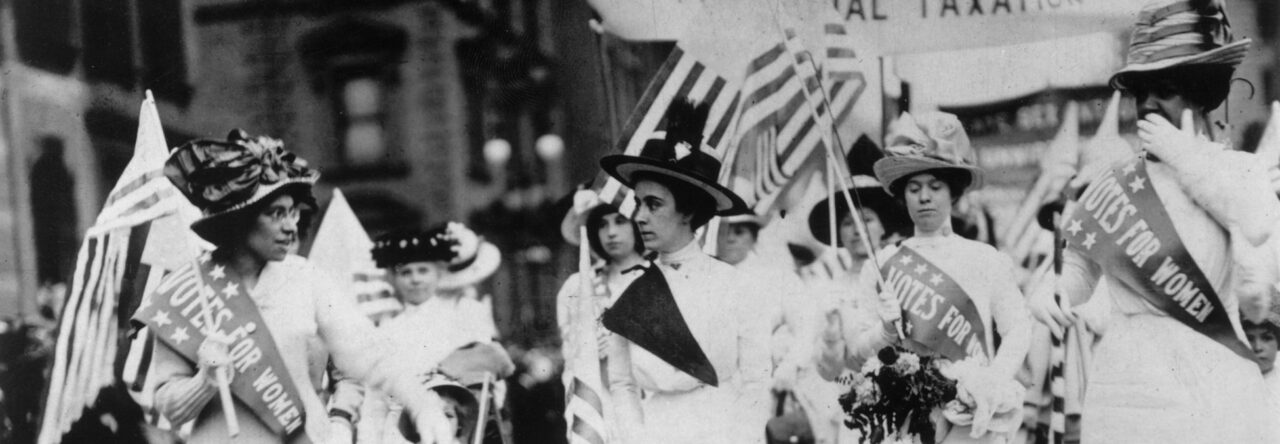
Prior to the presidential election of 1928, Senator William Borah of Idaho said he expected “the largest women’s vote, by far, yet recorded.” This prediction was reinforced by New York Times’ reports that in New York City there were 250,000 more women registered than in 1924, while the Chicago Daily Tribune reported female registration in Chicago had increased by more than 188,000 since the last election.

Sarah Schuyler Butler, Vice Chairman of the State Committee suggested, “the tremendous increase in the number of women who have registered proves beyond a doubt the keen interest of women in the the campaign […] We feel confident that this will mean a substantial increase in the strength of the Republican Party.” For many women the election represented not just a choice between Herbert Hoover and Governor Al Smith as candidates, but also a referendum on the issue of prohibition. Thus Dr. F. Scott McBride of the Anti-Saloon League predicted, “thousands of women who have never voted before, aroused by Smith’s wet threats, will go to the polls next Tuesday to vote against liquor by voting for Hoover.” Furthermore, a number of female voters believed that a Smith presidency would restrict the advancement of women’s rights, as National Woman’s Party Chairman, Mrs. Clarence M. Smith argued, “it is scarcely conceivable that any woman who believes in equal opportunities for women could give her support to Governor Smith, who, as he declared in his Newark speech, is unalterably opposed to industrial equality.”

Not all women supported Hoover. As Ms. Ben Hooper of Oshkosh, Wisconsin declared, “women are disgusted with the record of the last eight years […] I do not see how any progressively minded person can vote for Mr. Hoover.” Additionally, some Democratic leaders believed that endorsements by high-profile women, such as Mrs. Woodrow Wilson and Mrs. Francis B. Sayre, would be enough to hold in line the Democratic women.

As Republicans had predicted, however, early reports suggested that on November 6th an unprecedented number of women had turned out to vote and feminist scholar Jo Freeman confirmed that, according to straw polls, the female vote had overwhelmingly favored Herbert Hoover. In Huntington, Long Island most of the 23 districts reported nearly two-thirds of those who had voted were women and that many of these women had voted for Hoover. Across the country stories of first-time, elderly women voting for Herbert Hoover also emerged, including in Brooklyn, where the New York Times detailed the story of a 98-year woman, Rachael Fayette, who had cast her first ballot ever for Hoover as an example “which all of her associates followed.”

Hoover won in a landslide, carrying 40 states and receiving nearly 60% of the national vote. Upon hearing of Hoover’s victory, Vice Chairman of the Republican National Committee, Mrs. Alvin T. Hert proclaimed, “the result of yesterday’s election may in large measure – larger than ever before – be attributed to the untiring activity of women voters […] They have every reason to be proud of their part in the unprecedented victory.”

The 1924 Election: the Story of Politics and Radio

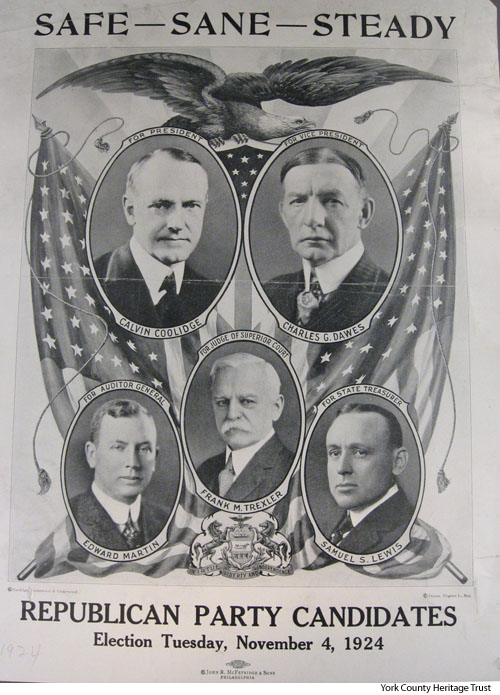
In 1924, with the Republicans riding a wave of prosperity, it looked like incumbent President Coolidge would be serving another term. But what seemed like a simple election would be punctuated by two very important developments in modern American politics. The election will be remembered for the final schism in the Democratic party in the 20th century, as well as the first election in which the American people heard their candidates speak for the first time; from their living rooms.

The Democrats approached campaign strategy with plans to, as author Donald McCoy put it, “lambaste the Republicans for wickedness and corruption in the office and in general.” (Calvin Coolidge the Quiet President 248) Lambaste they did, and with the advent of politics over the radio, their harsh words for the Republican party could be heard in most major cities daily during the convention and the campaign.

Holding back the Democrats, was the schism created over several issues during the convention. Amongst these were the endorsements of the League of Nations, repeal of Prohibition, and oil-tainted Democrats. The largest of the issues was the racist Ku Klux Klan, which had literally split the party in two. (Calvin Coolidge the Quiet President 248) William McAdoo, the best candidate, was ruined by his stance on oil, Alfred Smith by prohibition, and Oscar Underwood by his criticism of the Klan. Eventually, the Democrats chose the little-known John W. Davis (a conservative) for his dry stance on Prohibition and indifference to the Klan.

The Republicans stood by incumbent Calvin Coolidge. 1923 was a good year for America, with previous years just as good. Coolidge and his campaign manager decided that the race would be run on “prosperity, economy, and respectability… Prosperity, however distributed, was the leading issue among Democrats and Progressives as well as Republicans, and virtue was a close second. Coolidge had already made himself appear the procurator of prosperity and the symbol of virtue, and he had accomplished that almost by doing nothing at all.” (Calvin Coolidge the Quiet President 253)

Interestingly enough, a third-party independent, William La Follette, was given a voice by this radio revolution. Today, independents have a voice because of the availability of modern media at a relatively cheap price. In 1924, it could cost up to $5000 dollars to carry a speech over six radio stations. These charges had to be paid, and naturally the parties endorsing their candidates picked up the bill. This was the first time that campaign contributions would be set aside for media time, a practice that dominates the allocation of political funds today.

 Coolidge’s final speech was carried over the waves from 26 radio stations, Davis’ just 7. In Coolidge’s non-partisan, final speech, he simply urged citizens to vote, and concluded with, “To my father, who is listening in my old home in Vermont, and to my other invisible audience, I say ‘good night.’” Coolidge won in a landslide over Davis and La Follette in what the New York Times reported as the first national election in years to be decided so quickly. Coolidge captured 54% of the popular vote and 382 electoral college votes with Davis and La Follette carrying 28% and 136 and 16% and 13, respectively.

While the 1924 election marked a victory for the Republicans and a party-changing defeat for the Democrats, it also represented a major change in the way that the media and politics affected each other.  These effects can be seen over the last  century, where politics and media have created a symbiotic relationship, from Coolidge to CSPAN.

1932 Election Day Voter Fraud

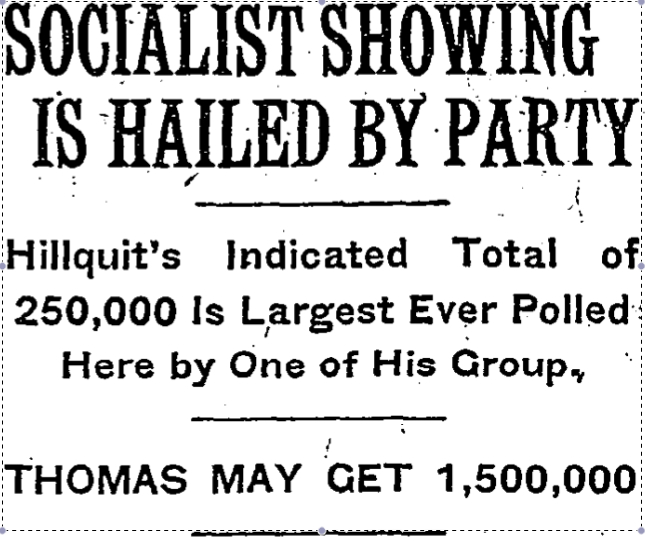
New York Times headline, November 9, 1932

On election eve in 1932, over the Columbia Broadcasting System, Socialist presidential candidate Norman Thomas made his final appeal to a crowd of eleven thousand socialists supporters on November 7, arguing that “neither of the old parties has any program for bringing us out of our misery and fear.” Scholars contest that Thomas’s campaign for massive federal aid for the unemployed and a drastic reorganization for the ailing economy was “more of a protest movement than an electoral race.” Thomas needed to convert the immense feeling of unease regarding American capitalism into votes for an alternative political party. Ultimately, it would come down to the quantity and aptitude of the Socialist vote, which Thomas believed had the power to alter to future of American politics. So the night before the election, Thomas promised his audience that “every vote will count.” 

However, Thomas was wrong—every vote did not count. Thomas failed to foresee that hundreds of thousands of votes went uncounted on Election Day. In districts lacking voting machines, election officials often disregarded votes for third-party candidates. It was evident that a lack of Socialist Party poll-watchers directly resulted in untallied votes for Socialist candidates. A socialist poll-watcher in a south-side Chicago polling site observed the familiar occurrence when Democrats and Republicans chose not to count Socialist votes. When challenged, one poll-watcher said, “When you Socialists have no poll-watchers, we do the same to you. But since you’re here, we’ll split up the Communist vote among the three of us.”   

With early precincts in, a New York Times story was headlined: “Thomas may get 1,500,000.” In hindsight, Thomas only received 900,000 votes. Had every vote been accounted for, estimates suggest Thomas could have reached 2,000,000—which was Thomas’s original campaign goal. With early returns on Election Day, Thomas said that 1,000,000 votes will be “moderately encouraged,” over 1,500,000 votes Socialists will be “decidingly encouraged,”  but every vote over 2,000,000 will be “tremendous jubilation.” With the total votes cast for presidential candidates at nearly 40 million, Thomas deemed his hopes modest. Yet, he was realistic regarding his chances of winning the 1932 election, and though disappointed, he did not show it. “The fine young intellectual element which composes the nucleus of Socialism today and which will be indicated by the vote cast for me today,” Thomas said in his so-called victory statement on Election Day, “is the most hopeful factor in America.”  Thomas ran for President as the Socialists Party’s candidate in every election between 1928 and 1948.  He devoted his career to matching the impact he had in the 1932 election, yet was never nearly as successful. After Thomas’s presidential attempts, American Socialism began to slowly collapse. As a result, Thomas is remembered for being a tireless symbol of the American Left, advocating for unpopular causes such as civil rights, but also for presiding over the end of Socialism in America.  

1867/1871: William “Boss” Tweed’s elections to the NY State Senate

William M. Tweed in 1865

“Immigrants were quickly naturalized by Tammany judges- on one occasion, under the eyes of horrified Republican observers in 1867, at a rate of 3 per minute.” -Excerpt from Dennis Hale’s introduction to “The Story A Grim Generation: Boss Tweed” by Denis Tilden Lynch

From 1854-1872, William “Boss” Tweed was the leader of the New York Democratic political machine known as Tammany Hall. In the course of his long and colorful career, Boss Tweed used his control of the largely immigrant electorate to get himself elected to the New York State Senate in 1967 and subsequently re-elected, as well as steal millions of dollars from state coffers.

Despite being the leader of a Democratic party machine, Boss Tweed was nominated for the New York State Senate as the candidate for the Republican party. The choice was unenthusiastically greeted by the major papers of the time, starting with the Tribune and followed by the New York Times. It was, in their words a nomination “not fit to be made.” Even so, with his control of the party machine his election was all but assured. The election would even go relatively unchallenged, as the power of Tammany Hall suppressed any real investigation into this widespread fraud.

The election of Boss Tweed to the NY State Senate in 1871 functioned much the same way as that of 1867, in terms of the tactics used by Tammany Hall. The main difference was the publication of Tweed’s crimes defrauding the public by the New York Times led to investigations of election fraud. The results from these investigations, and the elections themselves, clearly bore out these accusations. Not only was an incredibly large number of votes cast compared to the average election (see bottom of middle column), but the breakdown of votes in relation to the candidates that were on the ballot are shocking. In the Ninth District alone, all but 10 votes out of nearly 500 were cast for Mr. Tweed (see top of column three) and in the 8th District, which only say 126 cast, not a single vote was cast for another candidate. There was also a very famous cartoon series in Harper’s Weekly by Thomas Nash known to have greatly irritated the party boss, who griped “Stop them damn pictures. I don’t care what the papers write about me. My constituents can’t read. But, damnit, they can see the pictures.”

There was also a great deal of focus on the way in which the ballot boxes themselves were controlled through the placement of key election officials. This allowed Tweed supporters to monitor and organize the vote directly from voting booths. The positioning of these officials also led to one of the more famous, and telling, quotes attributed to Tweed: “As long as I get to count the votes, what are you going to do about it?” Indeed until a reform movement swept through New York in the early and mid-1870s, putting Tweed behind bars, there was little that anyone could.

1860 Election Day in Springfield, Illinois

This entry was originally posted by Don Sailer at Blog Divided.

“The Cannon Salvo that thundered over Springfield, Illinois, to greet the sunrise on November 6, 1860, signaled not the start of a battle, but the end of one…Election Day was finally dawning.” – Historian Harold Holzer

Abraham Lincoln, however, was not one to rush and vote right after the polling places opened in the morning. He apparently waited until 3pm when, as the New York Tribune explained, “the multitude…[had] diminished sufficiently to allow tolerably free passage.” The Tribune’s correspondent described what happened once the crowd realized that Lincoln had arrived:

“at that moment he was suddenly saluted with the wildest outbursts of enthusiasm every yielded by a popular assemblage. All party feelings seemed to be forgotten and even the distributors of opposition tickets joined in the overwhelming demonstrations of greeting…there was only one sentiment expressed – that of the heartiest and most undivided delight at his appearance. Mr. Lincoln advanced as rapidly as possible to the voting table and handed in his ticket, upon which, it is hardly necessary to say, all the names were sound republicans. The only alteration he made was the cutting off of his own name from the top where it had been printed.”

As Holzer explains, “Lincoln modestly cut his own name..from his ticket” and “vot[ed] only for his party’s candidates for state and local office.” Later that evening Lincoln went to the local telegraph office, where he waited for reports on election returns from across the country. “All safe in this state,” as Thurlow Weed explained from Albany, New York. Simon Cameron sent word from Philadelphia, Pennsylvanian, while a report from Alton, Illinois, noted that “[Republicans] have checkmated [Democrats’] scheme of fraud.” “Those who saw [Lincoln] at the time,” as the New York Times observed, “say it would have been impossible for a bystander to tell that that tall, lean, wiry, good-natured, easy-going gentleman…was the choice of the people to fill the most important office in the nation.”

Page 8 of 8

Powered by WordPress & Theme by Anders Norén