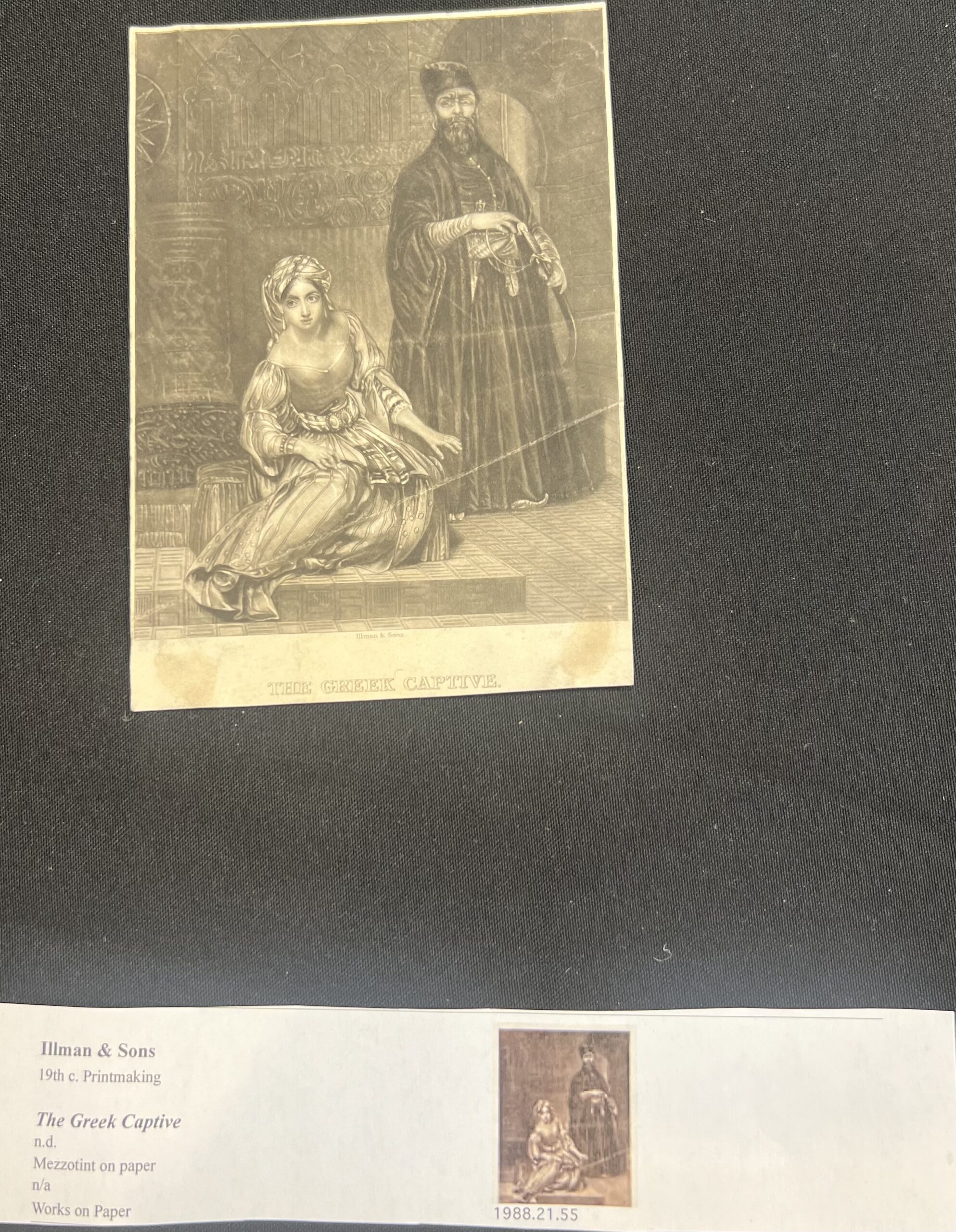
In Being and Nothingness, Jean-Paul Sartre insists upon the power of the gaze. According to his existential philosophy, humans understand their relationship to others and the world around them primarily through the sense of sight. Often, this results in a battle for power. When one gazes upon “the Other,” the Other becomes “an object” in the eyes of the gazer (343). This puts the gazer in a position of authority, as they can reduce the Other’s existence to pure conjecture. Perhaps the Other’s “voice” is nothing more than “a song on a phonograph;” perhaps a “passerby” is nothing more than “a perfected robot” (340). However, there always remains a “permanent possibility of being seen by the Other” (344). This forces the gazer to look inward, recognizing themself as “a being-as-object for the Other” just as the Other is a being-as-object for the gazer (344). In other words, the gazer finds that they are nothing more than “an object for the Other,” something to be ogled at and judged (349). Suddenly, the gazer finds the world “alien,” “for the Other’s look embraces [their] being and correlatively the walls, the door, the keyhole” (350). Nothing is certain any longer. Is the gazer less real for being gazed upon, or must the Other be acknowledged as a cognitive being? A power struggle arises from a mere sideways glance.
In art, the gaze is often subverted, challenged, or confused. Famously, Michel Foucault questions the nature of art that gazes back at the viewer. In the painting Las Meninas, for instance, an artist wields a palette and brush while staring directly forward. When standing in front of the painting, it seems as if the artist gazes directly upon the viewer. In Foucault’s opinion, “the observer and the observed take part in a ceaseless exchange. No gaze is stable, or rather, in the neutral furrow of the gaze piercing at a right angle through the canvas, subject and object, the spectator and the model, reverse their roles to infinity” (444). To put it more simply, the painting raises the question of whether the viewer is “[s]een or seeing” (444). If one applies Sartre’s philosophy, the painting also raises a question of power. Can a piece of artwork exert authority over its beholder? Whose world is more real—the painting’s or the gazer’s? Who gets the last laugh, and who gets the last look?
In his poem “At Rest,” Eugene Lee-Hamilton invites such questions by inviting the gaze. In the opening lines, the bed-ridden poet makes a dying request: “Make me in marble after I am dead; / Stretched out recumbent, just as I have lain” (lines 1-2). The statement seems audacious, even defiant. In “marble,” Lee-Hamilton could be sculpted in any position. He could loom as large as Michaelangelo’s David or lounge as comfortably as Donatello’s Saint John the Evangelist. He could finally escape his “daily rack,” or torture device (line 12). Instead, he chooses to remain “recumbent,” just as he has stayed for the better half of his life. Evidently, Lee-Hamilton’s disability constitutes an essential aspect of his identity. It is more important to him that this fact remains than any other. Yes, he wants his epitaph to acknowledge his creative capacities, too, but only if it first acknowledges that “his misery” compelled him “to create” (line 11). No matter what, his disability must come first.
As a disabled man in an era of rigid masculinity, Lee-Hamilton likely encountered the gaze repeatedly throughout his life. Confined to a bed, he would have stood out as a weak, feminine, asexual object. The Victorian man was expected to dominate the Victorian woman intellectually, socially, and sexually. Lee-Hamilton, on the other hand, would not have been expected to do any of these things. First, his disability would have rendered him an object that could quite literally be picked up, moved, and put out of sight. Then, the gaze would reduce him to an object once again, relegating him to a shadow existence in which his “consciousness” itself was called into question (Sartre 340). All his power, both physical and mental, would be usurped by the able-bodied caretaker or gazer.
By becoming artwork, though, Lee-Hamilton can reassert his masculine agency. He invites “those who care” to “see [him] once again / Such as they knew [him] on [his] hard wheeled bed” (lines 3-4). In welcoming the gaze, Lee-Hamilton takes control of it. Implicitly, he suggests that if he must be beheld, he should be regarded as artwork. No longer will he be considered inferior; he will ascend above the able-bodied beholder into the lofty realm of art. Moreover, in becoming a statue, Lee-Hamilton can finally gaze back. As Foucault argues, artwork can upset power dynamics established by the gaze. Instead of one party exerting authority over the other, art fosters a state of “pure reciprocity” (444). It levels the playing field. It forces the gazer to gaze inward, reminding them that they, too, are an object. It activates the superego. It forces a temporary empathy, a brief coexistence. With his “motionless and marble head,” Lee-Hamilton casts a stony glance upon his beholder (line 5). He demands not only to be seen but to be recognized as an equal.
“Look me in the eyes,” he says. “I am here.”
Works Cited
Foucault, Michel. “The Order of Things (Preface, Las Meninas).” Art and Its Significance: An Anthology of Aesthetic Theory, Third Edition, edited by Stephen David Ross, State University of New York Press, 1994, pp. 440–54. JSTOR, doi.org/10.2307/jj.18254729.53. Accessed 25 Mar. 2025.
Lee-Hamilton, Eugene. “At Rest.” Sonnets of the Wingless Hours, Mosher Press, 1908, p. 23.
Sartre, Jean-Paul. Being and Nothingness: A Phenomenological Essay on Ontology. Translated by Hazel Barnes, Washington Square Press, 1992.