For me, some of the most interesting stories involving the FBI in this period come from their attempts at disinformation or counter-intelligence. One example of this is the infamous story of William Albertson. William Albertson joined the Communist Party while he was still at the University of Pittsburgh in 1929. He was a dedicated member of the party both in Pennsylvania and later in New York City where he moved after being expelled from college for organizing rallies. Over the years he worked his way up to being one of the highest raking members of the party and serving as the secretary of the Communist Party for the state of New York. That is, until July of 1964.
In the early days of that July William Albertson had agreed to loan his car to a friend and fellow communist. The FBI saw this as an incredible opportunity to employ a tactic called the “Snitch Jacket.”[1]This tactic involved planting false documents on a person or a person’s possessions that would make it appear as if they had been funneling information
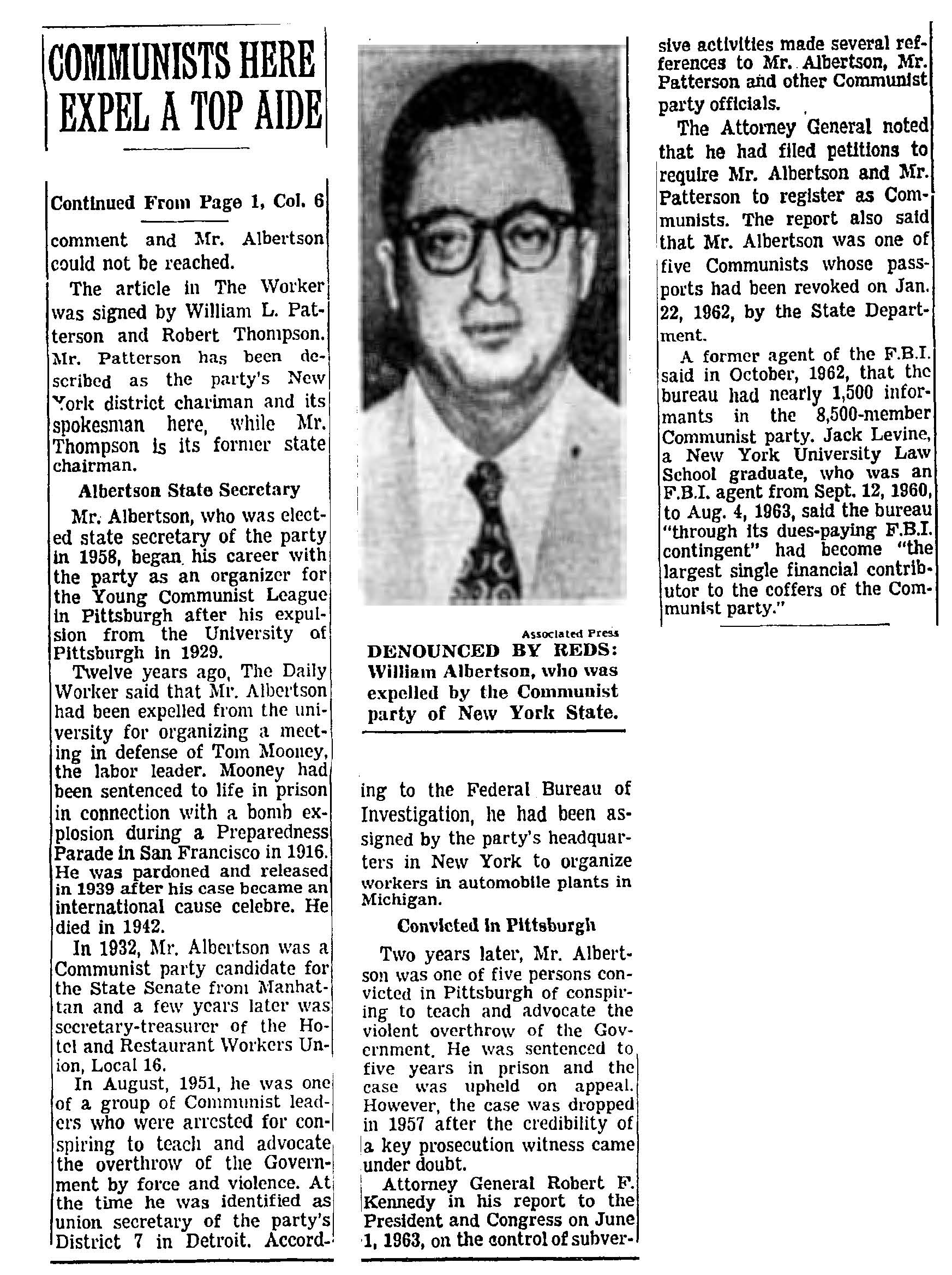
July 8, 1964: The New York Times reports that 54-year-old William Albertson is expelled by the Communist Party for being a suspected government informant.
to the authorities. Needless to say, the documents were found and Albertson was ousted from the Communist Party and exiled from the community he had been linked to for almost 40 years. The New York Times reported that, “The date of the expulsion was not given nor was the police agency that Mr. Albertson allegedly served identified. Party officials declined to make any comment and Mr. Albertson could not be reached.”[2] Albertson died sometime later in a car accident. He had never stopped trying to assert his innocence to the party but his attempts were futile.
It would not be until over a decade later that the world would know the truth about the Albertson case. The circumstances surrounding the discovery were recorded in a New York Times article from 1976. It says, “The truth came out by ironic mischance. Last year a journalist asked the F.B.I. for documents about its past efforts to disrupt white hate groups such as the Ku Klux Klan. When the papers were released, one was on another subject. It was a report to bureau officials dated Jan. 6, 1965, that said a high functionary of the Communist Party had been expelled “through our counter-intelligence efforts.”[3]
Many more contemporary writers and historians have looked at the interesting case of William Albertson as a sort of litmus paper for how effective the FBI had become at intimidating the party by reputation alone. David Garrow writes, “Widespread suspicion of informant penetration provided fertile ground for accusations of betrayal whenever movement tensions led to angry, personal recriminations. The CP’s knee-jerk acceptance of William Albertson’s snitch-jacketing is the worst but by no means the only example of how ready thousands of activists within a wide-ranging assortment of FBI target groups—the CP, the Black Panthers, SCLC, and the Ku Klux Klan—were to uncover real or imagined informants within their ranks.”[4] The Albertson case is a great demonstration of how effective the FBI had become in infiltrating not only the organizations of leftists, but also their imaginations. You can read more about this in my post on this topic.
[1] Curt Gentry, J. Edgar Hoover: The Man and the Secrets. New York: W.W. Norton and Company, 2001. Pp. 444.
[2] Murray Illson, “High-Ranking Communist Here Ousted by Party as ‘Police Agent,’” New York Times. July 8, 1964.
[3] Anthony Lewis, “A Cointel Story.” New York Times. May 29, 1976.
[4] David Garrow, “FBI Political Harassment and FBI Historiography: Analyzing Informants and Measuring the Effects.” The Public Historian. Vol. 10, No. 4. (Autumn, 1988.)