Sex and the City 3?

Remember Sex and the City? Remember the excruciatingly long first follow-up film during which very little happens apart from watching Carrie spiral dramatically into several different phases of self-pity thanks to Big ditching her at the alter (I’m so surprised, said no SATC fan ever). No one has forgotten the casually racist sequel, where the foursome randomly travels to Abu Dhabi. Thankfully the franchise ended there. Sort of.

Unknown

I was embarrassingly late to the Sex and the City scene. SATC had its run much before I was old enough to watch it, but that didn’t stop my friends in high school from catching reruns on E! years later. They were all about it: who in our friend group was Carrie? Who was Charlotte? No one wanted to be Miranda – gross. While this was going on, I made noncommittal remarks and pretended like I knew and cared what they were talking about, and why it even mattered; I was never interested in what all the fuss was about. A few years later I finally caved and watched all six seasons the summer between my sophomore and junior years of college. A part of me felt like I was only masquerading as a female because I hadn’t seen every episode five times, and part of me was finally curious.

Out of dark at last, I was both delighted and disturbed by what I found. Delighted because, yeah, this show is ridiculous and terrible in the best way. It’s hilarious and entertaining just because it’s so absurd. (And yes, I’ll admit it’s entertaining and addictive.) Disturbing because do women watch this show and take it’s messages seriously?

This got me thinking about what we’re actually supposed to take away from Sex and the City. Is it simply for entertainment – a 22-minute form of escape – or is there a deeper message here about modern femininity that’s unfortunately misconstrued?

A brief deconstruction:

Carrie: Our “relatable” narrator; we admire her; aspire to be her – right? She’s apparently fashion-forward (yikes), a decently well-known NYC celeb, and has a successful column. Plus, she never really has to work. Sure, she’s occasionally shown looking introspective at her computer, but she’s usually out spending all her money on clothes or getting brunch with her friends. Carrie doesn’t know how to cook or use her stove, and she’s proud of it – a modern woman! Let’s not forget about her puns – clever, right ladies? Fair enough. We’re led to believe that Carrie is what we would expect “single and fabulous” to look like.

                                        Unknown-1

Let’s be real: Carrie is pretty awful. She’s self-centered, borderline psychotic and looks ridiculous 100 percent of the time. And are we really supposed to believe that she can support her terrifying shoe addiction with a casual writing gig?

*Cue Carrie looking pensively past her computer screen, sucking on a cigarette*: And then I got to thinking, are men actually just like pizza?

And let’s not forget Carrie’s one big flaw: Big.

Big: older, shady, wealthy, terrible eyebrows. That’s all we ever really learn about Big. We don’t even know his name, so what is Carrie’s deal?

Carrie is supposed to be the model for a confident, successful, single thirty-something woman living in NYC. But while Carrie pretends like she wants to be single with no commitment other than her lease for her beloved apartment/closet, in reality she’s just waiting for Big to stop cruising around NYC in the back of his limo and commit already.

images-1

“get in”

Carrie’s entire existence is based off of what Big is or isn’t doing. In the episodes when she isn’t with Big, she’s either: a) Thinking about Big; b) Stalking Big; c) Pretending like she’s annoyed with Big’s consistent and demanding messages on her answering machine while secretly loving it; d) Comparing herself to Big’s current wife/girlfriend; e) Telling herself she’s better off without Big; f) All of the above. Meanwhile, she’s off rejecting perfectly fantastic guys (remember Nice Guy Aiden? Remember when he bought her a brand new laptop and redid her apartment and Carrie unreasonably proceeded to hyperventilate and then cheat on him – with Big? I can’t.) simply because they aren’t Big. The entire series is essentially Carrie trying to lock down the guy who doesn’t really seem to want her. Do we even know who Carrie is without Big? Does she?

images

Not so single and fabulous.

Miranda: No one wants to be the Miranda of the group. Everyone knows this. But why not? Miranda is intelligent and successful – an ivy league educated New York lawyer – so what’s the problem? Maybe her shoulder pads have something to do with it. For a more feasible model of what a successful and independent woman might look like, Miranda is made to be kind of a wet blanket; she’s intense, serious, and her level-headed solutions for most problems are dismissed by the other women. Plus, Miranda is hands-down the worst at dealing with men and romantic relationships. This girl can’t catch a break: she’s dressed in hideous pantsuits all of the time, she marries “down,” accidentally gets pregnant, and has to move to Brooklyn.  So what lesson do we take away from Miranda? Don’t become a successful, independent lawyer, apparently.

images

Samantha: Samantha is the oldest and most sexually confident of the group. Her confidence and sexcapades might be the most entertaining of the foursome, but that’s not to say that she doesn’t base her confidence off of the attention she receives from men. Samantha is adamantly against marriage throughout the series; true, she sticks to her word about not getting married, but that doesn’t stop her from ending the series in a serious monogamous relationship – with a much younger man no less.

Charlotte: We’re left with Charlotte, who seems to be the model of what a “traditional” woman might look like: educated, successful, sort of a prude, and looking for a husband who will take care of her. Unlike the rest of her friends, she openly wants to get married – the sooner, the better. Sadly for Charlotte, her earnestness often reads like desperation. At the same time, her openness about searching for the WASPiest guy she can find just might make her the most authentic; yes, Charlotte may be a little too earnest/obsessive in her search for love, but at least she’s honest about it. In the end, Charlotte marries a guy who turns out to be impotent. No worries – she divorces him, gets his enormous apartment, and marries her divorce lawyer who, yes, has a bit of a perspiration problem, but loves her unconditionally. Charlotte lives happily ever after.

There’s absolutely nothing wrong with wanting to get married – the problem is the mixed messages we’re getting from the show. The confusion comes with the way that the characters are meant to be portrayed (strong, independent and secure with being single) and the message that we’re getting (don’t end up single, old and alone). These women bash marriage and monogamous relationships, say they’re secure with being single, yet the entire series is about them going through man after man until they find their ultimate committed relationship. On their own, these women have a lot going for them – great careers, friendships and intelligence – so why is it that they seek their self-definition through their relationships with men?

Enter Sex and the City 3. Fortunately not another film, but a mock-Twitter feed bringing us “our favorite puns from the [fictional] movie set.” These Tweets are hysterical and hit the nail right on the head. The account offers a humorous take on what Carrie might be musing about in 2013. Not only do they draw on Carrie’s unending obsession with Big, but they have a firm whole on the essence of Carrie’s fellow city girls as well:

Screen Shot 2013-10-23 at 10.24.55 PM

Screen Shot 2013-10-23 at 10.24.43 PM

Posted in Student Blog Project 2013 | Tagged | Comments Off on Sex and the City 3?

Boots and Ballet

Its that time of year again. The days are cooler, the leaves are falling, and crisp autumn winds are blowing. AKA cue the sweaters and boots. When I think of going to dance class in the fall I imagine myself crawling into my coziest sweater, zipping up my boots, and wrapping myself in my warmest scarf. With my hair pinned up in bun, I’m ready to face the elements and trek to the dance studio.

Image

A vest, sweater, leggings, boots, and a scarf encompass my outer shell as I walk or bike to dance. This armor is necessary to survive through the chill some winds of the autumn season. The transition from place to place is where the elements are most harsh and therefore is often when we are most guarded. The most recent transition for me was from high school to college, from my hometown to a new city, from my family and friends to new faces. No matter how calm, cool, and collected people act, it’s truly a nerve-racking experience for all. So instinctively we put up walls to protect ourselves from the unknown of what is outside the familiar. But these walls can’t stay up forever.

Image

Before class starts, when I’m stretching, I leave on leggings, wool socks, and a sweater. This is the adjustment period. When we arrive to a new place or a new situation, we leave on a protective layer. This layer protects the vulnerable skin underneath. It is not as if we are hiding but rather staying cozy as we adjust to the new environment. Freshman orientation serves a similar service as stretching does. The first week or so of college is a time of testing the waters and trying new things. This period allows us to discover where we will fit in to the larger picture. In dance class while I’m stretching, I’m waking up my cold and nervous muscles and conversing with those around me. As I physically become warm, I also become comfortable with the dance studio and the dancers, allowing myself to shed my socks and sweater.

Image

The next stage is when the class is warming up together; I will wear leggings and a T-shirt, which act as my outer skin. This skin provides a safe environment for my body to move in. After we are first introduced to an environment we start to act like ourselves. A few weeks into college I have become accustom to the people and places I see on a daily bases. We begin to make our normal movements in character but keep the personal, slightly weirder sides, still covered. After dancing along with others, I make connections and feel a sense of communities. The college environment that was once a foreign place to me, now feels like a community. I can see where who I am and my talents can fit into the community. I feel ready to let down the final wall.

Image

It is the middle of class when I notice an ache in my muscles and the sweat on my forehead. This is when I am in my final layer: my leotard and tights. The room is warm and I am constantly moving around. This is when I am most comfortable. When we are truly are accustom to a place, we feel relaxed in our own skin. It is the middle of my first semester at Dickinson College and I am feeling comfortable in my own skin. Just as I get into the rhythm of a song for dance, I have gotten into the rhythm of my life here at Dickinson.

Each layer acts as a wall and although I had many walls up in the beginning, I think it is important to realize that with time those walls came down. We may be guarded to protect ourselves but we also let ourselves be vulnerable at times. Because it is when we are most exposed that we learn the most about not just ourselves but also others. Dance, for me, creates an atmosphere where my walls can come down and I can be myself. My emotions don’t need to be restrained but are actually encouraged to be releases and expressed. So I ease into the process of sharing who I am with others. Brick by brick, layer by layer, my walls come down so that who I am can shape others and vice versa.

This autumn season I will bundle up, but I will also dance free from layers.

Posted in Student Blog Project 2013 | Tagged | Comments Off on Boots and Ballet

Where it all begins: A cup at Dickinson.

Biblio Pumpkin Spice Latte

Biblio Pumpkin Spice Latte


Hello! My first post, how exciting! If only I wasn’t drowning in my school work after our “fall pause,” I think I would be a little less frazzled. But then again, I am always stressing myself out over one thing or another; making myself crazy about the little things so that in the end I feel accomplished. But now is my time, or our time, to sit, relax and enjoy some coffee…all stress aside. Today I start where my blog begins: Dickinson College. I am at the Biblio Cafe enjoying a pumpkin spice latte (some may say it is the drink that officially marks fall). I find it funny that we mark seasons with small items such as this, that certain drinks or candles can transport us to a particular season. Just a few days ago it was 70 degrees and I really regretted wearing a true fall outfit. What if I were to order a peppermint drink? Maybe I would transport myself to holiday season! And past all my finals…

Most of the time I will add music to the side of my blog that I am enjoying at a coffee shop, but because the Biblio is a library there is no music playing; just the sound of a cappuccino being made, students working, and some laughs here and there. I have always wondered how we all ended up here; people from all over the world coming to a small liberal arts college in Carlisle, PA. What I think is even more weird is that many of these people are a big part of my life and I don’t even know it. I am pretty social, but in no way friends with everyone at this school. If everyone I knew either very well or somewhat well were the only people attending Dickinson, I doubt my experience would be the same. We all ended up here for a particular reason, but a big part of it was for each other. Does that make sense?  Maybe I will make more of an effort over these next few months before I graduate to become more of a presence in some peoples lives.

Today my swim team had lunch with a perspective student. Usually we ask, “do you have any questions?” and the high school swimmer will respond “no.” (Although we all know they do). This girl was different though, she immediately asked, “Why did you choose to come to Dickinson?” Wow! What a loaded question. And that is something I am sitting here asking myself about all the students around me, students that I see everyday (for the most part…quite the small campus). My first ignorant thought is that they started here, most of these people did not exist before coming to Dickinson, and now that I have seen them they have begun life. No, Carson. Did they want to come here their whole life? Was this their safety school? Was it the coffee that made them love their tour here?…certainly wasn’t for me; but this latte is not bad. I enjoyed Dickinson on my first trip and kept in contact with the coach over time, but it wasn’t until I went back on the website one last time to look something up that I saw the “cool spiral staircase” (quoting myself) in the HUB… and that was it. I loved it. I always knew it was silly, but writing it out is always worse. Regardless, I thank that stair case because I love it here. But I wonder what it was for everyone else and what their story is.

This latte is getting cold so I should really give it my attention; I think that is only fair.  Thanks for stopping by! Happy hump day!

Posted in Student Blog Project 2013 | Tagged | Comments Off on Where it all begins: A cup at Dickinson.

The 21st Century: Redefining the Classroom and Community

Much anticipation and excitement surrounded finding out who my German exchange student was going to be. The German exchange program was organized by my high school, but I was first introduced to my exchange partner through Facebook. She lived in Baden-Württemberg in Germany and I live in New Jersey in the United States. Before we met in person, we got to know one another through sharing pictures and talking on Facebook. Even thought the exchange program is finished, we still keep in touch to this day through Facebook. The Internet makes physical distance obsolete. Although she lives across the Atlantic Ocean, we are able to stay in contact on a regular bases because of the Internet. Not only does Facebook allow me to keep connected with my exchange partner but also the community of people I met in Germany, such as her family and other students. This concept of accessing communities across the globe no longer just applies to social situations, but also to academics and business. The web has become a platform for individuals to share their work and get feedback from a global perspective. Therefore it is beneficial to learn about what web writing is and how to write in a concise matter for a global audience.

MySpace pioneered the idea of converting social interactions to the Internet but Facebook mastered it. From there, social media sites kept blooming and Twitter, tumblr, and many other sites were founded. These sites although all different in type and aim, all serve the same purpose: sharing ideas with others in a quick, engaging manner and connecting people to communities. These communities can be an online classroom, businesses, or people from across the globe with similar interests. Although social network sites were not founded for academic purposes, they are integrating themselves into the classroom structure. Professor Leigh Wright at Murray State University is using Twitter in the classroom to teach journalism students to be quick and concise in their writing through live-tweeting projects (14 Wright). In web writing, longer blog posts or articles are often glossed over. So a digital writer must be strategic in how much information he or she gives and how he or she presents it. Knowing how to effectively portray an idea within Twitter’s 140 characters limit trains a writer to keep his or her thoughts direct and clear.

Students at the University of South Caroline and the University of Georgia are also applying social networks in the classroom. These students are using Facebook to “improve nonprofit organizations’ public communications” (62 Dyrud). Most modern businesses have online aspects, which provide information and services to “prospective customers” (Kropf). Web writing for this platform needs to be clear and concise because a customer won’t spend much time sifting through information. Students that understanding and engaging in web writing, will be attractive to employers because they can contribute to the business’s online aspect, therefore gaining them more publicity and customers.
Also, social media and the Internet connects students with other students, teachers, or global communities, allowing them to ask questions, receive feedback,discuss topics, or work on projects if meeting in person is not possible. The Internet makes students and faculty more connected because social media encourages interaction on multiple levels. These multiple connections inspire “a new way of thinking about communication, collaboration, and group effort” (61 Dyrud). The web allows for communication at anytime with people from anywhere. This accessibility encourages connections to be made, which form communities and collaborations. Online communal collaborations are not bound by geographical boundaries because work can be shared through online peer review. Student blogging also offers an opportunity “for students to work together virtually in a loosely coordinated fashion”(Alterman). Because students do not need to be in the same place or same time zone to work together, people from different cultures bring new perspectives to enhance the work.

Web writing and online discussions can also help students from different cultures adjust to the new culture, which encourages domestic and foreign students to learn from one another. As an international student and teacher, Holly Oberle finds that non-native students “feel more comfortable communicating on “paper” rather than orally”. (22 Oberle) Online discussions are beneficial because they give foreign students more time to reflect on the topic. Also, because the discussion is recorded online, the “conversation [can] extend throughout the span of the semester” (Alterman). Online discussions then inspire the sharing of ideas and creating conversations from everyone, allowing the students to learn more about a global perspective.

Dickinson College understands and stresses the importance of a global perspective from a liberal arts education. President Roseman’s inaugural address described Dickinson’s goal as a liberal arts college to “prepare young people so they can successfully navigate the mid-21st century” (Roseman). The 21st century is unique in that advanced technology has become an integral part of individual’s lives, communal interactions, and global involvement. I feel the need to be prepared for these important technological aspects of the world today. A liberal arts education is an important place to learn about multiple disciplines and to create a global perspective. My liberal arts education at Dickinson will give me the confidence to approach new concepts or situations and say, “I have no idea how to do that, but I’ll figure it out” (Roseman). For me this concept of the unknown applies to technology. I have always struggled with navigating technology and with using technology to its full potential. So, I decided to face my struggle head on and take a technology-based class: Writing in and for the Digital Environments. This class is unique in its focus on web writing, which means learning to write concisely and for a larger audience. This skill is useful in the modern world because the Internet holds many opportunities for connections and promotions. Every college major and every business has online aspects, so engaging online is beneficial for those looking for information, those wanting to share information and even those applying for a job. This class teaches how to write for the web in a successful manner by keeping in mind the audience, tone, and length of the work. Also, this class fits into the Dickinson liberal arts mission because it crosses discipline boundaries by allowing the students blogs to
be unique in topic, from environmental issues to dance, and also by preparing students for the technological aspects of the 21st century.

As a college freshman, I’m still trying to figure out what major I am interest in and what major would best suit me. Regardless of what major I choose, I know this class will help contribute to the skills I will need for my major because web writing relates to every discipline. If I choose a major in humanities, such as English, then sharing my writing online will be useful in getting feedback and peer review. If I choose to major in Theater and Dance, then web writing will still have a use. I follow the New York City Ballet, the Pacific Northwest Ballet, the Australian Ballet, and Royal Ballet on YouTube and their web sites. The videos and information they post range from performances to ballerina’s profiles to behind the scenes. When I watch a video I feel like I’m connecting with the dance community by seeing insight into a professional dancers world. Dance blogs such as Dancing Branflakes offer the same opportunity to connect with people of similar interest who may be far away geographically. Although I am just an aspiring dancer and student at Dickinson College, this online access makes me feel like part of a larger dance community. This class made me realizes I can contribute to this dance community. I am no professional dancer or dance company, but I do have a unique perspective that I can contribute through my blog. By engaging in online communities through web writing and multi-modal aspects, I can expand my understanding of dance and my connections to dancers. Whatever major I decide, I know it will be beneficial to apply skills learned from this class, such as concise informative writing and considering a global audience. If I use my web writing skills learned from this class to share my ideas and who I am, I will be involved in communities and a networks of opportunities.

Work Cited

Alterman, Richard, and Johann Ari Larusson. “Participation and Common Knowledge in a Case Study of Student Blogging – Springer.” Participation and Common Knowledge in a Case Study of Student Blogging. Brandeis University, 01 June 2013. Web. 13 Oct. 2013. .
Dyrud, Marilyn A. “Posting, Tweeting, and Rejuvenating the Classroom.” Business Communication Quarterly (9 Jan. 2012): 61-63. Print.
Kropf, Dorothy C. “Connectivism: 21st Century’s New Learning Theory.” Eurodl RSS. Walden University, n.d. Web. 14 Oct. 2013. .
Roseman, Nancy A. “Inauguration Address.” Presidential Inauguration. Dickinson College, Carlisle. 28 Sept. 2013. Speech.
Web log post. Dancing Branflakes. N.p., n.d. Web. 13 Oct. 2013. .
“Web Writing: Why and How for Liberal Arts Teaching and Learning.” Web Writing Why and How for Liberal Arts Teaching and Learning. Michigan Publishing, n.d. Web. 13 Oct. 2013. .

Posted in 2013 Digital Writing Essay, Archives | Tagged | Comments Off on The 21st Century: Redefining the Classroom and Community

I Believe Introductions Are Necessary

Let’s start from the beginning shall we?

The term permaculture (permanent culture ) was coined in the 1970s by Bill Mollison and David Holmgren. Permaculture is guided by twelve principles and three ethics: earth care, people care and fair share.

Permaculture is a philosophy of working with, rather than against nature; of protracted and thoughtful observation rather than protracted and thoughtless labour of looking at plants & animals in all their functions, rather than treating any area as a single-product system.

— Definition of permaculture as defined by The Permaculture Design Manual

Apples

Apples

 Typically permaculture is applied to agriculture and garden design. However, David Holmgren writes in The Essence of Permaculture that, “Although permaculture is a conceptual framework for sustainable development that has its roots in ecological science and systems thinking, its grassroots spread within many different cultures and contexts show its potential to contribute to the evolution of a popular culture of sustainability, through adoption of very practical and empowering solutions.”

Between Mollison and Holmgren, there are a lot of big words in the last two paragraphs. That’s ok, permaculture is like tea: there are all kinds of tea lovers, but the two most dissimilar types are those who love plain black tea and the connoisseurs. They are both lovers of tea, but in different ways. Permaculture is the same way, you don’t have to be an expert to be a permaculturalist, you just have to care about the three things that Mollison sets out:

Veg 010 (1).jpg

Earth Care

People Care

Fair Share

Veg 010 (2).jpg

Veg 010 (3).jpg

Those three ethics are the guiding ideas behind everything permaculture; they determine the way you plant your garden, how to plant with the seasons and making the best use out of all energy expended. It’s an exercise in restraint, in efficiency and in ethical living. The real attraction to permaculture, however, is that it benefits everyone. This seems like an impossibility in our world – where for every winner, there is a loser – but nature doesn’t play by the same rules. In nature there is always an abundance, always more than you can make use of. So you share the excess, because we all live as part of a larger ecosystem, where each person, animal and plant has importance and value.

Gastronomic permaculture, follows these same ethics. The original idea originated with my partner Ema Williamson (a Permaculture Design Certified anthropology major at Millersville University of Pennsylvania) with whom I took my Permaculture Design Certification course. She scribbled a few notes about what the term “permaculture cooking” could possibly entail and showed them to me one  afternoon. A very long, accidental brainstorming session ensued and the idea for gastronomic permaculture was started. 

Tim 010 (1).jpg

Of course, we figured that someone was already doing this. Why wouldn’t someone combine permaculture and food? But aside from a job offer for a permaculture chef in Ethiopia, we couldn’t find anything. So we continued to work. We debated over the definition for months, picking our words very carefully until we created this long, overly complex definition sometime around 11:30pm:

Gastronomic permaculture (permanent culture) is the conscious design and maintenance of gastronomically productive networks which have the diversity, stability and resilience of natural ecosystems. It is the harmonious integration of environment, culture and bodily needs providing food, energy and non-material benefits in a way that goes beyond sustainability. The integration of regenerative culture, from the land, to the kitchen and at the table, is a means to achieving robust, holistic global and individual systems.

Tim 011.jpg

Yep. It’s wordy. It’s complex. It’s scientific and posh and hipster. But it’s exactly what we mean.

Gastronomic permaculture can start with creating a window box garden, getting to know your farmer, becoming friends with the people at a farmer’s market, shopping at local stores. It is a practice in redundancy and resiliency. A gastronomic permaculture network is designed not to fail. It is built around multiple relationships with the land, with farmers, with purveyors, with friends and acquaintances. 

 A gastronomic permaculture network remembers that we don’t live in a bubble. We live in an ecosystem; at some point our actions and choices affect everyone. We make our choices, setting our sights on the positives, the opportunities. We grow our food organically, we purchase locally and if possible, organically. When it’s not available locally, we purchase it fair trade, from a local store or at least a shop that makes it their mission to positively impact the world. 

A gastronomic permaculture network is good for you as well. It nourishes your entire being, both the material and non-material things we need to live. You should have abundant food, healthier food, better tasting food and you should be eating it with others.

Maine 010.jpg

As we write, you’ll see examples of how we’re able to live by our own definition. We’ll share how to go about ‘designing’ and ‘maintaining’ a gastronomic network. You’ll see what we mean when we say a “gastronomically productive network”. We’ll write about how to eat healthy, environmentally friendly and community friendly food without a CEO’s salary (heck, we’ll show you how to do that on a college student’s salary). Most importantly, we’ll be writing about the connections that are made when you pay attention to your food and where it comes from; to the integration of food and relationships, rather than the segregation.

If all this is confusing to you, don’t worry, it confused us too for a while (and we came up with the idea). The whole idea is best summed up by M.F.K. Fisher anyway:

It seems to me that our three basic needs, for food and security and love, are so mixed and mingled and entwined that we cannot straightly think of one without the others. So it happens that when I write of hunger, I am really writing about love and the hunger for it, and warmth and the love of it and the hunger for it… and then the warmth and richness and fine reality of hunger satisfied… and it is all one.

— M.F.K. Fisher

So if you love food, keep reading. If you love the earth, keep reading. If you love people, you should definitely keep reading. Because gastronomic permaculture is all three in one. And this is only the first post. We have a lot more to say. 

Posted in Student Blog Project 2013 | Tagged , | Comments Off on I Believe Introductions Are Necessary

Berry Berry Good

Image

*~Strawberries, blueberries, and raspberries (sorry blackberries maybe next time) ~*

We all have cravings for certain foods, and recently berries have been on my mind. I’m a college student and unfortunately, my college (Dickinson College to be exact) doesn’t have the luxury of serving berries on a regular basis, or really ever. So thank goodness for this fall break where I can eat my luxurious berries as a night snack. They give you that instant satisfaction right when you take your first bite into that ripe and juicy strawberry or even when that blueberry bursting in your mouth as you take your first munch out of it and the insides just ooze out.

Okay, okay, no one really thinks that much into eating berries, but who doesn’t love em?!

This healthy snack has also always been super trendy. People seem to just gush over what everyone is eating and what the latest food trend is, like Kale, which is a current trend and an obsession by many. But seriously, have berries ever gone out of style? The answer to that question is obviously no. They’ve been trendy since Adam and Eve and nothing is getting in their trendy ways.

Image

*~ Only the trendiest way to display what you’re eating is through the app. ‘Hipstamatic’ ~*

But because they have the label “fruit” on them, they instantly become a healthy addition to any meal. The best way to spice up any plain breakfast dish is simply by adding berries to it. (Just look at the picture below). From French toast to pancakes, or even a bowl of plain  cereal or Greek Yogurt, the addition of the berries adds texture and color. It’s important for your dishes to conceive of an array of colors because who wants to really Instagram a meal that’s only one bland color. The texture of the berries adds a little more zaz to each bight. So, next time you’re reaching for those Hershey kisses, stop yourself and think of something else that is just as sweet, and a little more trendy. But of course, chocolate is always good for the soul so you might as well eat both because chocolate mixed with berries is heaven on a plate.

Image

*~Homemade French Toast. Just look at those strawberries!~*

Posted in Student Blog Project 2013 | Tagged , , | Comments Off on Berry Berry Good

Web Writing as a Globalized Tool of Expression

Digital writing is focused on, if not limited to social media for most students, especially those in high school and early years of college. As Jen Rajchel, author of “Consider the Audience” on Web Wrting: Why and How for Liberal Arts Teaching & learning suggests, by the time of their freshman year in college, most students are immersed in networked media, forming a connection with friends and family through shared experiences on the internet. These experiences could include pictures, videos, favorite music and more. A change in context of the use of social media, specifically a shift from being focused on high-school students to being focused on college students, and possibly professors provides new ways of using the same media in a different way.


For personal, academic and professional reasons, the question of whom to be connected with and whom not to be connected with can be a critical question. Social media is an easily accessible way of reaching out to audiences on the internet through the availability of greater circulation. Rajchel compares web writing to thinking in public. This connotation has both advantages and risks. Web writing provides new writers with the chance to expose their work through a greater audience. This however, also leads to greater chances of being slaughtered by critics in case of mistakes. “Among the most important contours of web writing is the ability to negotiate publicness.” (Rajchel) As a result, the publicity that you get through the internet could be your greatest friend or foe depending on how you make use of it.


“When students publish online, they assume the responsibilities of authorship. The consideration of such implications for visibility is crucial for students, especially those who might not have picked a career path.” And so, the impact that your online work can have on your career, really depends on which direction you want to take your own career. Therefore there could be a greater degree of freedom on what you write about for some than for others. “Too often the digital fluencies of incoming students are confused with mastery of platforms and skills. Sophistication with media platforms should not be defined only by the ability to successfully complete a task on an interface” (Rajchel). The ways of manipulating a media platform usually goes much deeper than what most people think such platforms are capable of. Open-source platforms can therefore play a very significant part in the presentation of one’s blog.

Digital writing is, as mentioned earlier, widely used in pursuit of finding larger audiences. Many students who are web writers want their work to circulate beyond the classroom. Rajchel lists the ability to synthesize informaiton, read quickly and deeply, and enaging in discussions with candor and humility, as important aspects of liberal arts education that we learn from reading across disciplines, developing expertise, and delving in to discussions in school environment. These same qualities can be instrumental at improving a writer’s eloquence.


Another factor that has major implications on web writing is the issue of glottalization, not just as a result of the boundless nature of the internet, but also, especially in the United States, because of the cultural melting point that it has turned into. As a result, cross-cultural perspectives from a writer’s point of view can greatly attract approval from a wider, global audience. In the chapter “Web Writing as Intercultural Dialogue” in Web Writing: Why & How for Liberal Arts Teaching & Learning, author Holly Oberle mentinos that “according to the Institute for International Education, the 2011-2012 academic year was witness to the largest enrollment of international students in the United States, with nearly 75,000 students from primarily China, India, Saudi Arabia, and South Kore.” Although this too could have a reactionary effect towards “intensifying stereotypes and stifling intercultural dialogue”, Oberle suggests that globalization of education might facilitate cultural exposure and understanding.


The turn towards web writing as one of the many teaching tools in a 21st century classroom is an exciting development if appraoached cautiously, and with vigil for opportunity, especially as it relates to cultivating more cohesion among diverse students.” Web writing can function as an influential intercutural dialogue platform as it changes the typical ‘one-person audience’ scenario into an interactive platform where multiple audiences can offer feedback and enhance the writing experience, adding perspective on the same topic from different cultural backgrounds. “ Writing on the web exposes students to a wider audience, and forces them to consider a pseudo-global audience and thus how they may be interpreted, as well as their own political and social biases” (Oberle). Another important part of successfully implementing web writing is to actively converse with the readers and reply to their feedbacks and comments. “What is extremely important to the success of web writing as intercultural dialogue is the active and consistent participation of the instructor.


In her article Blogging in the Language Classroom: It Doesn’t “Simply Happen”, Carla arena Refers to blogging as affective tool for conversations, to improve thinking skills, and a way to gathering an authentic audience. As Arena points out, blogging doesn’t “just happen”. It is a great way to ignite conversations on topics of all sorts, and as the conversation starts taking a particular direction based on the voices of the writer as well as that of the audience, it demands and excercises certain thinking patterns. A given topic is bound to attract certain audience groups and not so much other groups. This means that the writer starts gathering an audience with a similar voice or outlook. Arena puts an emphasis on tagging on the success of blogs.


Tags simply help readers to recognize the content of an article without actually having to go through it. “Tagging can take a community of bloggers to establishing dialogs on any topic that interests the group and keep them archives in one single online space with the advantage of its being dynamic. Often when you tag, you can get an unexpected feedback and start a new node in the communication network you are building up with others who share common interests” (Arena). Tagging can also provide a network of writers to maintain connection within each other’s blogs and convert audiences, and can therefore be a tool to attract new audiences.

Most academic writing done for school courses tend to be rigid in the sense that they demand a writer’s perspective  (i.e if it is not completely a research paper) on a narrow set of topics, which although does exercise the writer’s skills on focalizing on a theme, can also bog down their creative aspect. Academic papers, more than often, suppress a student’s creative side as the demand is mostly put on specific facts and details, and on a particular style of writing. Although this is helpful in gathering information, it lacks emphasis on insightful knowledge, and limits a student’s ability to explore a subject. Of course, this may not be possible in case of subjects like mathematics and physics, but some room for exploration would definitely lead to students to further understand certain topics through different perspectives. Having said that, it is important for writers on the web to study and understand certain of their own writing and that of their audiences, especially when the internet allows you to target certain groups more easily than traditional media. Digital writing classes can off this freedom to students who not only get to freely express the writers within themselves but also the advantage of sharing those ideas with readers and expanding on their work through the ideas of those readers.


The opportunity of reaching an unlimited audience allows the writer to expand on an idea through an almost infinite array of inputs. After all, ideas only expand when shared, and web writing is an excellent platform to do so. Writers have the freedom to completely chose what they want to express and then gather ideas from an audience on the same topic by creating engaging conversations and developing on the idea. Not only does this help further expand understanding on the writer’s part but also that of the audience. As Rajchel and Oberle both suggest, the opportunity for intercultural dialogue, and to choose one’s audience, both raise the potential to do so. Many classrooms which do allow students to explore topics and style of writing of their own choice are often not web based and therefore may limit the exploration of the style and theme. Others, do not even allow that freedom of choice on style and/or theme depending on the course and subject. This could inhibit students from realizing their potential as writers and also at finding their own niche as writers. Therefore, more classes that allow students to freely express their writing need to adopted in order to not only improve students abilities to better express themselves through writing, but also encourage a greater number of students to get involved in writing. As long as students have this freedom but are still guided by teachers at the fundamentals of writing, this would allow new writers to develop proper writing skills while developing their own niche as writers. Once students realize the potential of the vast array of writing, this would encourage students to write even outside classroom environments.


References
Arena, Carla. “Blogging in the Language Classroom: It Doesn’t “Simply Happen”. Web log. TESL-EJ. N.p., 2008. Web. 2 Oct. 2013
<http://tesl-ej.org/ej44/a3.html>

Rajchel, Jen. “Consider the Audience” Web log. Web Writing: Why & How for Liberal Arts Teaching & Learning. N.p., N.d. Web. 2 Oct. 2013
<http://webwriting.trincoll.edu/engagement/rajchel-2013/>

Oberle, Holly. “Web Writing as Intercultural Dialogue.” Web log. Web Writing: Why & How for Liberal Arts Teaching & Learning. N.p., N.d. Web 2 Oct. 2013
<http://webwriting.trincoll.edu/crossing-boundaries/oberle-2013/>

Posted in 2013 Digital Writing Essay, Archives | Tagged | Comments Off on Web Writing as a Globalized Tool of Expression

Using Electronics in Class?!

Keep Up and Blog On

What is Digital Writing?

Digital writing is as vast and varied as the imaginations of those who compose, create, and craft it.  Digital writing can be anything from Twitter posts about what you ate for breakfast, to theses on urban storm water management, to funny and sarcastic critiques on the world at large.  I want to discuss good digital writing, especially in the context of learning inside and outside of classrooms.  Within its usefulness as a learning tool, digital writing has three main tenents: it is public, is it collaborative, and it is writing to learn.

Writing in Public

Digital writing’s inherent public nature gives students a responsibility to engage the topics learned in the classroom in a thoughtful way.  Though there are ways to make digital writing private (i.e. not publishing your blog, protecting tweets, etc.), writing privately removes this main tenent and does not provide the full digital writing experience.

Writing for a public audience requires an important shift in how students think as authors.  As Natalia Cecire stated in How to Public Like a Frog: On Academic Blogging, “thinking in public is a difficult habit to get into…because public is the place where we’re supposed to not screw up, and thinking on the fly inevitably involves screwing up. Blogging with any regularity in essence means committing oneself to making one’s intellectual fallibility visible to the world and to the unforgiving memory of the Google cache” (Cecire, 2011).  Awareness of the permanence of digital writing forces students to think through their opinions more thoroughly than when they are writing for a private audience.  Though it is fine to be biased as long as you are transparent about your bias, students do not want their opinions to seem uneducated, underdeveloped, or subjective.

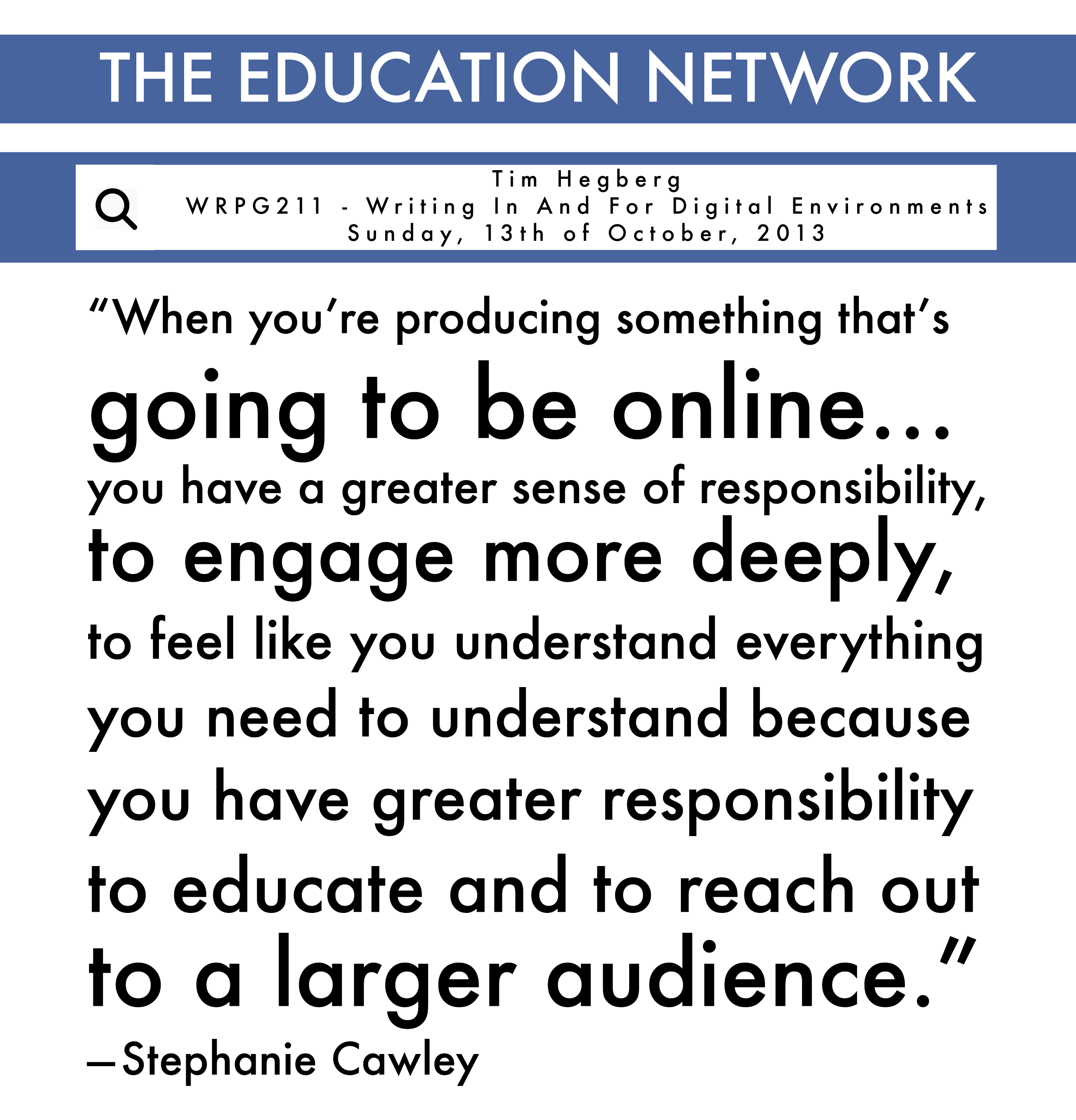
Having a public audience, rather than a single-person (the professor) or a small audience (classmates), is especially valuable for classrooms because students “have a greater responsibility to engage more deeply, to understand everything [they] need to understand, because [they] have a greater responsibility to educate and reach out to a larger audience” (Crawley, 2012).  For example, Amy Howard used a blog in her class, “The Urban Crisis in America,” to help students truly understand and engage with the issues that Richmond, VA faces.  She explains that having multiple components (a blog, video project, and research paper) that gave students a “greater responsibility” pushed students to engage and understand Richmond because they had to educate their classmates and the public on the issues they had chosen to study (Howard, 2010).

Writing Collaboratively

Writing collaboratively allows students to learn from each other, gaining an overall deeper understanding of the material presented in the classroom.  Having a student scribe each day who posts the lesson highlights for the other students on their classroom blog is a good example of learning collaboratively.  Using this method, the student scribe, at least for their assigned day, is truly engaged in the material and must figure out the best way to present it so that the rest of the class can understand and benefit from his or her knowledge (Leuhmann, 2009).

Furthermore, writing collaboratively mirrors the professional world that students will enter.  Professionals work together to develop ideas and build off of the ideas of others.  For example, rarely will you see a scientific article with only one author.  With this idea in mind, Michael O’Donnell, a chemistry professor, used wiki’s to allow students to collaboratively write lab reports (O’Donnell, 2013).  Each student wrote a part of the report and made comments on their group members’ sections, with one student acting as the principle investigator to make sure the entire report flowed together.  Professor O’Donnell saw success from this method because students felt they had more help while writing lab reports and better understood the scientific process, even if at times they were frustrated with their group members.  Even within fields in which sole authorship is more common, collaboration with and feedback from peers is an important part of the process.  Blogs can help students get feedback from their classmates and the public through comments on their blog posts.

Writing to Learn

As E.M. Forester said, “How do I know what I think until I see what I say?”  A blog gives students a chance to find out what they think by writing about topics covered in class.  Students can write to learn rather than learn to write.

During class debates or discussions, often it is difficult for students to articulate their opinions and arguments because they have not yet tried to explain them to others.  Writing on a blog, students can take the time and space to develop their knowledge and opinions on the ideas presented in class.  For example, two high school teachers who used classroom blogs found that writing allowed students to create strong opinions by fully considering counterarguments and having a place to reflect on their learning (Leuhmann, 2009).  Writing to learn is a valuable exercise because students learn more when they engage with ideas by writing about them.

In a world where problems need increasingly interdisciplinary solutions, writing to learn on blogs can help students develop the important skill of drawing connections between fields and ideas.  Teachers and professors can prompt students to draw connections in more typical academic writing, but the blog provides a powerful tool for drawing connections because other students and the public can expand on connections students make and offer connections that students did not previously consider.

Digital Writing and My Experience

In my opinion, digital writing brings immense value to the classroom.  It motivates students to learn, allows them to collaborate, helps them think through and reflect on their ideas, and so much more.  Two of the most important functions of digital writing are the ability to explore ideas and make connections between them.

In my own experience starting a blog about sustainability and livability within cities, I am discovering digital writing’s ability to help me explore my ideas by allowing me to write to learn and inviting feedback from the public.  My blog allows me to develop my thoughts and opinions on sustainable cities as I write them down in a manner that is intelligible and interesting to others reading the blog.  It forces me to attempt to explain my position and to fully consider counterarguments.  Moreover, once I start posting, the audience of interested citizens and professionals will be able to correct me, challenge me to expand my views, and point me to additional resources and information.  Their knowledge will become an invaluable part of my learning.  If my writing were private, I would not be able to collaborate with others to expand and improve my ideas.  I think that this blog will become invaluable to my own learning because it is public, collaborative, and it allows me to write to learn.

Furthermore, using digital writing to illuminate connections between seemingly dissimilar fields would be particularly helpful in interdisciplinary explorations, such as Environmental Studies, which is my major.  I would love to see the environmental studies department at Dickinson College begin using a blog because I frequently make connections between my interdisciplinary classes, but rarely do I formally write them down and strengthen them by examining them.  I think the department would benefit from a blog because professors and students could examine the connections between classes, but also because they could see connections they might not have previously made by reading others’ writing on the blog.

Works Cited

Cawley, Stephanie. “Re:Humanities ’12.” Interview at Re:Humanities ’12. Web. 1 Oct. 2013. http://www.youtube.com/watch?v=59D2AAQHyYg.

Cecire, Natalia. “How Public Like a Blog: On Academic Blogging.” Arcade (blog). 20 Apr. 2011. Web. 1 Oct. 2013. http://arcade.stanford.edu/editors/how-public-frog.

Howard, Amy L. “Engaging The City: Civic Participation And Teaching Urban History.” Journal Of Urban History 36.1 (2010): 42-55. Social Sciences Citation Index. Web. 27 Sept. 2013.

Luehmann, April, and Robyn MacBride. “Classroom Blogging In The Service Of Student-Centered Pedagogy: Two High School Teachers’ Use Of Blogs.” THEN: Technology, Humanities, Education & Narrative 6 (2009): 5-36. Education Research Complete. Web. 29 Sept. 2013.

O’Donnell, Michael. “Science Writing, Wikis, and Collaborative Learning.” N.p.: n.p., n.d. N. pag. Web Writing: Why and How for Liberal Arts Teaching and Learning. 15 Sept. 2013. Web. 25 Sept. 2013. http://webwriting.trincoll.edu.

Rajchel, Jen. “Consider the Audience.” N.p.: n.p., n.d. N. pag. Web Writing: Why and How for Liberal Arts Teaching and Learning. 15 Sept. 2013. Web. 25 Sept. 2013. http://webwriting.trincoll.edu.

Yang, C., and Y.-S. Chang. “Assessing The Effects Of Interactive Blogging On Student Attitudes Towards Peer Interaction, Learning Motivation, And Academic Achievements.” Journal Of Computer Assisted Learning 28.2 (2012): 126-135. Academic Search Complete. Web. 30 Sept. 2013.


Posted in 2013 Digital Writing Essay, Archives | Tagged | Comments Off on Using Electronics in Class?!

Public V. Private and Student Authority

The Internet has transformed from a space primarily used to retrieve information to a network for advancing and engaging such information. Moreover, the web has become a space to share ideas; it gives way to open participation, interaction and creative expression. Anyone can write and share ideas on the Internet; alternatively, anyone can read what is put onto the web. Such an open forum raises anxieties of authority: who am I to say what is that I am saying? Similar issues of authority in writing come to the surface in academic environments. In this way, the liberal arts classroom offers an ideal setting for practicing and teaching web writing, sot hat students may experiment with authority in a diverse writing environment. While web writing is a useful tool in academic environments for dealing with authorship and authority, it also brings up the problem of public and private space. How should professors and students decide how public student writing should be online, and what are the advantages to public writing? The liberal arts classroom offers an ideal space in which to grapple with these issues of student authorship and authority, offering a secure medium between public and private spaces.

In her article “Consider the Audience,” Jen Rajchel argues that it is essential to consider web writing in the liberal arts setting in order to take advantage of circulating student work; the tension arises when considering how to negotiate public and private spaces. Although students are familiar with interacting with peers through different forms of web writing – mostly through social media – there is a shift in boundaries when students move into new environments (Rajchel 3). Just as there is a shift in audience and context when students write on the web, there is a platform in the liberal arts classroom, which facilitates a similar environment (Rajchel 6). In these new boundaries of the classroom, new questions are raised: How does one brand oneself on Twitter? Do I friend my professor on Facebook? In this context, we as web writers must consider how public we wish to be with our audience, and how to maintain the amount of privacy that we desire. In order to determine this, we consider the risks and benefits of claiming authorship on the web through the structure of the liberal arts classroom.

Jack Dougherty’s article “Public Writing and Student Privacy” similarly grapples with ideas of negotiating authority in public and private spaces, and offers a perspective of the benefits of writing publically. Like Rajchel, Dougherty values the notion of extending the liberal arts education to the web, which allows for students to engage with ideas and conversations that are occurring outside of the classroom. Dougherty contends, “One of the best ways to improve critical thinking and writing skills is to post work in public, beyond the four walls of the classroom, and to invite others to respond” (Dougherty 4). He further asserts that prose has a greater potential to improve when the writing is aimed at a real audience, beyond simply the eyes of the professor. In the same sense, a true audience offers practical and diverse feedback, as well as alternative points of view (Dougherty 6). Dougherty and Rajchel are in agreement that writing for a more public audience gives way for more constructive and relevant criticism, which ultimately produces a stronger claim to authority.

Inevitably, writing in the public sphere directly intersects with issues of authority. The public sphere is a place in which we are not supposed to make mistakes, which makes writing publically more intimidating, particularly when there is a lasting record. Rajchel argues that when students are writing something that goes beyond the classroom, students feel greater responsibility to engage deeply and understand everything, because what is written will educate and reach a larger audience (Rajcel 13). Rajchel writes, “When students publish online, they assume the possibilities of authorship, which has online archival record long after its publication” (Rajchel 14). In this sense, there is more of a pressure to write well and knowledgably when writing is shared in the public sphere, and students are less inclined to claim full authority for their writing.

Alternatively, while Cheryl C. Smith agrees with Rajchel that students are likely to feel insecure as they transition into college classrooms with new expectations and audiences, she argues that error and fear of error should be used as a learning tool (Smith 36). Smith cites blogs as a “straightforward way to negotiate tensions of error” (Smith 37). Smith describes blogs as a platform for writing that supplement more traditional forms of writing without detracting from them, while also increasing opportunities for student expression, collective brainstorming, and community (Smith 37-8). Further, Smith states that when writing publically, students must be given a comfort zone, where they are able to examine their own experiences, while still encouraging them to venture beyond the familiar. Blogs do exactly this; they offer a place to negotiate the tension between making students comfortable with their own writing, and pushing them outside of their comfort zone to a place where they may take risks and interact with people in new ways (Smith 38-9). Ultimately, Smith argues that blogs create a safe place for risk-taking and error, which gives them the ability to empower students who are developing their own authorial voice.

Dougherty further raises the issues of students’ rights to privacy with their writing. He cites that “all students deserve – and are legally entitled under U.S. law – to some degree of privacy in our educational institutions, and ownership over the words they have authored” (Dougherty 16). Dougherty identifies that the root of students’ fears of publishing in the public sphere under their full names is that the writing that is published lasts much longer and is widely circulated; fears of error affects students’ decisions to write publicly online under their own name. Further, the anxiety of whether or not people will actually read what is written affects web writer’s validation that their words have been seen and have value. Nevertheless, he maintains the opinion that he wants all of his students to publish writing on the public web under their own names; however, he also encourages his students to retain control over their words. This offers a version of blogging as a “safe place” that Smith proposes.

In her article “Authority Issues In Online Instruction,” JoAnne M. Podis questions how the relationship between instructor and student shifts in an online forum. Podis asks the question: “How do the students’ contexts – social, educational, and personal – influence the authority relationship online as opposed to within the classroom?” (Podis 170). Although Podis argues that the authority of the professor lessons in an online environment, she also asserts that the professor becomes a point of security; because the professor is a source of familiar criticism, his or her criticism in a public space is readily accepted. Podis argues that her students are more sensitive to online criticism of their work. She believes that this could be for two reasons: first, that her students are accustomed to having only one audience – the professor – or, that her students’ experience with online communities where comments are commonly mean-spirited and aggressive (Podis 174-6). Ultimately, although Podis agrees that online writing fosters a more intimate relationship between professor and student, publishing in a public space raises anxieties for students. Alternatively, Julie Frechette asserts that allowing students to write and express themselves using a communication tool that they are familiar with and that is native to their generation enriches learning experiences and authorship. She argues that using familiar technology actually encourages authorship because students begin to see themselves and producers of knowledge who can “secure and legitimate cultural space to represent their world view and the fruitions of their education” (Frechette 23). In this sense, Frechette is arguing that writing in digital environments actually increases authority in writing, as opposed to increasing anxieties.

Rajchel ascertains that when it comes to negotiating public space, audience becomes the most difficult aspect. The web allows fro a diverse audience, but it also permits a broader dialogue between the readers and writer. Through writing, we engage in performance. In this sense, Rajchel determines, “liberal arts degrees can be thought of as training in the art of the audience. We are constantly being asked to articulate the role of rhetoric, the position of the speaker, and the effect on the audience” (Rajchel 23). Ideally, web writing offers a platform through which the liberal arts classroom can be expanded.

In terms of encouraging students to claim authorship of their work, I believe that there is a valid place for instruction on web writing in liberal arts classrooms. When it comes to issues of public and private publishing, Dickinson College has a useful medium to negotiate this space. Many Professors at Dickinson use Moodle forums as a kind of class blog. Moodle serves as an online extension of the liberal arts classroom, where conversations can continue and evolve in a different forum. In my own experience, the ways that Professors choose to use Moodle vary; some professors use Moodle to ask specific discussion questions, while other professors offer it as an optional space for continued discussion. In my senior seminar, my professor uses Moodle as an outlet for us to post our completed assigned papers if we choose to, although it is not required. In this instance, we are given the option of how public we wish to make our writing amongst our peers. I find Moodle beneficial in terms of expanding and articulating ideas that I was not able to say in class discussion. Further, Moodle is useful in terms of getting an understanding of what my classmates are thinking about; it offers a visual connection between different ideas. Moreover, Moodle makes it easy for peers to respond to one another and relate ideas. Writing in an online environment certainly implies a level of casual writing that is still insightful and conversational, which offers a useful break from formal academic writing.

However, although Moodle is meant to be a more casual space for student writing and discussion, there is undoubtedly a level of self-consciousness and anxiety when it comes to writing online. Professors are not necessarily always actively a part of the conversation that takes place on Moodle, however they do view the discussions; further, depending on the situation, they grade what is posted on Moodle. In this respect, I still feel pressure to write formally on Moodle with the knowledge that I will be graded on what I post. In other words, Moodle still feels like a high stakes environment for publishing writing. However, what I am most conscious of when posting on Moodle is that my peers will also be reading what I post; my writing is typically kept between myself and my professor, so opening it up to people in my class often changes the way in which I write.

The assigned blog project for Writing in and for Digital Environments has offered an ideal medium for writing in a public space; though people outside of my peers and professor will be reading what I write, this type of writing is less formal and more natural. Further, this blog project serves as a kind of connective tissue between my academic interests and allows me to apply what I have learned about academic writing in a different context. Blogging is the first opportunity I have had as a student at Dickinson to truly connect my academic interests. As an English and American Studies double major, I do a lot of analytical writing and critical thinking. However, this kind of writing and thinking does not always easily translate to every day conversations. This blog project allows me to create an intellectual conversation about issues that are discussed in the classroom, and revise them so that they are more approachable and relatable to everyday life. Admittedly, I have always struggled with issues of authority in my writing, so this blog project has raised some anxieties about publishing my writing in a public space. However, having the opportunity to write about something that I am passionate about makes writing in the public sphere less intimidating.

Ultimately, I believe that the liberal arts classroom offers an ideal space in which to deal with these issues of student authorship and authority. Tools like Moodle offer a space in which to publish publically with lower stakes and a limited outer audience. In some ways, this offers practice in both conversation and receiving criticism online, and claiming authorship over writing. Student blog projects offer a progression of these practices, ultimately allowing students to publish in a public space, that offers control of how much they wish to publish and identify with their work.


Works Cited

Dougherty, Jack. “Public Writing and Student Privacy.” Web Writing: Why & How and for Liberal Arts Teaching & Learning. 15 September 2013. Web. 3 Oct. 2013.

Frechette, Julie. “Learning Beyond the Classroom Walls: Keeping Students Engaged in Class 2.0.” The Journal of Media Literacy. 3 September 2013. Web. 6 Oct. 2013.

Podis, JoAnne M. “Authority Issues in Online Instruction.” Working with Student Writers169-178. Web. 7 Oct. 2013.

Rajchel, Jen. “Consider the Audience.” Web Writing: Why & How and for Liberal Arts Teaching& Learning. 15 September 2013. Web. 3 Oct. 2013.

Smith, Cheryl C. “Technologies For Transcending A Focus On Error: Blogs And Democratic Aspirations In First-Year Composition.” Journal Of Basic Writing 27.1 (2008): 35-60. MLA International Bibliography. Web. 13 Oct. 2013.

Posted in 2013 Digital Writing Essay, Archives | Tagged | Comments Off on Public V. Private and Student Authority

The Education Network

Education Network

The digital world is always shifting and we all know it. Myspace, once the king of social networks now finds itself clawing for any slight bit of relevance. Meanwhile, it’s successor, Facebook, is looking for every way imaginable to cement itself as a permanent force of the internet by providing convenient social systems (i.e. commenting, sharing, “likes”) that other websites are eager to employ. In slightly over 5 years, one service toppled another transferring millions of users. This is just a brief mention of how quickly the digital world shifts. In the meantime, education still has not fully embraced the digital age. Citation systems still are not sure if URLs should be required, teachers are hesitant to allow electronics in class and most courses have little to no content available online. This is beginning to change as schools realize the convenience and power of the digital world in educational systems.

A common sentiment made about writing digitally is that it removes students from the pressure of a class. This is both good and bad, Amanda Hagood and Carmel Price note in their article Sister Classrooms: Blogging Across Disciplines and Campuses, that having discussion over the internet is liberating for students. It allows them to write out their thoughts, rewrite them, fully flesh out their idea before they publish the idea. Hagood and Price note that students give superior answers online, where they can use writing as a way to learn, rather than being a product of learning. (Sister Classrooms) In a standard classroom, the student is pressured to know the answers at a moments notice, to formulate opinions and answers in seconds. It’s an incredible amount of intangible pressure, something that can often get results, but the results are consistently less thorough than those produced in online writing. When writing in a standard classroom setting, the teacher will usually assign a topic and the student will produce a paper directly on the topic. There will be a revision and a final draft, but the paper is designed to prove that the student understands the concepts taught in class. But often, a student will learn more from writing the paper than he or she will from the actual reading and lesson. (Writing Analytically, 6)

Digital writing is very different; a blog is asynchronous. In the words of Hagood and Price there is an, “absence of faces, voices and other non-verbal cues that help us understand face-to-face conversations.” We understand this to be detrimental in discussion groups, that speaking and discussing through digital means produces less efficient results because the extra effort must go into writing to be clear. It also requires the participants to be incredibly clear about what they mean, often at the expense of prose. This means that digital writing and commenting can simply confuse the student, unless the class is instructed in how to write a useful and clear critical analysis of the original work. (Hagood and Price)

While usually detrimental to prose, this lack of physical presence can be beneficial. Eric Zhi-Feng notes in his paper Using Peer Feedback to Improve Learning Via Online Peer Assessment, that students often feel anxiety during peer review of their work and that peer review through digital means (i.e. commenting systems, forums and Twitter interaction) actually reduces that anxiety by providing a distance between students and their peers. It is both a literal and metaphorical glass wall between students and criticism. It means that students are more relaxed and accepting of criticism, in fact, students reported back that they actually had a positive attitude towards the feedback. The students also reported that they had a much higher quality and quantity of feedback. (Zhi-Feng; Grabill) This feedback comes from an online community; ones who read and care about the subject that a student writes about. It can be other classmates, professors, perhaps just an engaged stranger. It changes the landscape of who the student’s audience is, taking what was previously just an assignment and putting the student in the shoes of an educator. It gives a student a sense of agency over their work that is lacking from standard assignments.

[youtube_sc url=”http://www.youtube.com/watch?v=rrkrvAUbU9Y”]

Educational research is not the only field that has noticed the trends that digital writing produces better results. In his TED Talk, Dan Pink, an author and expert on business and management, examined evidence showing that extrinsic incentives for accomplishing tasks caused a negative impact on any task that required even basic cognitive skill. This is completely counter to the way education currently works, the “carrot-on-a-stick” model of creating a better portfolio or writing a better paper for a better grade. Instead, what improves creative performance are three things: autonomy, mastery and purpose. (Pink) Autonomy is the idea that a the student is given the freedom to direct their own work. Mastery is simply the desire to improve in a topic or subject that matters, something echoed by students at Haverford who started the group RE: HUMANITIES. RE: HUMANITIES is an undergraduate conference on digital media run by Haverford College students, currently in it’s fourth year and showing a vast amount of growth. One of the students who helped organize the conference in 2013 commented saying that, students “feel like you understand everything you need to understand because you have greater responsibility to educate and to reach out to a larger audience.” (RE: HUMANITIES, 2:28)

[youtube_sc url=”http://www.youtube.com/watch?v=59D2AAQHyYg”]

Finally, Dan Pink cites purpose as something that motivates people to work creatively, the idea that what they are working on has “a larger meaning.” Digital writing takes the ideas in class and makes them applicable on a larger level, allowing students to take the lessons they learned in class and make them relevant to the average person. Writing with purpose means that the student’s work isn’t just written for a professor, it’s written for other experts, or possibly for those who have no background in the subject.

These are all properties of writing in a digital environment that aren’t possible in the same manner via a standard classroom setting. Digital writing allows the student a measure of autonomy in their work, while still remaining on topic with their class and learning far more than what they would have learned had they been assigned a topic.

Digital writing allows the student a chance at mastery of their topic, by writing to learn and then move on to educate, rather then using writing as a way to simply prove that learning has occurred. It also gives students a sense of purpose, that what they are writing can be seen by other students, used to educate others. Having students write in this manner requires that they attain a more specific knowledge of their subject matter so that their writing, which now has the purpose of educating a worldwide audience, is the best quality it can be. When a student is writing in a digital environment, their work is no longer within the four walls of a classroom, their work is global; it has meaning.

This global outlook is a key point of digital writing that comes back to community. Leigh Wright, an assistant professor of journalism at Murray State University, has been one to fully embrace digital mediums, going as far as to use Twitter (an online microblogging service) as a major platform for class writing. He has used projects such as “live-blogging” school basketball games and lectures from Spike Lee to teach students to tell a story in a concise manner. Let me rephrase that: you have 10 tweets, 140 characters each and a 2 hour lecture to tell your story. This project does not produce the same endless, mindless, pointless spam that Twitter is often criticized for. It’s a project that produced fantastic results because the students involved were given the three things that Dan Pink cites as being essential to creative solutions. The students were given autonomy to tweet about whatever they wanted within the event they were live-blogging. They were given a chance at mastery of writing quickly, concisely and in developing their own writing voice. And because it was live, online, viewable by the entire world, they had a sense of purpose. These live-blogging projects weren’t just for an assignment, they were for the world to see. (Tweet Me A Story)

The students in this experiment were thrown into a global community where ideas could build on each other, where they could combine all their tweets into one story, organized by a hashtag (a method of “tagging” a post on Twitter to make it easy to find). Where some students tweeted about the game, others tweeted about the fans or the food. There were no repeat observations, the students painted a picture of the entire event they attended, regardless of if they understood it. It allowed the students to engage a wider audience because their voices were so disparate, while still writing about the same events.

This is why digital writing is so powerful. It creates an environment where students care about what they write about. By giving them a measure of autonomy over their work, students have the freedom to expand their project in directions that might not have been thought of up until that point. It makes student work, suddenly of relevance to someone besides a professor, who already has a vast knowledge of the topic. The student is responsible to gain an additional level of mastery over the topic, for the purpose of educating their audience. It puts the teacher in the role of an educated critic, one who can encourage the student to move in a new direction or expand on a sentence they don’t realize has potential.

Digital writing also creates a system where in-person discussion is vital to the creative process. Because there is a lack of interaction via digital writing, the early stages of the writing process, that part where ideas are just beginning to form, are some of the most important. In person discussion allows students to build ideas and expand on them, growing those ideas in directions that wouldn’t be possible without running commentary from peers, bouncing ideas back and forth until the student has a starting place that they’re comfortable with. From there the student can move forward with research or writing, having the benefit of feedback as they write as well as when they are finished.

GPLogoCenter

My own experience with digital writing has been one where I know my writing improves vastly when I’m given the opportunity to write online. Mine and my partner’s blog (www.gastropermaculture.com) will be going live in about a week. We’ve been hard at work, not just for a semester or even a few weeks, but for months, developing ideas through face-to-face discussion and over the phone. We’ve had to figure out what we mean by specific words, how we feel about a certain post or if we should move the blog in a specific direction or not. It was a long four months of discussion and early planning, but now we are posting.

Our blog has taken ideas from sustainable agriculture and brought them together with gastronomy to create a project about sustainable food systems; how to source, shop, cook, eat and clean both sustainably and happily. The ideas we expanded on are based off of the principles and ethics of Permaculture, an ideology that is normally applied to agriculture. The definition was our prompt, just like we would get when in a class, but we had to find it ourselves and look for the connection between our own ideas and Permaculture. We had to research definitions and opinions, find out if our ideas could fit within the confines of Permaculture. There was one particular night where we took a definition of Permaculture by it’s originator, Bill Mollison, and rewrote it to have the same principles but with food in mind. It took hours and we worked long past when we normally would have slept, but we had to figure out the idea.

There are still some early posts that we are working on that are best approached by working in the same room, discussing ideas as we write and by visiting places together. But there are countless other posts that we’ve scheduled out what we want on the blog simultaneously, so that there isn’t an influx of similar content, that we can work on separately, using the ability to work at a distance, while still working together. Almost all of this would be impossible with a normal form of print media. Digital writing allows us to incorporate video, podcasts, limitless color photos and interactive media. And because the digital world is always changing and evolving, we have the ability to evolve our content with it. A lot of research will have to go into creating this content and so we are tasked with sorting through mass amounts of information, between Permaculture documents, food documents and nutrition documents as well as connecting all these ideas for different posts, there is a lot of education for ourselves before we even begin to educate others.

And so this is an illustration of how digital writing can create an ideal learning environment. My partner and I were self-motivated (autonomous) with our topic, deciding how to approach it, what to write about, our audience and how to integrate to normally disparate ideas into something entirely new. We are required to master our subject matter, having to learn an entire new field, both technically and how to communicate some rather lofty ideas to those who have little to no experience in either Permaculture or cooking, while still retaining the attention of those who are well-versed in both. Much of this learning will happen as we write, sometimes requiring multiple drafts. And we have purpose. We passionately believe that what we are learning about, writing about and educating people about. We believe that it can make a difference for people, to give them a freedom over one aspect of their lives and make a positive change in the world.

Digital writing allows us to do that and it allows other students to do that as well.


Bibliography

College, Haverford. “Re:Humanities ’12.” YouTube. Haverford College, 26 Apr. 2012. Web. 13 Oct. 2013. <http://www.youtube.com/watch?v=59D2AAQHyYg>.

“Re:Humanities.” ReHumanities. Haverford College, n.d. Web. 13 Oct. 2013. <http://blogs.haverford.edu/rehumanities/about/>.

Wright, Leigh. “Tweet Me A Story.” WebWriting. TrinColl, 15 Sept. 2013. Web. 14 Oct. 2013. <http://webwriting.trincoll.edu/engagement/wright-2013/>.

Hagood, Amanda, and Carmel Price. “Web Writing: Why and How for Liberal Arts Teaching and Learning.” Web Writing Why and How for Liberal Arts Teaching and Learning. TrinColl, 15 Sept. 2013. Web. 14 Oct. 2013. <http://webwriting.trincoll.edu/communities/hagood-price-2013/>.

Palloff, Rena M., PhD. “Online Learning Communities Revisited.” 21st Annual Conference on Distance Learning (2005): 1-5.Http://www.uwex.edu/disted/conference/resource_library/proceedings/05_1801.pdf. The Board of Regents of the University of Wisconsin System, 2005. Web. 14 Oct. 2013. <http://www.uwex.edu/disted/conference/resource_library/proceedings/05_1801.pdf>.

Grabill, Jeff. “Why Digital Writing Matters in Education.” Edutopia. The George Lucas Educational Foundation, 11 June 2012. Web. 14 Oct. 2013. <http://www.edutopia.org/blog/why-digital-writing-matters-jeff-grabill>.

TED Talks: Dan Pink: The Puzzle of Motivation. Dir. Daniel Pink. Perf. Daniel Pink.TED Talks. TED Conference, LLC., Aug. 2009. Web. 14 Oct. 2013. <http://www.ted.com/talks/dan_pink_on_motivation.html>.

Rosenwasser, David, and Jill Stephen. Writing Analytically. Boston, MA: Thomson Wadsworth, 2009. Print.
Posted in 2013 Digital Writing Essay, Archives | Tagged | Comments Off on The Education Network