
My project is on the tuberculosis epidemic in Russian prisons that started in the early 1990s. This epidemic was recognized by the World Health Organization and prevention methods were implanted in 1993, but many prisoners in Russia still have tuberculosis because it is an airborne and overcrowding disease, which makes a cramped prison cell a perfect environment to spread it. This project will hopefully explain why this human rights issue is a relevant topic about sustainability.
Yearly Archives: 2013
The “Seeds” of Eugenics

In this overt example of interwar propaganda, the practice of eugenics is promoted through a poignant visual and textual analogy to agriculture. The double meaning of the key term “seed” is utilized in a comparison between spreading healthy plant seed for a bountiful harvest and spreading healthy human “seed” for the purposes of procreation, specifically the creation of a physically fit, mentally proficient, racially pure population.
The first block of text that appears at the top of the poster, “Only healthy seed must be sown!”, alludes to the exclusionist principles of eugenics. People who were deficient in physical or mental health were considered unfit to procreate. More generally, anyone incapable of making an economic contribution to the state through gainful employment were subject to the scorn of negative eugenics (Mazower, 96). Such members of the population were considered sources of “bad seeds,” so to speak, a threat to the purity and longevity of the nation in question.
The textual motif of the poster stands in contrast to the bright and optimistic image of the farmer, portrayed as a literally shining example of the robust and productive citizens that eugenicists aimed to create. As Mark Mazower states in Dark Continent, eugenicists “believed that it was indeed possible to produce ‘better’ human beings through the right kind of social policies.” (91) This logic was employed by several European nations during the interwar period, most notably Great Britain, Russia, and Germany, the latter applying the simplistically and deceptively positive term “racial hygiene” to the practice of eugenics. (Mazower, 92).
This poster is a pithy snapshot of the dangerous ideological ground being tread by interwar governments in Europe. While the calculated and “logical” attributes of eugenics (as discussed in class) held several appeals for the recovering European governments after WWI, the concomitant dehumanization of the population in the eyes of the state may have in fact planted the “seeds” of social tension and injustice that helped steer the continent toward WWII. (Mazower, 97-98)
Image Source: http://www.niea.unsw.edu.au//sites/default/files/projects/323.jpg
Eugenics in Interwar Europe
“Eugenics is the science which deals with all influences that improve the inborn qualities of a race; also with those that develop them to the utmost advantage,” states Francis Galton in his article, Eugenics: It’s Definition, Scope, and Aims in July 1904. Eugenic ideas spread through out Europe following the First World War. While eugenics is supposed to be about race quality, it became prevalent in interwar Europe mainly due to fear, and the need to transfer blame.
In National Self-Sufficiency, John Maynard Keynes states that England’s vast trading network was “the explanation before man and the justification before Heaven of her economic supremacy.” This statement reflects the views of most European countries; their respective races were superiorto all others. After WWI, Europe began to lose control of its colonies. For example, the British were facing resistance to their rule in India. In addition to this, natives of those colonies were immigrating to the mother nations; there were Algerians in France and Chinese in England, to name a few. To nations that had been mainly of homogenous race up to this point, this immigration was a shock and an unwelcome change. Fear began to spread among whites of these people with different skin color, culture and language. Whites needed a way to establish themselves as the superior race and to keep their race pure. Thus, they turned to eugenics.
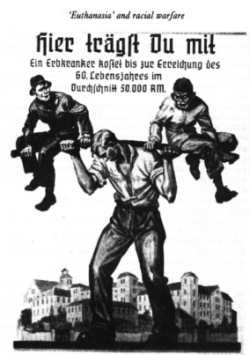
Not only was Europe physically destroyed by WWI, the global economic crisis of 1929 ruined its still weak economies. A general sense that someone needed to be blamed was felt through out the continent; who better to blame than these new races or less superior races within European nations? Especially in Germany, who shouldered the majority of the blame, according to the Treaty of Versailles, for WWI, this need was felt; the blame was placed mainly the Jews. During WWI, Jews held the majority of the seats in German parliament, and were the ones who agreed to a cease-fire. After the war, German officers came forward and said that they could have won if it weren’t for the armistice. This fueled hatred for the Jews. Eugenics became popular as a scientific way to justify this hatred. In this German eugenics propaganda poster, Germans are being told that they must take the burden for degenerates and those who are not as genetically fit. Taking these attitudes into account, it is not surprising that the Holocaust occurred.
Eugenics was a recognized science in Europe during the interwar period. Eugenists and those who supported eugenics were not extremists, but were close to mainstream thought. Eugenics was driven by fear and the search for an outlet for blame, and was itself an underlying factor in the Second World War.
source for picture: http://www.disabilityhistory.org/dd_camp2.html
British Eugenics: Race Versus Class
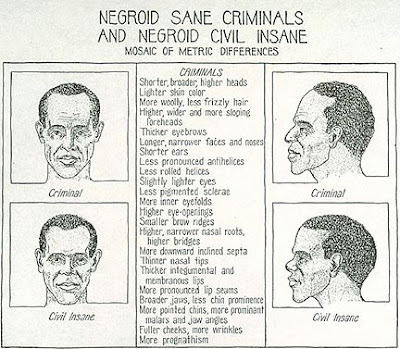
This eugenicist poster presents the differences between different African faces, highlighting the features of the so-considered “criminal” and “civil insane.” I found it to be a good demonstration of the belief within eugenics that someone’s facial features could be used to determine their personality type. Eugenicists believed that one’s personality could be determined by their appearance. Having a “shorter, broader, higher head” for example could classify one as a criminal according to this poster. Biology and anthropology were used as both logical proof and a moral conscience for these claims. It was thought processes like this that allowed for racism to flourish from eugenics in interwar Europe.
Another interesting aspect of this poster is the fact that it comes from Britain, where eugenics were supposedly based more in social class than in race. It helps to prove Stone’s argument in Breeding Superman that racial eugenics were more prominent in Britain than the nation’s eugenicists preferred to lead on. After the atrocities committed by Germany that used eugenics as their logic were exposed, Britain claimed that their eugenics programs were based around preserving the traditional class system that had been becoming obsolete. However, as an empire that spanned almost all the continents of the world, as well as the peoples of different races that resided on them, Britain felt it necessary to assert its dominance over the natives of their colonies. Therefore, eugenics was used to “prove” white supremacy. This poster shows how the British did this by using the reasoning that Africans were naturally savages who would disrupt the social order with their “natural” tendencies toward violence. Documents such as this could have easily manipulated the mindsets of the middle class through its fear tactics.
After having become aware of how British eugenics were based around similar ideals as those in the more extreme Nazi Germany, it fascinates me how one country used these ideas to justify a mass genocide, while the other fought against these actions. Could Britain have eventually reached a tipping point that would have caused the nation to undertake similar actions as Germany?
Eugenics in the Modern Socialist State
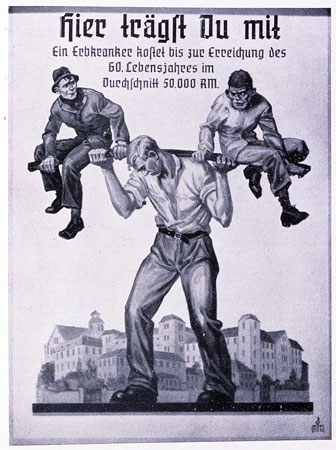
Nazi Eugenics Poster
With the rise of the modern socialist state, states now found themselves responsible for the well-being of their citizens. Because of the physical and mental capabilities of some citizens, many countries in Europe during the inter-war period began to advocate and implement eugenics programs in order to decrease the strain and burden on the bureaucratic system.
States such as France and Germany began to give benefits to its working class; the right to vote, improved health care, education, etc to name a few. All of these rights have costs and benefits to the state, costs that are worth every penny IF the citizen is a healthy and productive member of society. However, in the case of unproductive members (mentally challenged, “undesirables”, crippled, etc) they can act as a burden on the state. Thus, in order to provide for productive members in times of an economic crisis, citizens began to advocate and help implement eugenics into European society.
As demonstrated above, eugenics were not promoted by showing the end result of the people in question; rather, eugenics was promoted through propaganda using imagery designed to show the dead weight that the “unproductive” citizens were sharing with those who were productive. The ubermensch German is shown to carry the sick and deformed as part of their duty to the state while the freeloaders ride on his shoulders. This sort of imagery in the times of a recession agreed with citizens view points on making sure that they survived the crisis. Because of this agreement, citizens began to implement such programs as eugenics, leading to the Holocaust.
Photo Credit: http://www.theblaze.com/stories/2012/05/04/is-eugenics-reemerging-if-so-what-would-happen-to-these-heroes-with-special-needs/
Eugenics in Europe
Eugenics, the science of improving a countries human stock through specific breeding, had a significant impact on interwar Europe. Stone and Auslander both give their interpretations of how eugenics affected Europe. Stone discusses how, contrary to popular belief, eugenics in Britain was not exclusively targeted towards class, but how it was inadvertently also about race. Auslander explains how eugenics in interwar Europe manifests itself in the citizens aesthetic lifestyle choices, which reflects the sense of the countries nationalist philosophies.
The reality behind the eugenics movement and Britain was not that it primarily focused on class, but focused on race as well. Similar to Nazi Germany, there were also revered, racist British eugenicists. For example, Rentoul, a famous British eugenicist, saw blacks as sexual beasts that shouldn’t breed with whites. “The negro is seldom content with sexual intercourse with a white woman, but culminates his sexual furor by killing the woman, sometimes taking out her womb and eating it”. (Stone, 96) This popularized racist though process led to British sterilization laws. The main issue with claiming that the movement was solely about class, was that there was too much overlap between the lower class, which consisted of a lot of immigrants, and race. Although many saw these eugenics views as extreme, they still had an impact on the eugenics movement. After World War II, and the newfound widespread disdain for the extreme German eugenics movement, Britain claimed that their eugenics was class oriented, and they did this to disassociate with Nazi Germany.
Auslander describes the lifestyle choices and aesthetic tastes that the French, German’s, and Jew’s had in the interwar era when the national sense of belonging came from different ideologies. For example, Auslander gives us the idea that “…in Germany…citizens are understood to be born rather than made…”. (Auslander, 110) The foundation for German citizenship came from genetics, while French citizens were “French” through cultural adaptation. This reflects the national ideology of eugenics in the time period. Germany was more exclusive in the national sense, even if you were born in Germany but had non-German parents, you were not considered German. In France, however, anyone could be considered “French” as long as you spoke French, and engaged in the proper French activities.
Eugenics had a considerable influence on nationalist ideologies, a sense of belonging, and racism during the inter-war era in Europe. When confronted with the topic of racial exclusion in Europe during this era, almost all will point directly towards Nazi Germany. While it is true that Nazi Germany was the most extreme with their execution of eugenics philosophies, they were widespread throughout Europe at the time.
Eugenics in Interwar Europe

http://www.ushmm.org/propaganda/archive/film-eternal-jew/
This is a German poster for a government scripted movie, entitled the “The Eternal Jew”. It is described as a documentary, but a cursory glance at the poster reveals that it is a eugenics motivated propaganda film. The features of the Jew on the cover are deliberately depicted as ugly and evil, reminiscent of a witch from the tales of the Brothers Grimm. This movie was released in 1940, and represents the exaggerated European eugenicist view of “degenerates” (Stone, 98) during the interwar period.
The Nazi racialization of the state is well known, but according to Stone, race was a primary criterion even in Britain (Stone, 95). The image of a class based British Eugenicist Society was created by the Society after the Second World War and the disastrous culmination of racial eugenics in the Third Reich (Stone, 98-9). The difference between British eugenics and continental eugenics was their motive. Britain used eugenics to maintain the social hierarchy within the nation (Stone, 94), and to maintain supremacy over the Empire (Stone, 97). On the other hand, Italian and German ‘research’ was motivated by state ideology. Additionally, the methods implemented were very different. While Britain (Stone, 98), Italy (Willson, 84-6), and Germany (Mazower, 76) all advocated pro-natalism in a racial capacity, the former two were only able to legislate moderate laws, which were largely ineffective (Willson, 92-3), whereas the latter had more control over state policy and policing. Thus Eugenics had a greater effect in a German State that believed that blood descent, rather than assimilation, was the only claim to citizenship (Auslander, 110). Finally, while France believed that one could become a citizen through assimilation (Auslander, 110), they were still a colonial power who believed in the natural savageness of their colonial subjects.
In conclusion, it can be noted that Eugenics was an important debate in interwar Europe, but to varying degrees of implementation and success. State policies on women and families might have been influenced by these debates, but it must also be remembered that Europe had just suffered a large population loss due to the Great War. Therefore, these policies were also influenced by economic motives.
Eugenicist Posters
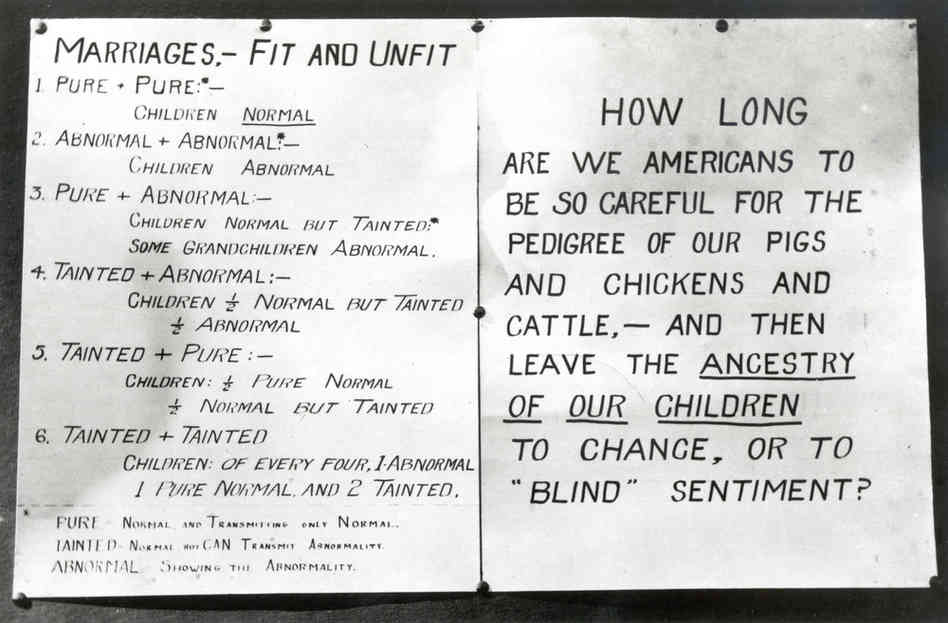
I found this image very interesting as it presents a chart of all the possible “blood” combinations imaginable.
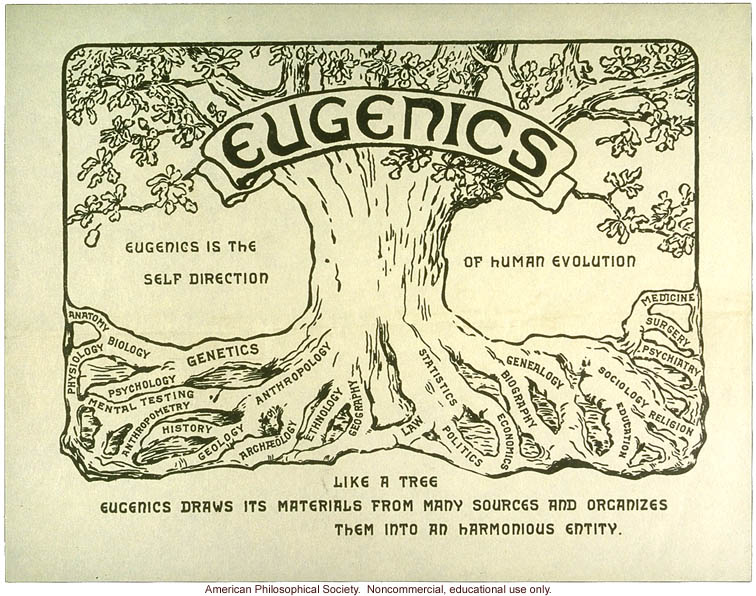
According to the eugenicists, each person belonged to a very specific racial category, one that completely determined every aspect of their life, from intelligence to physical appearance. As we can tell from the bottom picture, the eugenicists perceived themselves as humanists, advocating the best policies for the development of human civilization, even while advising states to adopt the most horrific and invasive social policies, ranging from sterilization to laws forbidding interracial marriage. Most tragic of all, these eugenicists never appear to doubt the goodness of their cause. As we saw in the article on eugenics and class, while they saw how some might confuse their agenda with that of the Nazis, they remained incapable of questioning their own motives and logic. As in the poster featuring the tree, the writing of eugenicists abounds with positive imagery of strength, health, and social harmony, reflecting a deep-seated fear of anything filthy or foreign.
I decided to include a poster made by American advocates of eugenics in order to better illustrate the nefarious aims of eugenicist groups. We now take it for granted that Americans can marry whomever they choose, regardless of their background. This poster’s denigration of “blind sentiment” stands in complete contradiction to this extremely important component of American society, and challenges the typically American idea that anyone can move beyond their roots, if they so choose. Looking at this poster, we see that the reactionary mentalities nurturing fascism did not remain confined to Europe, but contaminated the entire world. Perhaps the use of the word ‘contaminated’ obscures the true character of eugenics and its fascistic outlook. Could they stem from some inherent human nature we must seek to overcome?
Eugenics and Citizenship
In Leora Auslander’s ‘National Taste’? she explains how the German and French populations addressed questions about the conceptions of citizenship by examining the tastes and preferences of various citizens within specific regions and also the nation-state as a whole. Although each country had its own unique concept of citizenship; the French interpreted citizenship using a just soli policy (citizenship determined by region of birth), whereas in Germany citizenship was determined by ancestral lineage and blood lines, both cultures developed their own “language of goods.” This “language of goods” enabled citizens to look beyond the mere race or appearance of a person and instead focus on their material possessions to gain a cohesiveness between distinct social groups and form a national identity. The Jewish populations were oftentimes ostracized and blamed for many of the misfortunes that proceeded WWI without just cause. In reality they were not culturally different from the non-jewish citizens, they were incorporated into either German or French societies, forming a part of the nation-state and adopting the accepted customs.
In chapter four of Dan Stone’s Breeding Superman he examines the relationship between race and social class that existed in British eugenic theory throughout the interwar period. The racial component of eugenics has always existed, however Britain has been traditionally viewed as a government that focused primarily on the social components of eugenics while disregarding that of race. Stone explains how this is a misconception because the reality is that the racial and social components are inseparable. Many British officials believed in a racial hierarchy that saw white Europeans at the top and black Africans at the bottom. While policy makers sought to boost their respective populations, they wished to do so in a manner that limited the reproduction of the unproductive and parasitic social classes, and the ‘inferior races’ as well. The Nazi government of the Third Reich is singled out for their racist policies, and although they implemented these policies to an extreme degree, they were by no means the only country to do so. It was a common practice throughout most of Europe.
Leora Auslander wrote, in “National Taste? Citizenship Law, State Form, and Everyday Aesthetics in Modern France and Germany, 1920 – 1940,” how the concept of European national citizenship developed in the years between the world wars. She theorizes that the concept of citizenship is inextricably linked to the cultural understanding an individual’s everyday life, and that this link is traceable through the evidence of not political but anthropologic sources. Specifically she examines how the French and German citizens developed from regional to national citizens focusing on cultural norms and uniformity. She further divides the research into two group, the Jews and Gentiles, who lived on either side of the Rhine River.
She finds that citizenship is a concept already well developed by the twentieth century. Looking back to the French Revolution and German Unification, the idea of the larger national identity is a growing force of the centralized state. Her conclusion, drawn on detailed evidence and sound logic, discovers that the cultural similarities between the French population’s Jewish are strikingly consistent. That, juxtaposed to the German population of a similarly diverse Jewish and non Jewish body, are comparably also unified, but distinctly separate from that of the French nation.
Overall, the article seeks out a meaningful comparison through abstract means of developing an individual citizen. It deeply resonates with “The Lost Children” accounts of nationalism. The product of the French national education discussed in Zahar’s work is culminated in the uniformity of French society viewed in Auslander’s article. Therefore, in a sense singing “La Marseillaise” as a child in the French educational system had an affect proven by the homogeny of the French interwar population in comparison to the Germans or other states.