In the years around 2007 a team of graduate students and faculty associated with the University of Kentucky’s Institute for Latin Studies under the direction of Ross Scaife did valiant digitization work on a set of Colloquia Scholastica (Neo-Latin Colloquia), mostly dating to the 16th century. Several of the digitized texts produced by the Institute’s group were encoded in TEI XML and hosted on an instance of the Perseus hopper at Stoa.org. Due to server changes in 2019 those digital files have since fallen off the face of the internet, and are only available via the Internet Archive’s Wayback Machine.
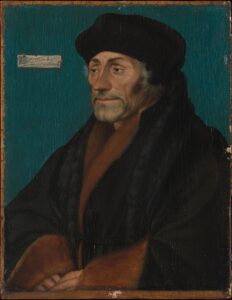
Portrait of Erasmus of Rotterdam by Hans Holbein the Younger German, ca. 1532. Oil on linden panel. New York, Metropolitan Museum 1975.1.138. Public Domain.
During the summer 2024 Conventiculum Dickinsoniense, Jackson Perry suggested that we at DCC might embark on a salvage project to scrape the files off the cumbersome and slow-loading home on the Wayback Machine and consolidate the pages. The amazing Megan Ayer completed that process recently, thanks to funding from the Roberts Fund for Classical Studies at the Dickinson Department of Classical Studies. The text are now in a publicly viewable Google Docs folder containing all twelve works from Stoa.org.
They represent approximately 457,650 words of digitized Latin not readily available elsewhere. They are free for copying and re-use.
What is the value of colloquia? They are precious guides to Latin as it was in its modern heyday as the main vehicle for the discourse of the scientific community, the scholarly world, and all the main academic disciplines. They deal with many topics and situations not encountered in surviving classical Latin, and so can serve as excellent guides to those who foster Latin as a spoken language today. (Ross Scaife is unfortunately no longer with us, but the University of Kentucky’s Department of Modern and Classical Languages and Cultures remains a thriving center for active Latin under the leadership of Professors Milena Minkova and Terence Tunberg. And work on the renewed study and enjoyment of neo-Latin colloquia scholastica continues there).
In addition to their obvious pedagogical value, the colloquia are also, as Terence Tunberg points out, precious historical sources:
Colloquia provide historians with a rich mine of information on daily life in the towns and cities of renaissance Europe, as well as academic life in schools and universities. In the Paedologia of Mosellanus, for example, … we learn the Latin authors studied in a given term could include works of contemporary humanists like Erasmus, as well as those of Roman authors like Cicero and Horace. We learn that it was still hard to find courses in Greek at most schools. We learn that better-off students might live off gifts from home, but many had to beg or do sordid jobs in the town to subsist. This was not just true of university students, but even of young boys in grammar schools. We see our student characters dress themselves for a festival, and learn that taking a bath was a special occasion, something one did only three or four times a year! In the colloquia not only of Mosellanus, but of many other authors too, we get a glimpse of the seedy characters, thieves and con-artists, pseudo-doctors who frequented the streets of late medieval towns.
(Terence Tunberg, “The Way Many Aspired to the Eloquence of the Few: The Neo-Latin Colloquium.” [2011]. In Mobs [Vol. 3]. Brill. p. 200)
Google Docs is obviously not a permanent hosting solution. My hope is that other fautores linguae latinae activae will pick them up and preserve them, maybe add macrons, pictures, audio, that sort of thing. If anybody wants to try editing some of this material in full DCC style, please let me know.
Ok, here is the list. Enjoy!
Franciscus Cervantes de Salazar (1514?-1575), Ad Exercitia Linguae Latinae Dialogi
Sebastianus Castalio (1515-1563), Dialogorum Sacrorum Libri Quatuor
Maturinus Corderius (1479-1564), Colloquia scholastica
Laurentius Corvinus (ca. 1465-1527), Latinum Ydeoma
Martinus Duncanus (1505-1590), Praetextata Latine Loquendi Ratio
Desiderius Erasmus (1466-1536), Colloquia familiaria
Ioannes Fontanus (1545-1615), Hortulus puerorum pergratus ac perutilis Latine discentibus
Petrus Mosellanus (1493-1524), Paedologia
Beraldus Nicolaus (1473-1550), Dialogus quo rationes quaedam explicantur quibus dicendi ex tempore facultas parari possit
Jacobus Pontanus (1542-1626), Progymnasmatum Latinitatis, sive Dialogorum Volumen primum, cum annotationibus
Petrus Popo, Colloquia de Scholis Herbipolensibus
Johannes Ludovicus Vives (1492-1540), Exercitatio Linguae Latinae