What is your favorite classical commentary? What place did it have in your intellectual development? Recently I asked the members of the DCC editorial board to write for the blog about these questions. Here is the response of Meghan Reedy, Assistant Professor of Classical Studies at Dickinson College. Her current research is on emotional display in Roman poetry, particularly in the moody love poems of Propertius.
I have a real fondness for David Mankin’s Green & Yellow commentary on the Epodes of Horace. As an undergraduate I loved Kenneth Quinn’s commentary on Catullus. It seemed to hold out the allure of Things Rare and Obscure, and I remember feeling drawn to its tiny fatness, and its densely printed pages—but it was in using Mankin’s Epodes as a graduate student that I came to appreciate something else: namely that an understanding of Rare and Obscure Things is a common goal, and not a trophy.
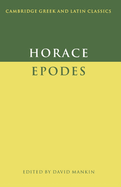 The first thing I learned from Mankin was that special, cool things need not be beyond comprehension, chilly or impersonal. A work in any genre of academic writing can give the impression, accidentally or on purpose, that it has been received from a higher plane of super-human erudition, rather than written by an insightful person. But the risk of giving such a false impression is especially high in a commentary. A commentator writing for students tends, for good reason, not to develop ideas at much length—which also means that there is not much opportunity to convey a sense of personality, of a distinctive point of view. The reader, on the other hand, tends to go to a commentary precisely for such succinct explanations, looking for aid in an encounter with the Real Author at hand, Horace or Livy or whoever, and not looking for an encounter with some commentator. But it happens anyway. Even with so little to go on, even without meaning to, one invariably trusts or distrusts a commentator, feels a kinship or a distance, ease or frustration. And with Mankin for the first time I felt a kinship. I had the sense as I worked through his Epodes that we were sharing an aim, and I appreciated his candor about what he thought Horace was up to and what struck him as difficult to interpret. It was a revelation to me that this was at all possible.
Which of course led to a knock-on revelation: I realized that commentaries could be controversial. If commentators were actually people, their work was thus something other people were entitled to form real opinions about, to engage with and turn over in the mind. Marvelous to consider, I found that I too had opinions, and could attempt to solve riddles.
Who would have thought a commentator, a mere commentator, could have such an effect? Who knew that commentators mattered in this way? But they do.
 My favourite commentary is R. Deryck Williams’ Aeneid, which dates from 1973 and is now published by the Bristol Classical Press. I think that the main reason that I love it is that it is the work of a man who himself loved Virgil both wisely and well. This love shines on every page. It is a deeply civilized edition, constantly slipping into quotations from English poetry which set the Aeneid in its place near the font of European literature. It is odd that, as reception gains a more and more firm foothold, editors have become increasingly uptight about including literary parallels from the Renaissance and later in their texts. Williams read the Aeneid once a year – each time, he used to say, wondering whether Aeneas would bring himself to abandon Dido – and his understanding of the poem as a whole informs the edition throughout.

![[t-e-page.jpg]](http://2.bp.blogspot.com/_RnoICdmSZT8/SYLeQvdnIJI/AAAAAAAAAcw/MxQRoaEymFM/s1600-h/t-e-page.jpg)