The Impact of German and Soviet Organizations

In Koenker’s The Proliterian Tourist in the 1930s, and Reagin’s Comparing Apples and Oranges, both authors place emphasis on specific societal institutions.  Tourism in the Soviet Union became very politically focused during the inter-war period.  In Germany, the ideals of consumption were promoted by housewives.  Both articles provide basic insights into each organization and their various contributions to society.  It is clear that in both the Soviet Union and Germany, tourism and housewife organizations were utilized for the promotion of political and social ideologies.

Koenker’s description of tourism was both intriguing and surprising; she argued that a concept as seemingly casual as tourism had intentions of a larger political scheme, which was to promote socialism, and stray away from the bourgeois life.  While there are many obvious ways in which they implemented this change, it is shocking that the Soviets would turn to organizations like tourism to solve these issues.  This essay is substantial, because it depicts the significance of everyday activities with regards to a larger political agenda.

Comparing Apples and Oranges was similarly striking in terms of highlighting Germany’s reliance on everyday institutions to solve social and political issues. What was surprising in this article was the reliance on women to solve such substantial issues.  During the inter-war period, it was clear that the woman’s place was in the home.  While this article supports that ideal, it argues that being a housewife was actually a crucial responsibility. Housewife organizations were responsible for promoting German manufactured goods, rationalization, and natural ingredients.  It is surprising that women, as second-class citizens at that time, would be relied upon for such pressing issues.

Why were everyday organizations like tourism and housewife organizations targeted as catalysts for political change? Why were these specific groups believed to be beneficial to the political agendas of the Soviet Union and Germany?
Influencing Culture

“The Proletarian Tourist in the 1930s: Between Mass Excursion and Mass Escape” by Diane P. Koenker and “Comparing Apples and Oranges: Housewives and the Politics of Consumption in Interwar Germany” by Nancy Reagin both focus on the politicization of different aspects of daily life and leisure. Koenker’s article illustrates the way in which the Soviet government propagated tourism as a means to turn this leisure activity into a political action and elevate the proletariat culturally. Similarly, Reagin’s article highlights how the various housewife organizations in Interwar Germany politicized daily activities, like grocery shopping, and changed how German culture was perceived and remembered.

The way in which culture changed in Germany based on the opinions of these housewives’ organizations is very intriguing. The points made in this article bring up questions about larger implications for culture: how were other aspects of daily life in Interwar Europe determined and influenced by campaigns such as these? The fact that organizations determined national attitudes about daily choices—the types of food people ate (wheat bread vs white bread) and where they shopped—is incredible. That the pre-existing cultural climate allowed for this level of influence points to the chaos and loss present during this period. Europe had drastically changed in the span of four years and the following decades were filled with attempts to find a new equilibrium. These measures, encouraged by these German organizations, were meant to help find a new balance and help restore order and security to Germany.

Koenker writes about how the USSR attempted to influence its culture with tourism. The government wanted this practice to expand beyond the Bourgeoisie to the Proletariat, but this failed. Tourism in the USSR quickly turned from another avenue of collectivization to a new form of individualism and independence; this did not reflect the new governmental policies that encouraged a collective philosophy to truly mirror the ideals and principles of communism. These practices never became part of the essential culture, like food choices quickly became in Germany. Why did these two similar campaigns work so differently? Perhaps because the German organizations targeted daily practices rather travel, a leisure activity that occurs more rarely.

Disappearing Cultures of Northern Siberia


I will be researching the disappearing cultures of the native tribes of the Krasnodar Krai region of northern Siberia. Their traditional livelihood of reindeer herding was severely disrupted with the industrialization of the Soviet Union in the 20th Century, and the changes in Soviet government and social structures have also effected them profoundly. Follow the link to below to view my initial bibliography.

Research Bibliography

Nuclear Waste in Russia

I hope to explore the development of the way nuclear wastes have been produced and disposed of since the industry’s inception during the early Soviet Union.


https://www.evernote.com/shard/s324/sh/4de80b0e-2365-42db-a8d7-378f71811635/2493d2ea17f870ea268fc44cf3a775d0

Project Bibliography (Jackson Shaw)

https://www.evernote.com/shard/s330/sh/bd1141d0-53db-4073-af93-0f43c9ba27c0/6c6fe41e20e744962e30879a7bfe1a92

My project will be focused on the the environmental fallout as a product of nuclear testing, nuclear power plants and waste disposal. In terms of sustainability, it will focus on how nuclear power should be disposed of properly as to not damage the environment. A large drawback of nuclear power, which is highly efficient, is the waste is very volatile and remains toxic for long periods of time. This project will also focus on the potential future of nuclear sustainability in terms of economy and workforce. Generally, the current situation of Russia’s nuclear program and what steps need to be taken to make it more sustainable.

Eugenics in Germany

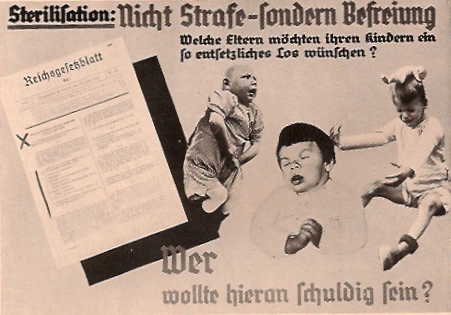
This poster shows Nazi’s eugenics propaganda. When in 1933 Adolf Hitler came in power, he started to imply his own vision about race in German society. He believed in the Aryan race, which he claimed if “purified” will become the ruling race of the world.

This poster shows three handicapped children and puts the question “Who would want to be responsible for this? “ The poster was part of the sterilization campaign that was going on in Germany during the rule of Adolf Hitler. This poster tried to make the population of Nazi Germany believe that certain people should be sterilized because they might have such children, which according to Nazi Germany will not be beneficial for the state, nor for the people in it. Unfortunately, in Hitler-ruled Germany, individuals who were labeled to be unproductive for the society were exterminated.

The eugenic movement took part also in Great Britain, France, Russia, America, and others, but it was only in Germany, where mixed with the idea of the Ubermensch( the superman), created a devastating outcome- the concentration camps, in which millions of people lost their lives.

Source for picture : http://www.calvin.edu/academic/cas/gpa/volkundrasse1936-8.htm / poster number 5

Pronatalism and the Soviet Union

Pro natalism

After the First World War, empires, both big and small, were trying to rebuild themselves to become stronger. Their economies were extremely weak and their population had greatly decreased due to all of the deaths during the war. Nations wanted their economies to be stronger by increasing industrialization and in order to do this, governments focused on family planning and parenthood.

All of Europe and the Soviet Union were focused on re-boosting their populations looking closely at birth rates. In Wendy Goldman’s text, Revolution and the Family, she goes into great detail about the issues surrounding family planning and parenthood just before the Second World War, specifically in the Soviet Union. The government outlawed abortion, created incentives for child bearing, and made it extremely difficult to divorce your partner. In Russia however, women entered the work force, which increased industrialization, but decreased birth rates. Due to both women and men being outside the house working all day, children were abandoned and neglected at home and would turn to petty crimes. The government then really focused on the family life and required parents to focus more attentively on their children and their education.

The picture attached to this blog is propaganda in Russia trying to get families to have more children. Families that had a certain amount of children were given incentives by the government and the more children you had the more they would pay you. The Soviet Union ran into the issue of there not being enough space for all of the children, especially in detention centers where they were sent when they got into trouble.

Due to strong government opposition and propaganda, birth rates did increase and the Soviet Union did find a complete balance between the work force and families.


Image source: http://takimag.com/article/motherland/print#axzz2fO2NkSzJ

Children of Russia

poster-1948

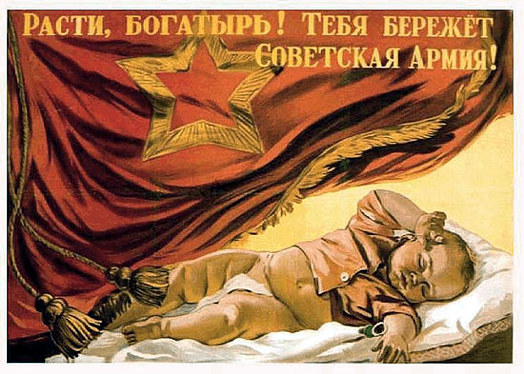
This photo depicts a Soviet child sleeping under a communist flag. The rough translation of the caption of this photo is “Grow, heroes! You will save the Soviet Army.” This pro-Natalist propoganda was distributed in Russia after World War II. The population of Russia had significantly declined after the war, and Russia wanted to increase their population. Although this piece of propaganda did not come about until after the Interwar Period, it connects to the thoughts of the Soviet Union during the Interwar Period.

In the reading Revolution and the Family by Wendy Goldman, there is a focus on the children, women, and the Pro-Natalist movement in the Soviet Union during the Interwar Period. The government was very concerned with the decreasing birthrates and lack of potential productive members of society. In order to attempt to increase the Soviet population, the Soviet Central Executive Committee and Sovnarkom outlawed abortion. To deter illegal abortions, there were heavy fines and prison sentences implemented.

In addition to deterring abortion, they also offered incentives to those willing to increase the population. The government would give stipends to new mothers, monetary bonuses for women with many children, and longer maternity leaves for those in the work force. In order to grow the Soviet Union, the government needed to grow their population, just as the propaganda picture above suggests.

Although the time period may change, the need for large, productive populations remains static.

http://lh5.ggpht.com/_ialE7-GoQ48/SuUueGWbE7I/AAAAAAAAAj4/2L0JFsbDJVk/s800/poster-1948.jpg


Germany and Pronatalism

fw6-20


(Image courtesy of “Politicizing Pronatalism: exploring the Nazi Propaganda of Women through the Lens of Visual Propaganda”, by Katherine Rossy)


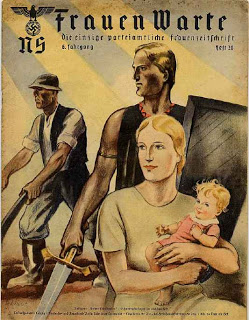
This image, taken from the Nazi party’s magazine for women, Frauen Warte, depicts a mother taking care of her baby daughter while her husband goes off to war. This particular image is from a 1937 issue, two years before World War II began. At this point in history, Germany is Nazi-occupated and Hitler’s power is rising. The picture illustrates clear gender roles that show the woman as a loving creature whose duty it is to make children just as it’s the men’s duty to fight. The Nazi Regime preached pronatalism to those “worthy” enough to reproduce, which was the Aryan race in their eyes. It was these women’s duty to make good German children. While women were getting more and more involved in the workforce, it goes to show that their first and foremost priority, at least as taught by the state, was to heighten the birthrate of the German population. Because of the alarmingly high divorce rates, and this new “modern woman, the state became highly concerned about the now declining birthrate. While this sparked Pronatalism regimes across Nazi Germany, it wasn’t an isolated situation. Several other countries across Europe began to outlaw abortion and contraception to rebuild the importance of the family unit.


Bibliography: The Union of Composers in the Soviet Union

https://www.evernote.com/shard/s353/sh/1a4907dc-0b8f-439e-8358-228ac70d3b72/8f9eaeab56c72646ce82f8db55f9bf74

My final project will be on the Union of Composers in the Soviet Union. The project will explore the different aspects of the union including its effects on the composers’ compositions and artistic expression, as well as society. The sources provided above share some insight from many different perspectives on the subject. I hope they are of help to anyone interested in music during the Soviet Union time period.