From the days when Latin was still very commonly taught in American schools . . . Check out this ad for the prominent department store chain Abraham & Straus (1865-1995), June 10, 1962, p. 59. Thanks to James Dee for the reference.
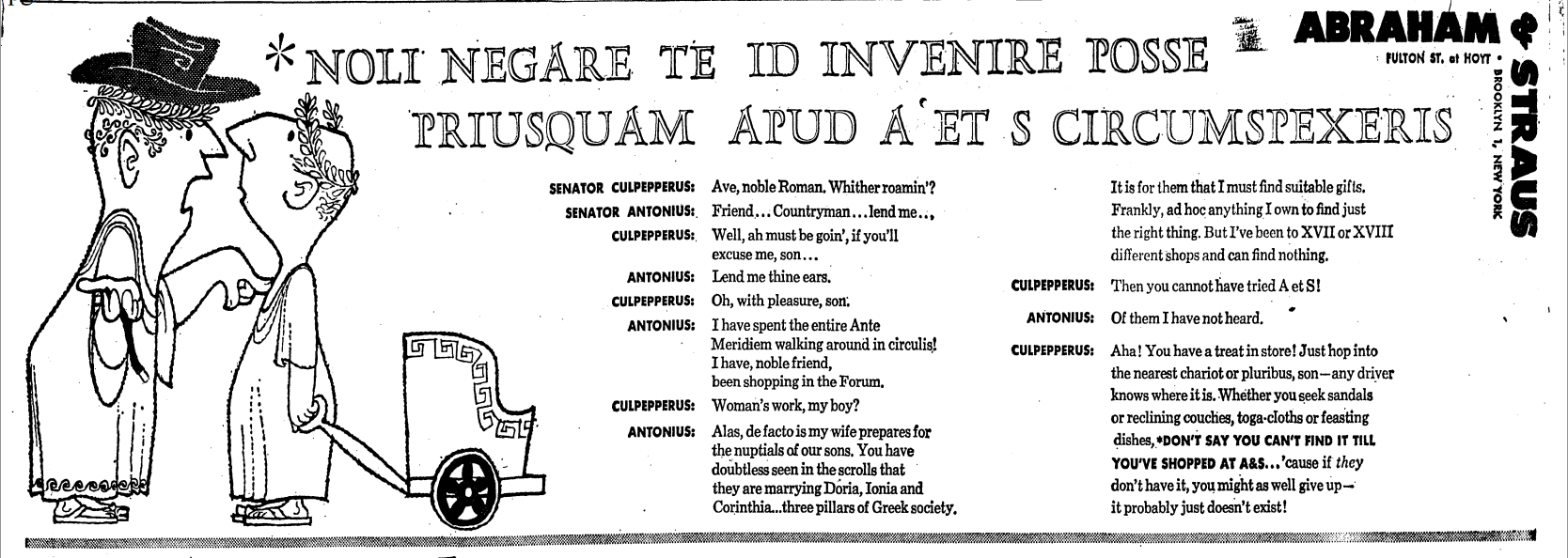
From the days when Latin was still very commonly taught in American schools . . . Check out this ad for the prominent department store chain Abraham & Straus (1865-1995), June 10, 1962, p. 59. Thanks to James Dee for the reference.
Barrington Atlas of the Greek and Roman World App. Princeton University Press, 2013. iTunes $19.99 US.
Reviewed by Meagan Ayer, Dickinson College (ayerm@dickinson.edu)
In December 2013 Princeton University Press launched the much anticipated app version of its Barrington Atlas of the Greek and Roman World. The original print version of the Atlas, overseen by Richard J. A. Talbert and published in 2000, was the first atlas to provide comprehensive maps of ancient Greek and Roman territories stretching from Britain to India and Africa. It immediately became the standard for maps of that part of the ancient world. The extent of territory and level of detail required that the atlas be large (13.25 x 18 in. unopened), and its high quality came at a fairly high price (currently $395 US), which meant that “the Barrington” was not always easily accessible to individuals. The application is, therefore, a welcome effort to make all the scholarship of the Barrington Atlas available to individuals anywhere at anytime.

The app itself is surprisingly small, weighing in at only 411 MB. In this compact package you have access to all 102 maps of the original Barrington which are stored locally, allowing the user to browse maps on an iPad without being connected to the internet. Upon opening the app, the Princeton University Press logo appears, followed by a cropped version of the dust cover from the print version. In order to access the application features from here, it is necessary to either tap the screen or swipe from left to right. Doing so reveals the navigation menu.

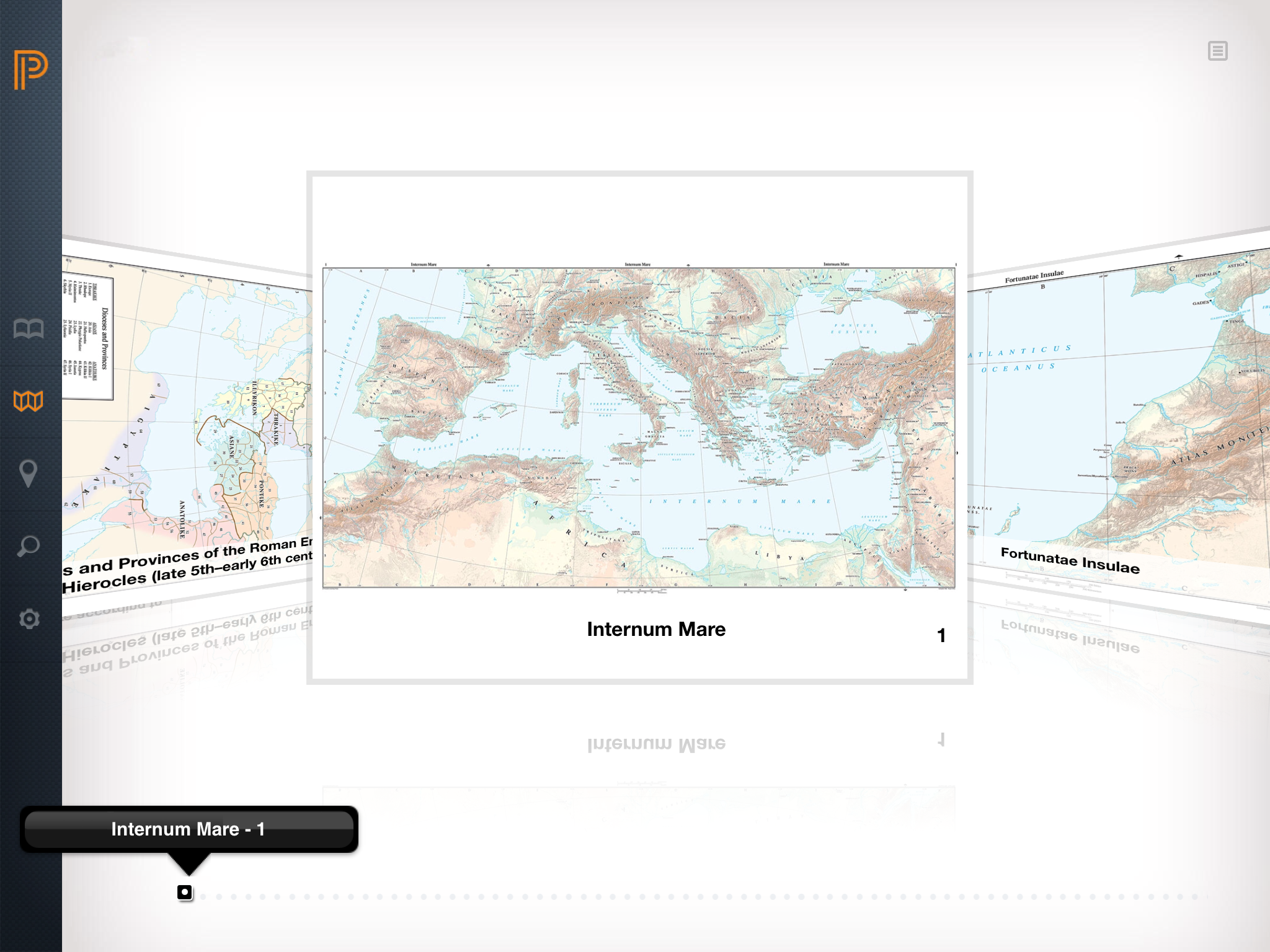
There are three different ways to view the content of the atlas. If you simply wish to browse the maps you can select the Maps tab. This will load a thumbnail gallery of all the maps in the atlas which you can flip through before tapping on a particular map to select it.
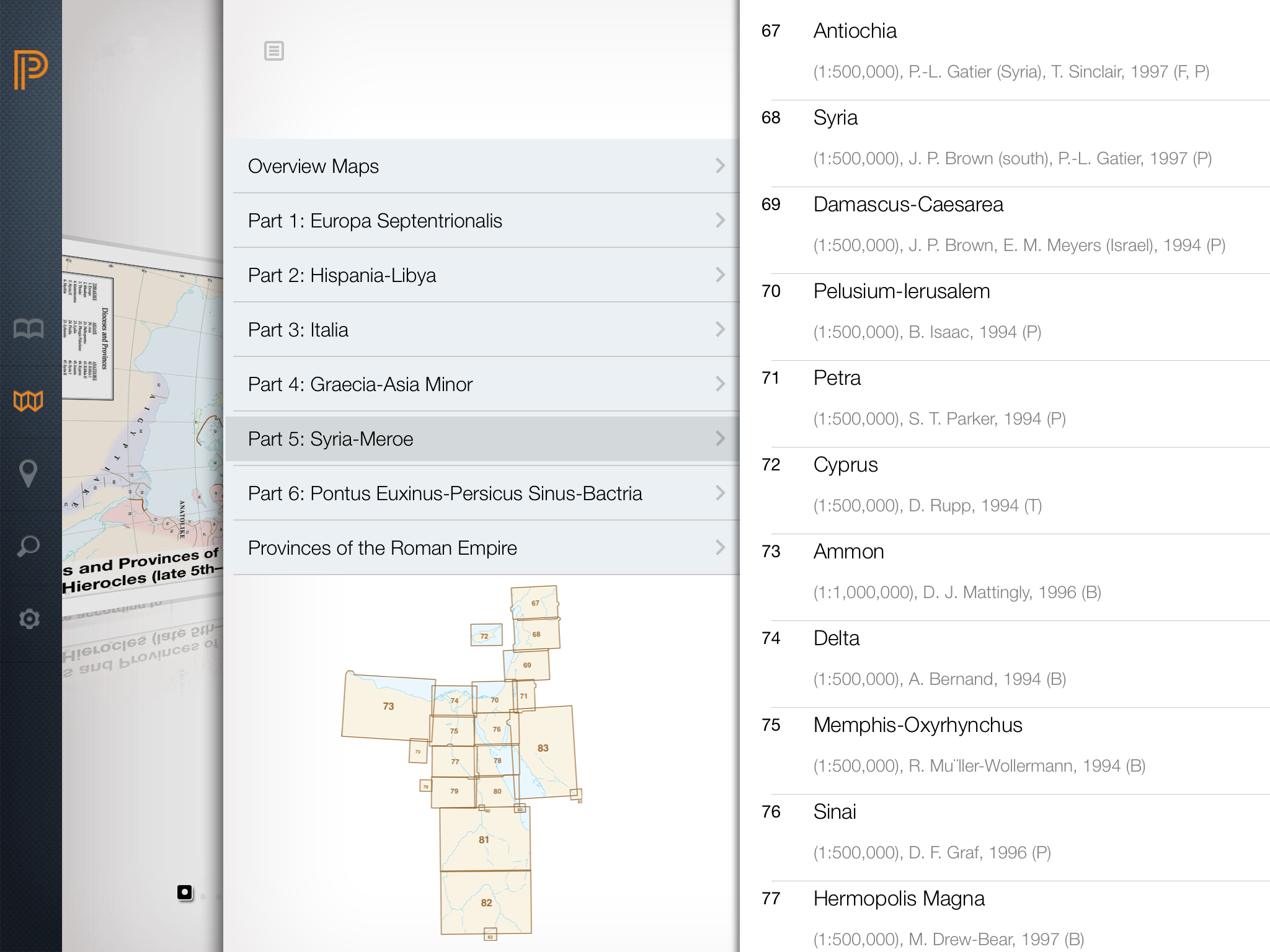
Alternatively, a navigational menu button in the upper right hand corner of the gallery allows for the selection of maps by region. Simply open the menu, choose your larger region and then select a specific map.
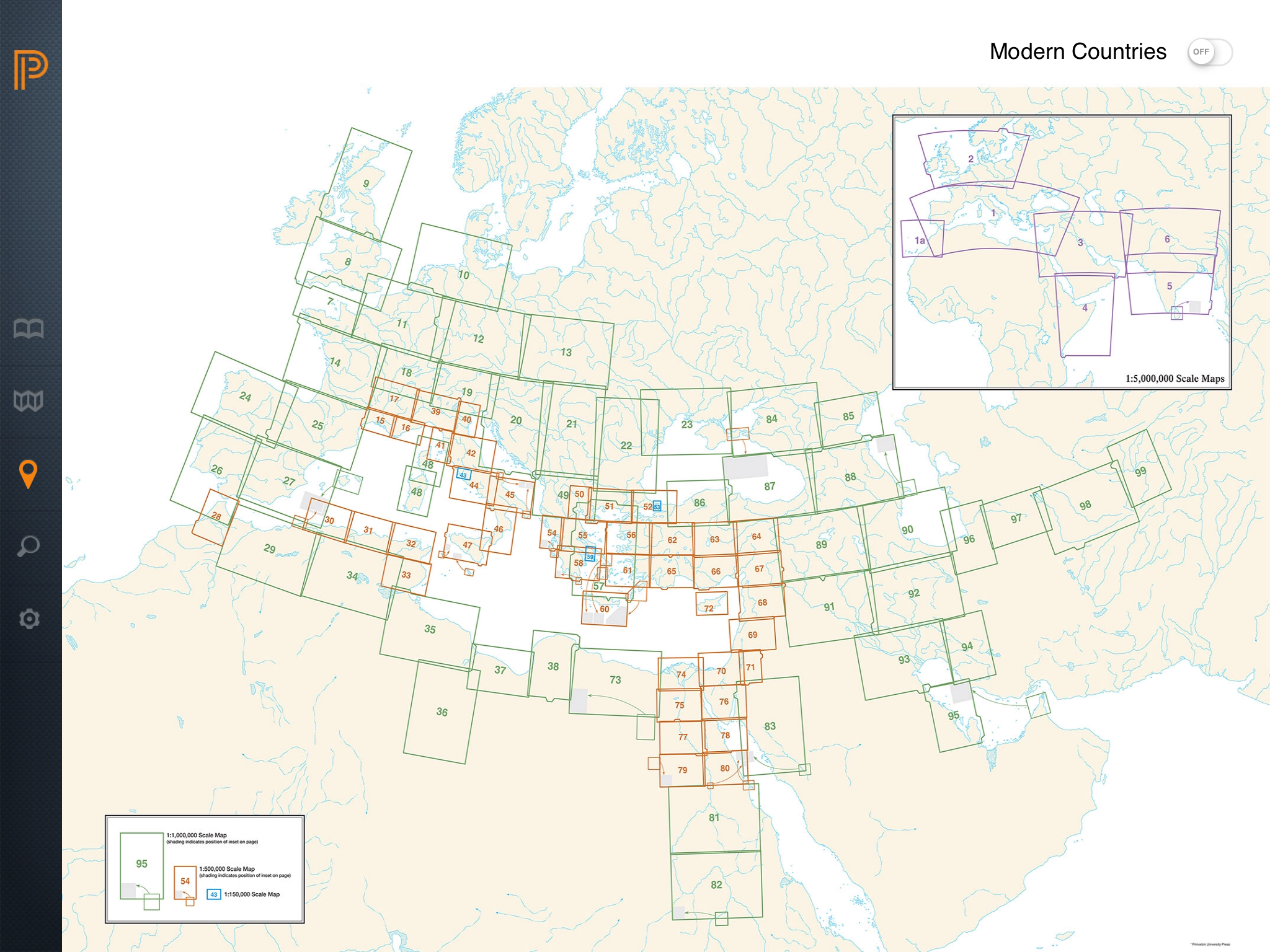
One can also use the Locator tab, which pulls up a map displaying the entire area covered by the atlas overlaid with boxes corresponding to individual maps. If you wanted to view a map of the Nile delta you could simply select box 74 to be taken to that map. If you are looking for maps of ancient sites within a modern country, a button is also provided in the upper right hand corner to turn on and off modern borders.
Finally, you might be searching for a specific site in the atlas. Selecting the Gazetteer tab opens a searchable alphabetical listing of all the sites included in the atlas. A pop-out drawer located in the upper right hand corner of the screen explains the organization of modern and ancient site names as well as country abbreviations. Searching for a site returns links to each map on which that site appears.
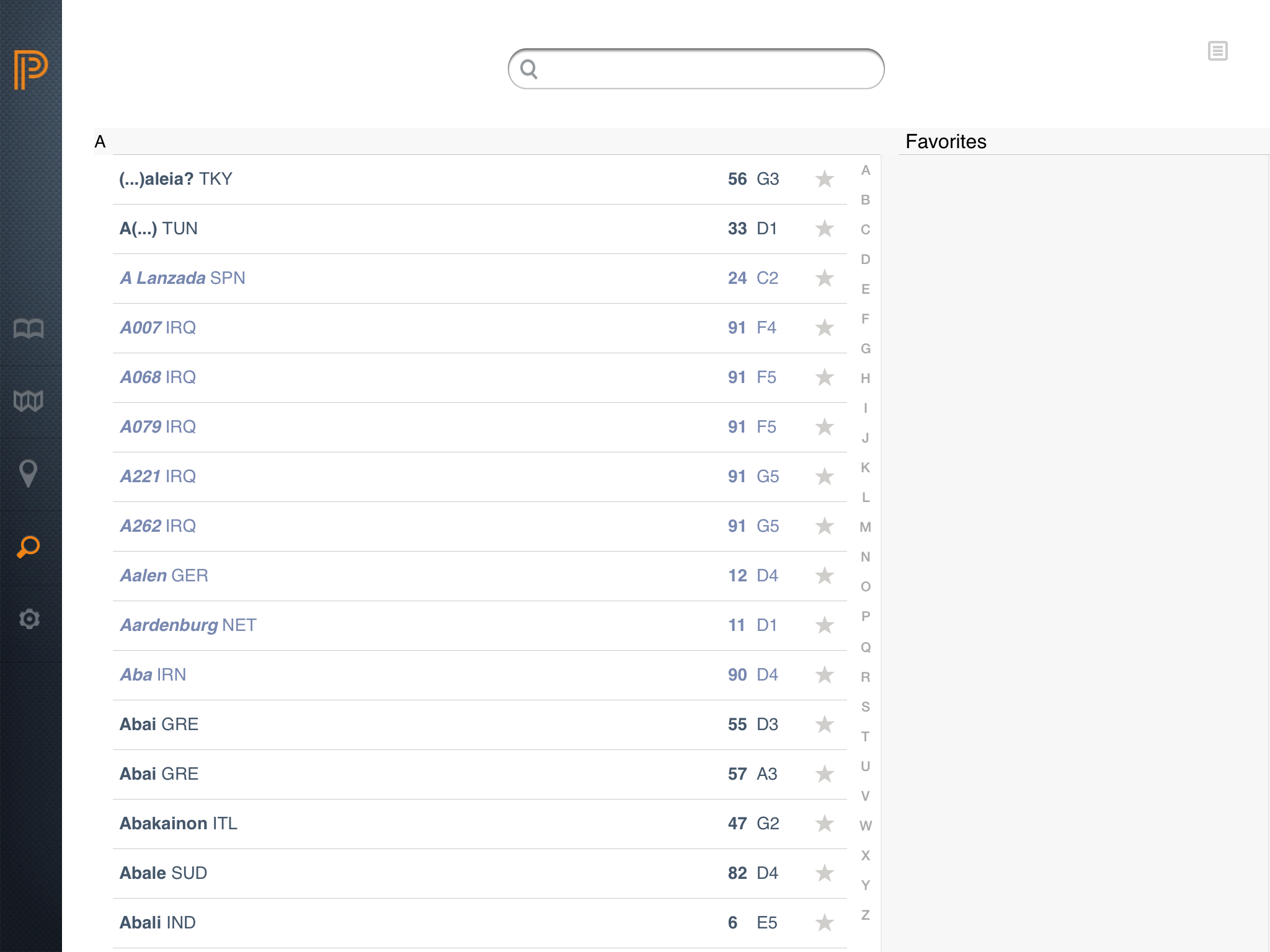
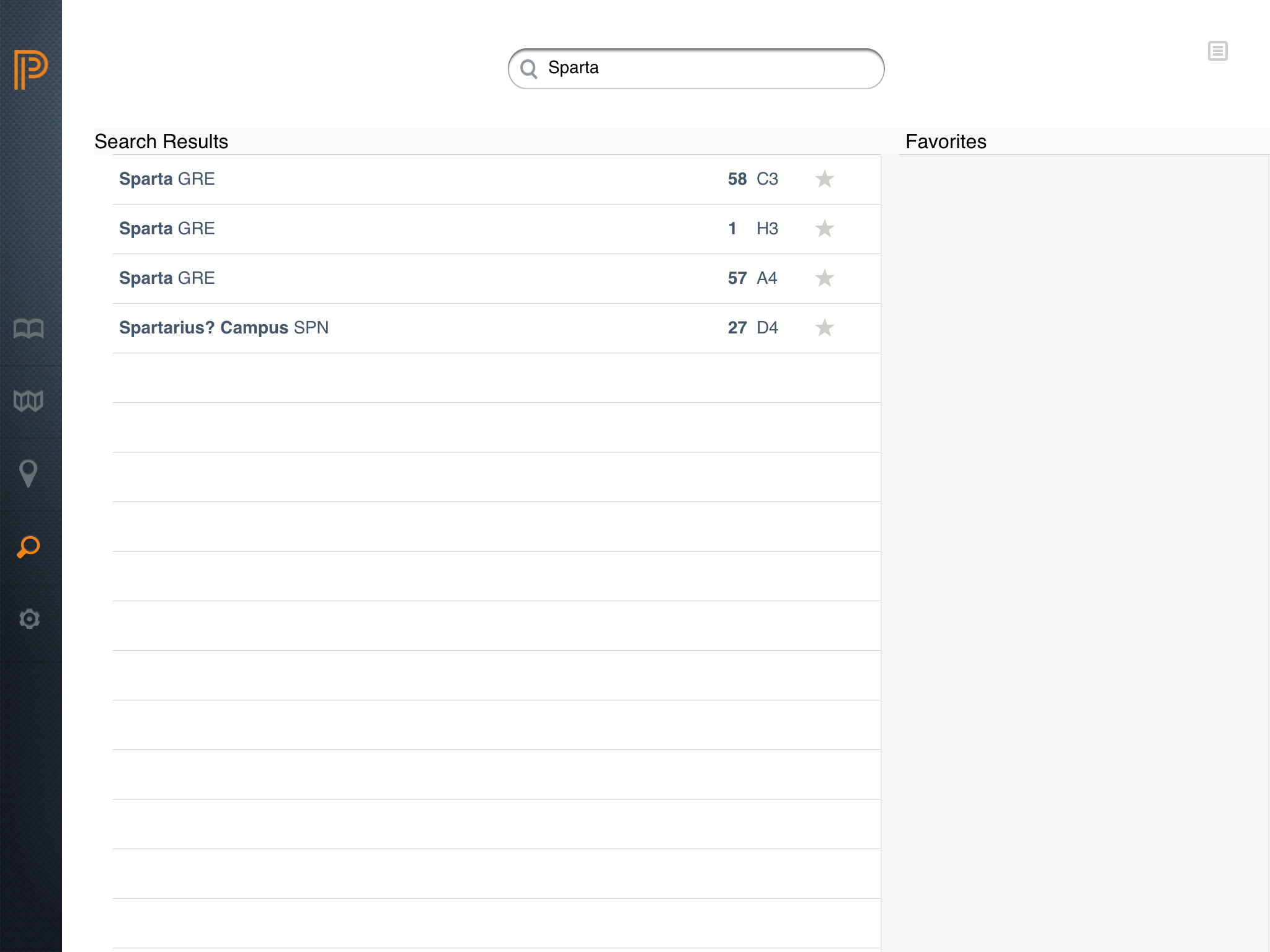
Unfortunately, search results are not saved, so that if you click through to one map, the search must be performed again to see the other maps. It is possible, though, to save individual maps to the Favorites section by tapping the star icon to the right of the map coordinates.
There are a few interesting features within the maps themselves. Tapping in the center of a map drops down a tool bar containing key and compass icons. Selecting the key icon slides out two drawers from the right which elucidate the symbols and coding of features and time periods on the map. This is a vast improvement over the print edition which required flipping back and forth within the atlas to read the key.

Tapping the compass icon in the tool bar reveals thumbnail maps of adjoining regions that can be used as short cuts to those maps. Additionally, a large compass icon appears in the center of the screen; touching this icon reorients maps so that true north appears at the top of the screen.

It also enlarges the map, which is less useful, forcing you to carefully zoom out again to see most of the map. It is extremely easy to accidentally zoom entirely out of a map and into the map browser; the creators might consider removing the feature allowing users to zoom out to the map gallery as it serves little purpose and can result in some frustration.
Version 1.1 has already begun to address some of the issues noted by early adopters. The app no longer cycles through the start-up sequence again after backgrounding; instead it picks up on the page or map last viewed. Stability has also been greatly increased. In version 1.0 the app was given to crashing during navigation, however, I have not experienced any crashing since upgrading to version 1.1. Also, smaller symbols and place names on maps that would often appear slightly blurry in version 1.0 when fully zoomed in, are crisp and easily read in version 1.1.
Still there are a few missteps, almost all of which appear to result from mimicking the print volume in digital format too closely. For example, the Introduction tab simply replicates the same material of the print edition, including table of contents and credits. While the introduction itself is worth reading, I am not certain how useful the table of contents from the print edition is within a digital app. It seems unlikely that someone searching for a map would backtrack to the introduction rather than simply use the browse or list features. Moreover, the short tutorial provided for the app is static and buried in the help section of the main menu. It would be beneficial to either pop-up the tutorial the first time the app is opened or run a short video illustrating how to navigate the app.
I could wish for more interactive features within the app, such as the ability to plot routes and otherwise manipulate the maps— similar to what is found in the Ancient World Mapping Center’s on-line tool Antiquity á la Carte— but that would, I suspect, require designing entirely new maps from the ground up. I might also wish that the app was available on more platforms. As of this moment it is limited to Apple’s iOS, preventing Android tablet owners from using this wonderful resource.
Overall, the app version of the Barrington Atlas of the Greek and Roman Worlds is an admirable effort. It provides all the information and resources of the original Barrington Atlas in an easily transportable format at a fraction of the cost. It is significantly more accessible to students and scholars at home or on the road and I suspect that, like its predecessor, it will become a standard tool for students of the ancient world.
This review of the Barrington Atlas App tested version 1.1 and was conducted on a 128GB iPad Air running iOS 7.0.4.
From the wonderful Sister Therese Marie Dougherty come these announcements, (borrowed from the latin-bestpractices listserv):
LLT511 Teaching Caesar and Vergil Spring 2014
This workshop-format course will cover the content of the new AP Latin syllabus, with a focus on teaching translation, grammar, scansion, essay writing and other components of the AP Latin exam. Classes will meet on six Saturdays from 8:30 to 3:00, beginning February 1 and ending May 10. An on-line option will be available for anyone who lives too far to commute. Meeting dates are February 1, 22, March 8, April 5, 26 and May 10. Students earn 3 graduate credits. Further information and registration forms may be obtained from Sister Therese Marie Dougherty at tdougherty@ndm.edu<mailto:tdougherty@ndm.edu>.
Tour of Roman Britain July 7-19, 2014
A ten-day program in England, July 8-18, plus two travel days. Most of the program will be based in London where we will examine artifacts from the Roman period in the British Museum and the Museum of London and visit some of the remains of Roman Londinium. Day trips will include Fishbourne Palace, Bath, Colchester, Cirencester and Verulamium. Our program will conclude with a tour of Roman Chester and the Roman fort at Vindolanda.
Register now to reserve a place. Information and registration forms are available from Sister Therese Marie Dougherty at tdougherty@ndm.edu<mailto:tdougherty@ndm.edu>.
Sister Therese Marie Dougherty, SSND, Ph.D.
Professor of Classics
School of Arts and Sciences
Notre Dame of Maryland University
4701 N. Charles Street
Baltimore, MD 21210
Phone: 410-532-5559
Fax: 410-532-5794
This is a talk I gave at the APA on Jan. 4, 2014, as part of a panel organized by the Society for the Oral Reading of Greek and Latin Literature. The full assignments, rubrics, and student projects are available here. The handout with a couple more links and Quintilian’s Guide to Dignified Gesturing, is below.

There are many ways to keep the sounds of Greek and Latin alive, and make them part of the classroom and the learning process. I want to share with you a podcasting assignment that helps me do this, and I hope that some aspects of or variant on it may be helpful to you as well. I use it in my fourth semester Latin and Greek classes, which are called “Introduction to Latin Poetry” and “Introduction to Greek Poetry.” The Latin course (typically 15 people) is based around Catullus and Ovid’s Amores, the Greek course (typically about 7) around the Odyssey. In addition to reading and transl
ating, the students do an assignment comparing different published translations of a particular poem or passage, to get them focused on close reading and different styles of translation. The podcast follows that, as a summative “final paper” substitute. The final product is a 6-8 minute audio recording with three parts:
This assignment reinforces the point that Greek and Latin poetry was performance art, meant for the ear, not just the eye. But it also helps forward my central learning goals for the class:
[See full assignments here: Latin, and Greek versions.]
Through the process of drafting the script and making the recording the students hit all these areas in ways that harness their creativity, help them fully master and “ownetize” a poem, contextualize and explain what they like about it to an audience of their peers, relating it to its historical context and its larger themes. The podcast medium, unlike a traditional research paper, is a piece of public scholarship, in which the students point out specific stylistic features, discuss its effect, and actually perform it for an audience, but without the pressure of a live audience. They attempt to explain, translate, and perform the poem as an authentic piece of verbal art.
Results vary, of course, but are often something to be proud of. Podcasts by my students are perennially at or near the top downloads on Dickinson’s iTunesU channel, and occasionally get a comment or two from the internet on the WordPress blog where I also post them. Of course, not all of them are perfect. For broadcast ideally we want not just good, correct writing, but something to grab the attention of the listener and hold it; not just competent recitation, but audible passion; not just research, but insight and application; not just accurate translation, but English that sings. In short we want not just excellence, but panache.
Now of course panache is exactly what you think about when you think about an academic research paper for a Latin class. Wait, no, it’s not. The reason I keep doing this assignment is not just because it fosters performance of Latin and Greek. It is also because of the way it transforms the writing process, wresting it from the Soviet tyranny of the five paragraph essay with its fulsome, stilted introduction, its formulaic paragraph structures and transitions, its smoke-blowing vaguery, its bottomless insincerity. The required style is more journalistic than academic. The main idea has to be up front, not languishing at the end of the first paragraph. You need to give the listener a reason to care. Since this writing has to be capable of being processed by actual human beings, not me, I am put in the position of a coach, rather than a judge and executioner. Students are thus much more willing to re-write and take advice, much less threatened when I criticize their work. The most common comments I make on the first drafts are
An in-person meeting is essential to get the recitation up to snuff. Most students are petrified about the meter and the macrons. This meeting is opportunity to make the point that there is really no such thing as reading “in meter.” Pronounce it well, read it like you understand it, sell it, perform it, that’s what counts. Here again the presence of that external audience and the project-based nature of this make the students much more willing to take instruction, less like a class and more like a music lesson.
Passing out a rubric ahead of time is also helpful.
This to me is a good example of the use of technology that, far from distracting for the core values of the humanities, enacts them, while at the same time working on public speaking skills and technological competencies that will be useful far beyond the Latin classroom. This kind of thing is really in some ways a recuperation of Roman traditions of rhetorical education and public speaking. The advent of digital humanities and of social media (which are two different things) is an opportunity to revive the ancient art of rhetoric, a point stressed by the entirely classicist-free group of authors of the 2012 book Digital Humanities:
In the era of pervasive personal broadcasting, the art of oratory must be rediscovered. This is because digital networks and media have brought orality back into the mainstream of argumentation after a half-millennium in which it was mostly cast in a supporting role vis-à-vis print. You Tube lectures, podcasts, audio books, and the ubiquity of what is sometimes referred to as “demo culture” in the Digital Humanities all contribute to the resurgence of voice, of gesture, of extemporaneous speaking, of embodied performances of argument.
Anne Burdick, Johanna Drucker, Peter Lunenfeld, Todd Presner, and Jeffrey Schnapp, Digital Humanities (Cambridge, MA: MIT Press, 2012), p. 11, original emphasis.
In closing, I’ll offer you some advice from that great Roman professor of rhetoric Marcus Fabius Quintilianus on how to take this podcasting approach to Greek and Latin orality one step further into the realm of video podcasting. Quintilian discusses performance and gesture at length in his treatise on the education of the orator. For your enjoyment I abstracted the key points about gesture, essential stuff as we make the move to Latin and Greek on Youtube:

Podcasting Training outline (Brenda Landis, Dickinson Media Center): http://blogs.dickinson.edu/mediacenter/2011/07/27/podcast-training-outline/
Tutorials:
Audacity: http://lis.dickinson.edu/Technology/Training/Tutorials/other/audtut.pdf
Garageband: http://lis.dickinson.edu/Technology/Training/Tutorials/media/GB%20tutorial.pdf
iMovie: http://blogs.dickinson.edu/mediacenter/files/2010/10/imovie-09-tutorial.pdf
In preparation for a project to edit notes from older school editions of the Aeneid for a commentary on the AP Latin selections (similar to the existing one for the Caesar selections) I have been assembling a collection of scanned Aeneid editions on Google Books and Archive.org. It’s not exhaustive, and consists mainly of those with notes in English (I also included Conington and Norden, which hardy fit the bill for school editions but are of great scholarly value). Still, I wanted to share the gleanings so far, and would appreciate any additions or comments. Frieze is of particular interest to me because of his very full Vergilian dictionary. Thanks, and happy holidays!
Anthon, Charles. The Aeneid of Virgil, with English Notes, Critical and Explanatory. New York: Harper and Brothers, 1843. Google Books.
Chase, Thomas. Six Books of the Aeneid of Virgil. Philadelphia: Eldredge and Brother, 1871. Google Books.
Storr, F. Books I and II of the Aeneid of Vergil. Oxford: Rivington’s, 1878) Storr is listed as “Chief master of moderns subjects in Merchant Taylor’s School, and late assistant master in Marlborough College.” Google Books.
Gossrau, God. Guil. Publii Vergilii Maronis Aeneis. 2nd ed. Quedlinburgi: Godfredus Bassus, 1876. Archiv.org. Complete Aeneid with notes in Latin!!!
Howson, E.W. P. Vergili Maronis Aeneidos Libri II. et III. London: MacMillan and Co., 1881. Google Books.
Sidgwick, A. P. Vergili Aeneidos Liber II edited with English notes. Pitt Press Series. London: C.J. Clay, 1884. Google Books.
Frieze, Henry S. The Twelve Books of the Aeneid of Vergil with notes and a Vergilian Dictionary, 2nd ed. (New York: American Book Co., 1883). Google Books Internet Archive
Robertson, Rev. J. Vergil’s Aeneid: Book I with Examination Papers, Notes and Vocabulary. London: Joseph Boulton, 1883. Google Books.
Conington, John. The Works of Virgil with a Commentary, vol. II, Containing the First Six Books of the Aeneid. 4th ed., rev. by Henry Nettleship, London: Whittaker & Co., 1884. Google Books.
Wetherell, J.E. Vergil’s Aeneid: Book I. Toronto: Gage, 1884. Archive.org
Stephenson, H.M. P. Vergili Maronis Aeneidos Lib. IV. Edited for Schools. London: MacMillan & Co., 1888. Archive.org.
Papillon, T.L., and A.E. Haigh. Virgil, with an Introduction and Notes, vol. 2, notes (Oxford: Clarendon, 1892). Google Books.
Harper, William R. and Frank J. Miller, Six Books of the Aeneid of Vergil. New York: American Book Co., 1892. Archive.org (not a terribly good scan). Google Books with Eclogues
Walpole, Arthur S. P. rev. H.C. Johnson, Vergili Maronis Aeneidos Liber 1.New York: Macmillan, 1893. Google Books.
Comstock, David Y. Virgil’s Aeneid: Books I-VI, VIII, IX, and Selections from the Other Books. Boston: Allyn and Bacon, 1894. Comstock was Principal of St. Johnsbury Academy, Vermont. Google Books.
Greenough, J.B. and G.L. Kittredge. The Greater Poems of Virgil, vol. 1, The First Six Books of the Aeneid. Boston: Ginn and Co., 1895. Google Books.
Henderson, John, and E.E. Hagarty. Vergil’s Aeneid Book II. Toronto: The Copp, Clark Company, 1898. Archive.org.
Nettleship, Henry, and Wilhelm Wagner. Vergil’s Aeneid Books V. to XII. London: George Bell & Sons, 1898. With English Notes abridged from Conington. Google Books.
Warman, A.S. P. Vergili Maronis Aeneidos Liber Quartus. London: George Bell & Sons, 1899. Assistant Master at the Manchester Grammar School. He quotes frequently from Sidgwick, whose “notes have a clearness of power and stimulating interest,” but is pitched to “older boys.” Archive.org
Knapp, Charles. The Aeneid of Vergil. Books I-VI, Selections from VII-XII. Chicago: Scott, Foresman &Co., 1900. Google Books.
Page, T.E. The Aeneid of Vergil. Books I-VI. London: MacMillan & Co. 1902. Archive.org. 1967 reprint much better quality.
Henry S. Frieze, Vergil’s Aeneid Books I-VI, revised by Walter Dennison (New York: American Book Co. 1902) Google Books
Sidgwick, A. P. Vergili Maronis Aeneidos Liber I. Cambridge: Cambridge University Press, 1904. Archive.org.
Bennet, Charles E. Virgil’s Aeneid: Books I-VI. Boston: Allyn and Bacon, 1905. Google Books.
Carter, Jesse Benedict. The First Six Books of Virgil’s Aeneid. New York: D. Appleton and Co., 1906. Google Books.
Ladewig, Th., Karl Julius Heinrich Schaper, P. Deuticke, and Paul Jahn, Vergils Gedichte, Bd. 2, Buch I-VI der Äneis. 13th ed. (Berlin : Weidmann, 1912).
Jerram, C.S. Virgil: Aeneid 1. Oxford: Clarendon Press, 1916. Archive.org. Good for breaking up text into chunks.
Carruthers, Adam, and J.C Robertson, Virgil, Aeneid: Book 1.1-510. Toronto: Gage & Co., 1917. Archive.org.
Carruthers, Adam, and J.C. Robertson, Virgil: Aeneid: Book 2.1-505. Toronto: Gage & Co., 1918. Archive.org.
Fairclough, H.R. and Seldon L. Brown, Virgil’s Aeneid Books I-VI with introduction, notes and vocabulary. Chicago: Benj. H. Sanborn, 1919 (orig. 1908, reprinted with corrections 1912, 1919, 1920). Google Books
Norden, E. Aen. 6. Leipzig 31926. 1903 edition at Archive.org
Perseus digitized some Greek grammar resources early on (see below), but since then more has become available in .pdf form from thanks to Google Books and Archive.org. This survey for some reason does not include scans of books. One need in my view is for a good searchable school grammar of ancient Greek. The searchable ones currently available are of the more systematic variety, and are potentially bewildering to students and non-expert readers. Smyth and his 3048 chapters is not for everybody. The best choice in English in my opinion would be Goodell (see below). This spring DCC will be embarking on a project to digitize it properly, making it searchable, and integrating it into the notes of our forthcoming Greek commentaries. This will be done with crucial assistance from Bruce Roberson at Mount Allison University, and Rigaudon.
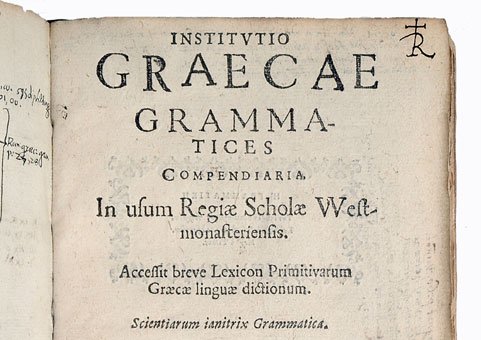
Frontispiece of Greek grammar, William Camden, 1598, via museumoflonson.org.uk
Another problem with the existing Greek grammar digitizations at Perseus is that the indices have not apparently been included. The index, as anyone who uses the print versions of these books will be aware, is the primary way that we consult these works, and not having the index amounts to a serious impediment to usability. Our Goodell will be browse-able via the index. And we are almost finished with a modification of the Perseus XML of Allen & Greenough’s New Latin Grammar that includes the index. We hope to make an index-browseable A&G available early in the new year.
Ok, here are some Greek grammars. Let me know your favorites, and if you think I am misguided in my love of Goodell.
Babbit, Frank Cole. A Grammar of Attic and Ionic Greek (New York: American Book Co., 1902). Google Books. archive.org
Buttman, Alexander. Grammar of the New Testament Greek (Andover: Warren F. Draper, 1891) at archive.org
Brugmann, Karl. Griechische Grammatik 3rd edition (Münich: Beck, 1900) at archive.org, and Google Books
Goodell, Thomas Dwight. A School Grammar of Attic Greek (New York: D. Appleton & Co., 1903) Google Books. Archive.org (better scan)
Goodwin, William W. Greek Grammar, revised and enlarged (Boston: Ginn & Co., 1896). Google Books.
Hadley, James. Greek Grammar for Schools and Colleges, revised and in part rewritten by Frederic De Forest Allen (New York: American Book Company, 1912) Google Books.
Meyer, Gustav. Griechische Grammatik, 2nd ed. (Leipzig: Breitkopf & Härtel, 1886) at archive.org and at Google Books (and another).
Monroe, D.B. A Grammar of the Homeric Dialect (Oxford: Clarendon, 1891) at archive.org.
These items are already available at Perseus:
Goodwin,William Watson. Syntax of the Moods and Tenses of the Greek Verb (London, Melbourne, Toronto 1889) Goodwin’s Moods and Tenses
Gildersleeve,Basil Lanneau. Syntax of Classical Greek from Homer to Demosthenes (New York 1900)
Smyth, Herbert Weir. A Greek Grammar for Colleges (1920) and (also at Philologic Chicago)
Kühner, Raphael, Friedrich Blass, and Bernhard Gerth. Ausführliche Grammatik der Griechischen Sprache (ed. Ildar Ibraguimov, Hannover und Leipzig, 1904).

They don’t get much in the way of posthumous glory, but Roman surveyors have left us a wealth of technical treatises, collectively known as the Corpus Agrimensorum Romanorum, which is of unique historical importance for its detailed descriptions of the nature of land settlement, and the role of emperors, especially Augustus, in regulating urban centers in a rural environment.[1] Archaeologist David Gilman Romano, longtime director of the Corinth Computer Project, has been using the Agrimensores to understand the rural geography of Corinth and the nature of Roman re-settlement of the city.[2] One of the highlights of his recent Dickinson Latin Workshop was the handy glossary of Roman surveying terms, given below.
First, though, where can you read these texts online? Several are available on PHI:
Balbus,Exposito et Ratio Omnium Formarum
Sextus Iulius Frontinus, De Arte Mensoria, De limitibus, De controversiis, and De agrorum qualitate,
Hyginus Gromaticus, De limitibus
Siculus Flaccus, De condicioninus agrorum
F. Blume, K. Lachmann and A. Rudorff, Die Schriften der romischen Feldmesser (Berlin: Reimer, vol. 1, 1848, vol. 2, 1852) includes a larger index auctorum. There is also the more recent Teubner edition of C. Thulin, Corpus Agrimensorum Romanorum, vol. 1, fasc. 1 Opuscula Agrimensorum Veterum (Leipzig: Teubner, 1913) which includes Frontinus, Hyginus, and Flaccus, and is the source of the PHI texts. The two earliest manuscripts, dating to the 6th-7th and 9th centuries, have a wealth of color illustrations. Here is a b/w reproduction of a few, from Thulin:
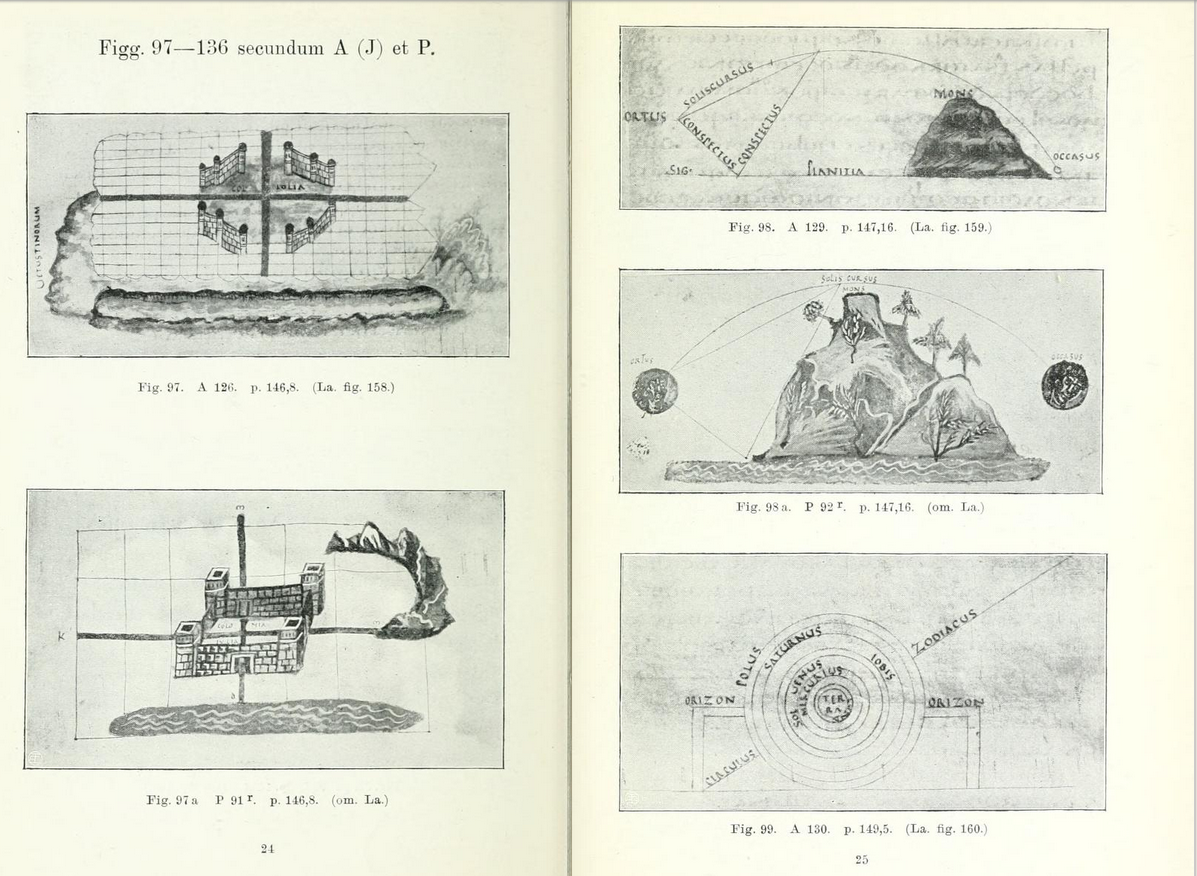
Illustrations from the earliest manuscripts of the Agrimensores, the sixth century codex Arcerianus (A) and the ninth century codex Palatinus Vaticanus latinus 1564 (P), from Thulin’s edition (Leipzig: Teubner, 1913), plates 24 and 25.
A good translation is available in print: J. B. Campbell, Corpus Agrimensorum Romanorum, The Writings of the Roman Surveyors, Journal of Roman Studies, Society for the Promotion of Roman Studies, Monograph Vol. 9, London, 2000; and Prof. Romano also recommends M.J.T. Lewis, Surveying Instruments of Greece and Rome (Cambridge, 2001).
Ok, here is Prof. Romano’s lexicon. May it help to foster the study of these texts! If you are looking for examples of the actual uses of these words, Volume 2 of the Blume-Lachmann-Rudorff edition has a full index verborum.
Abluvio – the erosion of soil by a river
Actus (plural actūs) – linear measure 120 feet
Actus quadratus – an area 120 feet square or ½ iugerum
Ager – field
Ager publicus – land owned by the Roman state
Agrimensor – a land surveyor
Alluvio – the deposit of soil by a river
Ambitus – a space of 2 ½ feet between neighboring buildings for a right of way
Arca – a square or rectilinear boundary marker often hollowed out
Arcifinius – land on the periphery of Roman territory
Cardo – a limes dividing individual centuriae often running north-south and forming a set of parallel limites. Cardo means ‘hinge’
Cardo maximus – the main and widest limes usually north-south
Centuria – a unit of land division created by the intersection of four limites often measuring 20 actus square and containing 200 iugera, each traditionally contianed 100 allotments of 2 iugera
Chorobates – an instrument used for levelling
Cippus – a boundary stone
Colonia – a self-administering community of settlers; Citizen colonies, Latin colonies, veteran colonies
Colonus – a farmer, tenant farmer, farmer in a colony (from colere)
Decempeda – a surveyor’s 10 foot measuring rod
Decumanus – the name given to limes dividing individual centuriae often running east-west and forming a part of a set of parallel limites
Decumanus maximus – the main and widest limes often east-west that intersected the cardo at right angles
Decus – derived from decem (X) in surveying the intersection of two lines in the form of an X
Dioptra – an instrument for surveying or for making astronomical observations
Ferramentum – the iron base of a surveying instrument
Finis – a boundary between territories or landholders
Forma – map
Forum – a commercial or market center
Fundus – one square actus also’ acnua’ also actus quadratus
Geometres – a land measurer
Groma – an instrument for surveying straight lines and right angles. Derived from Greek gnomon
Heredium – a heritable plot of land traditionally two iugera
Indiviso – land not allocated to individuals but left for common pasture land
Iter – pathway, road, journey, right of way
Iter populo non debetur – The roadways in the urban center could be planned and built so as to fully respect the entire calculated area of the insula according to a legal formula iter populo non debetur meaning that the widths of the roads were added outside of the regular iugera measure of the insulae.
Iter populo debetur – In the rural landscape there was a different solution, iter populo debetur, which meant that roadways could be added over land that was divided into iugera for farming purposes. This would mean that portions of the assigned rural land would in fact be utilized as paths or cart roads through the agricultural fields.
Iugerum – two square actus, land able to be plowed by a yoke of oxen in one day.
Latifundium – large estate
Libri aeris – mapping registers associated with a bronze forma containing details of land allocations
Limes (limites) – a man made boundary or balk
Limitatio – the process of establishing intersecting limites to divide land (centuriatio)
Mensor – a measurer
Meta – cone shaped turning post in circus, a surveyors moveable mark
Metator – a surveyor, military surveyor
Norma – a carpenters square
Ager occupatorius – land that the Romans occupied for their own use after defeating an enemy
Pagus – a country district
Passus – a pace or stride mille passus = one Roman mile 1000 paces
Pertica – a surveyor’s 10 foot long measuring rod. Total area measured
Pes – a foot 0.2957 m.
Plethron – a Greek area of land 100 feet square = 10,000 square feet
Possessio – possession of land or object as opposed to ownership
Praefectura – a community of Roman citizens to which Rome had sent out legal officials
Principia – headquarter buildings in a military camp
Proprietas – ownership of an object or land as opposed to possession
Quadrifinium – a place where the boundaries of four properties or territories met
Quintarius – every fifth limes after the KM and DM. It was wider than the other secondary limites
Rigor – a manmade straight line forming a boundary with no width
Saltus – according to Siculus Flaccus 25 centuriae; According to Varo 4 centuriae. An estate
Scamnum – a rectangle of land broader than it was long from the sighting
Servitus – in law an easement or servitude on a property
Striga – a rectangle of land longer than it was broad from the sighting
Subruncivus – limites intervening between KM, DM and quintarii. Means ‘weeded’
Subsecivum – land unsuitable for settlers
Tabulae aeris – bronze records associated with the bronze map
Tabularium – public records office
Terminus – a boundary marker. In Roman religion Terminus was worshipped as the spirit of all boundary markers
Territorium – all land within the boundaries of a community
Tetrans – a quadrant. In surveying the point of intersection of two lines
Usucapio – in law a process by which ownership could be attained by continuous possession
Varatio – the process of diagonal sighting
Vectigalis – land yielding revenue for the Roman state, colony, municipium
Via publica – a publicly maintained road
Vicus – a district, village
Villa – a dwelling associated with at rural estate or farm
1. John Brian Campbell, Oxford Classical Dictionary, 3rd ed., s.v. gromatici
2. David Gilman Romano, “Roman Surveyors in Corinth,” Proceedings of the American Philosophical Society 150.1 (2006), pp. 62-85. Idem, “City Planning, Centuriation, and Land Division in Roman Corinth: Colonia Laus Iulia
Corinthiensis & Colonia Iulia Flavia Augusta Corinthiensis,” Corinth, Vol. 20, Corinth, The Centenary: 1896-1996 (2003), pp. 279-301.
The New York Times has a front page story today under the title, “As Interest Fades in the Humanities, Colleges Worry.” I hated most everything about this story: the assumption that students choose either science or the humanities, the over-hyped crisis rhetoric, the manufactured horse race . . . BUT buried in there is a note about classics students at Stanford using a text annotation program called RapGenius, which is interesting.
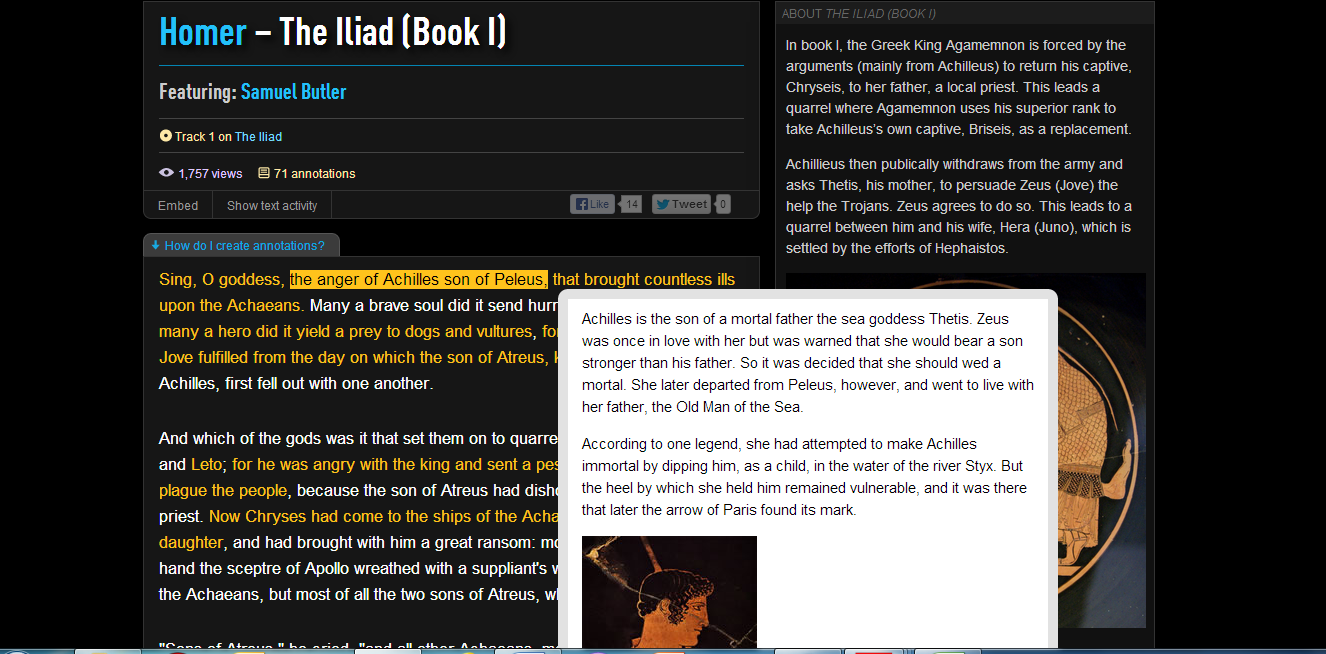
Susan Stephens at Stanford has a class called “Teaching Classics in the Digital Age” that deals with many aspects of pedagogy and research in classics. Jeremy Dean of RapGenius was visiting the class one day this month, and the NYT reporter attended as well, hence the inclusion of this in the story.
The attractive thing about RapGenius is its large community of users, and also its flexibility for annotation. You can annotate by sentence, phrase, word, whatever, and easily add images, audio, and other media to the pop up annotations. Though originally designed for obsessive rap fans to analyze lyrics, the potential of the tool for other branches of the humanities is obvious, and recognized clearly by the company. They hired Dean to be their humanities specialist, and they are developing an alternate brand for the same tool, Poetry Genius.
Oh, and it collects statistics on lyrics and creates effortless visualizations, a la Google Ngrams. Here is the graph for the occurrence of the words “love,” “hate,” and “rhyme.”

As for the humanities crisis, don’t ask a Latinist about that. We’ve taken some hits in the last century or so. On the other hand, my friends in math and science fields certainly don’t seem to feel that everything is ducky in their disciplines. It is a struggle to get students to substantively engage in science and math, just as it is a struggle for us in the humanities. Students are often utilitarian in their thinking, and this should be no cause for surprise or lament. We should use every tool at our disposal to promote learning and intelligent living in all disciplines, and to create connections between, say, computer science and humanities. This is an attractive enterprise to some computer scientists of my acquaintance as well.
Prof. Stephens’ course is a model of this kind of forward, engaged thinking. The description of the course goals lays it out nicely:
This Workshop is predicated on four assumptions: (1) on-line teaching is here to stay; (2) within the career trajectory of those of you who are now graduate students it will replace or force essential modification of traditional classroom and book-centered learning; (3) the field is growing exponentially in tools and sophistication of applications; and (4) we do not all come to these emerging technologies with equal expertise. For those of us with low technical skills, the challenges may often seem to outweigh the rewards.
Therefore the Workshop has as its primary goal to allow us to gain familiarity with a broad range of digital materials currently available for teaching classical subjects (1) initially by engaging with experienced users or designers of various digital media, then (2) by experimenting ourselves with a selection of sites in order to evaluate what works in various teaching environments. You should learn how and in what ways a medium can enhance (or distract from) learning, gain familiarity with various ways of assessing the success of various media in teaching, and understand issues of intellectual property, copyright, and plagiarism. A secondary goal is to facilitate thinking collaboratively about pedagogical issues and to encourage departmental sharing of individual digital classroom materials.
The course is a mix of presentations about all kinds of online resources and digital tools, along with a practicum component in which students create lessons using them. All along there is searching discussion of how to marry tools to learning goals in an intelligent way. RapGenius may not be your cup of tea, but the kind of dialogue going on at Stanford among humanists and those in other fields about digital tools and humanistic methods is exciting, forward thinking, and unfortunately missed by the big media outlets. But then again, I guess that’s why we have blogs.
DCC board member Wille Major of Louisiana State University sends along this handy guide to typing polytonic Greek in a Windows environment—no special keyboard required.
TYPING ANCIENT (POLYTONIC) GREEK
in a Windows environment
This is a practical guide to setting up Windows to type ancient (polytonic) Greek. It does not require you to purchase or install any software, just to activate a feature in Windows.
Step 1: Activate polytonic Greek in Windows
Setup instructions for Windows Vista or Windows 7
1. Go to the Control Panel.
2. Select Clock, Language and Region (or Regional and Language Options).
3. Select Change keyboards and other input methods.
4. A window will appear. Select Change Keyboards button.
5. A window will appear with three tabs. The “general” tab is open by default. Click the Add button.
6. You will see a list of keyboards based on languages. Scroll down and click on Greek, and then select Greek Polytonic keyboard.
7. Click OK on this tab and then all the previous tabs until you are back in the Control Panel. Close the Control Panel.
Setup instructions for Windows XP
1. Go to the Control Panel.
2. Double-click Regional and Language Options.
3. Click the Languages tab,
4. Click Details under “Text Services and Input Languages”
5. Click Add under “Installed Services”
6. You will see a list of keyboards based on languages. Click on Greek Polytonic from the list.
7. Click OK on this tab and then all the previous tabs until you are back in the Control Panel. Close the Control Panel
After you activate Polytonic Greek, you should have a language button or taskbar similar to one of the images below.
• The English keyboard is represented by the letters EN.
• The Greek keyboard is represented by EL.
By clicking on this symbol, you can toggle between the English and Greek keyboard at any time! You can move and manipulate the appearance of the bar if you wish.


If you want, you can pull up keyboard images and type directly on them.
• Go to START:
• select ALL PROGRAMS
• select ACCESSORIES
• select ACCESSBILITY (or EASE of ACCESS)
• select “On-screen Keyboard”
IMPORTANT: No matter how you input polytonic Greek, you must use a Unicode font. If the basic alphabet and vowels with acute accents appear correctly, but other accents and breathings do not appear correctly, it is because the font you are using is not consistent with Unicode. There are many Unicode fonts available, but a good one that comes with Windows is “Palatino Linotype.”
Step 2. The keyboard layout of the Greek alphabet and punctuation
These layouts show the placement of the letters. This arrangement is the same for Ancient and Modern Greek keyboards. The keys in yellow will be used for placing polytonic diacritical marks:
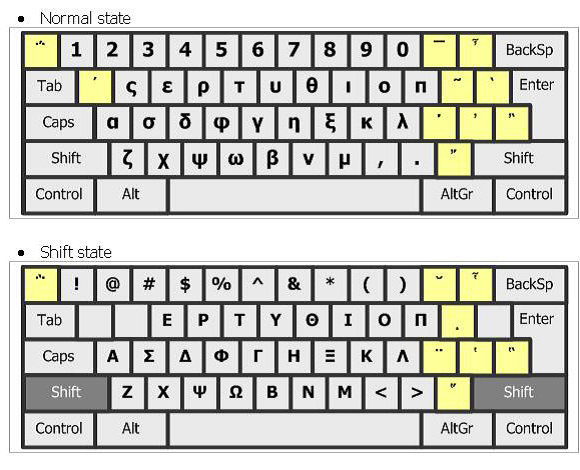
Punctuation
remember: “q for question”!
Make sure to type the space after the q. Otherwise, if you type a vowel next, it will put an accent on the vowel. (See below.)

The Dickinson College Department of Classical Studies will sponsor a full day Saturday Workshop of interest to teachers and students of the classical world and of archaeology.
Ancient Corinth and Roman City Planning
Saturday, November 16, 2013, 10:00 a.m. to 5:00 p.m. Tome Hall Room 115.
Speakers:
 Dr. David Gilman Romano, Karabots Professor of Greek Archaeology at the School of Anthropology, University of Arizona, and Director of the Corinth Computer Project and the Archaeological Mapping Lab
 Dr. Nicholas Stapp, Director of Geospatial Research at the Archaeological Mapping Lab at the University of Arizona
There will be four hour-long sessions, with time for questions and discussion. Lunch will be provided. The workshop is free of charge, but to order materials and food we need to have an accurate count of attendees. To register please contact Terri Blumenthal at blumentt@dickinson.edu by November 10, 2013.
Description:
When the former Greek city of Corinth was settled as a Roman colony by Julius Caesar in 44 BC Roman land surveyors were called upon to lay out the urban as well as the rural aspects of the new colony. In the 70s AD when a second Roman colony was founded there, again the agrimensores were involved in new organization of the city and landscape. The agrimensores were Roman land surveyors responsible for the planning and measurement of cities and landscapes all over the Roman world. They were a professional group, usually a part of the Roman army, and we know a good deal about their work from a compilation of ancient texts known as the Corpus Agrimensorum Romanorum. The Corpus was originally compiled in the fourth or fifth century AD, but includes texts as early as the first century AD. These texts give us substantial information about the training of the agrimensores and their day-to-day activities as well as some of the practical issues that they faced in the field.
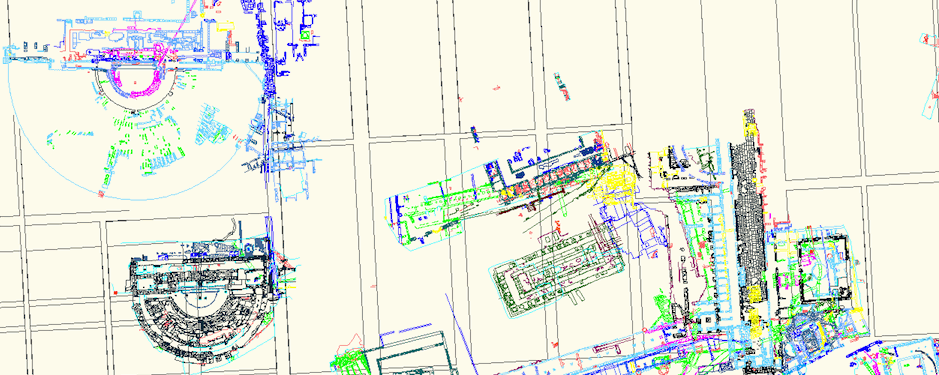
Since 1988 a research team from the Mediterranean Section of the University of Pennsylvania Museum of Archaeology and Anthropology at the University of Pennsylvania has been involved in making a computerized architectural and topographical survey of the Roman colony of Corinth. The leader of this team, Prof. David Gilman Romano (Karabots Professor of Greek Archaeology at the School of Anthropology, University of Arizona), will present a workshop on the results of the Corinth Computer Project, http://corinthcomputerproject.org/ as they relate to the ancient written evidence for Roman city planning. He will be joined by Dr. Nicholas Stapp who has worked with Dr. Romano on the Corinth Computer Project since 1995. He is an archaeologist and an expert in the use of new emerging technologies in higher education and research.
In the workshop participants will learn some of the Latin terms that refer to Roman surveying and city and land planning and, in addition, they will learn about high tech methods utilized in the research: electronic total station survey, digital cartography and remote sensing, utilizing air photos, balloon photos and satellite images, all in the study of an ancient city. The planning of the urban and rural aspects of two Roman Colonies at Corinth are outlined in detail, including some of the social, economic and political implications of these foundations.
Anyone with an interest in Roman culture and archaeology; digital cartography, GIS, and spatial analysis; ancient and modern surveying techniques; or city-planning and urban design will find this a rewarding workshop.
Funding for this workshop is provided by the Roberts Fund for Classical Studies at Dickinson College.