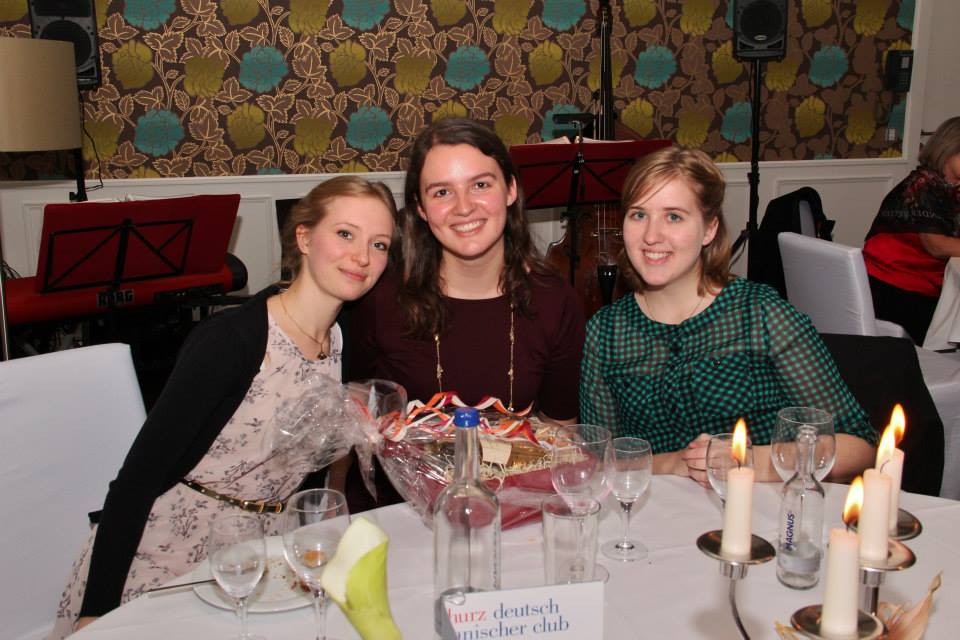
It was by coincidence that this little get-together at Dickinson happened on March 17, 2012, which made it all the more fun!
Beer is a staple of any social gathering or meal in Germany but the way it is made is a mystery to many people. The Dickinson in Bremen program recently took a tour of the Beck’s Brewery right here in Bremen to discover more about this important and delicious drink. We first learned that Beck’s is not only the most popular beer here in Bremen but that it is also Germany’s largest export beer. It can be found in every corner of the globe. The next part of the tour took us through the process of beer production; from harvesting the hops to bottling and packaging the product. Finally, we were able to sample various types of beer produced at the Beck’s brewery. They had us guess whether the beer was Beck’s, Alcohol-free Beck’s, or Haake Beck, a beer produced by Beck’s but only served in Northern Germany. The Dickinson crew guessed correctly with only 4+ months of drinking Beck’s and Haake Beck under our belt. To our surprise, we were not rewarded with a lifetime supply of beer.
With all other Dickinson students having flown the Bremen-coop, I was left to experience New Year’s Eve in Bremen by myself. Fortunately I had two great Bremen-natives, Verena M. and Christine M. to show me the ropes of the quirky German New Year’s traditions. Even before arriving at Verena’s apartment in the Neustadt in the evening, I heard loud cracking and popping sounds all day in my usually quiet neighborhood; I should have realized that that was only a small sign of the firework enthusiasm I would later experience that evening.
Much like the yearly holiday showings of “It’s a Wonderful Life” and “A Christmas Story,” Germans enjoy watching a short film titled, “Dinner for One” or “Der. 90. Geburtstag” on New Year’s Eve. Afterwards we ate the traditional jelly-donuts ‘Berliners’ and also did the traditional ‘lead pouring’ called ‘Bleigießen.’ This process involves melting lead shapes on a spoon over a candle, pouring the liquid into a pot of cold water and then telling fortunes from the shapes formed in the water.
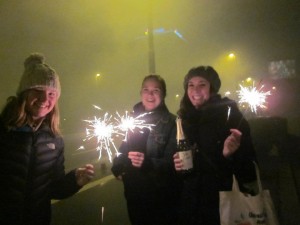
We then decided to brave the streets to watch the fireworks along the Weser River. Words cannot describe how chaotic and wild everything was. Little kids were handed rockets to set off, groups would walk along and toss fire-crackers in the streets and at cars driving by, and the cracks, pops and whistles were so deafening that it almost felt like I was in a war-zone. Unlike the big city-organized firework displays one finds in the United States, Germans buy and set off their own fireworks. Verena informed me that fireworks are only available during the few days before New Year’s and that otherwise you can’t find them in Germany, which helps account for their general pyro-enthusiasm. After lighting our own rather tame sparklers and toasting the New Year with some champagne, we managed to find our way back home through the smoke-filled streets. I hope to bring back some of the German traditions I learned!
by Gwyneth van Son ’13
What?! We have to feed ourselves?!
Nope, no three meals a day at the cafeteria, no maintenance staff, and no campus life living. This, my friends, is as close to the real world as I ever care to get. Here at the Bremen program we have no host families, but rather live in apartments owned by the university and receive a stipend (due to the lack of an all you can eat buffet). However, because I so love to be different, I live in a private apartment with Verena, a German TA in 2010-2011. Verena and I live in the Neustadt, which is about a 30-minute tram ride away from the University of Bremen (a very long way away by Dickinson standards). There are, however, many advantages to where we live; we are not very far from the inner city and we walk one minute to both the grocery store and the tram stop. Our building is very much the typical old single family Bremen townhouse renovated into apartments. It has three stories, a basement, balconies, a garden in the back and very high ceilings. The one thing that makes our building standout is that it is bright pink with a mural of water lilies painted on the front.
Because I decided to live in a private apartment that meant I needed to purchase a few things, such as a bed. Two highly successful trips to Ikea were made, one with Verena and one with Jens. I now feel I can truthfully say I know my way quite well around the Ikea store, if a guided tour is requested I am more then happy to oblige. I managed to find a great bed on Bremen’s much less creepy version of Craig’s list, and due to Jens it was speedily dismantled, transported, and rebuilt.
My living situation in Bremen may be completely different from that at Dickinson, but the one thing they have in common is that there is always something to be done in terms of decoration. Even after I move out of a room I think of how I could have decorated it differently, and I know with my apartment here it will be just the same. After living in a dorm for the last two years I enjoy cooking for myself, cleaning the apartment and knowing no one except Verena or I will come in and leave dirty dishes in the sink, as well as the lack of constant loud music. Our landlords, who live above us, are thankfully not into blasting music so loud that I worry for their future ability to hear. I am sure, however, that after eleven months of real life living I will welcome back dorm life and the caf with wide open arms, but until then I am perfectly content to live the life of a big kid.
Dickinson connects, even beyond school!
Caitlin Hahn ’08 spent her year abroad in Bremen and – after graduating – came back to Germany with a Fulbright scholarship to teach English in Hamburg. She decided to stay in Germany and enrolled in an applied literature degree course at Free University in Berlin. Insa Kohler (TA ’10) and Jens Schröder (TA ’07) studied at Uni Bremen and only heard about Caitlin through others. Now that Insa is enrolled in the same degree course at FU Berlin as Caitlin, they both met for the first time in person. So, Jens finally took the chance to visit them both while attending a conference in Berlin.
1. Bergen, on the southwestern coast of Norway, is the country’s second-largest city.
2. Someone setting out from Bergen for the village of Flåm by train to Voss, bus to Gudvangen, and finally boat would arrive in five hours.
3. This would be at the end of the Aurlandsfjord, a branch of Norway’s longest fjord, the Sognefjord (over 200 kilometers). Walking the ten kilometers along the Aurlandsfjord from Flåm to Aurlandsvangen, the administrative center of Aurland municipality, one could only follow the hiking path from Flåm partway. (The remainder to Aurlandsvangen must be walked along the E16 highway.)
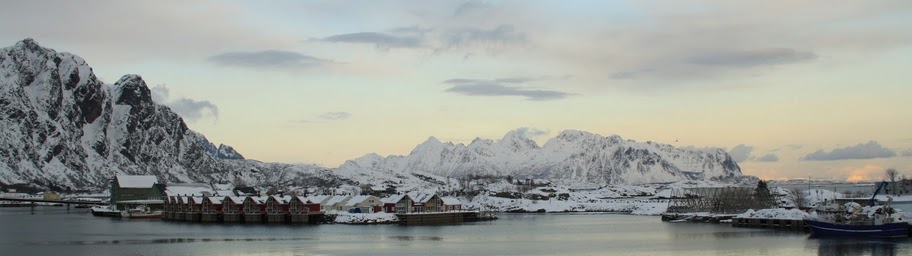
4. If on a winter’s morning a traveler outside the village of Flåm at this point ascends the steep slope, what story up there awaits its end? The houses stand from the 17th century.
5. On your way to Myrdal with the Flåm Railway, you pass by the Kjosfossen, frozen in winter.
6. There is an excellent view of Bergen from Mt. Fløyen, one of the seven mountains surrounding the city. But which ones are these?
7. A departure from the gateway to the fjords on a northbound Norwegian ferry would bring one to the Art Nouveau city of Ålesund on the following afternoon. 418 steps ascend to the Mt. Aksla summit.
8. The coastline grows increasingly rugged going north after leaving Trondheim, but may remain under cloud and snow still falling faintly.
9. North of the Arctic Circle, sea eagles watched us near Ørnes.
10. Snow faintly falls on dark tree-lined ridges, in a network of lines that enlace, in a network of lines that intersect.
11. Imagine that the same previously shaded islands and snow-covered coasts were, southbound, sunlit.
12. Along the Trollfjord, one almost wants to say that this is the most spectacular segment of coastline, but what does that mean here?
13. The second time in Trondheim, following the trend of returning, was warmer and brighter, weather in which the near rainbow colors of the warehouses lining the Nidelva showed themselves even more vibrantly.
14. Not yet home, we rearrive to the far calls of gulls amidst the mountains of Bergen.
by Nicole Couturiaux ’12
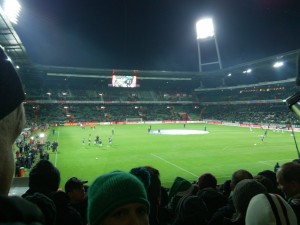
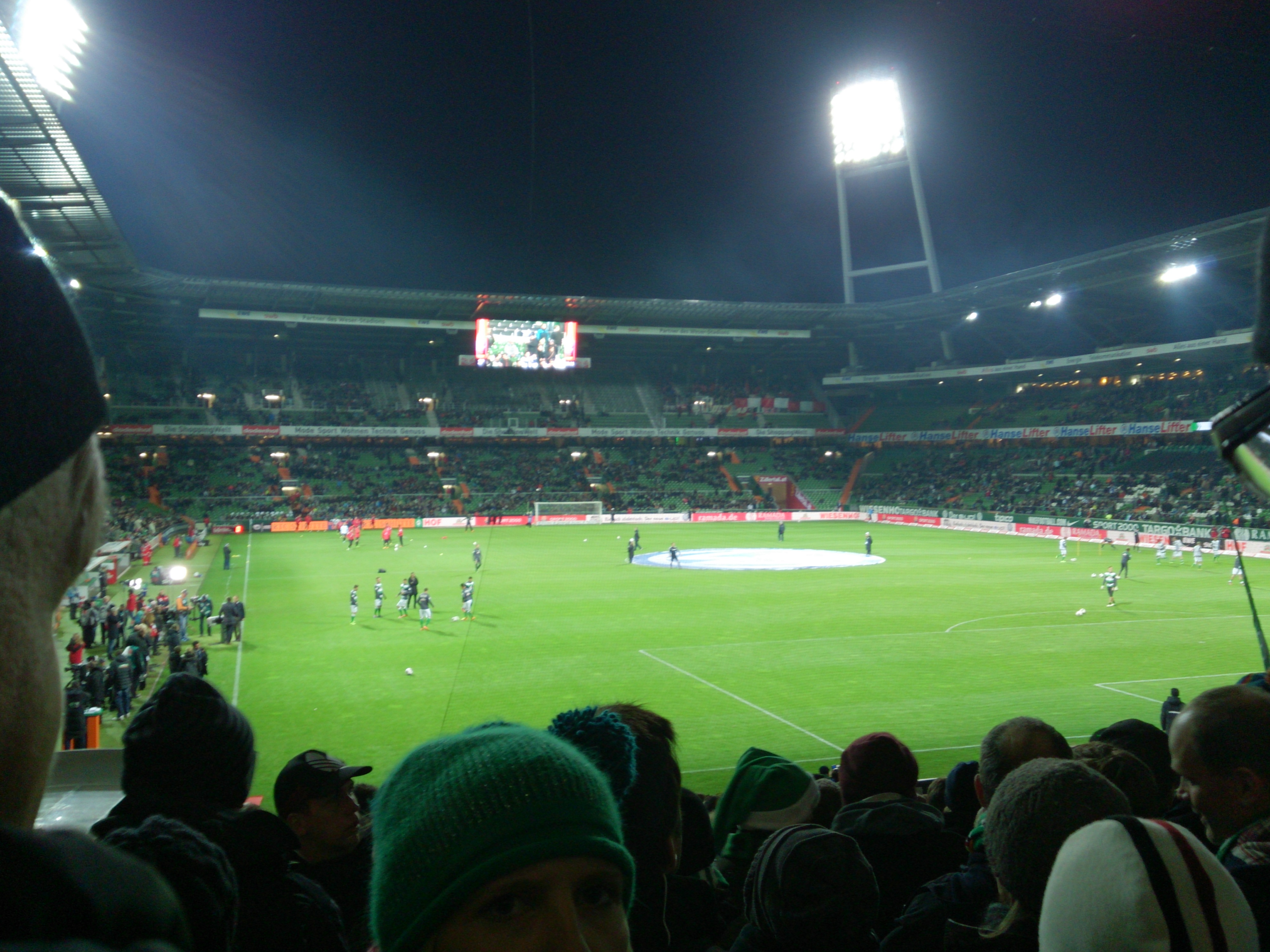
When local Fußball club SV Werder Bremen has a home game, the entire city gets decked out green and busy with energy from thousands of fans. I get caught up in the frenzy too, sporting my Werder scarf and meeting up with friends to join the public viewing in pubs downtown. This past Friday, though, my fanship was taken to a new a level.
Prof. Ludwig and Jens were able to score tickets for the game against Wolfsburg, so the Dickinson in Bremen program took an evening excursion to the standing block of the stadium. Our group was in the center of the action. Everything you may have heard about the German passion for Fußball is true – and then some! Bratwurst and bier abound, huge flags and scarves are waved in the air, and Bremen’s team chants and songs ring continuously through the stadium.
The best is when the Werder team/lineup is introduced with the announcer calling out the player/coach’s name and the crowd yelling back the last name. At the end of the intro, the announcer calls out “#12, that’s…” and the crowd roars “us!” back and forth a million times! There are actually only 11 players from a team on the field at once, but this cheer shows how strong and important the role of the fans really is. You also get the sense that Werder is much more than a team, Fußball much more than a sport. It’s a commitment, and one that often lasts a lifetime. Though Werder was unable to score and in the end lost, our group had a great time and we’ll ready to show our support in next game – back at our usual pub seating.
by Julie King ’12
Early Monday morning Bill flew home back to the United States. He left before the end of our winter semester here to make it back in time for the beginning of spring semester at Dickinson, where he has to be due to ROTC obligations. Of course a proper farewell was in order, so Friday night the six of us Dickinsonians, Janine Ludwig, Jens, and some of our Dickinson “family” friends (i.e. Insa, Jan) enjoyed an evening together at Schüttinger, a microbrewery and restaurant in the Altstadt of Bremen.
Bill, Doug, Ethan and I went to Schüttinger around 7:30, just in time to get a beer during happy hour (only 2 Euro for 0,4 L!) and to have a traditional German dinner while we waited for the others to arrive. Bill and Doug both ordered the Leberkäse Pfanne, which they deemed appropriate, as Bill’s quasi “last supper.” I’ve never ordered it myself, but Leberkäse is kind of like a better, German version of spam. “Pfanne” means pan, so it came served over hash brown-like potatoes with a fried egg on top. Ethan and I each ate Flammkuchen, which is a sort of flat bread with toppings. His had baby shrimp and onions on top of a sour cream like spread, and mine was the same except with bacon instead of baby shrimp.
After dinner we moved to a bigger table and by about 9:30 everyone had arrived. We presented Bill with a partially completed scrapbook with pictures from the past 4 months. With the help of glue sticks, red and yellow paper, and lots of Stabilo pens we all wrote notes to Bill and finished the scrapbook. Hopefully when he is missing Bremen he can look through it and get a sense of his home away from home here in Bremen. Although we didn’t get our dance on underneath the disco ball to “Take Me Home Country Roads” at Schüttinger, we finished our night at Tower, a popular dance club near the train station. Even though we’ll miss him there’s a chance he’ll come back to Bremen for a visit in May, but regardless a perfect way to say goodbye as a group a our small yet lively “Abschiedparty.”