Bremerhaven Auswandererhaus

Last month I had the pleasure of visiting the “Auswandererhaus” (Emigration House) in Bremerhaven. It is a museum which focuses on the emigration of Germans to other countries throughout history. I really enjoyed the set up of the museum. There were many models which showed, for instance, how the harbor looked at various times and the different types of ships people traveled on. The first large room was made to look like the harbor with mannequins dressed to look like emigrants from various time periods and social classes. I really enjoyed how they showed examples of what people packed to bring with them. It was shockingly little, but I think it says a lot about a person, what few personal belongings they bring along to their new life. 

In the second room you could hear personal stories about families or individuals. Much of the information was gathered from letters they wrote to loved ones or personal journals. There were also display cases which explained the main reasons why Germans were leaving their country during various time periods. In the time from 1871-1913 most emigration was from poorer classes who wanted to move up in society. From 1914-1918 the main reasons for emigration were the depression after WWI, inflation, and lack of work. In the years during and directly after WWII, many of the people who emigrated were political or Jewish refugees trying to escape persecution by the Third Reich. These are just a few examples, but I found it very interesting to see how peoples’ reasons for leaving their homeland changed throughout history. 

The next section of the museum was my favorite. They replicated some of the living situations that passengers on different types of ships would have lived in. I am always surprised at how deplorable the living situations were for emigrants with little money, and just how long they needed to be living this way. The difference between the 3rd class and 1st class was actually disgusting. 

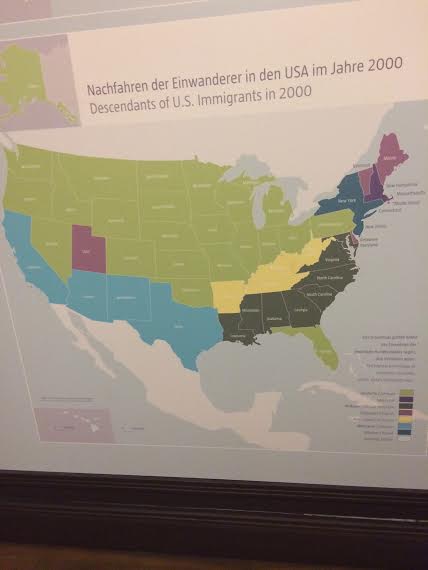
I particularly liked this one map that showed the U.S. and in each state is said which country the majority of citizmapens had descended from. I liked this because you could see how the culture of the country were the most people immigrated from still shapes the culture of that area today. For instance New York is especially known for their pizza, and by no coincidence the most people who immigrated there were Italians. Whereas in Pennsylvania the largest immigrant group was German, and there is still a large Amish population which have roots in Germany. 

After visiting the museum I had the pleasure of visiting the Bremerhaven Christmas market, which I must admit was not as impressive as Bremen’s but still very fun!

Katie Mooradian ’16

World Cup 2014

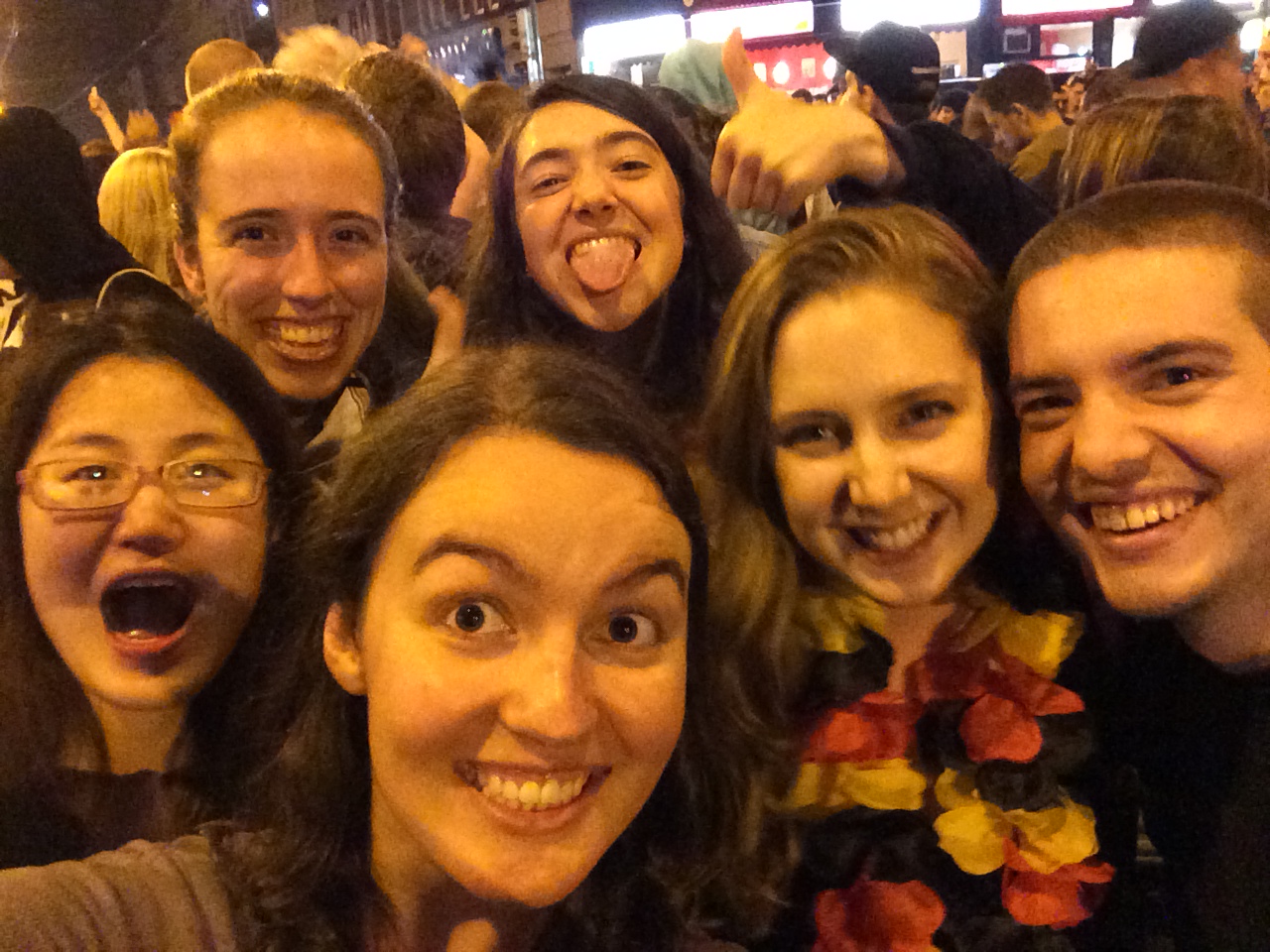
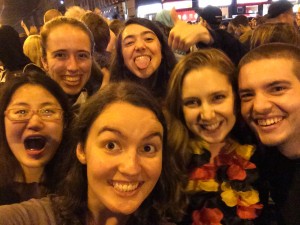
IMG_5347Want to relive Germany winning the World Cup? Then read the following statements by this year’s Dickinson-in-Bremen students as well as by Dr. Ludwig and Prof. McGaughey, who was in Germany as well, and also recaps our excursion to Hamburg and Lübeck. (Visit our Facebook page for additional video footage: Dickinson-in-Bremen on FB!)

Joan:
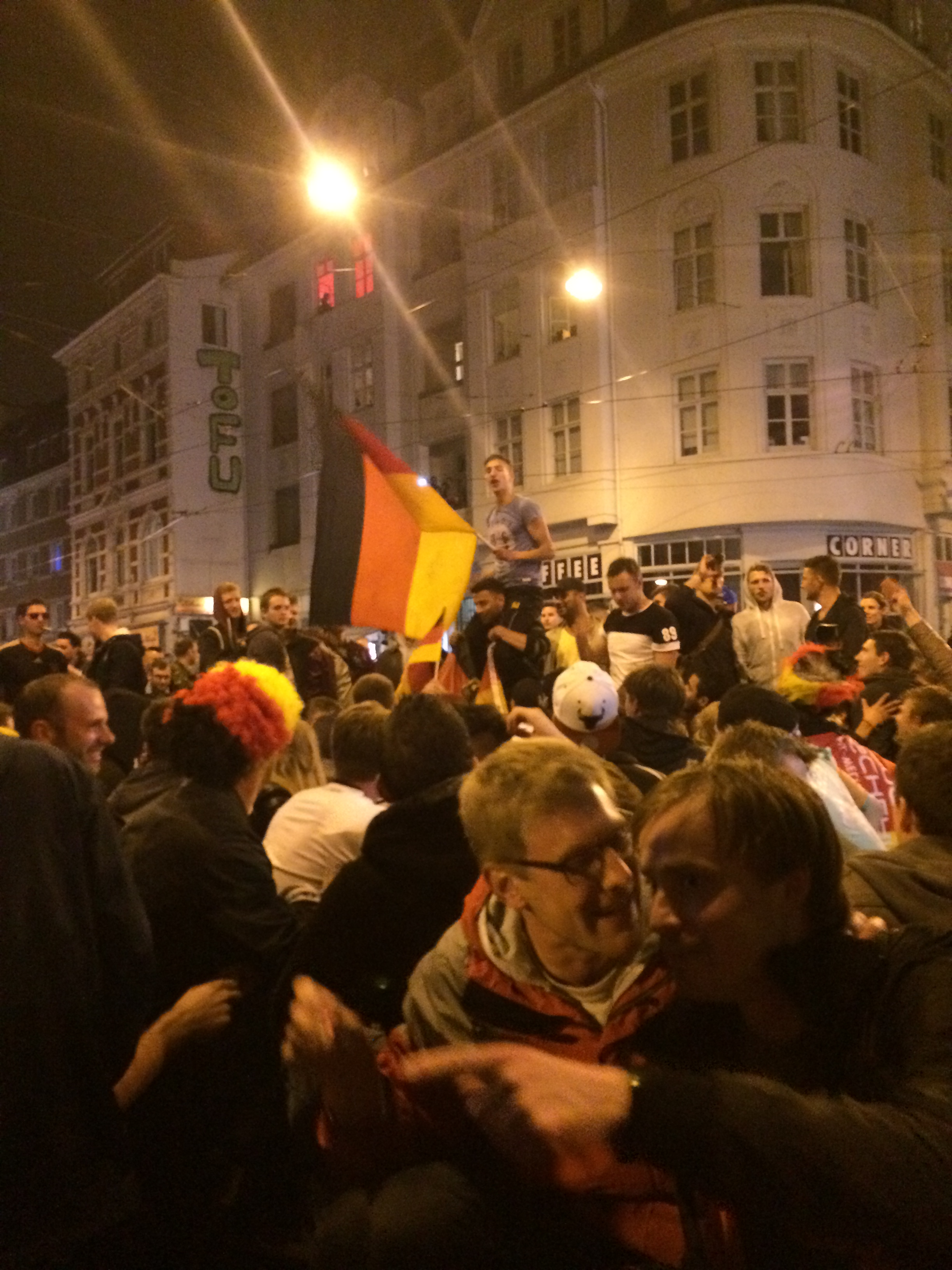
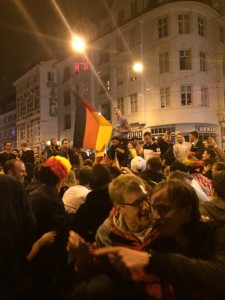
I’m so happy I got to be in Germany for the World Cup — and feel so lucky to have seen them win too! The atmosphere in the city after each game was incredible, and only built as Germany advanced further. My favorite part would probably be after the games, when people would gather at one of the intersections in Viertel and just celebrate in the streets. Most of the time people would completely block the intersection with celebrating, chanting, and dancing. I had so much fun during the weeks of the World Cup and will never forget this experience.

Devon:
I knew throughout my trip to Germany that I was experiencing something unique and very much special; to be able to have watched my host country win the World Cup while here was simply the icing on the cake. While I was separated from the rest of the group, being in a crowded bar as the cheers erupted was truly sobering.

Shuwei:
We are certainly the lucky ones. After twenty-four years Germany became the World-Cup Champion again and we are here to experience all the stress, excitement and ecstasy. We celebrated on streets, danced and sang loud, and had high fives with people passing by. What a memorable experience! Cheers Germany!

Sean:
The World Cup excitement in Bremen was absolutely incredible once the Finale rolled around. I went to one of the larger public viewings in Bremen, despite the forecast of rain. By the time Mario Götze made the defining goal, we were all standing in a complete downpour. Not even rain could kill the mood after Germany won the World Cup. Hundreds of people quickly took to the streets and celebrated in the main intersection of Das Viertel and remained there until the early hours of the morning. It was one of the most memorable experiences of my year abroad. Deutschland ist Weltmeister!

Anna:
Even when the WM games were on weekday nights — whether at 6pm or midnight — the bars were packed and we would show up hours early (literally, three hours early to save seats for the final). The energy was just amazing and somehow got more intense every game, everyone on the edges of their seats (or standing) the whole time and alternatively gasping, leaning forward, cheering and jumping up and down in unison. And then when Germany won in the Finals, we were in Viertel, singing and dancing in the streets all night. It’s definitely an experience I’ll never forget!
GERvBRA3Margaret:
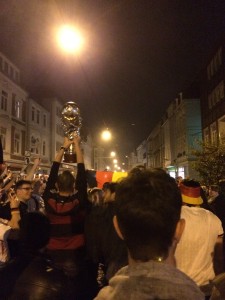
I’m still in disbelief over how lucky I was to be in Germany during the World Cup this year. Experiencing Germany’s victory was something I’ll never forget. I watched the final game with a group of other Dickinson students at a public viewing at a bar, where together we suffered through the seemingly-eternal nailbiter 0-0 score (and overtime! It really got rough…) before finally seeing Germany sink the winning goal shortly before overtime ran out, and jump to our feet cheering and hugging along with the rest of the crowd. When the game ended, we already knew the streets would be filled with people and the city basically shut down, but outside was even more insanity (and fun) than we could have expected. In the heart of the younger Viertel section of the city, the streets and sidewalks were filled so much we could barely walk, our ears rang from the fireworks being set off directly over our heads (or sometimes on sidewalks), and we got used to random people hugging, high-fiving us, or just yelling “DEUTSCHLAND!” or “WELTMEISTER!” in our faces. By 3 AM, we had joined the section of the crowd dancing to music being blasted from one of the overlooking apartments. There were block-long conga lines, instances of everyone putting their arms over each other’s shoulders and just happily swaying to the slower songs, and of course at least three separate heartfelt renditions of Queen’s We Are The Champions. I had a sore throat from yelling, sore feet from dancing in the street, and ringing ears from the fireworks, but I wouldn’t have traded that once-in-a-lifetime experience for anything.

Danette:
I had the good fortune of being able to watch the World Cup with several of my close German friends. They invited Janie and I over for the game to drink and watch. We were all decked out in fan gear with our faces painted with German flags and a German flag around our shoulders. As a huge football fan myself, this was the ultimate game for me. I watched breathlessly as the game ended in regular time at 0-0, and I think I was praying to every religious figure I could think of that Germany would win this game. Sadly our screen was delayed by about 2 minutes but I could hear cheers erupting around the neighborhood we were in, so I knew something good had happened. Then I watched Mario Götze receive the ball and volley it into the back of the net, I believe I almost cried because of how happy I was. There was still time left to play and never have I been so tense watching a game, I think I almost broke the chair handles because I was clenching them so hard. But then the whistle sounded and the game was over, GERMANY HAD WON. Janie and I knew that we needed to get into the city and quickly to have a great celebration with our friends; we boarded the next tram into the city and we hopped off at the Hauptbahnof. What a party it was. Trams and buses had stopped moving because they couldn’t get through the throngs of people, there were fireworks going off, people everywhere were yelling, chanting, dancing and cheering at the top of their lungs. It was insane. We made our way from Hauptbahnof to the Viertel and the party was even bigger. People were dancing in the streets, throwing beer around, and waving flags. It was an amazing experience to be a part of and something I will never forget.

Janie:
The night of the World Cup was, for me, absolutely unforgettable, and was one of my favorite memories of being in Germany. Danette and I watched the game at a close friend of ours, along with some other German friends. Naturally, we were all decked out in black, red, and gold to support the German national team. For some reason, probably because so many others were streaming the game online, there were delays, and we soon were a few minutes behind. We heard cheers outside, but still were not sure – and then Götze scored, and we all just yelled at the top of our lungs in pure joy. Then, the night got even better because Germany won, and it just truly felt like such a once-in-a-lifetime experience – being in Germany for the once-every-four-years cup, and then Germany won! Danette and I decided to continue the celebration outside, and went to the central train station. Absolute madness was ensuing there, with fireworks, and endless chants. From there, we walked to the “alternative quarter,” where it seemed like the entire population of Bremen had congregated. Everyone was out of their minds cheering, dancing, singing, and drinking, and there was a really awesome sense of friendly camaraderie. Even though we had to walk all the way home (about an hour and forty-five minutes), it was all so worth it, and it is definitely an experience I will never forget.

Dr. Ludwig:

Winning the World Cup is first and foremost: huge fun. The biggest party of the year. When Germans, often considered rather stiff, are dancing in the streets. But there is so much more to it: Soccer, or, Fußball/Football, as any European calls it, is not only the favorite German type of sport and a huge money-making machinery or a social glue that helps keeping the society together when young and old, men and women, people of all colors, backgrounds, and societal strata sit together in bars on weekends watching the Bundesliga or in public viewings of international tournaments… What is more, Fußball has often carried a national and historic dimension: When the Federal Republic of Germany won the first World Cup in 1954, it was called the “Miracle of Bern,” a symbol of the recovery of West Germany after WW II. Some linked it to the ambiguous phrase “Wir sind wieder wer” (We are somebody again.) When the GDR beat the FRG in the first round of the Cup in 1974, it was a symbol of the Cold War and an embarassment for West Germany which made up for it by winning the World Cup eventually. In 1990, when the rapidly uniting Germany won the Cup for the second time, with players from East and West, it was a symbol of reunification and its truest celebration. When the World Cup was held in Germany in 2006, the country took the chance to present itself as a pacified, liberal, open, and friendly society to the world and celebrated a 3rd place as if it was victory (something not really typical for Germans ;-). This was also the first time one could see national flags everywhere and hear the national anthem being sung in public – something that had been considered nationalist and dangerous for decades and was therefore seen with mixed emotions by many of the older generations. Winning the Cup for the 3rd time in 2014 does not have the same dimension anymore, but it rather seems like being world champions has healthily regressed into just something it would be for any nation: huge fun. The biggest party of the year. People dancing in the streets. Maybe that marks the true importance and experience of this victory.

Prof. McGaughey:
Distraction.

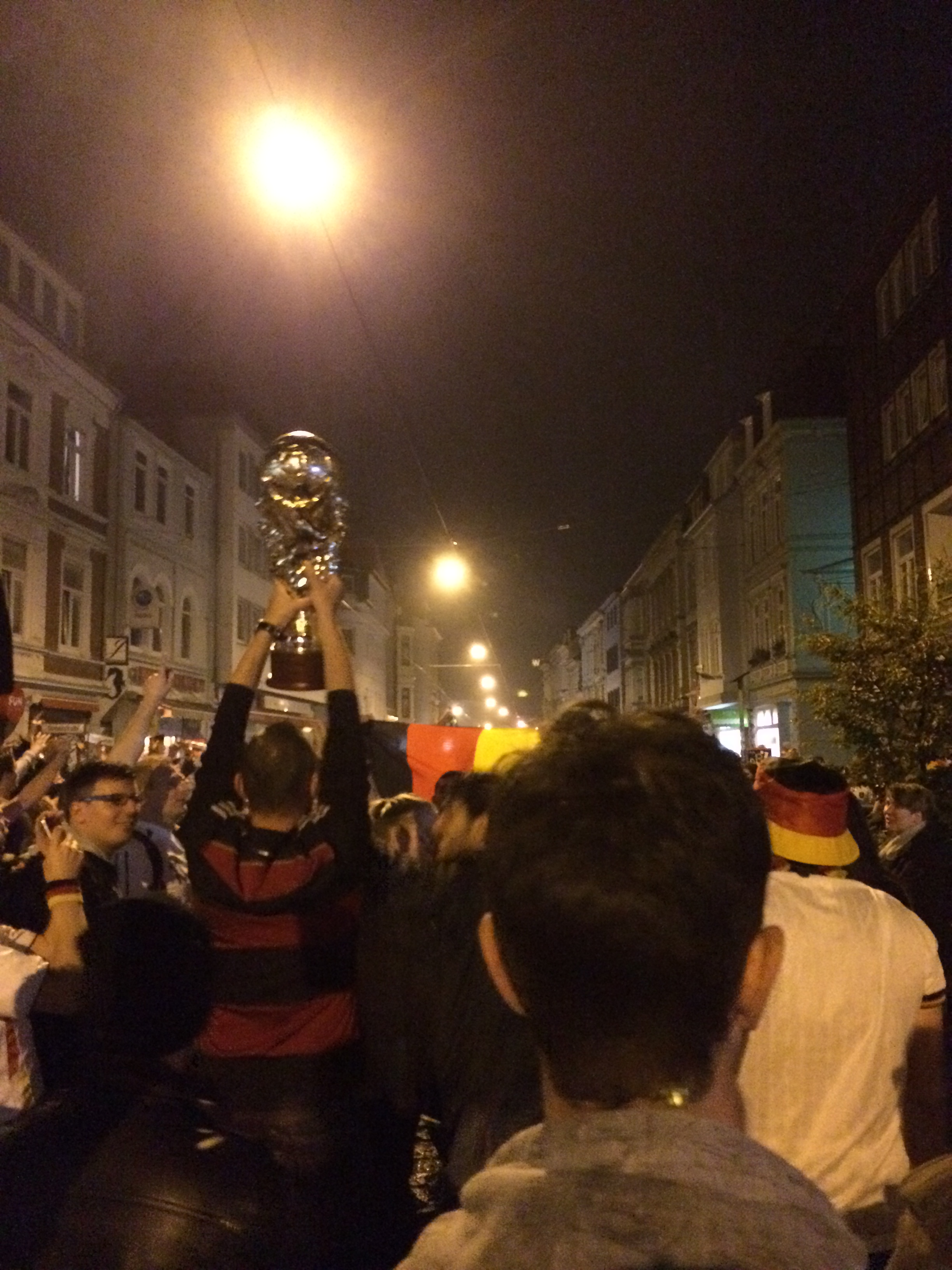
In the midst of a World Cup summer all activity that was not associated with soccer could be categorized under distraction. Distraction is what happened between games. In that time when you were waiting until the moment when you could reload the soccer site again and again with the hope of learning the lineup of the next game. Distraction was hard to come by, however. So much of the summer in Germany was about the World Cup. There were reports of the overpriced, island retreat of the German team in Brasil, the expensive stadiums, the corruption within FIFA, and the corruption and violence FIFA and soccer initiated in Brasil and throughout the world. And then there were the constant updates of the health of the team – could Schweinsteiger play? Was Hummels sick? The news was saturated with soccer scores and analyses and towns were full of public viewing sites, pulsing with conversations about the teams and the tournament. For games, the Germans sat or stood and watched ARD or ZDF – the two public channels – and heard passionate commentaries from former soccer stars Mehmet Scholl and Olli Kahn. Even during the advertising breaks, Pep Guardiola assured us that German engineering (or soccer?) was about innovation and “Vorsprung.” As the tournament went on and Germany continued to win (OMG, that historic game against Brazil!), the continuous presence of soccer in daily life became more difficult to take. Thus, my move from Tübingen to Bremen came at just the right time. Time to say “Moin” instead of “Grüß Gott” and time to see all of the Dickinsonians in Bremen. Even better, Verena had organized a short trip of two days and one night in the Hansestädte of Lübeck and Hamburg. We learned how to model mice and hearts out of marzipan and read about the tragedies and literary successes of the Mann family. We had a delicious dinner (fish, of course!) on the Inner Alster Lake on a boat (On a boat!) and wandered through the Fischmarkt on Sunday morning. We spent hours watching amazing moving miniature replicas of Switzerland, Austria, and Middle Germany and studied the miniature representations of party platforms from the last two elections. We drank excellent coffee. We spent an hour and a half moving blindly through daily spaces at Dialog im Dunkeln (Dialogue in the Dark). It was a fabulous trip. As the weekend trip came to a close and the second major soccer game of my lifetime approached, this all became distraction. Despite attempts to not discuss the game or soccer (there was a pact involved; it was agreed upon), the real focus was the game. Where were we going to watch it? Should we bring our backpacks home or just go straight to the Lagerhaus and take our seats? Arriving in Bremen only an hour and a half before the game began was taking a risk. We were late. Where do we find seats? Luckily, Joan had saved seats. Under a roof. At first, seemingly unnecessary, but after a huge storm hit mid-game, the (relatively) dry Dickinsonians were all the more thankful for Joan’s efforts. For all the focus on keeping ourselves distracted, I can’t tell you much about the game. It was fascinating and compelling, nerve-wracking and horrific (I mean, why wasn’t there a goal in the first half?!). But it all became a blur, when The Roar happened. Most people don’t call it “The Roar”. Most people refer to it as the goal made by Mario Götze in the 113th minute (yes, that’s overtime, if you don’t know soccer). But the lived experience I now call “The Roar.IMG_5370” I couldn’t even hear myself screaming as I jumped up from my seat. And the roar was not just a moment; it repeated itself as the goal was replayed and everyone hugged one another. Only after the third or fourth replay did the roar become a rather large cheer. And then the cheering happened. The crowd, thousands of miles away from the game, wanted the German team to hold their ground. And so they cheered. The last minutes of the game became a resounding repetition of “Deutschland, Deutschland.” And then we won. The game was over. And we sang “Oh, wie schön” perhaps best translated as “Oh, how wonderful.” “Such a beautiful thing,” we all sang, “we had not seen in a long time.” A long time. And it was beautiful. Manuel Neuer told us we were world champions. And to celebrate we watched the ceremony and headed out onto the streets to celebrate more.
Academic Differences Between Dickinson and Uni Bremen.

While studying abroad at a different university, definite differences are apparent. Before coming to Uni Bremen, I expected classes to be fairly similar to Dickinson but just larger. I soon came to realize that this was not the only difference. First, let me list all of the academic differences I have noticed between Uni Bremen and Dickinson and then I will explain each one:
1. The class size
2. The students ages
3. The “homework” and graded “assignments”
4. Semester time-frame
5. Grading system
6. The professors
The class size, at Dickinson, will not exceed 60 students and it is not uncommon for a class to have only 5 students. At Uni Bremen; however, the class size is much larger on average. To have a class with less than 20 students is not as common as having a class with 100+ students. My largest class had about 150 students. And on that note, this class of 150 or so students were composed of 4 students in their 20s and the rest of the students were over 70 years of age. To have older adults as students is not uncommon. Thirdly, the assignments for classes at Uni Bremen have a different expectation than those given at Dickinson. At Uni Bremen, the assignments given throughout the semester are typically readings listed on the syllabus. These readings will either be posted online or the student must go to a local bookstore. These readings are not mandatory, but an aid. If the class consists of discussion then reading the listed assignment(s) is recommended but again not mandatory like Dickinson. The actual graded assignments do not come until the end of the semester as one large grade. This one grade is what the student will receive for the class. This grade can either be a test, a project, an oral presentation, or a 10-15 page paper depending on the professor. As for the actual grades, they are not based off of a “A, B, C, D, F” system, but rather a point system. This point system is 1-5 in which a 1 is a perfect grade and a 5 is failing. The professors will be understanding to those who are international students, but it is very rare for professors at a German university, such as Uni Bremen, to know the names of the students. This is mainly due to the fact that most classes have over 50 students, but also because the student-professor relationship does not work at Uni Bremen like it does at Dickinson. Another academic difference between Dickinson and Uni Bremen is attendance. Unless professors at Uni Bremen take attendance and make it an important issue to not miss classes, attendance is not taken as seriously as it is at Dickinson. Nevertheless, going to class is important! …but taken lightly by the majority of students. For one of my classes – that had no attendance requirement – there was a student who came to the last day to take the final exam… This student did not come to a single day of class throughout the semester. And lastly, as for the semester, the first semester (winter semester) begins late October/early November and ends in February as opposed to late August to December.
To those of you who find the differences to be intimidating, please do not be alarmed! These differences are very easy to adjust to ;-).

Fair trade!

July King ’12 at UTAMTSI’s stand in Baltimore

In June, Prof. Antje Pfannkuchen (German Department), former exchange student Julie King ’12 and Jens Schröder (Program Coordinator) visited the sustainable coffee company UTAMTSI outside Bremen (see blog entry below). The company is already engaged in educating Dickinson students in sustainable coffee production and its fair distribution in Cameroon. Back in June, both sides expressed their wish to cooperate more closely together and share expertise and knowledge about sustainable planting methods. Now, a first step is accomplished: Morin Fobissie Kamga, one of the founders of UTAMTSI, visited Dickinson this week and is now in Baltimore attending a conference about sustainable food production. At the conference, Morin is supported by – yes – Julie King. The triangle Bremen-Cameroon-Dickinson works in a true Dickinson spirit: globally and sustainably!

But there is more: in the same week, Bremen was awarded the title “Germany’s Capitol of Fair Trade”, recognizing Bremen’s efforts to promote fair trade projects across the city. Find the newspaper article here (in German):

https://www.weser-kurier.de/bremen/stadtteil-schwachhausen/bremen-will-hauptstadt-des-fairen-handels-2011-werden-doc7e3kkjykxvbk480jmx


UTAMTSI: “A Story of Encounters” / “Eine Geschichte des Begegnens”

by Julie King ’12

Wednesday afternoon Prof. Antje Pfannkuchen, Jens, and I hopped in the car that Dickinson occasionally borrows through a car sharing company in order to drive to Lilienthal, a suburb of Bremen in Niedersachsen, where we had an appointment with a representative of UTAMTSI. As Dickinson-in-Bremen’s “Sustainability Intern” I got to come along to visit the fair-trade coffee company. When we arrived, I realized my expectations were all wrong – in the good way. Perhaps because of the giant building near the central train station with the giant Jacobs (Coffee) sign, I had expected something bigger, more urban and definitely more stereotypically corporate. In actuality, the UTAMTSI office and roasting house in a wooded area of Lilienthal is a small part of a complex that appeared to have some other offices as well housing for handicapped individuals.

To my surprise, our appointment was not just with a representative of UTAMTSI, but the founder himself, Mr. Morin Fobissie Kamga. The three of us sat down at a table with Mr. Kamga and another visitor who appeared to be a student. Before I get started on the fascinating story of UTAMTSI I need to explain its pre-existing relationship to Dickinson. In February Brian Brubaker, the director of Dickinson’s Office of Global Education, visited UTAMTSI to find more about the sustainable company that is coincidentally based in Bremen, Germany, and Yaoundé, Cameroon, both of which are the locations of Dickinson Study Abroad Programs. After hearing the “UTAMTSI Story,” Brian Brubaker must have spread the word, because the students in Yaoundé visited the Cameroon location where Mr. Kamga, who annually returns for the coffee harvest, shared his story and showed the girls where coffee beans are grown and then sorted. Therefore, it shouldn’t have a surprise, but it was still surreal to sit down with a man I had just met in Bremen to look at pictures of girls I know from Dickinson visiting the same man in Cameroon.

While showing us pictures of coffee trade and his home in Cameroon, Mr, Kamga began the fascinating story about how UTAMTSI originated. The son of coffee farmers in a village outside of Yaoundé, Mr, Kamga, persevered and worked hard in school to pass standardized tests in a land variable teaching skills and curriculums. Having learned English, French, and German he applied to a private university in Koblenz, Germany. After a short time he transferred to the University of Bremen where he studied economics. In his student-housing complex, he met another student named Stephan Frost. Having told Stephan all about his home and the coffee industry, where farmers only received 3% of the final sale-price for their coffee beans, Mr. Kamga rejected a job offer from the World Bank and decided to start his own coffee company with Stephan. With fewer middlemen he could offer better profits for the farmers near his home and better quality for his customers.

Spreading the word to farmers that he would pay 1.30€ instead of 0.30€ Mr. Kamga initially faced threats from a few crooked competitors, but now successfully has contracts with over 1000 farmers, who use peer-to-peer quality control and natural farming techniques. UTAMSI is also unique in that women and slightly handicapped workers are welcomed workers. There is even an employee to watch after the children while their mothers sort out good beans. Once harvested the beans are shipped to Bremen, where they are roasted, packaged and sold. The smaller location in Bremen also employs handicapped individuals who weigh, grind and package the roasted beans.

Additional UTAMTSI projects include the funding for a local health center outside of Yaoundé and contributions to rural schools that are always in need of supplies and adequate teachers. Student interns from Germany have gone to Cameroon to teach German and to help with the coffee bean harvest. And lastly, loyal customers have had the opportunity to travel to Cameroon for weeklong home stays with coffee-bean farming families.  Future plans include a trip to a business fair in September in Baltimore and hopefully a visit to Dickinson. Mr. Kamga also shared his ambition to open another location somewhere in Germany.

To fulfill the goal of our visit, we presented the idea that a professor and student from Dickinson’s International Business and Management department write a case study about UTAMTSI. The company fits perfectly with Dickinson’s mission to „engage the world sustainably,“ and as a former economics student himself, Mr. Kamga, happily accepted the offer, understanding the benefits of a case study about his company.

While we enjoyed a cup of fresh pressed UTAMTSI coffee and some cake, Mr. Kamga explained the meaning of the name UTAMTSI. In his native language Nafi “U” means “we” or “a collective group” (“Wir/Gemeinsam”); “TAM” translates to “meet” or “encounter” (“Begegnen”) and means the “the story of humanity is characterized by constant encounters” (“Die Geschichte der Menschheit ist von ständiger Begegnung geprägt”); and “TSI” translates to “water” (“Wasser”) and means “ancient cure that gives power” (“Uraltes Heilmittel, das Kraft schenkt”). Leaving UTAMTSI and smelling like coffee, I couldn’t help but think how accurate and fitting the name UTAMTSI is for the triangular relationship between the coffee company and Dickinson.  Dickinsonians helped sort coffee beans in Yaoundé, we saw the roasting process in Bremen, and when Antje returns to Carlisle, the German professors will drink coffee that completes the circle.


Lebenslang grün-weiß !!

by Nicole Couturiaux ’12

When local Fußball club SV Werder Bremen has a home game, the entire city gets decked out green and busy with energy from thousands of fans. I get caught up in the frenzy too, sporting my Werder scarf and meeting up with friends to join the public viewing in pubs downtown. This past Friday, though, my fanship was taken to a new a level.

Prof. Ludwig and Jens were able to score tickets for the game against Wolfsburg, so the Dickinson in Bremen program took an evening excursion to the standing block of the stadium. Our group was in the center of the action. Everything you may have heard about the German passion for Fußball is true – and then some! Bratwurst and bier abound, huge flags and scarves are waved in the air, and Bremen’s team chants and songs ring continuously through the stadium.

The best is when the Werder team/lineup is introduced with the announcer calling out the player/coach’s name and the crowd yelling back the last name. At the end of the intro, the announcer calls out “#12, that’s…” and the crowd roars “us!” back and forth a million times! There are actually only 11 players from a team on the field at once, but this cheer shows how strong and important the role of the fans really is. You also get the sense that Werder is much more than a team, Fußball much more than a sport. It’s a commitment, and one that often lasts a lifetime. Though Werder was unable to score and in the end lost, our group had a great time and we’ll ready to show our support in next game – back at our usual pub seating.

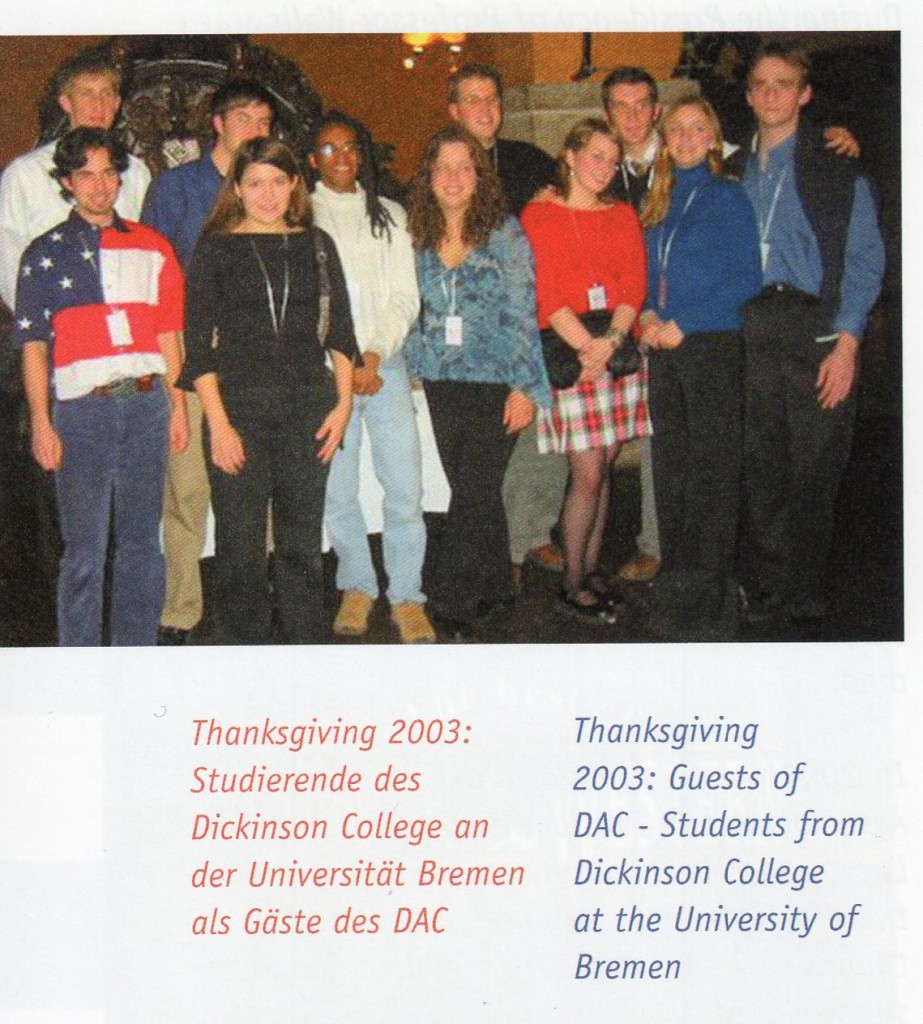
Thanksgiving 2003

Dickinson students were mentioned in a booklet honoring the Sixtieth Anniversary of the Carl Schurz German-American Club (CSDAC). The picture shows the exchange students of 2003/2004 participating in the traditional Thanksgiving Dinner CSDAC organizes every year. We are thankful and honored to be part of this annual dinner where Germans and Americans come together celebrating America’s long-lasting tradition and we are looking forward to this year’s event!

Everything is more extreme in Hamburg

by Julie King ’12

Saturday October 23rd we had our first Dickinson excursion outside of Bremen. With our semester tickets we can take regional trains to a good number of cities within Niedersachsen, the state surrounding Bremen, and we can go to Hamburg, which, like Bremen, is one of the three city-states in Germany, the third being Berlin.

We left our apartment at 7:10am to meet at the central station at 8:00am. As awesome as German public transportation is, the street trams don’t start at our stop until 8:00am on the weekends, so we had to walk part of the way at what we college students consider an ungodly hour – especially considering that here at 54 degrees North, the sun doesn’t rise until close to 8:00.

We pulled into the Hamburg central station around 9:30am for what was actually my second visit to Hamburg. Earlier in the month Insa, Bill, Doug and I went to Hamburg for an evening.  My first visit we walked around Speicherstadt, which is a canal-filled warehouse district built in the late 1800′s.  It’s a beautiful district, and later I was surprised to learn that Hamburg actually has more bridges than Venice.  Later in the evening we got a taste of the Redlight District along the famous Reeperbahn (street) before catching heading home at a reasonable 11:00pm. (In reference to the title, I must say that Hamburg’s Redlight area is a District, whereas in Bremen it is only a short street).

Our official Dickinson visit to Bremen was a more wholesomely educational trip.

dscn

Hamburg Rathaus

It started out with a tour of the city hall, which in my opinion was a little excessive. (I prefer the older, smaller, more approachable Bremer Rathaus). The current Hamburg Rathaus is actually the “new” city hall, built between 1886 to 1897 ; the original burned down in the great fire of 1848. The new city hall has hundreds of rooms, each of which are lavishly decorated, to house the Hamburg senate and parliament, as well as two mayors. Some of the rooms have leather covered walls bedazzled with Hanseatic or Hamburg related designs.

Gotthold Ephraim Lessing and the Dickinsonians

Gotthold Ephraim Lessing and the Dickinsonians

The most massive hall even had chandeliers so large that they weigh 1.5 tons each. My favorite fact from the tour, is that on New Year’s day city hall is open to the public so that you can personally wish the mayor “Happy New Year,” just be prepared to wait a long time in line.  After the Rathaus tour we took a slight detour to have a group photo in front of Lessing, one of Germany’s most famous writers. The only ones I can think of are the ones I have read, “Emilia Galotti”, Nathan der Weise, and a fable “Der Rabe und der Fuchs” (the raven and the fox).

Our next activity was a boat tour of the Hamburg harbor.

IMG

Hamburg Habor

Germany’s biggest port and the second biggest/busiest port in Europe after Rotterdam in the Netherlands.  Despite the cold and the wind, we (or at least I) enjoyed more than an hour of sightseeing and information from our humorous tour guide who used to be sailor on one of the massive container ships. Also hidden in port amongst all of the commercial ships was the world’s largest and most expensive personal yacht, owned by Roman Abramovich (the 4th richest man in Russia who also owns FC Chelsea).  Overall, my favorite part of the boat tour was just seeing the Hamburg shoreline because of the variety of the ages and styles of all the different buildings.

By time we were done with our boat tour, we were all quite hungry and ready for lunch at Joh. Albrecht Brauhaus, right along one of the canals.  We each got a delicious house draught beer. I had a delicious bowl of pumpkin soup for an appetizer and a vegetable “Flammkuchen,” which is sort of like a flatbread pizza.

After our leisurely lunch we took the subway to the St. Michaelis church. Supposedly it is one of the more famous churches in Germany, which it must be considering Loki Schmidt’s funeral was held there earlier this week. (She’s the German equivalent of Nancy Reagan). To work off our generous lunch, we climbed 400 steps to the top of the tower for a beautiful view of Hamburg.

The weather worsened and just as we arrived in Sternschanze, the artsy, liberal, young area of Hamburg, which is…surprise… a bigger, dirtier version of Bremen’s Viertel. The rain was a good excuse to pop into to a coffee shop where we enjoyed a hot beverage and lively discourse. After that we decided it was time to head home, and had an uneventful, sleepy ride back to Bremen.

picture

Crests of Hamburg (left) and Bremen (right)

Overall, I really like Hamburg, and I’m pretty sure I’ll go back, especially considering it’s free with our semester ticket. It’s even been recommended a few times that we go to Hamburg to go to the clubs and then stay out so late that we go to fish market when it opens and take the first train back to Bremen. I’m not sure I’m up to European party stamina yet, but perhaps before the end of the year I will try it. But for those of you who don’t know, Hamburg is called the “das Tor zur Welt” the gate to the world because of its port and its crest, but the joke in Bremen is: Hamburg may be the gate to the world, but Bremen has the key (because the Bremen crest is a key).

Freiburg Language Course

September 3
Homesickness, sleeplessness, thankfulness, untrammeledness. At the spatial separation from the familiar; from the temporal separation from the familiar; for a safe, timely, and uneventful arrival; at the novelty of experience.  Then two more days in Freiburg. Language course started. Hunger and thirst, but not yet for that.

September 4
Day-trip to Alsace, in contrast to prior Freiburg. Went to Hochkönigsburg, Riquewihr, and Kaysersberg. Spoke in English, thoughtlessly, conversing with Americans, Australians, English, and Irish. In French, tentatively, ordering a snack at Hochkönigsburg and lunch at Riquewihr. In German, thoughtfully, communicating with non-Americans, non-Australians, non-English, and non-Irish. In Spanish, livelily, chatting with a Spaniard. Pleasant remembrance of bicycling up to Hochkönigsburg four years ago on the tandem with Wolfgang; vivid perception of the Riquewihr alleys, architecture, and colors, plus that perfect slice of peach pie; underwhelming impression of Kaysersberg. Worth it.

September 5
Went for a run on my first appointmentless morning around a nearby lake with a perimeter of, at a jog, about eight minutes. Afternoon sojourn to the Schlossberg; lots of steps; nice views of Freiburg before returning. Took away a filling yet inexpensive Turkish döner to eat beside the cathedral. Finally both well-nourished and well-hydrated.

September 6-10
Feeling occasionally with respect to the German language like an adolescent Andre Agassi with respect to tennis, but sharing none of this attitude for the sport itself.

September 11
Day-trip to the Black Forest, near St. Peter’s. Left the freshness of the first time unmatched, but at least being there amidst the trees was a nice sensation to revisit.

September 12
Rapturous. Woke up at 5:30 to leave the Freiburg train station 70 minutes later. Arrived to a sea of fog in Titisee. Some glorious false starts finding the path to the top of the mountain Hochfirst. Eventually got there with directions from a Frenchman, his dog, and a couple of German joggers, to enjoy a view that was as calming as a remoteness dotted only occasionally with Nordic walkers. Descended back into town with plans to return to Freiburg prior to finding a €16,95 lunch buffet; felt sufficiently hungry to make my discovery worthwhile. Made my way inside and was greeted successively by the head waiter, noodles, rice, and vegetables of the season. Opting for an outside table with my plate, received notice from said waiter, who, realizing either that this rustic tourist, in not having selected any of the extravagant French appetizers, was somewhat incongruous, or merely that this ravished alpine hiker was just as famished, inquired whether to consider the entire buffet in the price, or that plate only, in which case he would make a special offer. Cheerfully accepted this and the iced tea with fruit from the forest that he complied to bring, which accompanied my favorite meal of the trip to that point. Some almond pastries from the Titisee train station complied to accompany me back to Freiburg. Pensive remembrance of descending the road cutting visibly through the trees to Titisee then.

September 13-18
Still deepening in esotericism, familiarity, restlessness in Freiburg.

September 19
Revisited the schedule of that seven days hence to visit, for the first time, the Schluchsee. The additional half hour riding the train to Aha turned out not to detract from a land-and-seascape that was still more impressive than its predecessor. Departed from the train to an immediate dawn. Jogged, lingered, walked from Aha along the Schluchsee to the town of the same name. Let us call it the best day so far.

September 20-23
I was worried that everyday communication in German would, if only marginally, lessen my adeptness in English, as was unequivocally true after a month here two years ago. Contrary to this expectation, but understandably so, as I did next to nothing with English during that visit, and during this one had still been primarily reading in it, not speaking English now had refined it to reflect the input it receives, rather than deteriorated it to a lesser degree than previously (a refinement more noticeable at the time, as I was still reading Proust; at least this is written a month later). And in terms of written comprehension, as the bald eagle goes highest and fastest, the flight of the black eagle still skids, so to speak, and although it outstrips almost all others, the closest behind being the rooster and the wolf, eyeing each other carefully, the secondbest eagle cannot keep pace with the nonchalant stride of the bull.

What the World Cup Means

by Andrew Shuman ’11

As with many Americans, indeed, many more than Europeans may expect, I’ve played soccer nearly my entire life – since I was five, to be exact. As such, I’ve been a fan of the game for a very long time, starting with 2002 World Cup in Korea and Japan, when I got up in the wee hours of the morning to watch the final, where the Germans and their immortal keeper, Oliver Kahn, previously next to unbeatable in the tournament, lost to Brazil and Ronaldo. Arguably, those two players, Ronaldo and Kahn, are the best striker and goalkeeper of all time, respectively. That epic matchup, which ended 2-0 for Brazil, one of the goals coming following Kahn’s only error of the tournament, got me hooked on the international game. From the Champions League, in which Europe’s top club teams compete, to the 2006 World Cup and the 2008 European Championships, I don’t think I’ve missed a televised game if I could help it.

Being here in Germany for the 2010 World Cup and having just seen the die Mannschaft (literally, ‘the team’) crush archrivals England at a public viewing yesterday, though, has given me a real appreciation for the meaning of international football here in Europe. The World Cup and the Euro are far more than simple spectacles of sport; the national teams embody the histories and identities of entire nations.

Soccer is an inextricable part of Germany’s past, and, unlike the World Cup history of the United States, Germany’s history of participation in the tournament is riddled with momentous victories and defeats that came at defining moments in the history of the nation itself. Those moments have been indelibly etched upon the national conscience of the German people and that history gives added meaning to classic matchups like Germany vs. England. It’s obvious to everyone, of course, that two world wars fought between the two nations, as much as it is politically correct not to acknowledge it, play a role. However, the fact that England’s only World Cup victory in 1966 came against West Germany in the final at Wembley Stadium in London and the fact that the English have caved under pressure and lost to the Germans in two penalty shootouts on the international stage in the 90’s provide just as much of a backdrop. The looming quarterfinal matchup with Argentina, for instance, is far more than a game between, arguably, the two best teams in the tournament so far; it’s a rematch of the quarterfinal of the 06 World Cup, where Jens Lehmann saved 2 Argentine penalty kicks to put the Germans through, a rematch of the 1990 World Cup Final, where an Andreas Brehme penalty give the Germans their 3rd World Cup victory against the Argentineans, and a rematch of the 1986 final, where the greats of the German game, names like Lothar Matthäus, Karl Heinz Rummenigge, and Rudi Völler lost out to Diego Maradona and Argentina. Almost every matchup has that historical dimension and undertone, and, if I had to pick one thing only, I’d say that’s the biggest missing element from the World Cup experience from an American viewpoint. Hopefully, one day we can develop a storied World Cup history, to the point where a USA v. England matchup isn’t just presented as a ‘second American Revolution’, but as round two, or even three, of a matchup that has already delivered truly classic World Cup games.

Moreover, football has, at times, taken on a far greater role than that of a mere sport in German history. The German’s first World Cup victory in 1954, during the depression and disillusionment of the post WWII years, inspired and helped to heal a downtrodden nation, creating, to some extent, a new, positive national identity free from the ghosts of the Nazis. In German, the 1954 victory is known as “Das Wunder von Bern”- The Miracle of Bern, since the underdog German team beat the Hungarians in the final, a team considered nearly immortal and unbeatable. Germany’s third World Cup victory in 1990 came just as West and East Germany, so long divided, were coming together at long last as a reunified Germany, and die Mannschaft’s win over Argentina crowned that triumphant moment in German history.

This World Cup, regardless of whether the Germans can win the 4th star or not, I think the very makeup and playing style of the German team speaks volumes about German society and it’s development over the last few decades. A cursory glance at the German roster reveals that many of the players don’t exactly have names that seem ‘typically Germany’, and it is indeed true that the team is made up of many players from a diverse immigrant background. Lukas Podolski and Miro Klose, for instance, are of Polish heritage, as their names betray. Sami Khedira is of Tunisian extraction. Mesut Ozil is of Turkish lineage, Cacau is a nationalized Brazilian, and Jerome Boateng is half German, half Ghanaian. Ignorantly, I think, many people jibe that this German team isn’t really German at all. Sure it is. The jingoist assumption that to be ‘German’ means having blonde hair and blue eyes and having a last name like Schweinsteiger or Mertesacker no longer has a place in modern German society, and, for their part, I think the Germans are rightfully proud of the diversity and tolerance the national team reflects in their society.  What’s wrong with a new German national identity, one that stresses the nation’s willingness to accept immigrants and people from all sorts of different backgrounds and consider them just as much a part of Germany as any others? Nothing.  The new, ethnically diverse identity of the national team has, it seems, coincided with a radical change in the teams of style of play. Gone are the days of the stereotypically dour, efficient, and stout playing style of the German teams of the 70’s, 80’s, and 90’s. The team we’re seeing in the 2010 World Cup is young, vibrant, fast, aggressive, and they combine and move the ball around the field at the speed of light, often times catching opponents flat footed for a counter-attack goal (England, Australia). Thirty years ago, such a free flowing style of play would have been unthinkable from a German side. As the Germans say, these guys have Spielfreude.

The World Cup doesn’t have to, and indeed should not have, the jingoistic undertone of ‘pure’ races of men from different nations having at each other on a grass field to see which race is the best at putting a ball between two posts. The players on the national team represent the people back home- their friends, families, fans, and supporters- as well as the youth football system that made them into the players they are. In that sense, then, if Podolski, Klose, Ozil, Khedira, and Boateng were all born and raised in Germany, how do their ancestries or last names make them any less worthy of representing Germany in the World Cup than Bastian Schweinsteiger or Holger Badstuber? As Americans who live in a society that is defined by its diversity, we should, I think, appreciate how open German society has become.