by Alex Arnold ’27
Dear reader,
I’d first like to extend to you a belated new year’s greeting. Wherever you may be tuning in from, us students of the 2025-26 Dickinson in Bremen cohort wish you an exciting and successful start to 2026. Now, on to the meat and potatoes. Well, maybe not so much meat, but the potatoes were no figure of speech. The topic of this blog post is SoLaWi’s!
“Wait, So La What?”, you may be asking yourself. Well, stick around and let me to explain, because if you like to eat food, enjoy nature, or perhaps just playing in the dirt, I wager that you’ll be interested in learning about this topic and that you may even be inspired to discover more after reading this brief post.
Allow me to begin by writing a little bit about my background and why I care to share about SoLaWi’s (SO-LAH-VEE’s). My name is Alex Arnold (‘27) and I am a German major studying in Bremen for the full ‘25-26 academic year. Beyond my major in German, I am also pursuing a Food Studies certificate and am, when in Pennsylvania, engaged with the Dickinson College Farm. In the summer of 2024, after finishing my first year of college, I stayed on campus in Carlisle to work on the farm full time. That summer, I not only became intimately acquainted with each and every street in a 10-block radius of campus, but I also learned about organic farming and alternative food systems. Before I knew it, I had become fascinated with agricultural and food production.
My interest in food systems did not decline after that summer; it developed further as I enrolled in a variety of Food Studies courses, eager for more knowledge about the field that I had been working in–literally. With some information regarding my background provided, I’d like to transition back to Germany and explain why this whole SoLaWi business is so exciting.
Finally, a definition! SoLaWi is an acronym for “solidarische Landwirtschaft” which, directly translated, means solidarity agriculture. For those readers already familiar with alternative food systems, I have a comparison to the U.S. that I will provide in just a moment to help you visualize what sort of system this blog is about. For readers less familiar with the topic, a quick summary of this “food system” talk is helpful for understanding what makes SoLaWi’s special.
Things can quickly become abstract when talking about food systems, but don’t worry, the concept is actually quite simple. A food system consists of all the interactions along the supply network which, beginning with the producers (that’s the farmers who grow food), result in food getting to your plate. In between farms and you are any number of processors, distributors, and sellers, which changes based on commodity, location, etc.[i] When we look at today’s conventional food system we are looking at systems based on large-scale, intensified agriculture (many crops per unit of space, i.e. high density) in which, worldwide, the number of food-producing farms is decreasing, and size of those remaining farms is increasing.[ii] Furthermore, the length of food chains–the distance food is traveling and how many intermediaries there are in between producer and consumer (that’s you!)–are far longer than they were in the not-so-distant past (1980s), when free trade agreements began allowing for more specialization in food production.
Phew, that got a little dense. I hear you, reader; I’ll get to the point. As you can imagine, today’s food system isn’t without its flaws. Although specialization and intensified agriculture have provided us with year-round access to all sorts of fruits, vegetables, meat and dairy products at prices that are relatively affordable, this has also resulted in a host of problems, both environmental and social. First, intensive agriculture relies heavily on the use of synthetic fertilizers, pesticides, herbicides, and lots of tillage to achieve high yields. Among other consequences, these practices result in a loss of biodiversity and, counterproductively, make soil less and less fertile for crops as time goes on.[iii] Perhaps just as importantly, our current food system has resulted in a disconnect–not just in terms of distance–between us consumers and the places our food comes from, farms and farmers, that is.
Since the late 20th century, these issues have not gone unnoticed. One concept that emerged in response to these trends in the food system was the banding together of communities to collectively bear the costs–and some of the responsibility–of operating a farm. That’s what SoLaWi’s are all about. A community supported farm, so to speak, or a community supported agriculture (CSA). Perhaps you’ve heard of CSA’s; they are essentially the U.S. counterpart to the German SoLaWi. Interestingly, German ideas surrounding agricultural in the early 20th century, such as Rudolf Steiner’s exploration of biodynamic farming, happened to serve as a foundation for CSA in the U.S. The idea of community supported farming isn’t unique to just the U.S. or Germany, however. Similar movements can be traced across the globe, yet their origins are largely independent. Today, however, this network of community-supported, small-scale farms is more connected, with knowledge and experience being shared through various pathways.
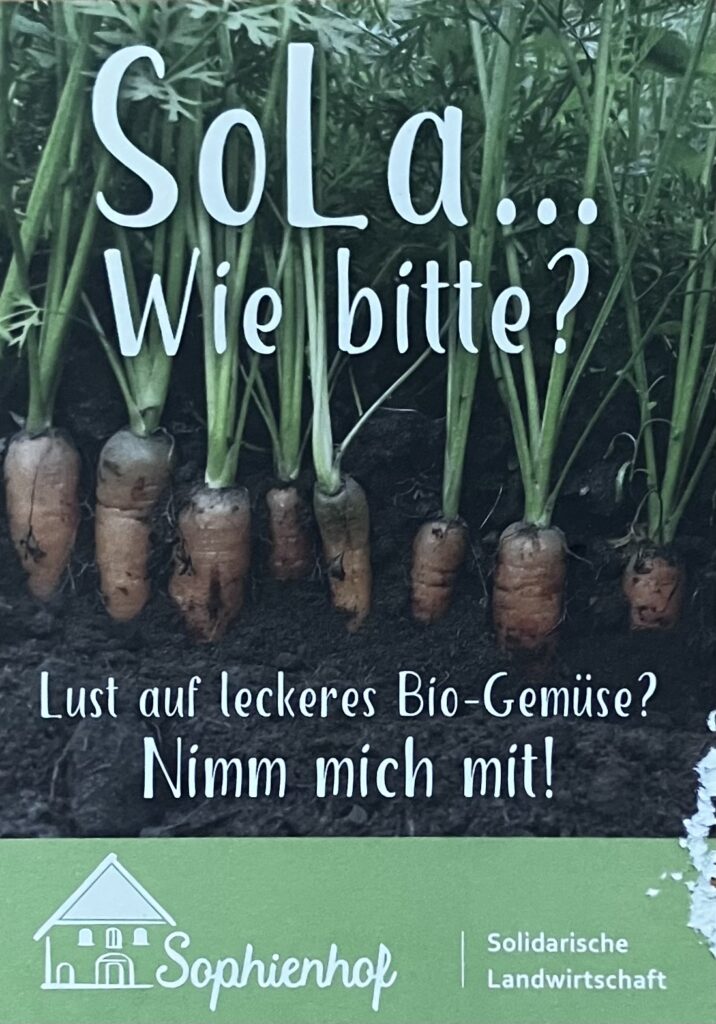
This brings us to a small farm in northern Germany called Sophienhof, one of a few hundred SoLaWi farms in the country today. As of 2021, the total number of SoLaWi farms in Germany according to the solidarische Landwirtschaft network stood at 368, reflecting major growth since the founding of the first SoLaWi in 1989.[iv] Sophienhof is located in a small town about 25 miles outside of Bremen called Oldendorf. In 2013, Sophienhof began operating as a SoLaWi and, as of 2024, supports and is supported by around 420 members, with visions of continuing growth into the future. The farm is ecologically certified under the German Öko certification (similar to an organic certification in the U.S.) and operates with the guiding principles of sustainable resource management and fair treatment of animals. Yes, there are animals on the farm as well; a small herd of cattle, specifically. Beyond a diverse offering of vegetables, members of the SoLaWi can also choose to receive beef as part of their share.
After arriving in Bremen in early October, I soon realized a part of me was missing my work on the Dickinson College Farm and the accompanying supply of seasonal vegetables, the kind so fresh that you can still smell the earth on them. It was in my exploration for fresh produce that I discovered an online tool designed by the solidarische Landwirtschaft network, allowing me to search for SoLaWi’s in my area. A quick search led me to Sophienhof, which appeared to be just what I was looking for. Having some experience with CSA’s, albeit from the producer side of things through Dickinson College Farm’s very owncampus supported agriculture, I was eager to see what it was like being a part of a SoLaWi in Germany. Not to mention, it was becoming harder to ignore the restless dreams I was having about Lacinato kale and radicchio.
A quick inquiry form was all it took, and I was signed up to receive vegetables from Sophienhof! The way it works in practice is sort of like a subscription service. Members of the SoLaWi pay a monthly “subscription” fee and, in exchange, receive a box of fresh vegetables each week, available for pick-up at select locations across the city. Sophienhof offers a choice between three different portion sizes, at varying price points: small (for a single person), medium (two people), and large (four people). After selecting your preferred portion and pick-up location (in my case, a small portion to be picked up from the nearby home of a long-time SoLaWi member), the fun begins! Each week on Friday, the team from Sophienhof delivers boxes full of vegetables to the different pick-up points. Members of the SoLaWi–“Solawistas” as we are affectionately addressed in farm communications–flock to the depots to pick up our vegetables.
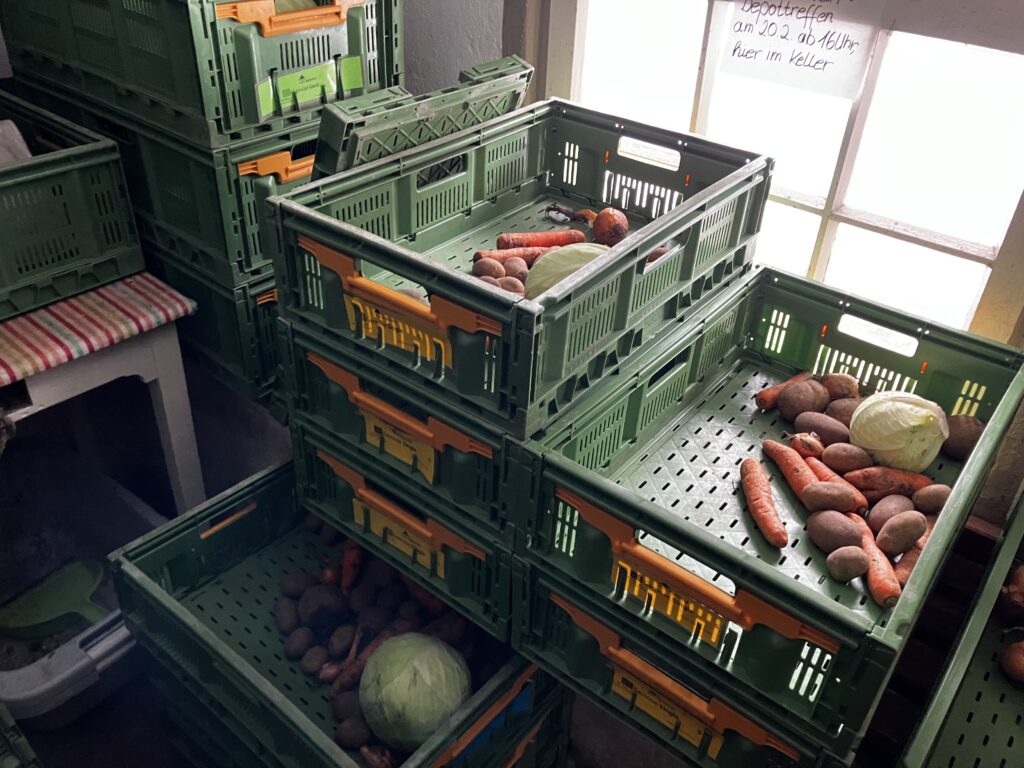
On a regular fall/winter week, I receive cold hearty vegetables such as kale, cabbage (of all varieties), kohlrabi, as well as vegetables that hold up well in storage such as beets, carrots, onions, and lots of potatoes. To any of our readers who have a favorite potato-based recipe, I encourage you to share it in the comments as I would be thrilled to find new ways to eat the high volume of starchy tubers slowly colonizing my shelf space.
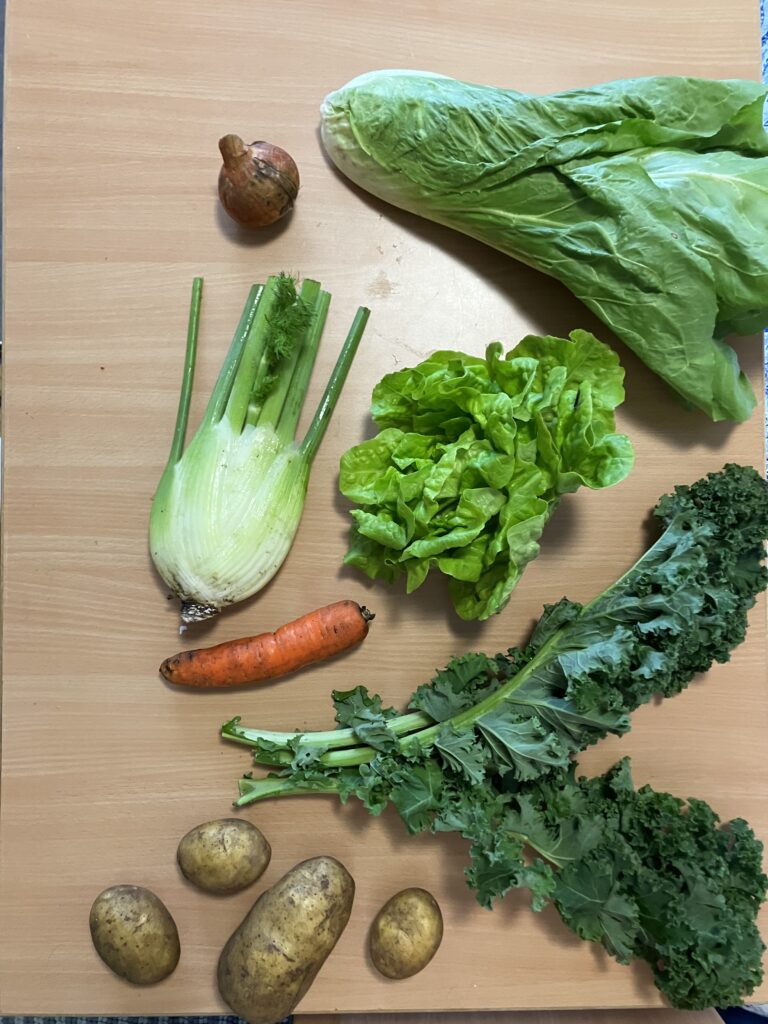
An important question is how much this all costs. As I began considering the possibility of joining a SoLaWi, I wasn’t sure that it would be feasible on our stipend budget. However, I was surprised by the affordability of vegetables through Sophienhof. Per month, it costs €61 for my “small” share of vegetables. This puts the cost per week at just over €15, which is still well within my weekly grocery budget. I found the relatively low cost surprising, having conceived the price for fresh, organic vegetables to be much higher. In fact, after doing some comparison, I discovered that if I were to purchase the same quantity of organic produce at a supermarket, it would cost the same if not more than what I pay to directly support Sophienhof.
I’ll leave you with this reflection about what makes this concept of community supported agriculture so special. By choosing to buy my produce from a small, local farm, I am accomplishing a few really cool things at once. First, to my benefit, I am receiving fresh veggies at a fair price that are, without a doubt, tastier than what I can find in stores. Additionally, shifting toward the broader social benefits, I get the privilege of knowing exactly where my food is coming from, who is growing it, and what their philosophy for tending the land is (e.g. what types of inputs they are using, how they are treating the soil and ecosystem, etc.). At a community level, I am supporting a local business and in turn supporting the region itself. By being a part of a SoLaWi, I am not just paying for vegetables, I am paying to support well-paid agricultural jobs in the area, to strengthen community ties through food, and to support folks who manage the land in a respectful and sustainable way. Lastly, there is the environmental aspect to consider. By taking part in an alternativefood system, I am choosing a path that seeks to remedy some of the flaws in today’s conventional system. Sourcing local vegetables through a SoLaWi means less transport and associated emissions, little to no packaging waste, and more responsible land stewardship without the use of harmful chemicals.
Thanks for reading along and I hope that I’ve sparked some curiosity regarding where your food comes from!
[i] Parasecoli, Fabio. 2019. “Making Sense of Food Systems.” In Food. MIT Press. 45.
[ii] Lowder, Sarah K., Jakob Skoet, and Terri Raney. 2016. “The Number, Size, and Distribution of Farms, Smallholder Farms, and Family Farms Worldwide.” World Development 87 (November): 16–29. https://doi.org/10.1016/j.worlddev.2015.10.041.
[iii] Gomiero, T., M. G. Paoletti, and D. Pimentel. 2008. “Energy and Environmental Issues in Organic and Conventional Agriculture.” Critical Reviews in Plant Sciences 27 (4): 239–54. https://doi.org/10.1080/07352680802225456.
[iv] Netzwerk Solidarische Landwirtschaft e.V. 2021. Solidarische Landwirtschaft: Das Netzwerk stellt sich vor. Accessed on 01.18.2026 from https://www.solidarische-landwirtschaft.org/fileadmin/media/solidarische-landwirtschaft.org/Das-Netzwerk/Ueber-uns/Selbstdarstellung_2021_DRUCK.pdf
 pumped storage power plant and the VW EV-production facility, talking to renewable energy specialist, etc., spanning over three big cities in Germany: Berlin, Dresden and last but certainly not least Bremen!
 wonderful group and dining together at the famous “Ratskeller” in the city center, followed by a very entertaining Night Guardian tour of the city.