by Andrew Shuman ’11
A few weeks ago, the Dickinson in Bremen program took a trip to Germany’s capital, Berlin. Most of the students, myself included, had been there before, so the novelty of tourism was somewhat lessened in degree, but the trip was nevertheless well worth it. The main reasons for that, from my point of view at least, were the two hour long meetings that Janine Ludwig arranged for us with two German politicians, Dr. Carsten Sieling, a representative to the German Parliament from Bremen, and Hans-Ulrich Klose, the coordinator of German-American cooperation. I’d never met with any politician on such an informal, small group basis, much less politicians with an active hand in the handling of a very much current crisis. That European crisis, which began with the massive debt issues in Greece, has seen the Euro plummet in value to about $1.20 and prompted the parliaments of the EU member nations to approve a massive rescue package for the beleaguered Greek government.

Dr. Carsten Sieling (with Dickinso shirt), Dickinson students, and Dr. Ludwig (right)
How Dr. Sieling, who is a member of the SPD political party, which, suffice it to say, means that we don’t exactly see eye to eye on economic issues, articulated the issues the German people and government were facing with regard to the Euro crisis was particularly impressive. As Americans, we’re pretty used to politicians giving short, sound-bite answers that are almost always ideological in nature. For instance, in the midst of the financial and credit crisis in the states, the favorite lines of politicians both right and left revolved around “the greed and excess of Wall Street” and “Wall Street taking down Main Street”. While politically pungent and polarizing, both lines are frustratingly simple, and when one really takes a closer look, they do next to nothing to explain how the US economy really collapsed.
Dr. Sieling, who was actually set to give a speech in the German Parliament later that day on the very issue of the Euro crisis, didn’t say a single thing that made him seem an ideologue. On the contrary, his explanation of how the crisis developed was thoroughly reasonable, rational, and economically sound (which made me, as an econ major, very happy). He alluded to the fact that Germany’s ability to control labor costs relative to other Euro zone trading partners, namely Greece, Spain, Portugal, and Italy, had enabled the German export economy to thrive with those nations as prime customers. As he noted, Greece’s negative balance of trade as an importing nation had caused the Greek government to become highly indebted, and some of its main creditors, ironically enough, were major German banks. Thus, as he understood only too well, the Germans were stuck between a rock and a hard place; if they let the Greeks fail, they would shoot their own banking system in the foot, and if they approved the bailout of Greece, German taxpayers would be on the hook (something they’re understandably not too happy about). In his place, I would have expected an American politician to boorishly point the finger at the eternal scapegoats of financial calamities, ‘greedy speculators’, as if speculation had been the sole cause of the Greek government’s debt problem and the rapid decline of the Euro.
Dr. Sieling, if I recall properly, only mentioned speculators once in the entire hour of conversation. Perhaps it’s that politicians wear a different face when behind closed doors with a small group of college students, but I couldn’t help but marvel at how well informed and incredibly candid he was. Of course, like a true politician, he wouldn’t exactly stop talking, which gave us very little chance to pose the questions we had prepared, but because he elaborated so well on the topic the one-sidedness of the conversation was hardly onerous.
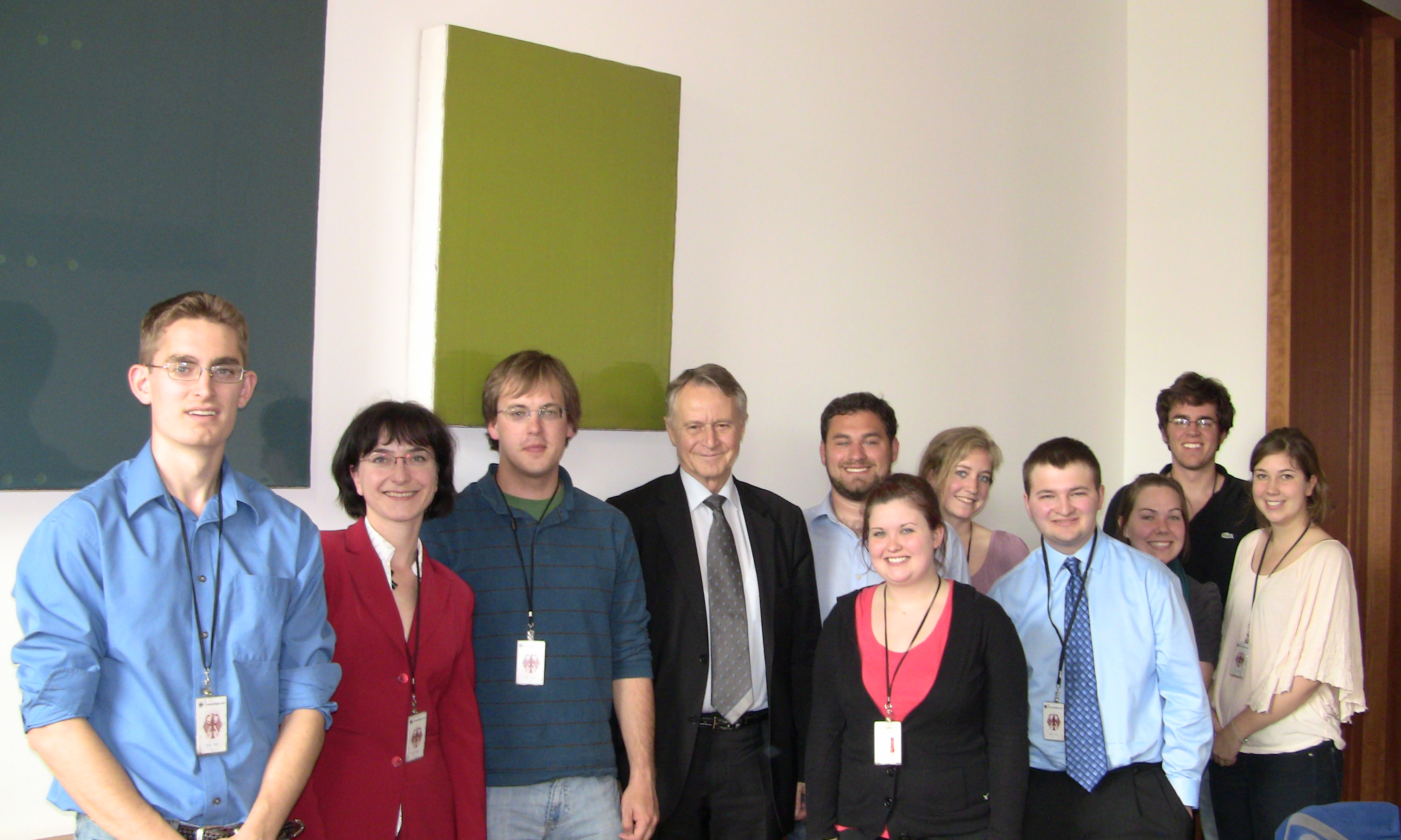
Hans-Ulrich Klose (4th from left), Coordinator for Tranatlantic Cooperation
Hans-Ulrich Klose, whose job it is to conduct relations with America, seemed to welcome us very warmly. His demeanor and degree of candor was just as high as Dr. Sieling’s, and the way he approached the issue of dealing with Iran’s nuclear ambitions was particularly well-reasoned and rational. Rather than hanging his hat on economic sanctions or military threats to resolve the issue, Klose seemed to truly appreciate the depth and complexity of the issue, like a true diplomat. He stressed the extreme importance of collaborating with Russia in any negotiations with the Iranian regime, as the Russians have a high degree of interest in preserving Iran as a source of energy.
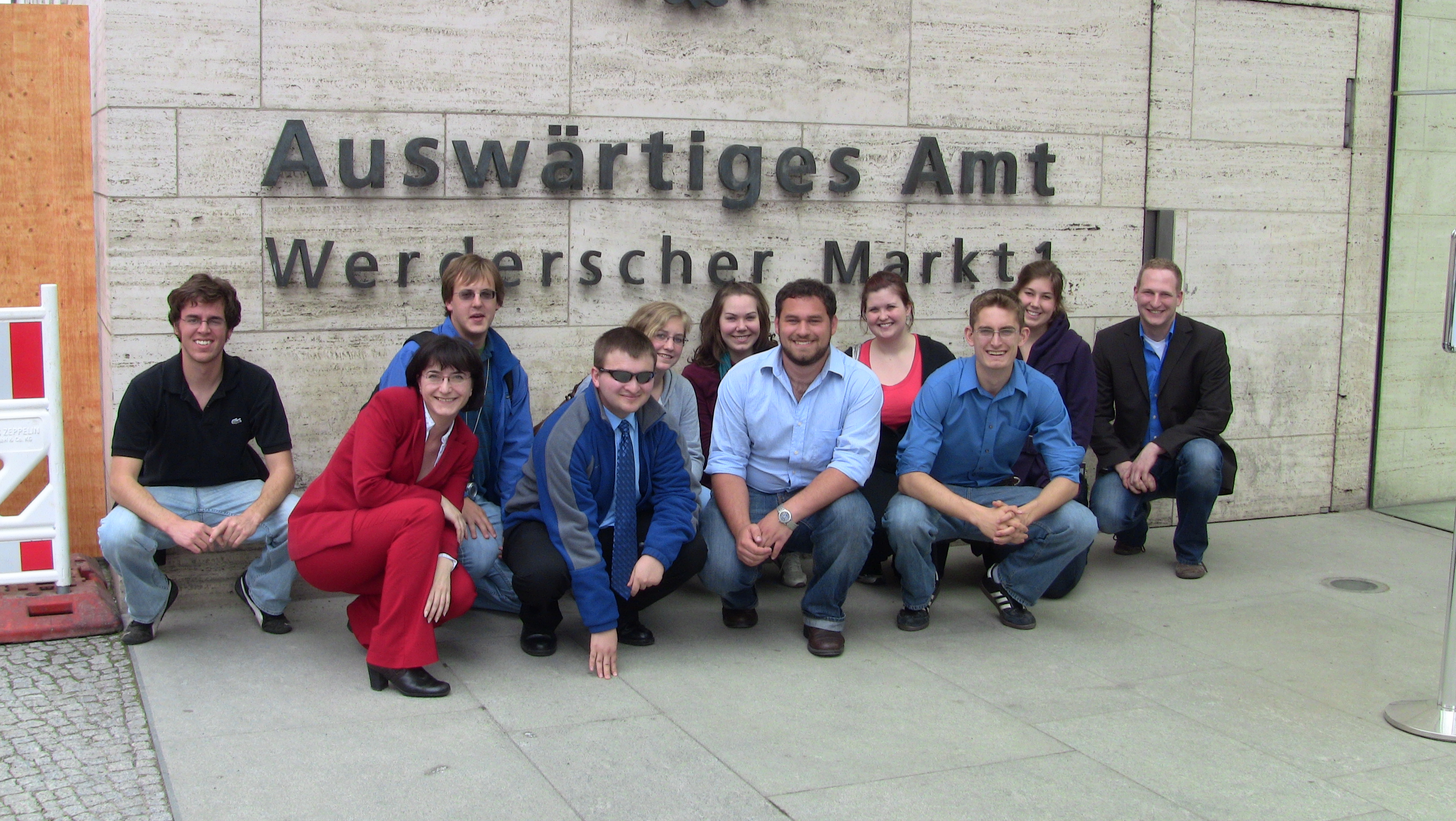 As someone who has become somewhat disillusioned with the deterioration of American politics into partisanship and mindless ideological sound-bites, the experience in Berlin taught me that American politicians could learn a lot from their German counterparts. Instead of saying one thing and doing another, I truly got the sense that Dr. Sieling and Hans-Ulrich Klose were speaking to us as honestly as they would to a meeting of the German parliament.