by Andrew Shuman ’11
As with many Americans, indeed, many more than Europeans may expect, I’ve played soccer nearly my entire life – since I was five, to be exact. As such, I’ve been a fan of the game for a very long time, starting with 2002 World Cup in Korea and Japan, when I got up in the wee hours of the morning to watch the final, where the Germans and their immortal keeper, Oliver Kahn, previously next to unbeatable in the tournament, lost to Brazil and Ronaldo. Arguably, those two players, Ronaldo and Kahn, are the best striker and goalkeeper of all time, respectively. That epic matchup, which ended 2-0 for Brazil, one of the goals coming following Kahn’s only error of the tournament, got me hooked on the international game. From the Champions League, in which Europe’s top club teams compete, to the 2006 World Cup and the 2008 European Championships, I don’t think I’ve missed a televised game if I could help it.
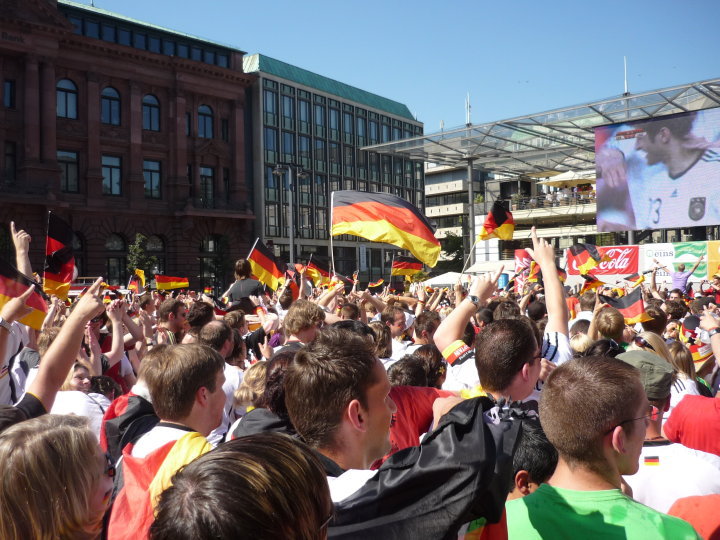
Being here in Germany for the 2010 World Cup and having just seen the die Mannschaft (literally, ‘the team’) crush archrivals England at a public viewing yesterday, though, has given me a real appreciation for the meaning of international football here in Europe. The World Cup and the Euro are far more than simple spectacles of sport; the national teams embody the histories and identities of entire nations.
Soccer is an inextricable part of Germany’s past, and, unlike the World Cup history of the United States, Germany’s history of participation in the tournament is riddled with momentous victories and defeats that came at defining moments in the history of the nation itself. Those moments have been indelibly etched upon the national conscience of the German people and that history gives added meaning to classic matchups like Germany vs. England. It’s obvious to everyone, of course, that two world wars fought between the two nations, as much as it is politically correct not to acknowledge it, play a role. However, the fact that England’s only World Cup victory in 1966 came against West Germany in the final at Wembley Stadium in London and the fact that the English have caved under pressure and lost to the Germans in two penalty shootouts on the international stage in the 90’s provide just as much of a backdrop. The looming quarterfinal matchup with Argentina, for instance, is far more than a game between, arguably, the two best teams in the tournament so far; it’s a rematch of the quarterfinal of the 06 World Cup, where Jens Lehmann saved 2 Argentine penalty kicks to put the Germans through, a rematch of the 1990 World Cup Final, where an Andreas Brehme penalty give the Germans their 3rd World Cup victory against the Argentineans, and a rematch of the 1986 final, where the greats of the German game, names like Lothar Matthäus, Karl Heinz Rummenigge, and Rudi Völler lost out to Diego Maradona and Argentina. Almost every matchup has that historical dimension and undertone, and, if I had to pick one thing only, I’d say that’s the biggest missing element from the World Cup experience from an American viewpoint. Hopefully, one day we can develop a storied World Cup history, to the point where a USA v. England matchup isn’t just presented as a ‘second American Revolution’, but as round two, or even three, of a matchup that has already delivered truly classic World Cup games.
Moreover, football has, at times, taken on a far greater role than that of a mere sport in German history. The German’s first World Cup victory in 1954, during the depression and disillusionment of the post WWII years, inspired and helped to heal a downtrodden nation, creating, to some extent, a new, positive national identity free from the ghosts of the Nazis. In German, the 1954 victory is known as “Das Wunder von Bern”- The Miracle of Bern, since the underdog German team beat the Hungarians in the final, a team considered nearly immortal and unbeatable. Germany’s third World Cup victory in 1990 came just as West and East Germany, so long divided, were coming together at long last as a reunified Germany, and die Mannschaft’s win over Argentina crowned that triumphant moment in German history.
This World Cup, regardless of whether the Germans can win the 4th star or not, I think the very makeup and playing style of the German team speaks volumes about German society and it’s development over the last few decades. A cursory glance at the German roster reveals that many of the players don’t exactly have names that seem ‘typically Germany’, and it is indeed true that the team is made up of many players from a diverse immigrant background. Lukas Podolski and Miro Klose, for instance, are of Polish heritage, as their names betray. Sami Khedira is of Tunisian extraction. Mesut Ozil is of Turkish lineage, Cacau is a nationalized Brazilian, and Jerome Boateng is half German, half Ghanaian. Ignorantly, I think, many people jibe that this German team isn’t really German at all. Sure it is. The jingoist assumption that to be ‘German’ means having blonde hair and blue eyes and having a last name like Schweinsteiger or Mertesacker no longer has a place in modern German society, and, for their part, I think the Germans are rightfully proud of the diversity and tolerance the national team reflects in their society. What’s wrong with a new German national identity, one that stresses the nation’s willingness to accept immigrants and people from all sorts of different backgrounds and consider them just as much a part of Germany as any others? Nothing. The new, ethnically diverse identity of the national team has, it seems, coincided with a radical change in the teams of style of play. Gone are the days of the stereotypically dour, efficient, and stout playing style of the German teams of the 70’s, 80’s, and 90’s. The team we’re seeing in the 2010 World Cup is young, vibrant, fast, aggressive, and they combine and move the ball around the field at the speed of light, often times catching opponents flat footed for a counter-attack goal (England, Australia). Thirty years ago, such a free flowing style of play would have been unthinkable from a German side. As the Germans say, these guys have Spielfreude.
The World Cup doesn’t have to, and indeed should not have, the jingoistic undertone of ‘pure’ races of men from different nations having at each other on a grass field to see which race is the best at putting a ball between two posts. The players on the national team represent the people back home- their friends, families, fans, and supporters- as well as the youth football system that made them into the players they are. In that sense, then, if Podolski, Klose, Ozil, Khedira, and Boateng were all born and raised in Germany, how do their ancestries or last names make them any less worthy of representing Germany in the World Cup than Bastian Schweinsteiger or Holger Badstuber? As Americans who live in a society that is defined by its diversity, we should, I think, appreciate how open German society has become.