Studying Econ in Bremen

by Grear Boyd ’25

Hello!

My name is Grear and I was an economics student at Vanderbilt University until the Spring of 2025. I was blessed to be able to participate in the Durden Dickinson in Bremen program in Sommersemester 2024, where I took two German Studies equivalent classes and two economics classes at Uni Bremen. I was pleased to find that the economics department at Uni Bremen offered a wide variety of courses, both core and elective, in both English and German. Typically, the core courses were more so offered in German and elective courses more so in English, although there were exceptions. If you feel your German ability is sufficient to take a core economics class in German, I would highly recommend it as I believe it would make a significant and positive addition to the immersion aspect of the program at large.

Personally, my German skills were not quite sufficient to be able to do this, and I took Environmental Macroeconomics with Professor Klarl and International Public Finance with Professor Heinemann. Both professors were approachable, despite English being their second languages, and passionate about their respective subjects, especially Prof. Klarl, who has extensive publications in the field of environmental economics. I was particularly impressed, and even moved by his obvious passion for environmental protection and his emphasis on how environmentalism and economic viability are not mutually exclusive.

In contrast to typical American course structure, economics coursework at Uni Bremen are largely independent, with lectures meeting only on a weekly basis and graded homework being virtually nonexistent. That said, you will be solely responsible for mastering course concepts both in preparation for final papers (Hausarbeit) and for the general advancement of your education. Initially, that seemed to me to be slightly intimidating, but, after having experienced this system, I now consider it to be rather empowering. After all, absorption of personal responsibility in this manner is, in my opinion, what an immersive study abroad program like this one is all about. It serves to transform children into personally responsible adults! Just kidding, but only kind of. Really, these courses do serve you in becoming a stronger, more independent person. And that is truly reflected in the structure of these economics courses.

That said, you will not be without support, should you feel you need some. In my experience, Professors Klarl and Heinemann were happy to schedule meetings or speak after class about any questions or concerns you may have about course materials or Hausarbeit. Aside from that, you will always have the opportunity to connect with your peers, as many of them are also international students, likely with the same or similar concerns as you may have. So be sure to take advantage of that resource.

Lastly, a final note of appreciation for these courses that I might add would be the European perspective applied to the field of economics. I often found that, in the United States, the teaching of economics revolves around American economic history, United States (US) central banking and the Federal Reserve. Put simply, I learned economics in the US with “America as the center of the world”, if you will. My point is, I found it mind opening to view global trade, supply chains, taxation/public finance, etc., from the perspective of the European Union and with the US as a foreign entity.
Laboratory science courses at Uni Bremen

by Ellen Boldt ’26

As a Biology major, I pursued multiple laboratory science courses during my time abroad.  These were often my most challenging classes, due to the complexity of the vocabulary.  In the fall, I took a Vertebrate Biology course, which involved three-hour dissection labs every week, during which time I dissected a mouse, goldfish, and part of a preserved dogfish shark. The labs were supposed to teach us to focus on certain aspects of what we had learned in class.  We looked at organs in terms of an evolutionary continuum, except for the shark dissection, which focused on sensory exploration. 

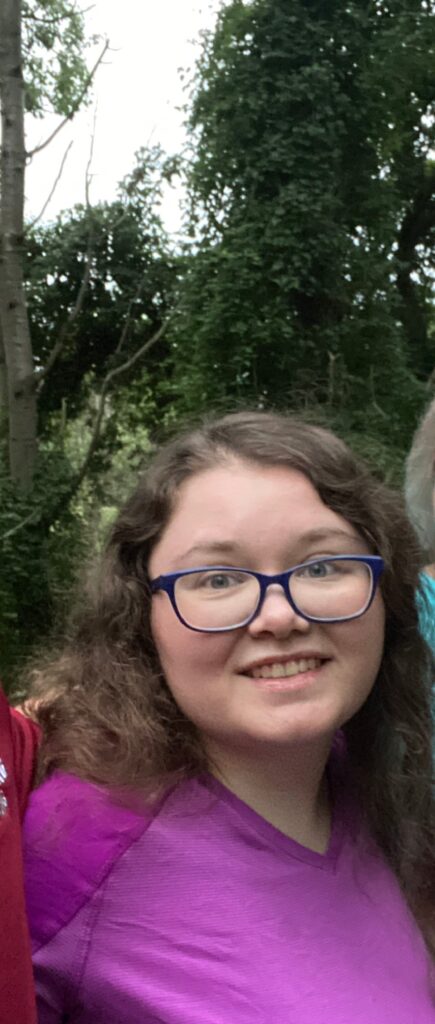
Nature Walks in Bremen ©Ellen Boldt

In the fall semester (Vertebrates), there were about 40 students in the labs, overseen by one professor and about four teaching assistants.  This structure was a much larger class than I would have been used to in the US, and with less supervision and group work for the lab procedures than I expected as well.  The lab procedures were more broadly structured and less rigidly paced, as students were expected to follow a written procedure with minimal overview and help.  In my American lab experience, the final product of the lab on which we would be graded would be a written report with observations, or possibly showing our dissection work for an anatomy lab.  However, both my vertebrate class in the fall and my animal diversity class in the spring, which focused on invertebrates, required us to submit notated drawings and diagrams of the structures we were dissecting and observing, with minimal forehand guidance of what we were looking for: just a list of parts that we would need to label. 

These differences were challenging but provided a practical way for us to learn structures.  Making us try to find structures as we dissected, and then draw them as we found them, was a good way for us to show what we were learning, and to show that we had captured the context of the body parts we identified. 

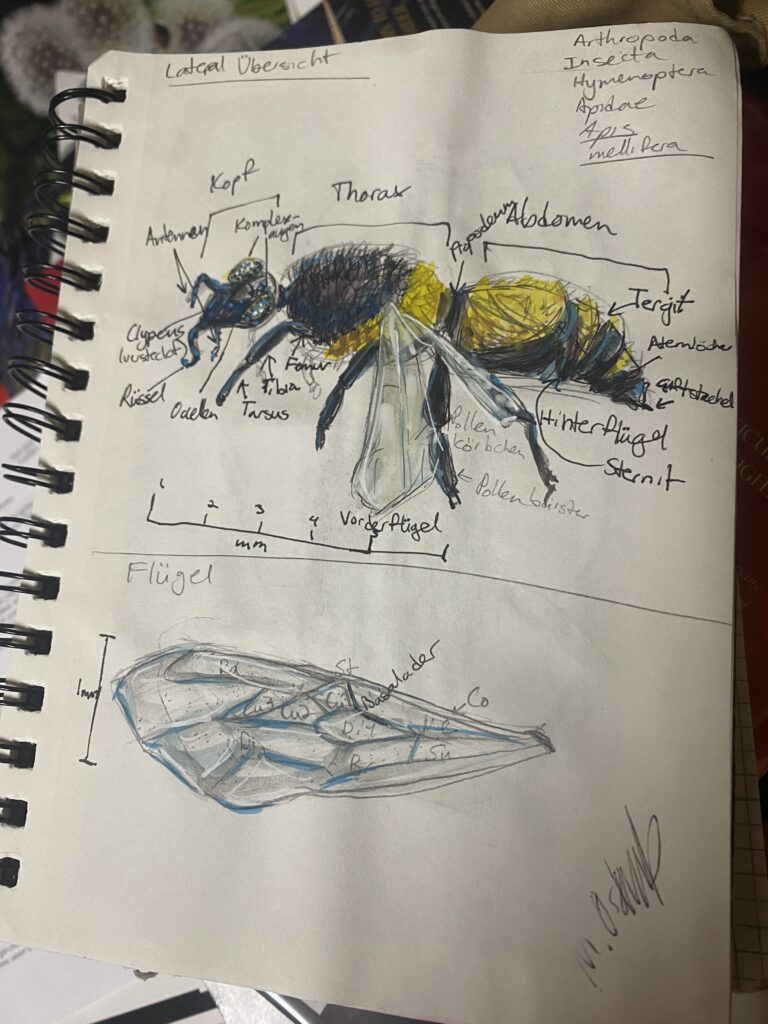
In the spring semester (Animal Diversity), there was an even bigger class of at least sixty students in each lab group.  Rather than dissecting, we observed whole samples of arthropods and invertebrates preserved in alcohol.  This was easier in some ways than following a delicate dissection procedure, but labelling microscopic structures was its own challenge, as well as identifying the samples by species through use of a dichotomous key (in German!).  One assignment I struggled with particularly was when I tried to draw sections of bumblebee wings so I could label them.  On the other hand, I enjoyed making the drawings and occasionally received compliments on them, which helped to build my confidence.  While I was familiar enough with using dichotomous keys to be mostly effective, I draw the line at beetles.  The known beetle species comprise 25% of all known animal species—there are too many for an amateur to meaningfully differentiate with so blunt a tool as a dichotomous key! 

Drawing and labeling the sections of bumblebee wings. ©Ellen Boldt

It was hard when we did field work at an outdoor nature preserve, because I didn’t have my computer with me for looking up words; I could sometimes identify an animal by its English name without knowing what it was called in German. 

One of the last Biology projects for my year in Bremen was a trip with my Animal Diversity class to the Übersee (Oversea) Museum, which is a sort of natural history museum.  A group of about 30 of us went into a back room and got to handle some of the artifacts that had been collected from around the world, including ancient wasps that had been preserved in amber.  My group made dichotomous keys to identify specimens of squid and octopi. I was amazed to learn that Germans don’t have differentiated commonly used words for squid, octopus, and cuttlefish:  they were all called by the same name in German, “Tintenfisch”! 

Conducting the labs in German provided an extra layer of challenge, but I am glad I was able to familiarize myself with a new category of German vocabulary.  I communicated with my lab partners in German but did find myself looking up quite a few words in my German-English dictionary.