Typically, when folks hear “study abroad” they think about cheap flights to Italy or weekend excursions to Prague. In other words, “abroad” usually comes first and “study” second in the archetypal image of study abroad. But what comes third? While travel adventures and classwork certainly were part of my experience abroad, I want to share in this post about the less rumored but equally (if not more) meaningful elements that shaped my time in Bremen. These being community engagement and volunteering. In doing so, I also hope to convey precisely why these experiences are so meaningful during study abroad and how they contributed to my time in Germany.
To begin, it is important to mention that volunteering isn’t something that always “comes third” during study abroad. The Dickinson in Bremen program is unique in this way. Built into the Germany program is a student community engagement requirement. While the idea of seeking out and applying to volunteer with local Bremen organizations is – to be fully transparent – usually met with a certain degree of fear by the students, I’d like to share how my perspective changed through and after volunteering. I, too, had reservations in the beginning, but was able to outgrow these fears and build connections in Bremen through volunteer work.
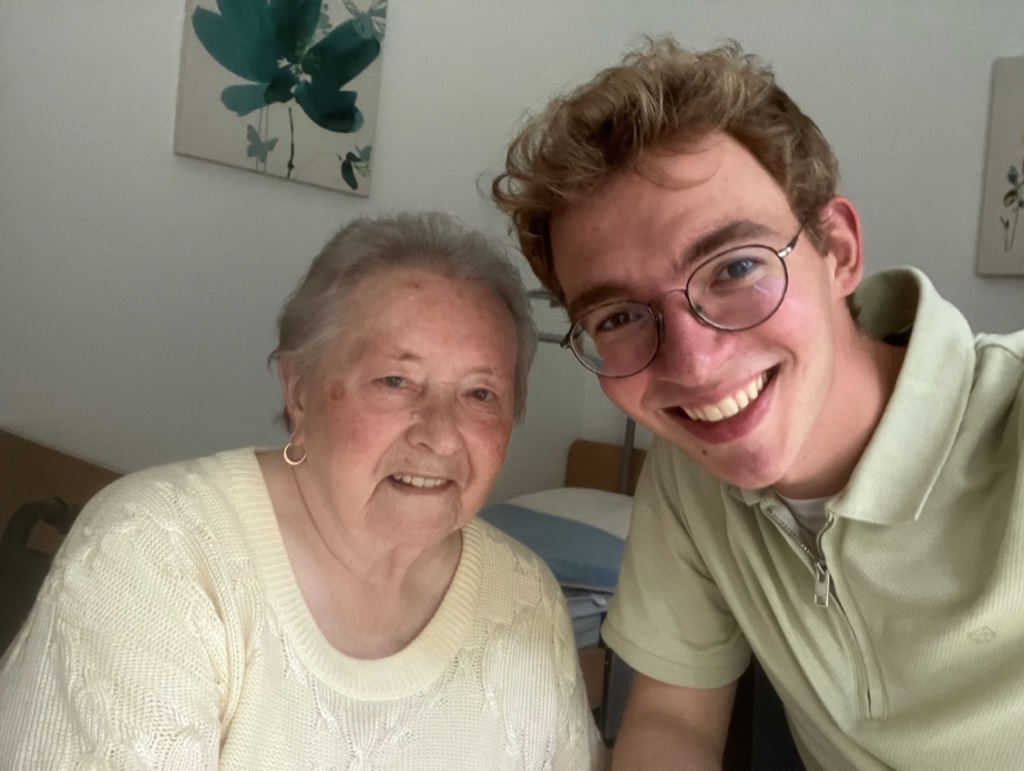
How did I get engaged? Scrolling through the “Freiwilligen-Agentur” website (linked below), Bremen’s online platform where organizations seeking volunteers post opportunities, I stumbled upon a posting from Johanniterhaus. The nearby retirement home, located in Bremen Horn, was requesting cheery individuals to bring companionship to retirees. With many doubts about the aptness of my German skills but convinced that I could brighten the lives of a few retirees, I decided to reach out to the retirement home.
My doubts were assuaged by the immediate and enthusiastic welcome I received from staff at the home. At first, I was puzzled by just how welcoming the staff members were. My hand was shaken at least ten times and I received more smiles from strangers than I had in the previous five months of being in Germany. I couldn’t see what I had done to deserve such a warm reception on my very first orientation visit. The following week, upon meeting with a group of residents for the first time, however, I understood.
To those unfamiliar with retirement homes, everything works on practically the same schedule, day in day out. Despite attempts to liven up the routine with programming such as bingo, movie screenings, and the occasional concert, there is just no helping the fact that life in a home can be utterly dull; especially for residents with decreased mobility, which is to say most. Thus, an eager 20-year-old walking through the doors of an assisted living facility is essentially like the sun entering on two legs. Add to it that I was an exchange student from the United States and you can believe I was the most interesting subject that had stepped foot inside the home in a decade.
And so I began my weekly visits to the retirement home. On Mondays, I would visit two specific residents, with whom I chatted and exchanged stories with. One gentleman, whose name I will not share for privacy reasons, a Bremen native who was mentally very sharp, despite being unable to leave his bed. We enjoyed talking about German literature together and he would recite poems from the likes of Goethe and Schiller from memory. And then there was an elderly woman, Frau Krause, who had migrated to Bremen from Poland in the 1970s, with whom I spent the most time. Frau Krause had been a teacher for Polish, German, and Choir in a neighboring school district. She told me stories about learning German as an immigrant, how she managed to gain respect in the classroom as a young teacher with an accent, her home in Poland, and her grandchildren.
On Wednesdays, I assisted with the larger gardening group, which served as a good opportunity to bring the residents outdoors and get some fresh air. Both my individual visits and time spent gardening with the residents were great fun. I enjoyed bringing positive energy into the home and virtually everything I shared with the residents was met with wonder. I don’t know if I have ever encountered a more supportive bunch than the retirees who constantly expressed what a kind young man I was and that I was bound to accomplish great things.
Too soon, it was time for me to depart back to the United States. On my last day at the home, the staff and residents threw me a goodbye party, emphasizing that if I were to ever come back to Bremen, that I should not hesitate to stop by for a visit. I said goodbye with a heavy heart, knowing that, if I were return someday, many of the residents I had gotten to know over the past four months would no longer be there.
I had, however, learned a great deal from the residents and my visits to the retirement home. I learned, for instance, that there is a personal benefit to community engagement while abroad, beyond the benefits that one provides to the community. By getting involved in Bremen, I felt a sense of belonging and the responsibility for something beyond just myself that I had been lacking. Second, simply by conversating and chatting with the residents, my German speaking and comprehension skills improved. And lastly, through my many conversations with Frau Krause, I learned two things: that I shouldn’t fear making mistakes in the language and that immigrants like her and millions of others can really, truly overcome the challenges of living in a new place and succeed. Her example was the undeniable proof that I, too, could adapt and thrive.
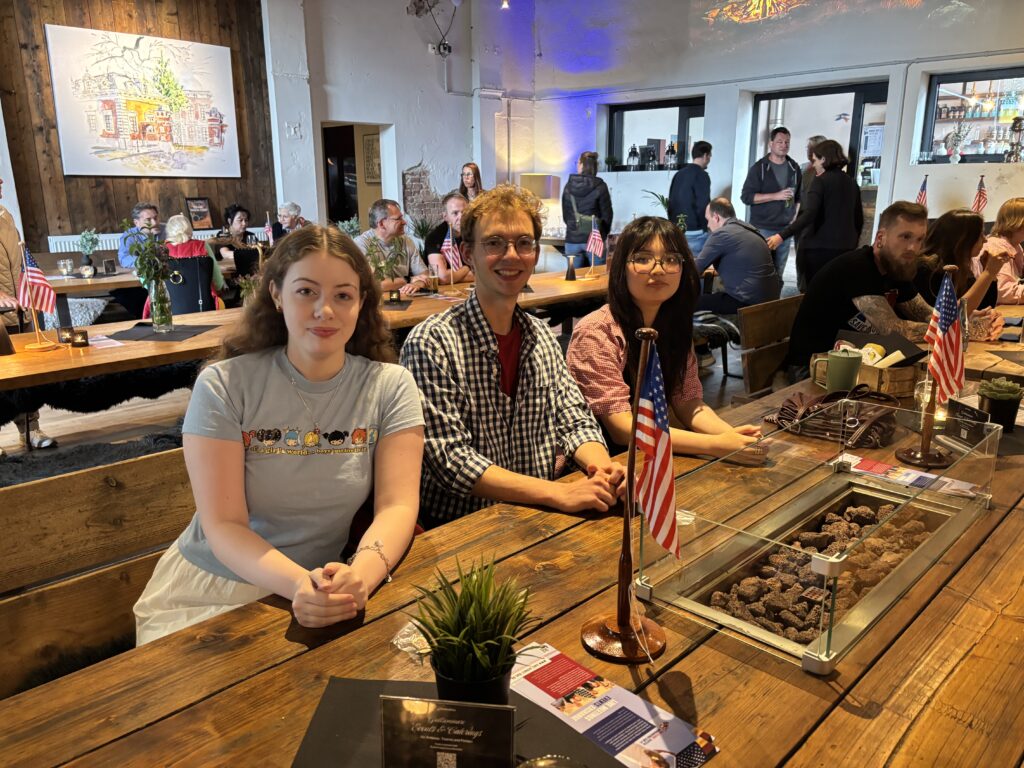
On Saturday, 4th of July, we attended the celebrations in honor of the 250th anniversary of the United State, hosted by the Carl Schurz German American Club. The festivities took place in the newly opened Grünewalds Grill-Institut.
With delicious burger creations by owner Kai Grünewald and his team, a keynote address by Mr. Eduard Dubbers-Albrecht, former president of the Chamber of Commerce and chairman of the Northwest Metropolitan Region, as well as a trumpet solo of the America National Anthem by Aaron Dering, we celebrated the 250th anniversary of the American independence in fitting style.
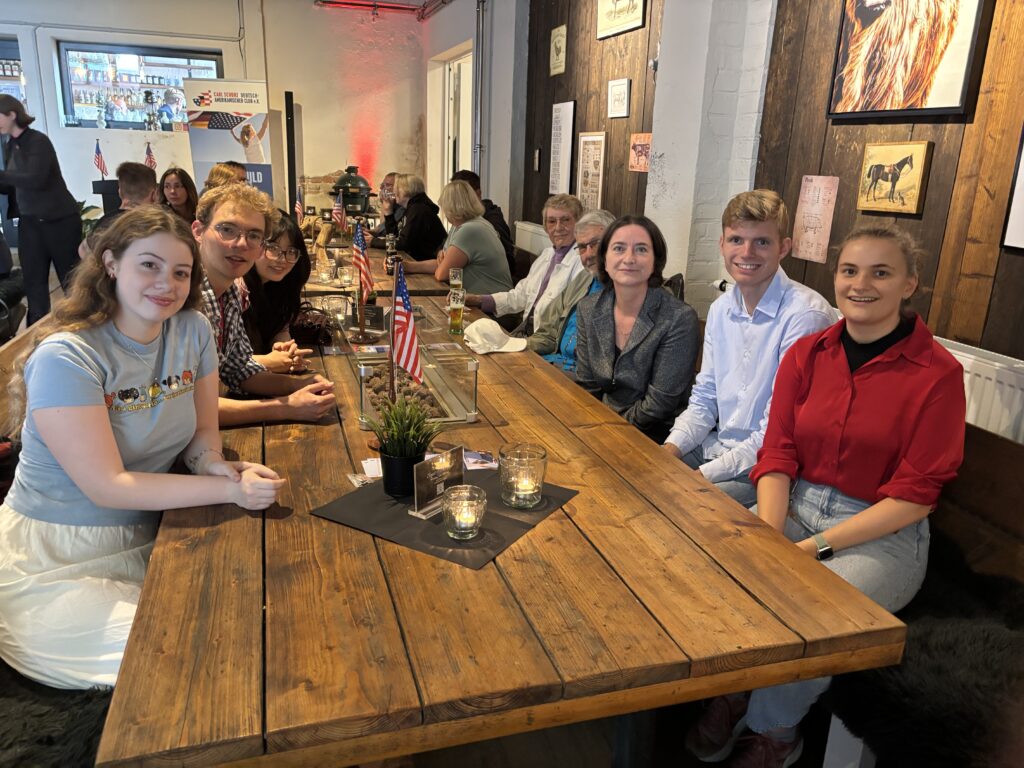
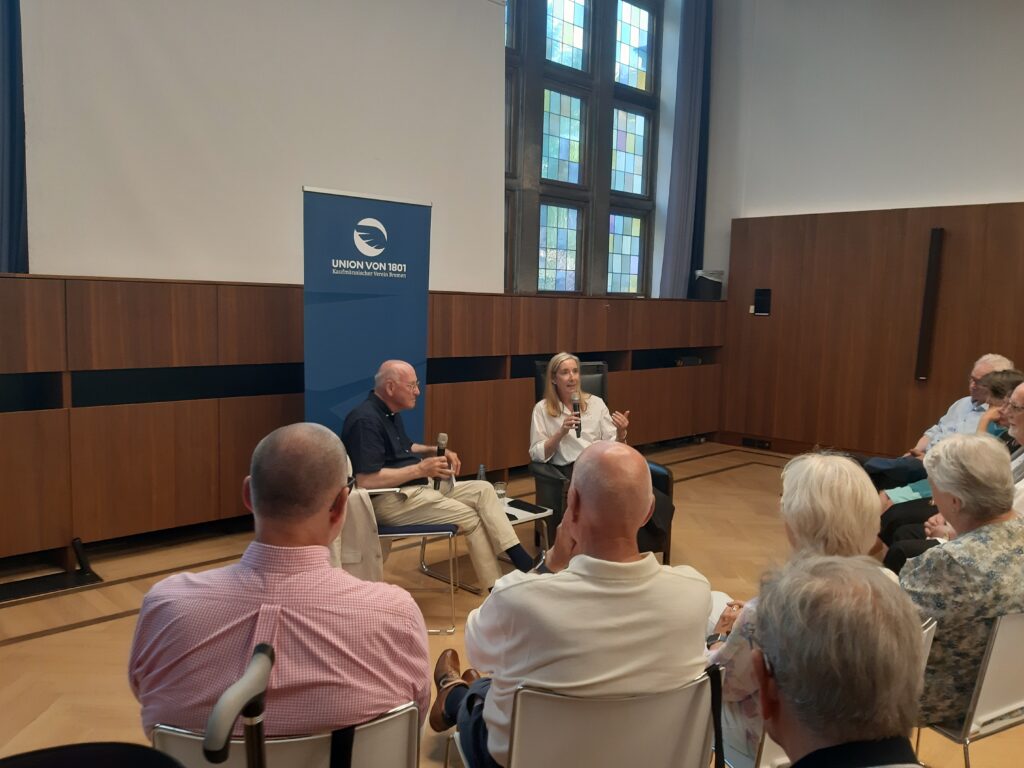
On the evening of June 19th, I was able to attend my first Bremer Sessel. The “Sessel” (German for “armchair”) is a regular interview series hosted by the Bremen Union von 1801 in partnership with the Carl Schurz German-American Club. The Union von 1801 is a merchant’s association local to Bremen, dating back to the city’s rich history of independent trade. I will admit that, this being my first time attending a “Sessel” talk, I was skeptical that I would get much out of being there. However, I was very pleasantly surprised!
This meeting’s guest was Cornelia Holsten, a trained lawyer who serves as the director of Bremen’s “Landesmedienanstalt”, which is essentially the German version of the Federal Communications Commission (FCC). Remember that since Bremen is a “Stadt-Staat” (city-state), it has its own independent administration and institutions. I can imagine that most readers’ knowledge of this field encompasses, at most, a loose familiarity with the acronym FCC. Thus, I think that you will understand when I say that I had absolutely no clue what the German Landesmedienanstalt is or does. As it turns out, it’s actually quite an interesting topic. The Medienanstalt is responsible for monitoring everything that is broadcasted on TV, radio, and the internet and ensuring all of this media is in line with the law when it comes to content and advertising. Holsten shared that the Medienanstalt is responsible for everything from making sure that no inappropriate shows air on TV before 8 pm to warning social-media influencers that they can’t advertise for a product without mentioning they own the company.
All in all, Cornelia Holsten was a witty and informative guest, who captured the audience’s attention. I also learned a thing or two about media law and regulation. Oh, and in case you were wondering, the guest always sits before the crowd in an ancient leather armchair, hence the name “Sessel.”
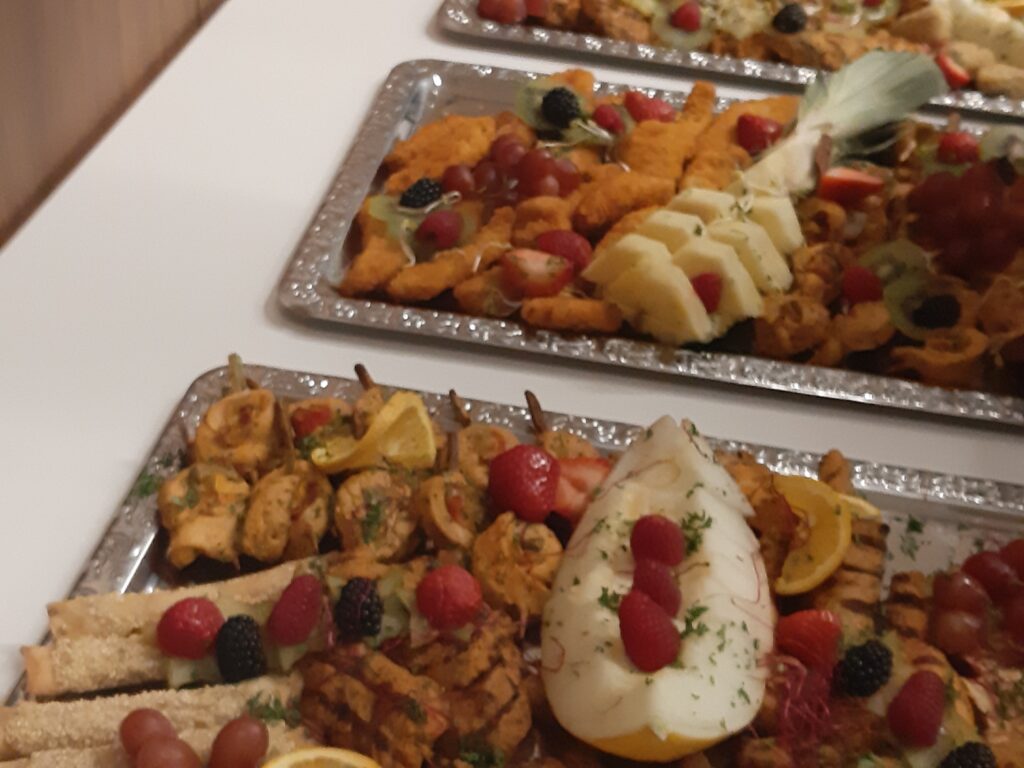
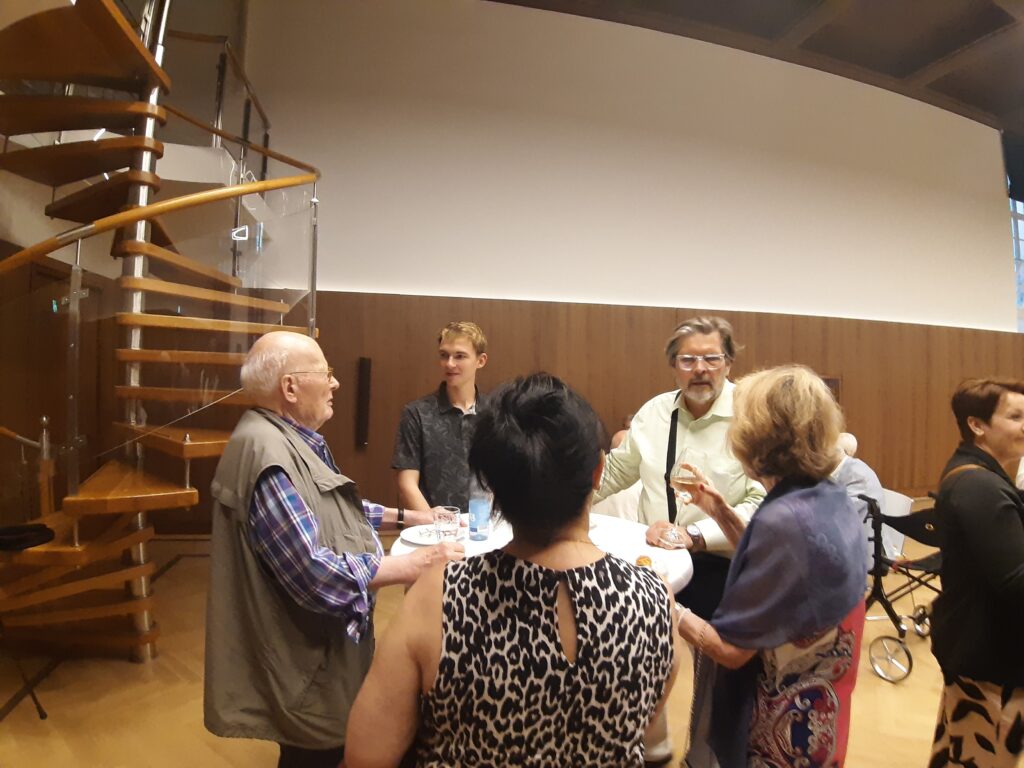
after the talk, snacks and light refreshments were provided
There’s something mysterious and alluring about the kitchens which hide behind cafeterias and the way they prepare high volumes of food at a lighting pace. This fact doesn’t change whether you’re in Germany or the US. One thing that does change, however, is the word that we use for cafeteria. In Germany, the cafeteria is known as the Mensa. While Dickinson’s slings out food for breakfast, lunch, and dinner seven days a week (minus Sunday mornings, of course), the Mensa at the University of Bremen is open only during weekdays for lunch. And unlike the cafeteria at Dickinson, it is the great equalizer: students, staff, and faculty alike can be seen making the pilgrimage down the Boulevard at 12 o’clock towards the Mensa. A trend partially reinforced by the wonderfully cheap prices for high-quality food achieved through subsidies. The Mensa is a mystery hiding in plain sight. It is an essential cog within the university, (literally) fueling the work that is done here. Yet, although it is a part of our everyday routine here in Bremen, no one seems to think twice about how the Mensa succeeds at delivering tasty, fresh, and diverse food options for a university of nearly 18,000 students and 3,500 more staff each day.
It’s time we lift the curtain and see what’s going on behind the scenes. How does the Mensa operate here in Bremen? Who calls the shots? Who is cooking the food we eat and where is it coming from? These are the questions that I wanted to answer. On a June weekend, the perfect opportunity presented itself! Each summer, the University of Bremen hosts an “Open Campus Day” on which members of the community are invited to visit the university grounds to see what sort of work is being done – and, importantly, where their tax Euro are being spent; after all the university, like most others in Germany, is a public, entirely state-funded institution, enabling tuition-free study for its students. On this particular Open Campus Day, a guided tour through the University Mensa was being advertised online. Upon hearing of the opportunity from our Dickinson program coordinator, Antonia (Toni) Gabler, I jumped at the chance to learn more about this beloved and mysterious campus feature and quickly signed up for the tour. Below, I will recount my fascinating excursion behind the scenes of the Mensa and share what I learned in the process.
The long-awaited Saturday finally arrived. The start of the tour could perhaps be best described as the exposition in a gruesome and frightening thriller novel. I and the other perhaps 20 people who had signed up for the Mensa tour, including program coordinator, Toni, were guided through the glass doors which serve as the entrance to the Mensa. The group hushed in anticipation, gathered around two employees wearing black chef’s uniforms. We stood in the entryway of the large, familiar space. Normally bustling with the din of lunch-goers laughing and chatting, today oddly still and empty. We were divided into two groups; my group followed the interim operations manager of the Mensa, our expert tour guide for the day, as he led us back outside. Outside? Yes, he muttered, something about a “back entrance”.
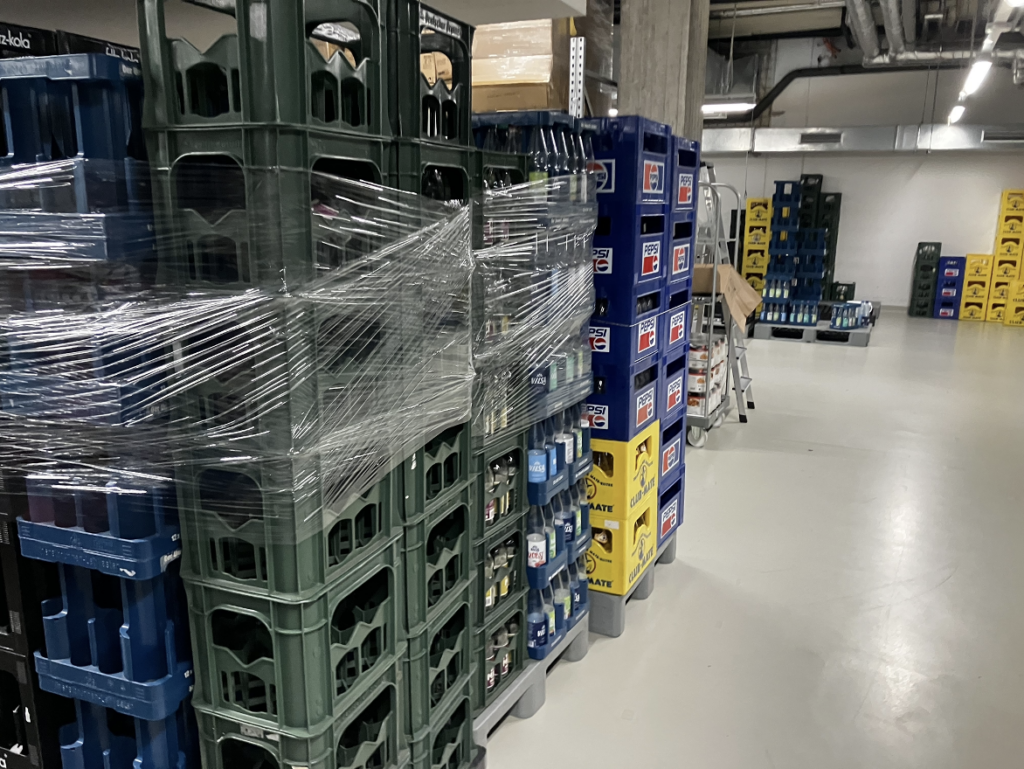
It was a confused type of day. One moment rain would pour from the clouds, the next, the sun shone through patches of blue sky. Back on the Boulevard, the wind whipped, spattering rain across our faces. We followed our chef leader down the stairs to the lower level of the university complex. For those who haven’t been there, the University of Bremen’s campus is somewhat labyrinthine, with utility entrances and loading docks located beneath the main level of the academic and administrative buildings. Having reached the gloomy lower, semi-outdoor space beneath the brutalist concrete structures, we were sheltered from the rain. A particularly violent gust of wind blew through the tunnel. Bang! The wind had caught the metal door of a cage surrounding some trash bins which reverberated loudly as it slammed into the solid concrete facade. Still, our leader marched on in front of us, guiding us somewhere. Was the cold drop sliding down my back merely from the rain we had recently walked through or the result of a nervous sweat? Our guide stopped outside a large garage door, we stopped too. Where are we? I had never been to this part of campus before and everything was unfamiliar. The wind whistling, a large menu card appeared in my mind’s eye. Messy red letters spelling “Today’s special: You”. These frightening visions were, however, thankfully extinguished as soon as we entered through the door. The tour proved to be highly informative and very fun. First, we were told how the Mensa receives deliveries every morning beginning at 6:30 from a wide variety of suppliers, depending on the goods being delivered. The group was still rather quiet at this point, no one wanted to pose questions yet. I suspect this had to do with the fact that they, too, were recovering from reveries about the newest kitchen murder mystery. From the loading bay, we moved to dry storage where all of the shelf stable items used by the Mensa are stored. Here, the sheer volume of the ingredients struck me. Pallets laden with 25-pound bags of salt, sugar, and coffee. All, our guide explained, are used by the Mensa in only about a month’s time. Then they must be restocked. Some canned goods and preserves were also to be found in dry storage, but the operations manager emphasized that he didn’t much like using canned goods and tried to use fresh whenever possible.
Image 1: Dry storage in the lower level of the university Mensa.
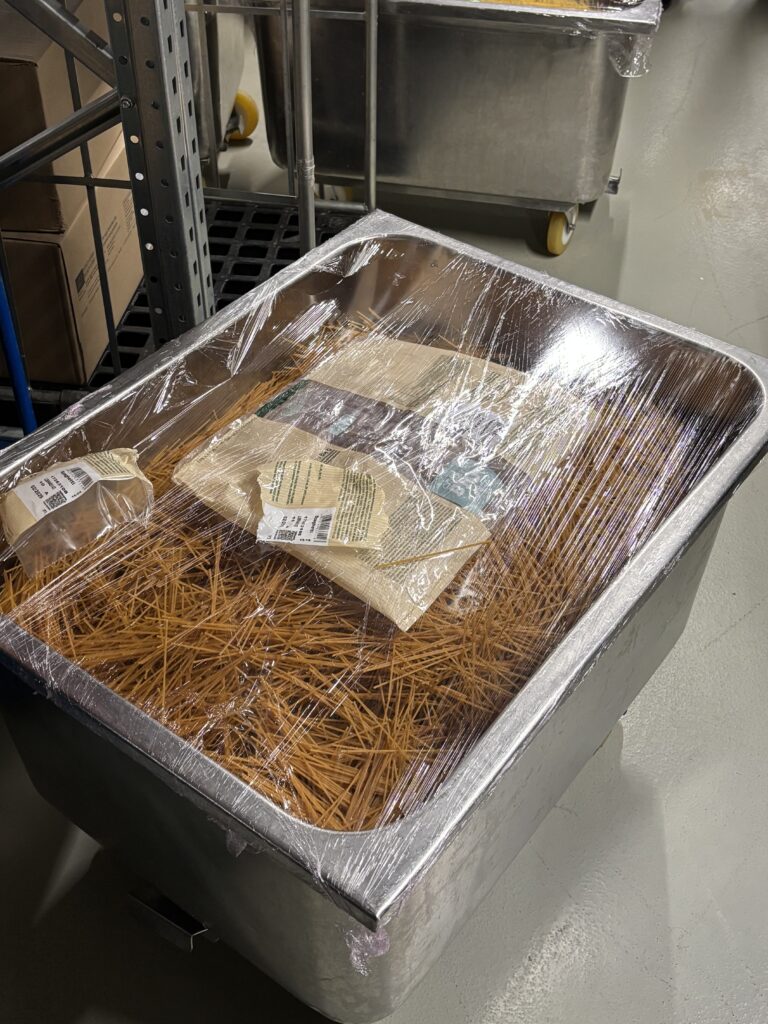
Image 2: Spaghetti ready to be cooked for next week’s lunch
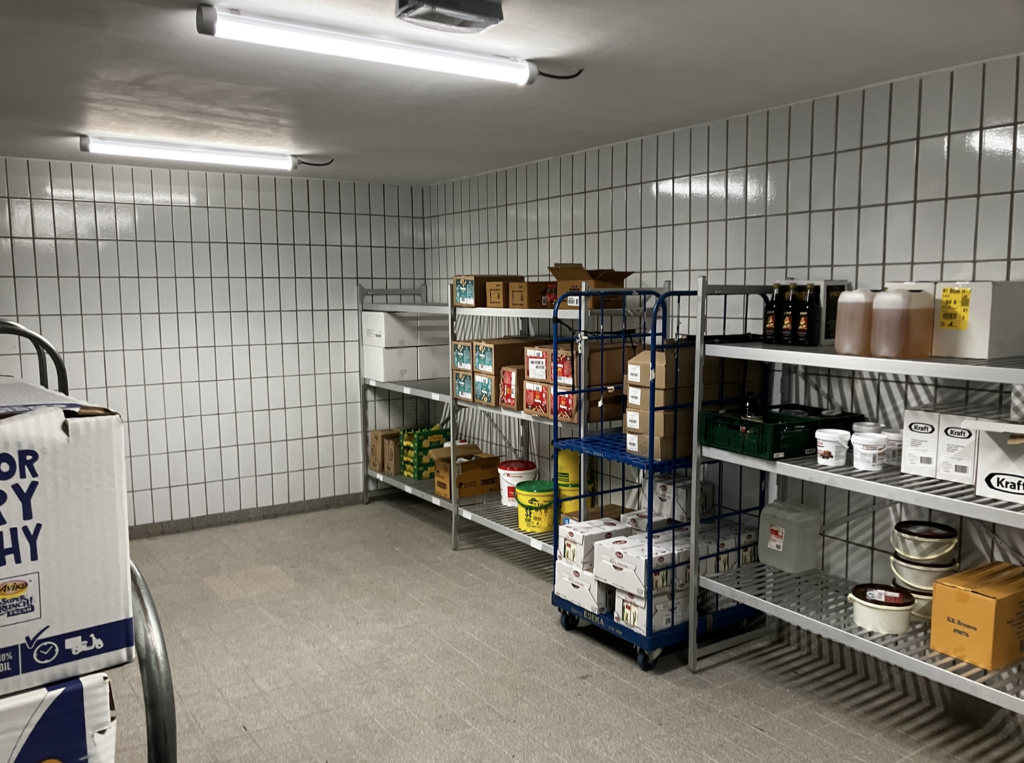
Next, we got to see a few of the Mensa’s many walk-in refrigerators and freezers. Having worked in food service myself, I was impressed with the degree of organization and meticulousness in the storage areas. Everything had its place and all is kept in a neat order.
Image 3: View from inside one of the Mensa’s walk-in refrigerators, everything is neatly organized.
From storage, we moved on to the areas where the true magic happens. The prep areas and the kitchen. First, we walked through the salad and pasta prep areas. All of the Mensa’s nearly 100 employees are divided into teams of 3 to 4 people, the manager explained. These teams work together and rotate through the various tasks which need to be accomplished each day for the Mensa to run smoothly. For instance, one week, Team A might be on salad prep station, washing lettuce and cutting up ingredients for the daily salad bar. Team B, meanwhile, might be on sauce duty, whipping up the various sauces and dips required for that week’s menu. The Mensa operates a six-week menu cycle, by the way. All recipes are created in house. After a certain number of days, the teams rotate and get a new assignment. This way, the guide explained, the Mensa is never left in a bind if someone doesn’t show up for work. All the employees are able to accomplish all the tasks and jump in where needed. Additionally, the rotating teams method breaks up the monotony of peeling carrots day after day.
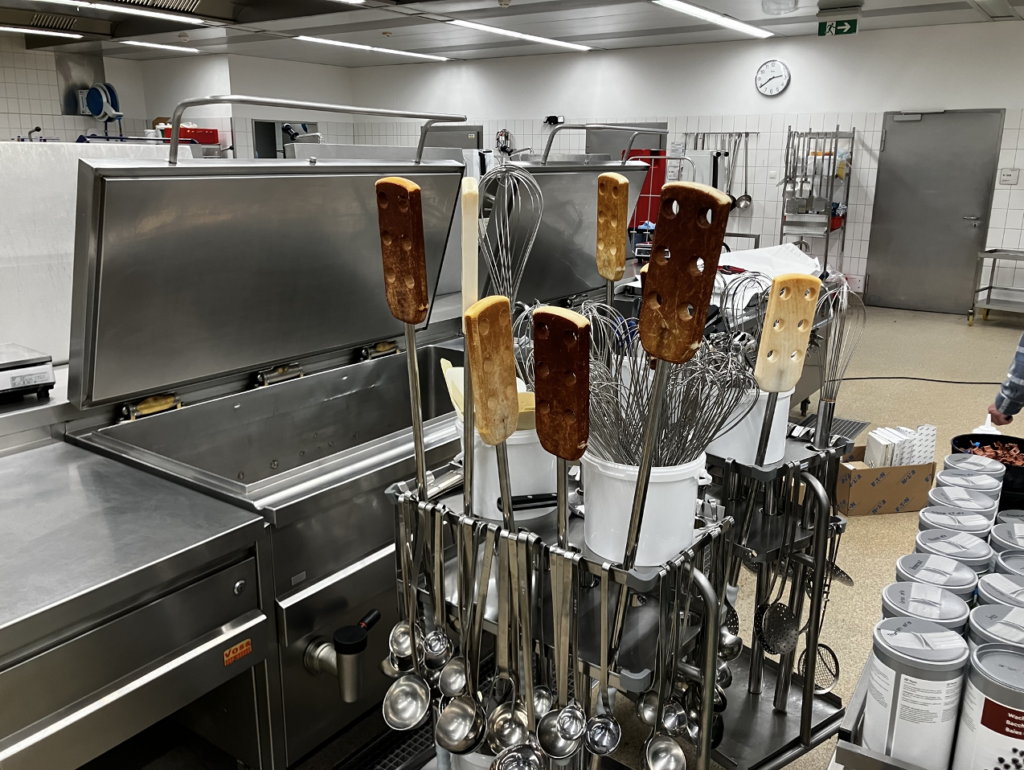
In the prep kitchens, too, the scale was impressive. One could see jumbo-sized versions of familiar kitchen appliances like a 30-liter stand mixer or pasta maker. Even the kitchen tools, like whisks and spatulas, had to be scaled up to handle the high volumes of food they are used to prepare. Two of the most special sights were still to come, however.
Image 4: Super-sized kitchen equipment, whisks, spatulas, and paddles, located in the main kitchen
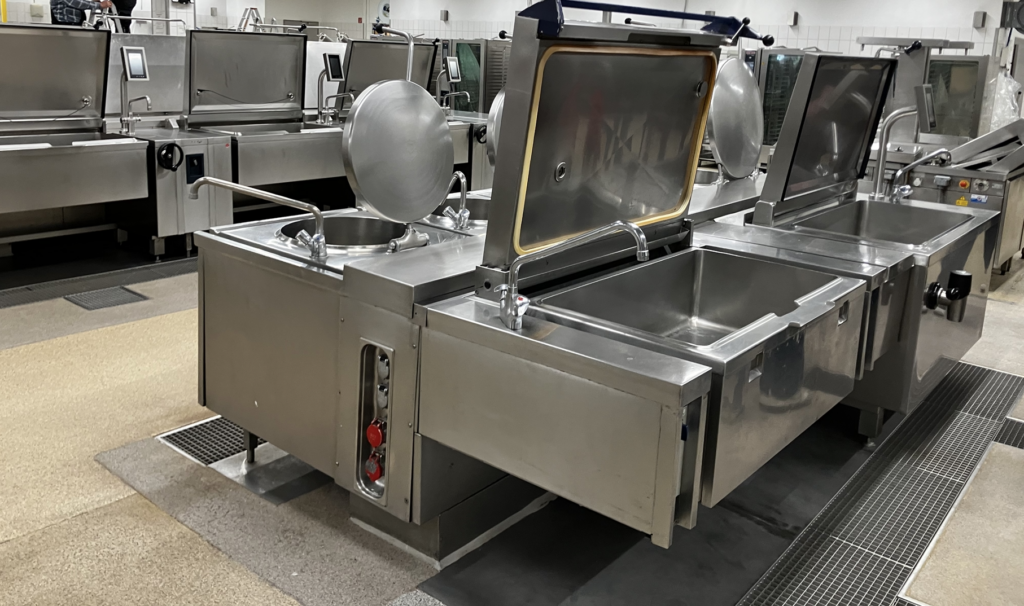
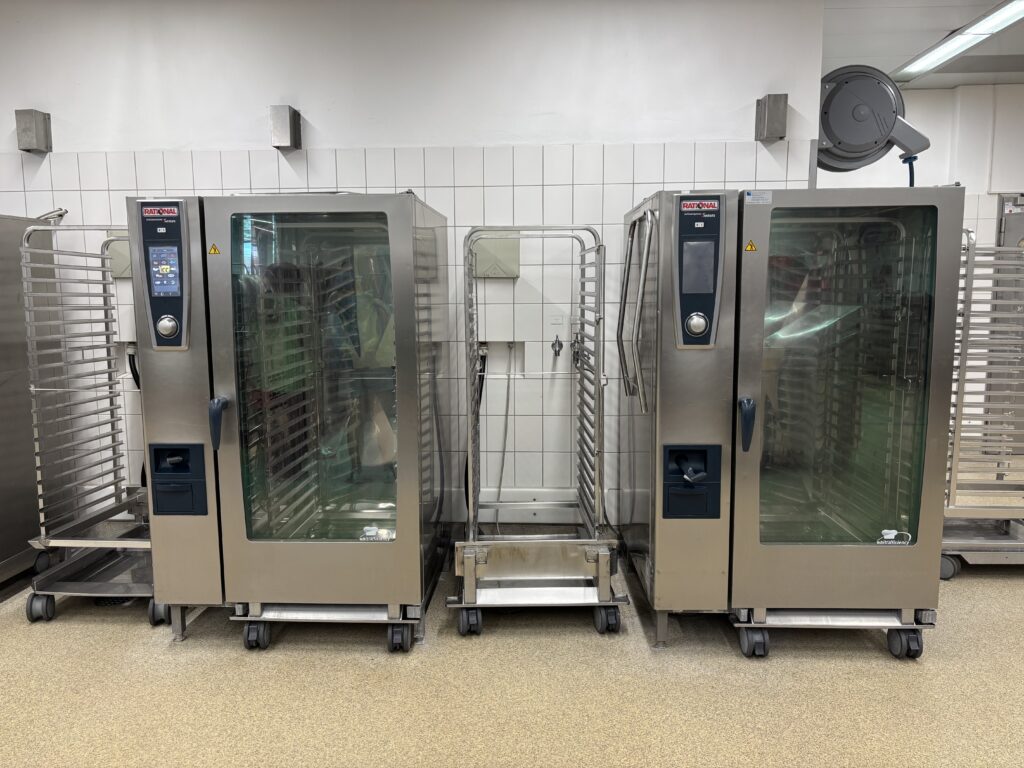
One of these highlights was the main kitchen itself. Located back upstairs on the main level, the kitchen is a particularly exciting sight. This is because, as a regular customer of the Mensa, one catches tantalizing glimpses of the action happening in the kitchen when the double doors swing open and piping hot batches of whatever-the-day’s-dish are efficiently bustled out to the service line on shining silver carts. A full and unimpeded view of the main kitchen did not disappoint. Here, it is also divided neatly into stations. You have the friers at one end (oil changed weekly), kettles – which more so resemble bathtubs – for soups in the middle, a large selection of flattops and grills, and a row of 6 large, high-tech ovens in the back.
Image 5: Large kettles and grills used to cook each day’s meals in the main kitchen of the MensaImage 6: The high-tech ovens of the Mensa
At this point, I was able to ask a question that had been on my mind for some time. Namely, how much food waste is generated by the Mensa and where does it go? It is clear that quite some thought has been put into this matter, and our guide emphasized how little actually gets wasted. For one, initiatives like the “Zero-Waste Plate”, first implemented a few years ago, during which leftovers from that day’s service are sold at closing time for reduced price, have helped cut down on prepared food waste. The unavoidable waste that is generated through scraps and byproducts is sorted thoughtfully into bio-waste bins, which is a staple of the fabled German “Mülltrennung” or trash-separation system. This bio-waste is then presumably mixed with other municipal bio-waste and either composted or turned into biogas.
But I have left one stop unmentioned, and intentionally so. I wanted to save my favorite moment until the end. I invite you, reader, to take a moment and consider which essential part of any dining hall kitchen I haven’t described yet. Imagine you have just finished with an extraordinarily satisfying lunch of risotto-style barley in tomato sauce with succulent vegan meatballs. You scrape the last grain from your bowl and mentally prepare to return to work. Picking up your tray, you walk towards the exit. And what do you do? You set your dirty-dish-laden tray upon the rolling conveyer belt (Fließband) which takes them conveniently out of sight and delivers them… Where? Perhaps the most overlooked and most wonderful part of any dining hall is this conveyer belt. Day in, day out, we simply set our tray down, and it is carried smoothly out of our consciousness.
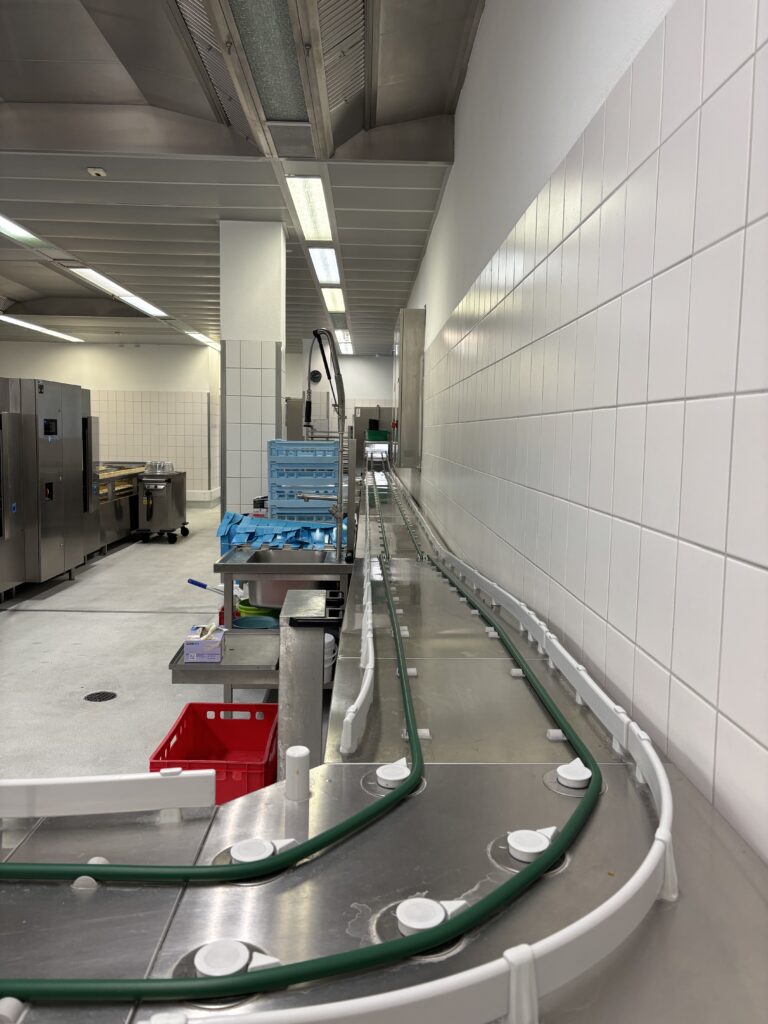
It was a great joy to see where this magical invention takes our dirty dishes and what happens thereafter. The dish return belt at the Mensa snakes out of sight, around a corner and through a small gap in the wall. Before we entered the main kitchen, our guide took us to a special doorway. Before entering, he turned to face us, expression stony, and said, “before you stands two and a half million Euro”. And he opened the door. Before us, central in the small room, stood a great gleaming beast of stainless steel. At one end of the chamber, the conveyer belt could be seen entering the room through the small gap in the wall. The belt followed the wall right to the other end of the room and then curved into the mouth of the beast.
Image 7: The conveyer belt entering the room through the small gap in the wallImage 8: View of of the Mensa’s million-dollar dishwasher
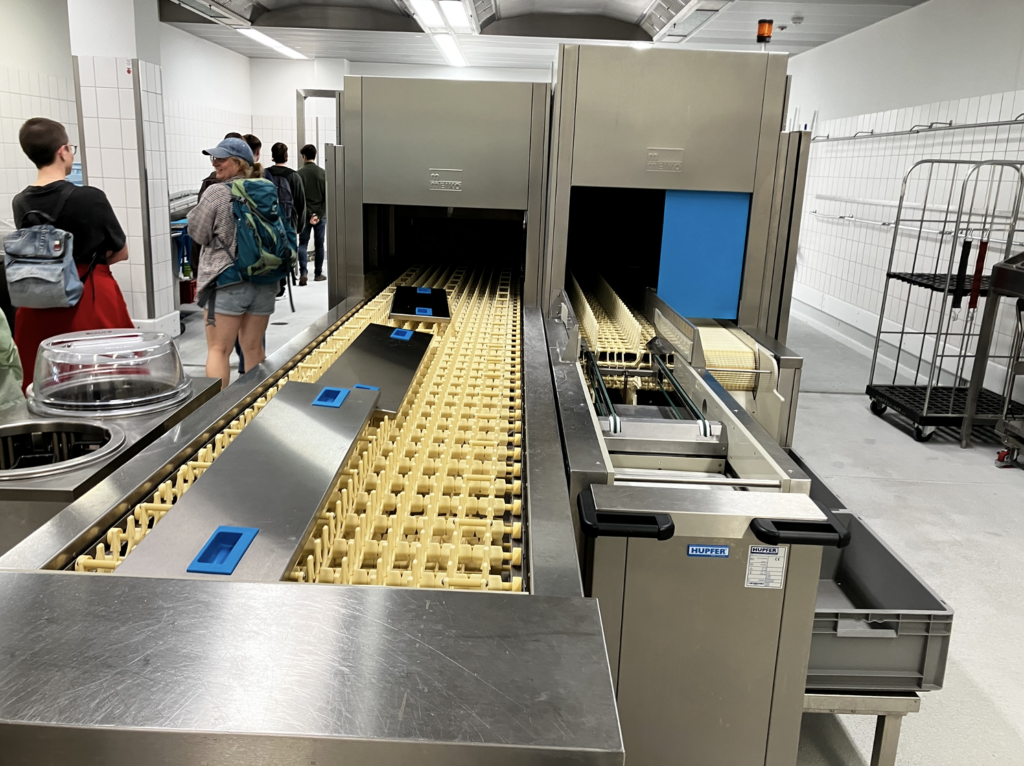
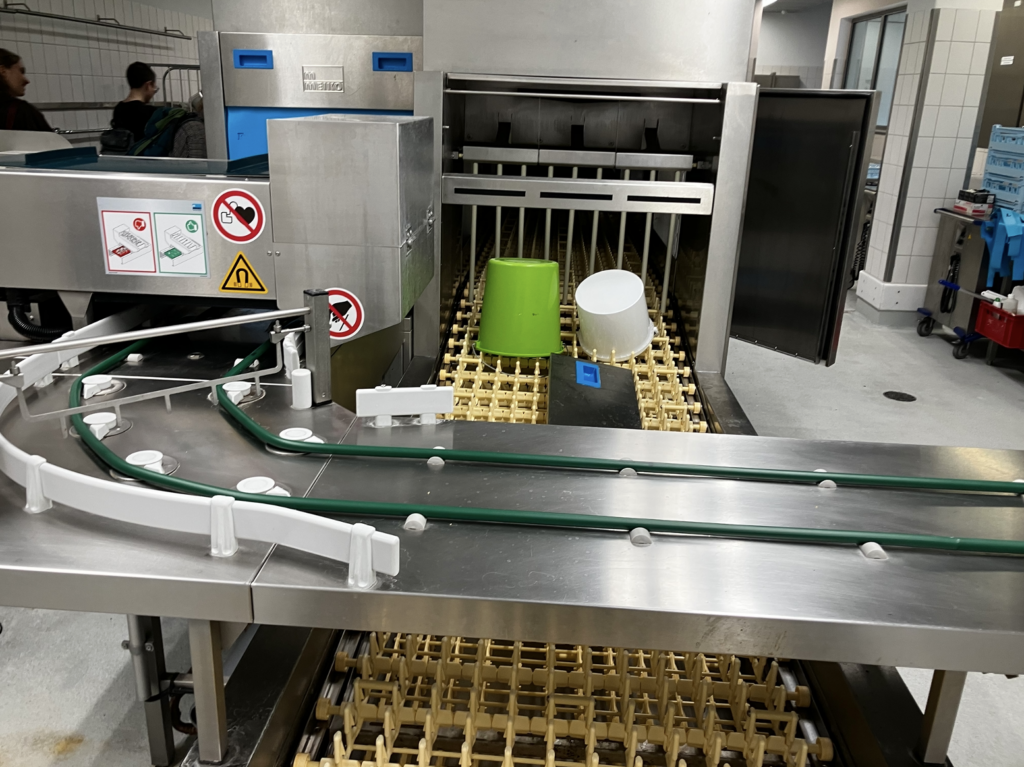
Here, shared out guide, stand two employees on duty during service, scraping plates clean, removing lingering napkins, rearranging silverware, before they are fed to the great machine. They have to work fast; the belt doesn’t stop. They pick up the plates and bowls, removing them from their gray plastic chariots on which they arrived and arrange them neatly in the likewise constantly moving belt which is designed with bumps and ridges to hold the dishes in place as they move onward. The beast has three bellies: one for dishes, one for silverware, and one for trays. After the trays are free from plates and bowls, they travel through a separate section of the machine. Hidden within this next metal-plated tunnel is a powerful magnet. It snatches the silverware up off of the tray and deposits it all onto a separate silverware-specific belt (the second belly). The trays themselves, now freed of all their cargo, travel through the third belly where they are washed and sanitized like the other items. On the other end, the clean dishes and silverware roll slowly out and are sorted manually by employees. The trays, on the other hand, stack themselves neatly onto carts. Then, the cleaned items are wheeled back into the dining area and the process repeats itself.
Picture 9: The conveyer belt enters the dishwasher, left is the magnet which attracts silverware
I hope that this post encourages you to think about and have more appreciation for the miraculous feat that is the university canteen. And next time they’re out of your favorite soup or there is a traffic jam at the dish return, maybe you’ll have more understanding armed with the knowledge of just how many moving pieces hide behind this system.
In the Dickinson in Bremen program, there is a strong emphasis on community engagement, with a volunteering requirement to encourage students to interact with Bremen in a positive way. Keeping with Dickinson’s global impact, I hoped to find an opportunity that would help me interact with locals.
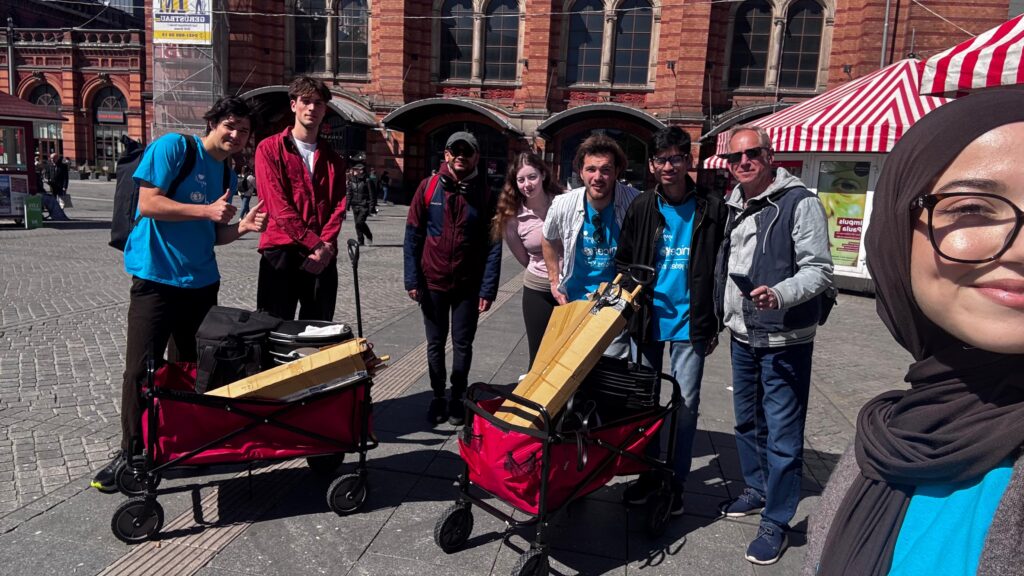
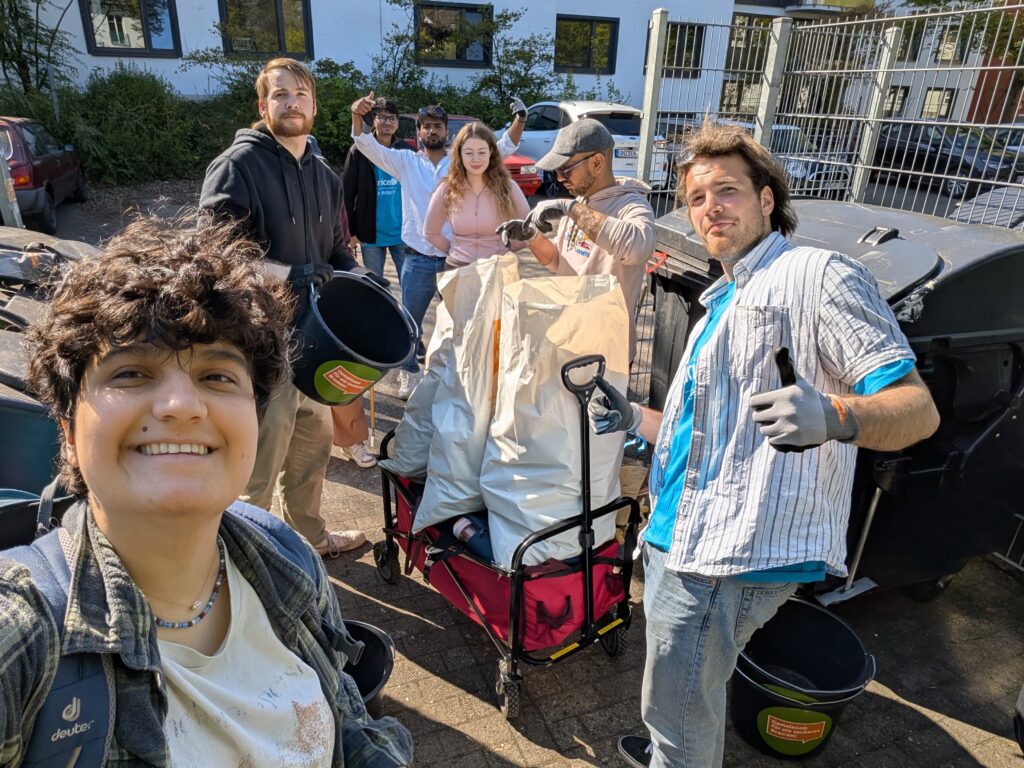
For this, I decided to join the Unicef Bremen chapter. Unicef volunteers in a multitude of ways, from cleanups, fundraisers, sustainability education, and many other opportunities. Most recently, I had volunteered with Unicef for an Earth Day trash clean-up. Dividing into different groups, we spread out across Bremen to pick up any trash that we saw.
My group focused on the University and the tram lines, where we geared up for the afternoon. There were many people that I was able to meet as well as some familiar faces from past events. I loved getting to talk with everyone and make Bremen a little bit cleaner in the process.
Overall, I really recommend volunteering with Unicef as they are very welcoming and have a wide arrange of events to participate in. I hope to continue volunteering in Bremen.
Webinar: 40 Years of Dickinson’s Bremen Program Wednesday, May 6 Noon-1:30 p.m. (EDT) / 6:00 p.m. to 7:30 p.m. (CEST)
Last year, the William G. and Elke Durden Dickinson-in-Bremen program celebrated its 40th anniversary. Join us for a webinar that looks back on the history and forward into the future of this successful study abroad program. First, we will introduce you to the specialties of northern Germany and the beauty of the city of Bremen. We’ll also highlight the strengths of Bremen’s university and glimpse behind the scenes of the Dickinson-in-Bremen program. Then, we will share pictures and impressions of last year’s splendid three-day anniversary celebrations in Germany. Finally, we will present a short film of memories from past decades in Bremen. Current and past Dickinson-in-Bremen students will answer your questions and share their experiences during the Q&A session.
Presented by: Dr. Janine Ludwig, academic director, and Antonia Gabler, program coordinator of the William G. and Elke Durden Dickinson-in-Bremen Program.
Please register by Tuesday, May 5. The Zoom link is included in your confirmation email.
As we prepare to start the second semester here in Bremen, I wanted to take a moment to share about one of the central elements of the Dickinson in Bremen program, which often gets passed over in blog posts in favor of exciting excursions or volunteer experiences. What is this overlooked, yet fundamental, piece of the study abroad experience? The academics, of course. But wait! Don’t let your eyes glaze over and your focus drift away, because, unlike the monotone lecture of a professor who just can’t seem to retire, this reflection about completing my first semester at the University of Bremen is far more interesting than you might think! I’d like to share about the unique experience I had while writing one of my final papers and why I, counterintuitively, had a blast doing it.
First, an overview of where the academic calendar in Germany differs to the one we are used to in the United States. While in the U.S. the fall semester typically starts in late August/early September and ends mid-December, in Germany, there is the “winter semester”. In the German winter semester, classes begin in early October, continuing through the end of January with a two-week break for the Christmas and New Year holidays. At the beginning of February, lectures end, but the winter semester is still not over! Two months succeed the end of the lecture period in which students compose final papers, known as Hausarbeiten, for their courses (particularly those in the humanities), which are due in March. This period is known as the “Vorlesungsfreie Zeit” or “lecture-free time”. Of course, not all courses follow this structure, with some relying instead on exams. After all work from the first semester has been handed in, the second semester, “summer semester”, begins in the second week of April, with much the same structure.
In this blog post, I want to share about my experience writing one particular Hausarbeit for a course I took in the winter semester entitled “Niederdeutsch – Sprachliche Variationen in Norddeutschland”, or “Low German – Linguistic Variations in North Germany”. For those who haven’t studied German, it might come as a surprise to learn that a country as small as Germany is home to a wide variety of dialects. In northern Germany, one such dialect, which is sometimes even considered its own language, is “Niederdeutsch” or “Low German”. It is better known to Germans as “Plattdeutsch” or simply “Platt”, meaning flat. In the Middle Ages throughout the Renaissance, Low German was used widely across northern Germany, particularly as a common language for conducting trade during the highly lucrative time of the Hanseatic League. Since its golden age, the dialect has lost its prominence and is spoken far less frequently. Today, it is mostly found in small pockets across northern Germany, primarily in rural areas, spoken by older generations.
While brainstorming possible research questions for my Hausarbeit (a paper’s focus is usually left open for students to determine and approved after consultation with the professor), I began looking into the connection between Low German and the United States. Much to my surprise, I discovered that Low German has a rich history in the United States. Determining how the dialect made its way into the U.S. and what influence it’s had became the guiding questions of my paper. Finding a way to connect the topic to back home, of course, made the research far more enjoyable. But there was something else that made this project feel special, and for that, I have to thank the EU.
In 1999, the European Union officially recognized Low German with the status of “regional language” and in doing so mandated the implementation of measures to protect and preserve the language from extinction in Germany. These measures included the establishment of a council for the preservation of Low German, introduction of Low German courses in select schools and universities (such as the very course I was taking at the University of Bremen), as well as the creation of a dedicated institute called the “Institut für niederdeutsche Sprache” (INS) to support research on the dialect.
It was a dark hour. I had neared the end of where the university library catalog could get me in terms of the history on Low German in the United States, having found nothing but a single anthology. I was seriously starting to worry that I was not going to be able to find the information I needed to write about this topic. That’s when some luck struck in the form of the INS.
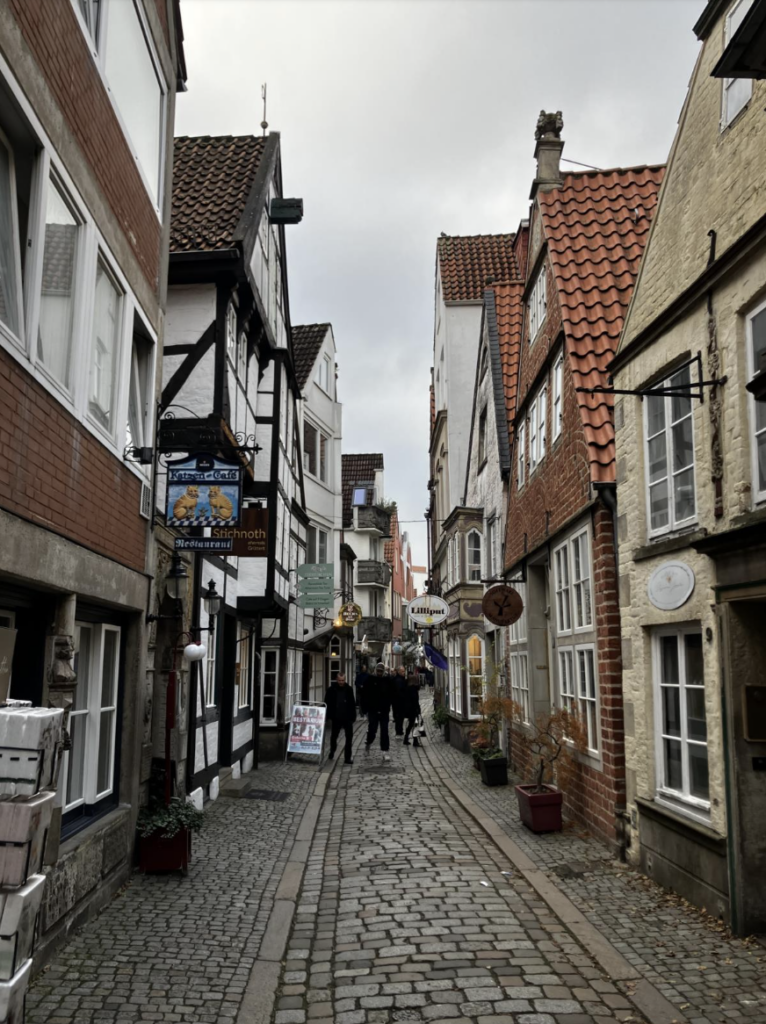
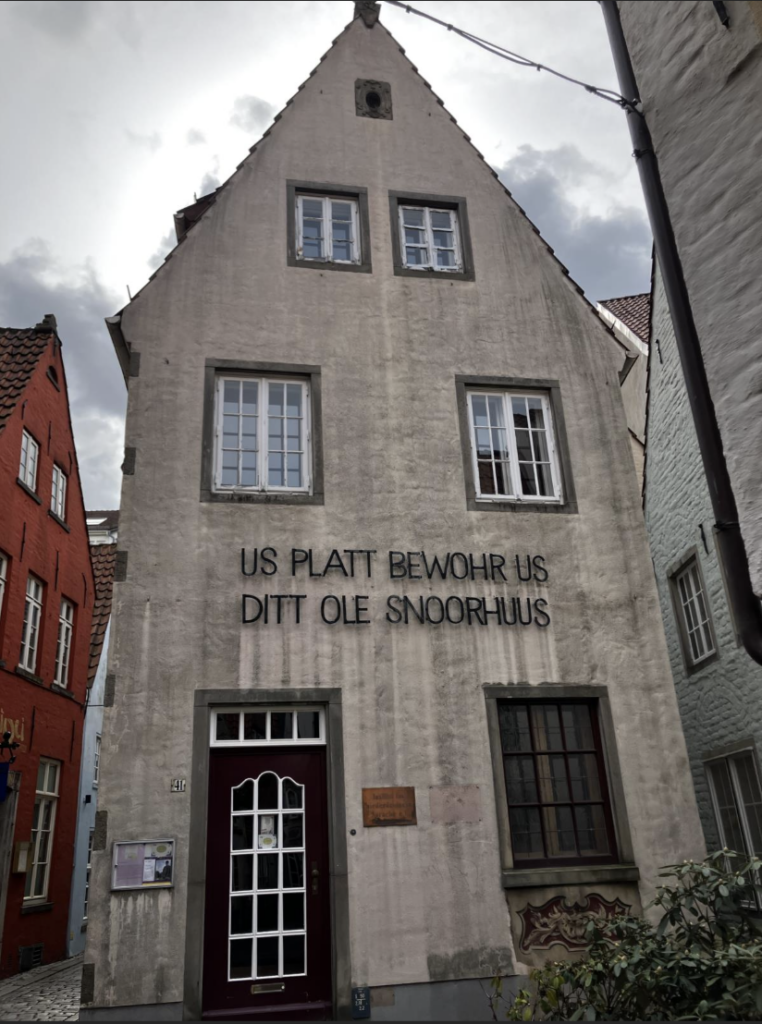
Having heard about the existence of the INS in my seminar, I decided to do some poking around and see just what type of institute it was. All I knew about the place was that it was situated in a historic building in Bremen’s “Schnoor” district, one of the oldest and most beautiful areas of town. I had walked by it many times, in fact, but had never seen so much as a light on inside. I had little hope but great desperation. I think this is what led me to pick up the phone and make a call to the number listed on the INS-Website. With a mounting fear that someone would actually pick up on the other end of the line, I paced determinedly, ready to spring into my rehearsed dialogue. Next to tornadoes, talking on the phone in German may be one of my greatest fears, you see. To my surprise, I had a lovely conversation that proved to be invaluable in the process of writing my research paper. What I learned over the telephone was that the INS is home to the largest collection of books written in Low German as well as countless other works regarding all things Low German and that all these materials could be browsed online using the INS’s library catalog search service. Jackpot.
From that point on, the fun really started. Next thing I knew, I had arranged an appointment at the INS building in Schnoor to read through the many resources that I had found in my searches through the online catalog. During this process, I found out that INS had very limited hours, opening only for a few hours Tuesday through Thursday, which explained why I had never seen any sign of life in the building before. I wasn’t sure what to expect when I stepped foot in the charming building for the first time.
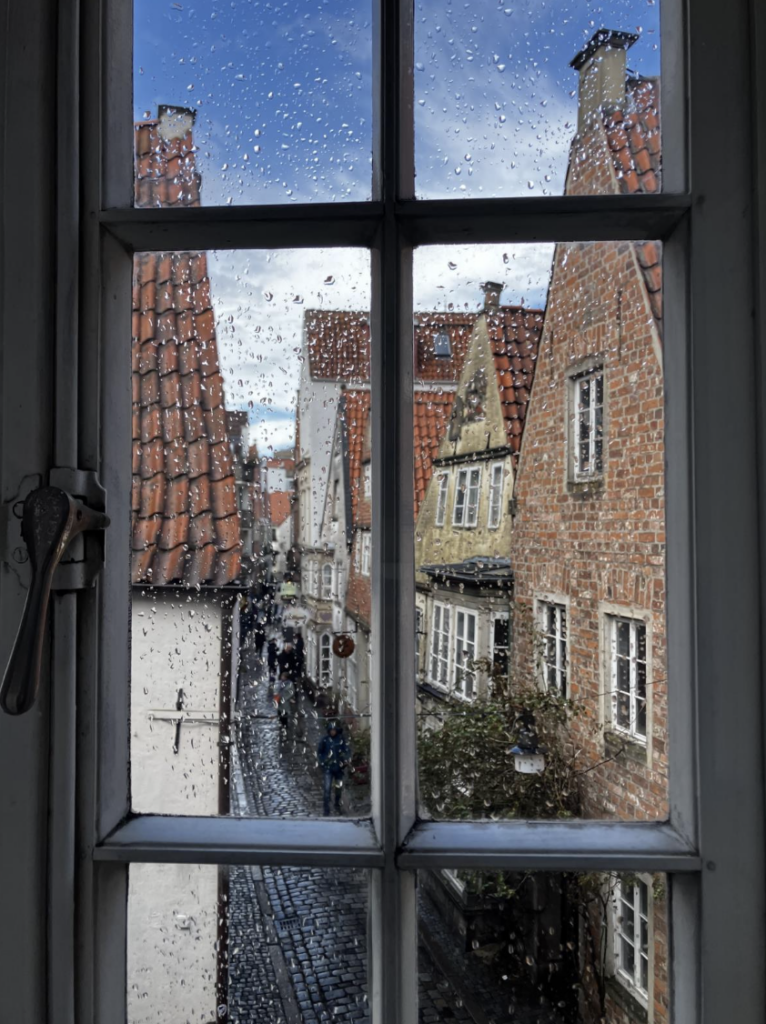
Whatever my expectations were, it’s fair to say that they were quickly exceeded. The house, although it doesn’t look it from the outside, contains four stories. The spiral staircases, various small rooms, winding corridors, and a frankly confusing but homey layout attest to its ancient construction. All of it lined, floor to ceiling, with books and other archived materials, either composed in or relating to Low German. There must be some organizational system to it all, because, upon showing the INS-library’s only employee the call numbers of the resources I wanted to access, she sprang into action, retrieving the works I had identified. What really sealed the deal was when the librarian offered me a quiet workplace on the building’s second floor where I was allowed to stay as long as the premises were open. The view out of second floor window, looking out into the narrow, picturesque street of Schnoor says it all.
I came back to the INS building as often as I could while working on my paper. Upon its completion, I was met with a little bit of sadness that I wouldn’t have a reason to visit the INS so often anymore. But, in thanking the librarian for all her help, she reminded me that I am always welcome to stop in whenever I’m passing by. And as for Low German in the United States, the story continues into the present. Many groups with North German heritage living in the U.S. today, particularly Mennonites who immigrated in the late 19th and early 20th century, together with members of clubs founded by immigrants, as well as various academics dedicated to the study of Low German, keep the dialect alive across the United States.
It’s difficult to pick out just one experience from the trip as my favorite as they all added to another in some way, giving us more perspective regarding the city’s history and culture. Another reason behind this simply being that the entire trip was filled with special moments. However, for the sake of sharing one of these special moments, I will highlight my Tuesday, the fifth full day of our excursion.
My Tuesday began, like many other mornings of the excursion, early with a morning walk through still-sleepy streets of the capital. While I treasured roaming through the history-rich streets throughout the trip, the most special part of our Tuesday was still to come.
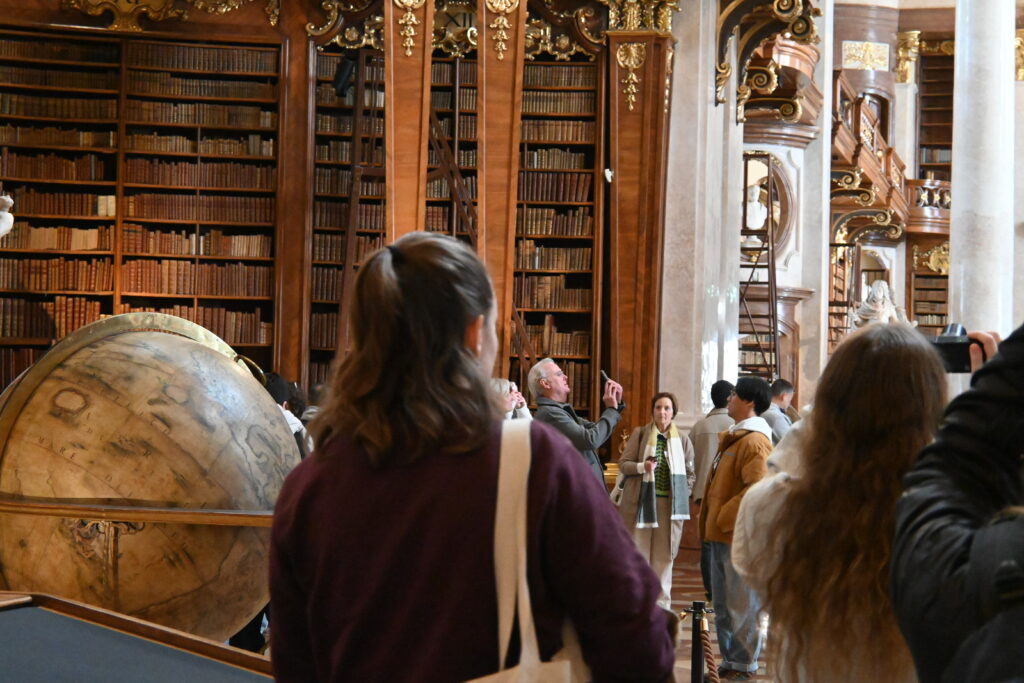
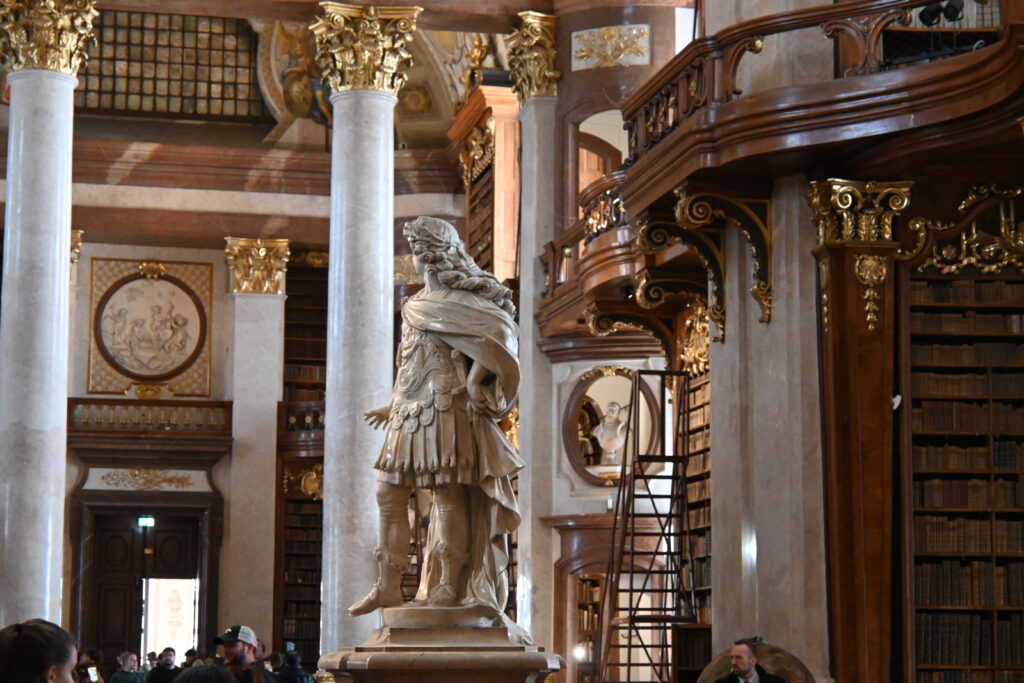
The Austrian National Library
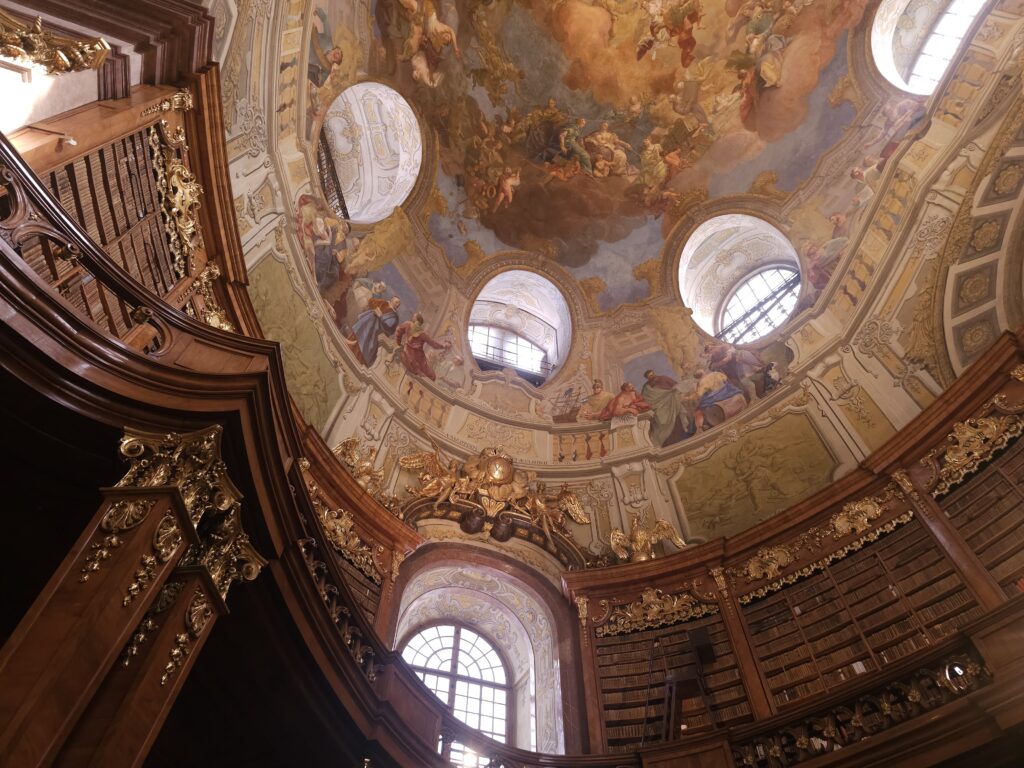
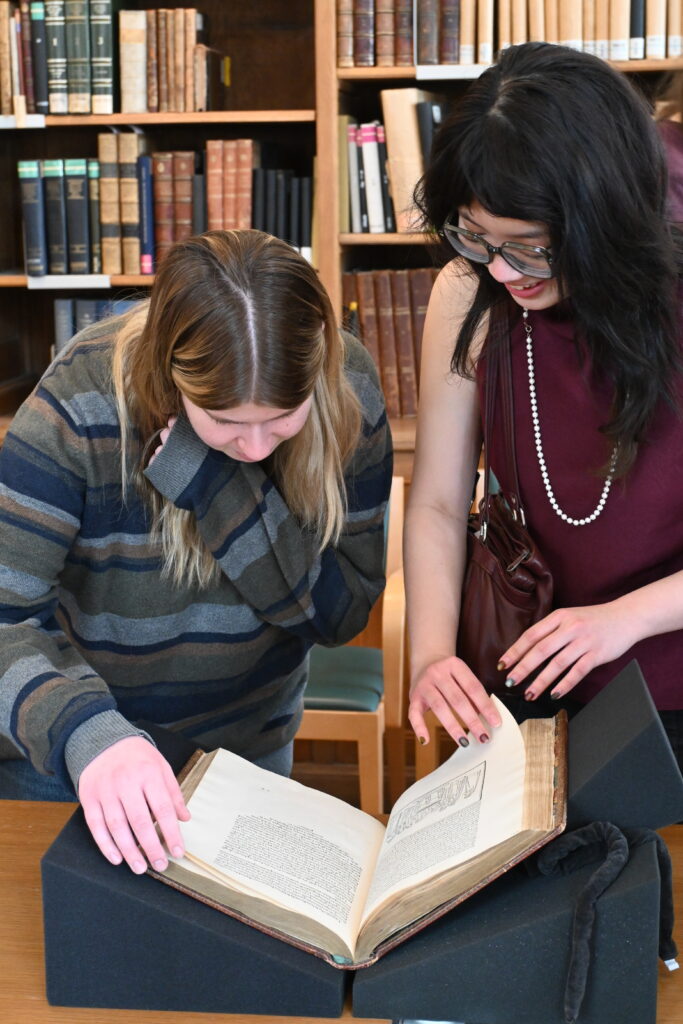
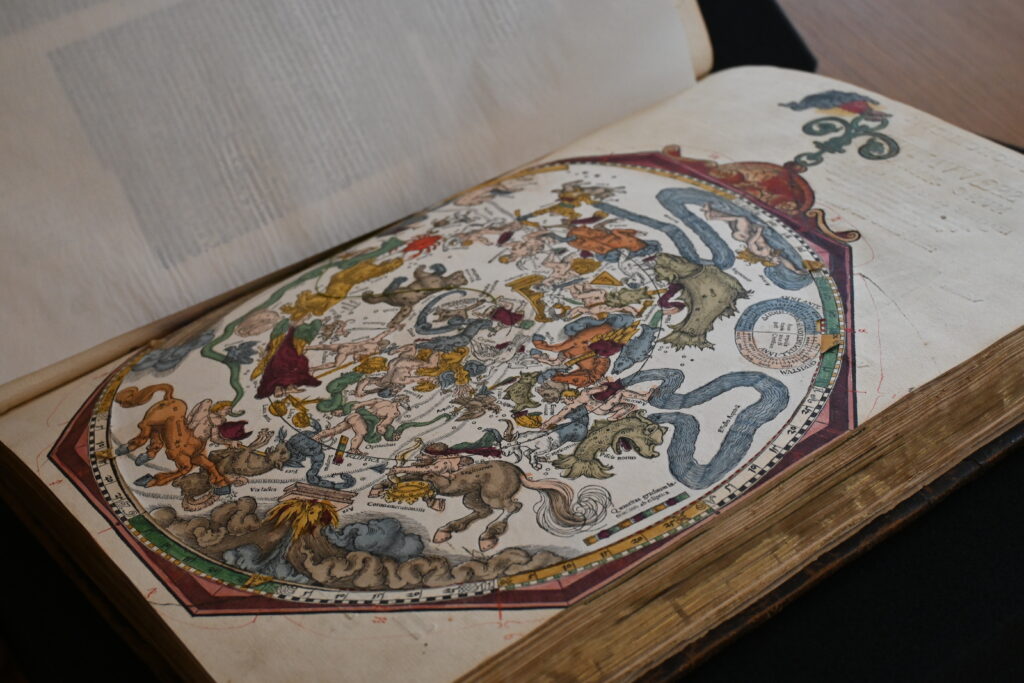
The day’s scheduled program began with a journey to the Austrian National Library. Located in the former royal castle complex, the staff at the national library generously provided us students with a private tour, during which we were able to look (and even touch) some of the library’s oldest books. Many could be traced back to the Middle Ages, some of which were hand-written, as they predated the invention of the Gutenberg printing press. Speaking of which, we even saw a page of one of the first Bibles to be printed by Johannes Gutenberg and his newly developed printing press, dating back to the mid-15th century.
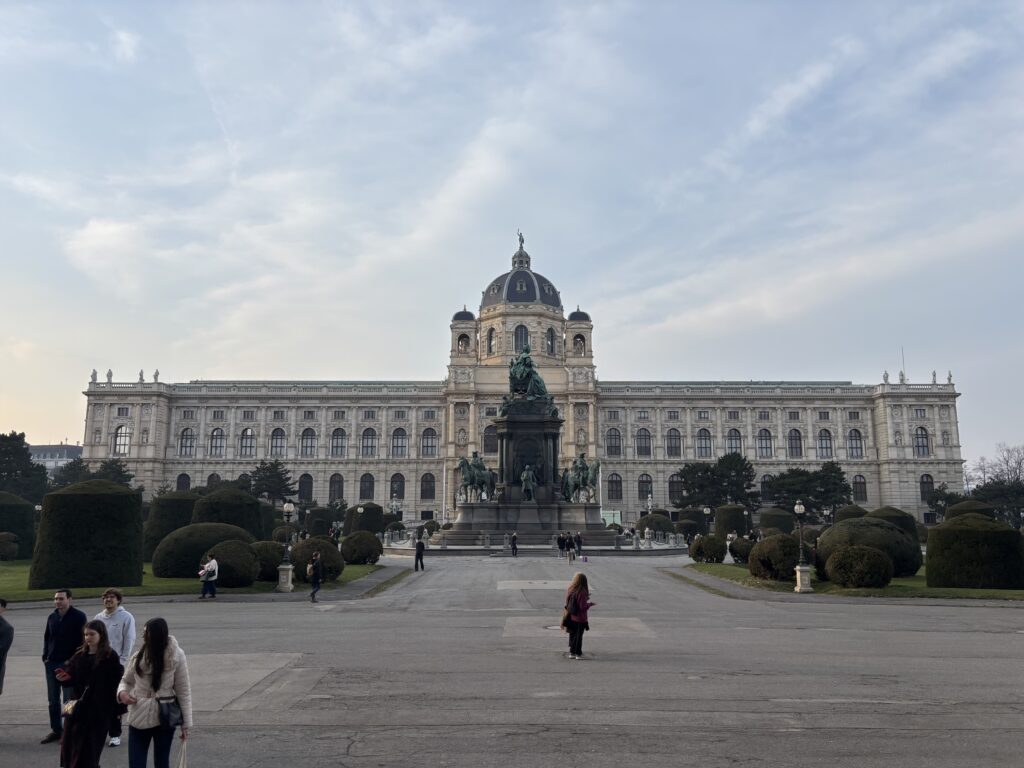
Afterwards, we were treated to a delicious and traditional Austrian lunch at a nearby locale. I swear I could eat that potato salad every day of my life and be happy. After a sweet end to our lunch with Palatschinken for dessert (traditional Viennese pancakes, similar to crepes), we moved on to our next destination: the Kunsthistorisches Museum. The art museum is one of Vienna’s most spectacular and largest. The Renaissance Revival building alone, built between 1871 and 1891 under Habsburg Emperor Franz Joseph I., is nothing short of breath-taking. Audio-guide in hand, I joked about staying until the museum closed, and they threw me out. I quickly realized it wasn’t a joke at all, minus the being thrown out part. After around 4 hours in the museum, I left 10 minutes before the doors closed, having managed to see about an eighth of the permanent exhibit. Not wanting to miss any of the history, I had read every placard and listened to every audio file that I could. Despite how shockingly little of the museum I saw, I enjoyed every second of my deep dive into the section of the exhibit that I visited which was filled, primarily, with Renaissance sculptures and devices.
Due to the popular demand of her Feb. 24th webinar, Dr. Ludwig is offering a repeat session of her talk on the Ukraine War for all those who could not attend on that date. Those who did attend and would like to ask more questions are welcome to participate again for the Q&A.
February 24 marked the fourth anniversary of Russia’s full-scale invasion of Ukraine, escalating a conflict that began in 2014.
Many people, including Vladimir Putin and Donald Trump, seem convinced that Ukraine is losing the war. Are they correct?
Free Repeat Webinar Four Years of War Against Ukraine: Where Do We Stand?
Wednesday, April 15 3 p.m. (Eastern time)
After briefly reviewing the events of the past four years, we’ll discuss the current situation on the front lines and in the rear for both sides. What are their strategies, and are they successful? Then, we’ll talk about the so-called peace negotiations of the past year. Will Ukraine (have to) accept a dictated peace deal? Where do things stand, and what options are available? How are other actors, such as the U.S., the E.U. and China, positioning themselves?
This lecture will be complemented with maps and visuals. An extensive Q&A session will follow. No prior political or military knowledge is needed.
Please register by Monday, April 13. The Zoom link will be included in your confirmation email.
Faculty: Janine Ludwig is the academic director of Dickinson’s Bremen program, a literary scholar, the vice head of the Institute for Cultural German Studies (ifkud) at the University of Bremen and the chairwoman of the International Heiner Müller Society. Ludwig studied contemporary German literature, philosophy and theater studies/cultural communication. She is an expert on East German and postwar literature and has published seven books and 50 articles on Heiner Müller, images of America, socialism, the Cold War, migrants’ literature, rock music, German national anthems, theater, women’s literature, poetry, medievalism and more.
Ludwig teaches at Dickinson and in the Departments of Cultural and German Studies at Uni Bremen. Recently, she has given several talks on Russia, Putin and the war against Ukraine for Dickinson, Hope College and the U.S. Army War College in Carlisle.