by Alex Arnold ’27
As we prepare to start the second semester here in Bremen, I wanted to take a moment to share about one of the central elements of the Dickinson in Bremen program, which often gets passed over in blog posts in favor of exciting excursions or volunteer experiences. What is this overlooked, yet fundamental, piece of the study abroad experience? The academics, of course. But wait! Don’t let your eyes glaze over and your focus drift away, because, unlike the monotone lecture of a professor who just can’t seem to retire, this reflection about completing my first semester at the University of Bremen is far more interesting than you might think! I’d like to share about the unique experience I had while writing one of my final papers and why I, counterintuitively, had a blast doing it.
First, an overview of where the academic calendar in Germany differs to the one we are used to in the United States. While in the U.S. the fall semester typically starts in late August/early September and ends mid-December, in Germany, there is the “winter semester”. In the German winter semester, classes begin in early October, continuing through the end of January with a two-week break for the Christmas and New Year holidays. At the beginning of February, lectures end, but the winter semester is still not over! Two months succeed the end of the lecture period in which students compose final papers, known as Hausarbeiten, for their courses (particularly those in the humanities), which are due in March. This period is known as the “Vorlesungsfreie Zeit” or “lecture-free time”. Of course, not all courses follow this structure, with some relying instead on exams. After all work from the first semester has been handed in, the second semester, “summer semester”, begins in the second week of April, with much the same structure.
In this blog post, I want to share about my experience writing one particular Hausarbeit for a course I took in the winter semester entitled “Niederdeutsch – Sprachliche Variationen in Norddeutschland”, or “Low German – Linguistic Variations in North Germany”. For those who haven’t studied German, it might come as a surprise to learn that a country as small as Germany is home to a wide variety of dialects. In northern Germany, one such dialect, which is sometimes even considered its own language, is “Niederdeutsch” or “Low German”. It is better known to Germans as “Plattdeutsch” or simply “Platt”, meaning flat. In the Middle Ages throughout the Renaissance, Low German was used widely across northern Germany, particularly as a common language for conducting trade during the highly lucrative time of the Hanseatic League. Since its golden age, the dialect has lost its prominence and is spoken far less frequently. Today, it is mostly found in small pockets across northern Germany, primarily in rural areas, spoken by older generations.
While brainstorming possible research questions for my Hausarbeit (a paper’s focus is usually left open for students to determine and approved after consultation with the professor), I began looking into the connection between Low German and the United States. Much to my surprise, I discovered that Low German has a rich history in the United States. Determining how the dialect made its way into the U.S. and what influence it’s had became the guiding questions of my paper. Finding a way to connect the topic to back home, of course, made the research far more enjoyable. But there was something else that made this project feel special, and for that, I have to thank the EU.
In 1999, the European Union officially recognized Low German with the status of “regional language” and in doing so mandated the implementation of measures to protect and preserve the language from extinction in Germany. These measures included the establishment of a council for the preservation of Low German, introduction of Low German courses in select schools and universities (such as the very course I was taking at the University of Bremen), as well as the creation of a dedicated institute called the “Institut für niederdeutsche Sprache” (INS) to support research on the dialect.
It was a dark hour. I had neared the end of where the university library catalog could get me in terms of the history on Low German in the United States, having found nothing but a single anthology. I was seriously starting to worry that I was not going to be able to find the information I needed to write about this topic. That’s when some luck struck in the form of the INS.
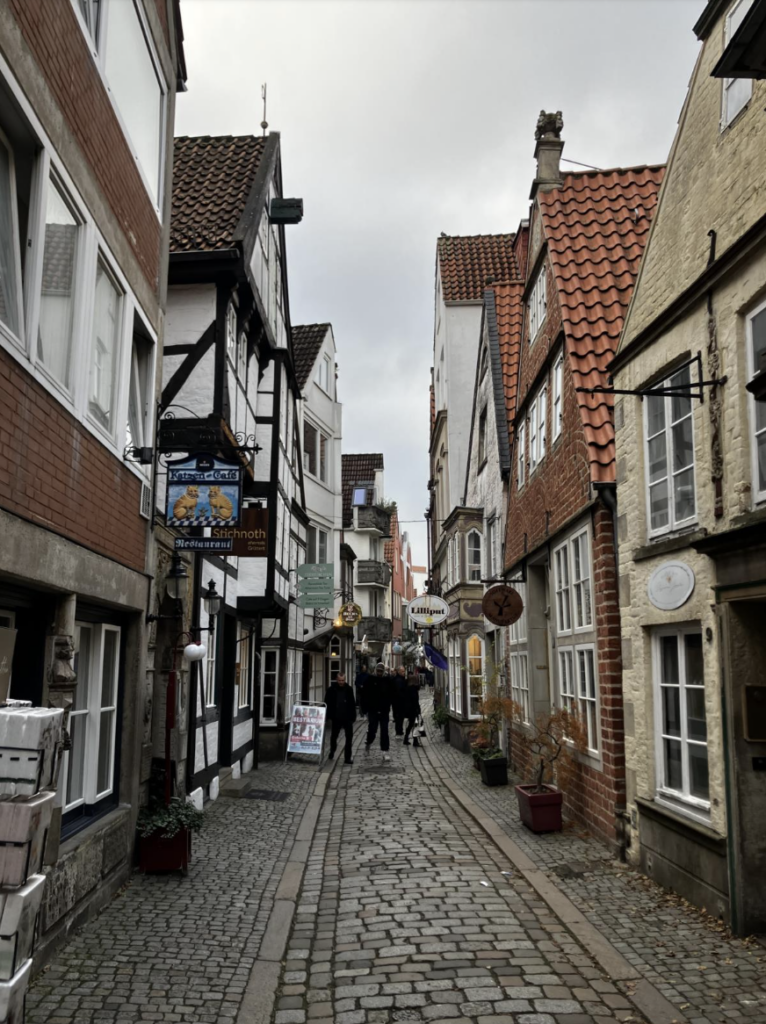
Having heard about the existence of the INS in my seminar, I decided to do some poking around and see just what type of institute it was. All I knew about the place was that it was situated in a historic building in Bremen’s “Schnoor” district, one of the oldest and most beautiful areas of town. I had walked by it many times, in fact, but had never seen so much as a light on inside. I had little hope but great desperation. I think this is what led me to pick up the phone and make a call to the number listed on the INS-Website. With a mounting fear that someone would actually pick up on the other end of the line, I paced determinedly, ready to spring into my rehearsed dialogue. Next to tornadoes, talking on the phone in German may be one of my greatest fears, you see. To my surprise, I had a lovely conversation that proved to be invaluable in the process of writing my research paper. What I learned over the telephone was that the INS is home to the largest collection of books written in Low German as well as countless other works regarding all things Low German and that all these materials could be browsed online using the INS’s library catalog search service. Jackpot.
From that point on, the fun really started. Next thing I knew, I had arranged an appointment at the INS building in Schnoor to read through the many resources that I had found in my searches through the online catalog. During this process, I found out that INS had very limited hours, opening only for a few hours Tuesday through Thursday, which explained why I had never seen any sign of life in the building before. I wasn’t sure what to expect when I stepped foot in the charming building for the first time.
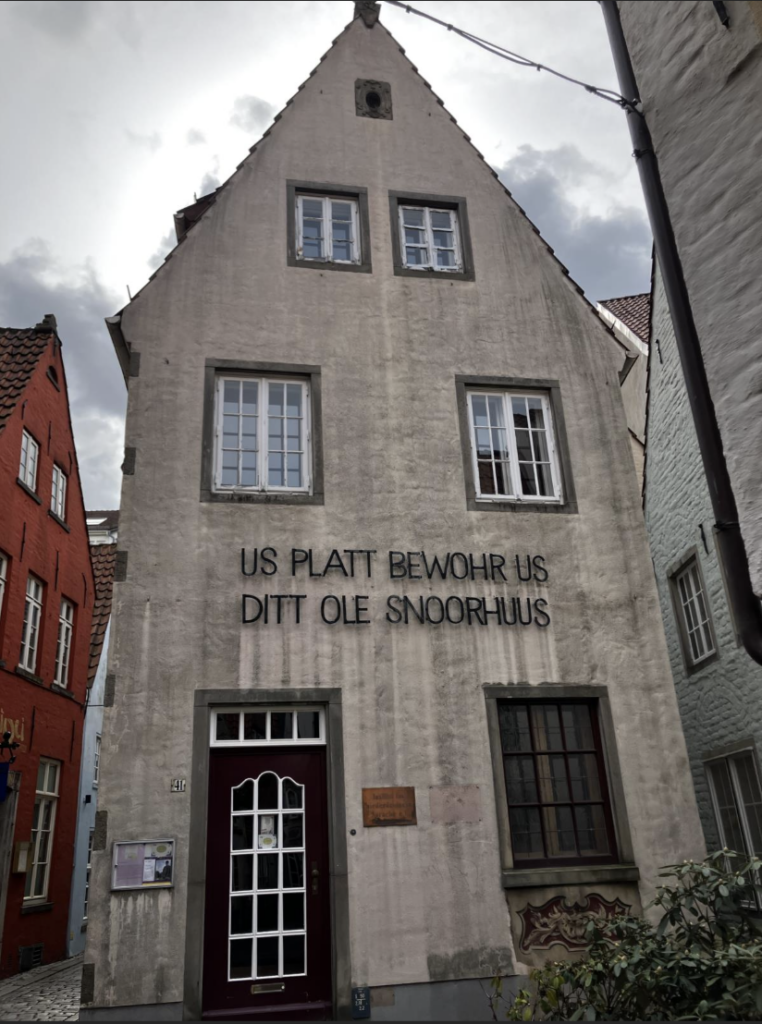
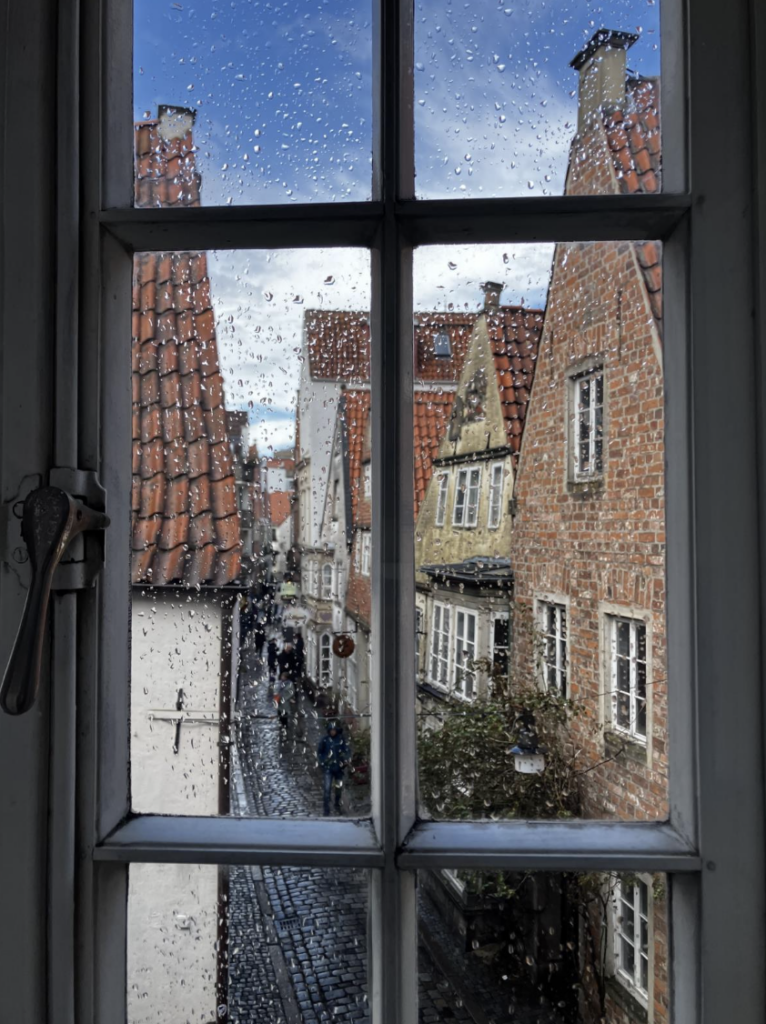
Whatever my expectations were, it’s fair to say that they were quickly exceeded. The house, although it doesn’t look it from the outside, contains four stories. The spiral staircases, various small rooms, winding corridors, and a frankly confusing but homey layout attest to its ancient construction. All of it lined, floor to ceiling, with books and other archived materials, either composed in or relating to Low German. There must be some organizational system to it all, because, upon showing the INS-library’s only employee the call numbers of the resources I wanted to access, she sprang into action, retrieving the works I had identified. What really sealed the deal was when the librarian offered me a quiet workplace on the building’s second floor where I was allowed to stay as long as the premises were open. The view out of second floor window, looking out into the narrow, picturesque street of Schnoor says it all.
I came back to the INS building as often as I could while working on my paper. Upon its completion, I was met with a little bit of sadness that I wouldn’t have a reason to visit the INS so often anymore. But, in thanking the librarian for all her help, she reminded me that I am always welcome to stop in whenever I’m passing by. And as for Low German in the United States, the story continues into the present. Many groups with North German heritage living in the U.S. today, particularly Mennonites who immigrated in the late 19th and early 20th century, together with members of clubs founded by immigrants, as well as various academics dedicated to the study of Low German, keep the dialect alive across the United States.